Notice:

 search
search
search
Sep 14, 2026


When sourcing an air fryer, buyers often focus on capacity, power, temperature range, basket design and price. However, one technical detail that can have a significant impact on product design and user experience is often overlooked:
Where is the heating system located?
Air fryers generally use different internal heating configurations. Two common approaches are top-mounted heating and rear-mounted heating.
Neither design should be considered universally better. The right choice depends on the product architecture, airflow design, cooking requirements, cleaning expectations, target market and retail positioning.
For brands and importers developing or sourcing air fryers, understanding these differences can help make a more informed product decision.
The basic difference is the location of the heating element and associated airflow components.
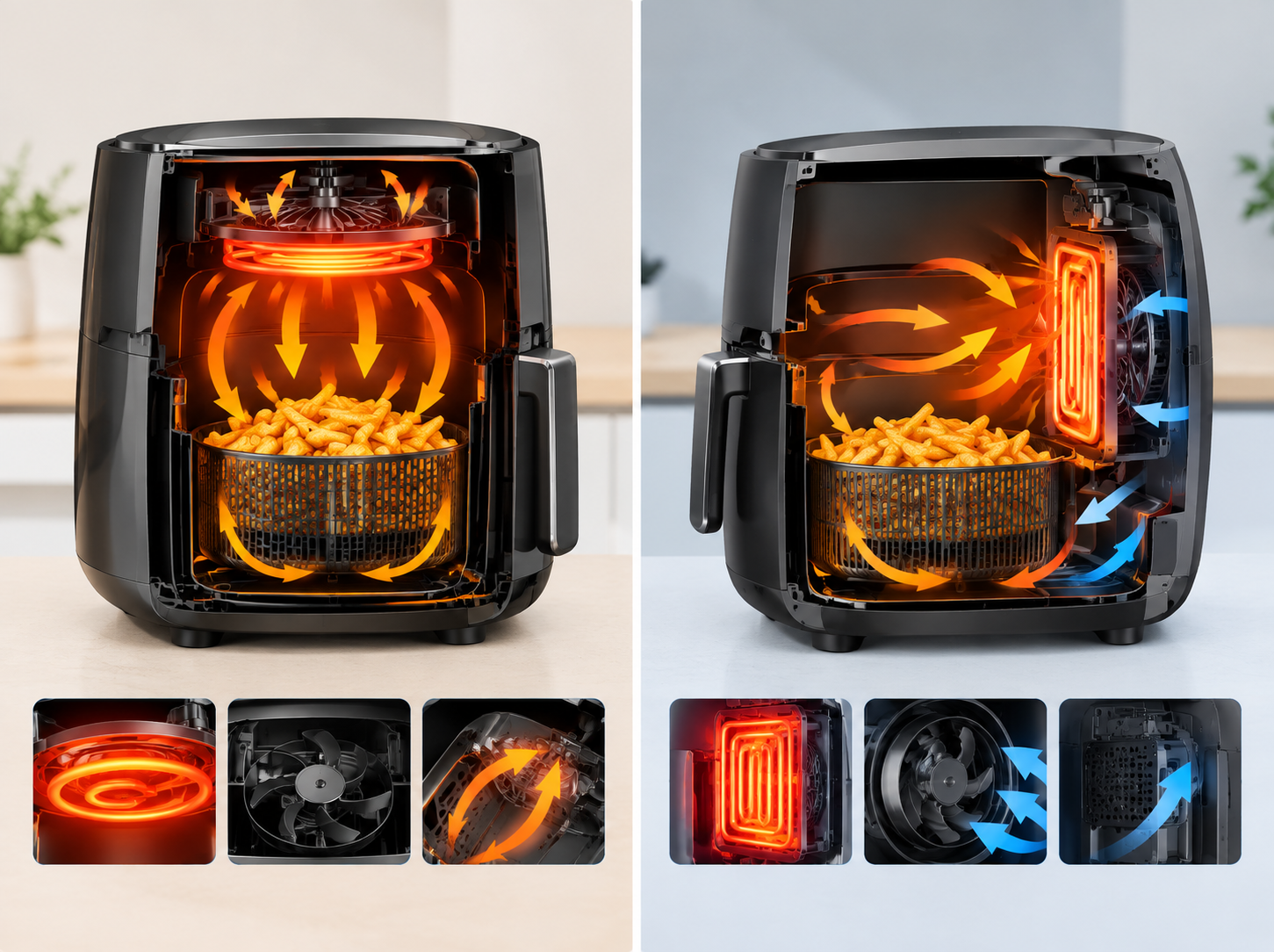
In a top-heating configuration, the heating element and fan are positioned above the cooking chamber.
The system typically works by:
Heating element → Fan → Hot air circulation → Food → Return airflow
This configuration allows the heating system to be integrated into the upper section of the appliance.
In a rear-heating configuration, the heating element and fan are positioned toward the rear of the cooking chamber.
The hot air is generated at the rear and circulated through the cooking space.
Both designs can achieve effective hot-air cooking when the heating power, airflow, temperature control and internal geometry are properly engineered.
The heating position itself does not determine the overall performance of an air fryer.
The heating location is closely connected to the airflow path.
For an air fryer to cook effectively, the system needs to deliver sufficient hot air throughout the cooking chamber while maintaining appropriate temperature control.
A top-mounted system can create a relatively direct airflow path from the upper heating area toward the food.
This configuration can also allow the heating and fan assembly to be concentrated in the upper housing, leaving the rear of the cooking chamber with fewer heating-system components.
However, the actual cooking performance depends on the complete airflow design rather than the heating position alone.
Important factors include:
· Fan size and speed
· Heating power
· Air duct design
· Distance between heating element and food
· Cooking chamber geometry
· Air inlet and outlet design
· Temperature control
Rear-mounted systems can provide a different airflow pattern, with hot air introduced from the rear of the cooking chamber.
This can work effectively when the internal air ducts and fan system are properly designed.
However, the rear section may require additional structural space for the fan, heating element, airflow channels and protective components.
For buyers, the key question should therefore be not simply “top or rear heating?” but “how does the complete heating and airflow system work together?”
Heating configuration also affects the internal architecture of an air fryer.
With a rear-mounted system, components such as the fan, heating element, motor and airflow structure need to be accommodated toward the rear of the appliance.
This can influence:
· Product depth
· Internal cooking chamber design
· Rear housing structure
· Airflow channels
· Component accessibility
· External ventilation requirements
A top-mounted system concentrates more of the heating assembly in the upper section.
This can provide greater flexibility for certain product architectures, particularly where designers want to maximize the usable rear area of the cooking chamber.
However, the trade-off is that the upper section needs to accommodate the heating element, fan, motor, thermal protection and associated electrical components.
For OEM/ODM projects, the heating configuration should therefore be considered during the early stages of product development rather than after the external design has already been finalized.
Cleaning is one of the most important considerations for air fryer users.
During cooking, grease and food particles can become airborne and may eventually reach different parts of the appliance depending on the airflow pattern and cooking design.
One potential consideration is the distance between the food and the upper heating assembly.
Because the heating system is located above the cooking chamber, the heating element and fan area can be exposed to grease and food particles depending on the product’s protective structure and airflow design.
Therefore, buyers should examine:
· Heating element protection
· Fan protection
· Grease accumulation
· Accessibility for cleaning
· Internal surface design
· Ease of maintenance
A rear-mounted system can place the heating assembly farther from the main food-loading area in some designs.
However, grease and food particles can still be carried toward the rear by the airflow.
Therefore, rear heating does not automatically mean that the product will be easier to clean.
The overall appliance design, protective structure and airflow management are more important than heating position alone.
For an air fryer, the heating element, fan and motor are important components that can affect long-term product reliability.
Grease exposure should therefore be considered during product development.
A well-designed air fryer should take into account:
· Grease control
· Heat shielding
· Component protection
· Thermal insulation
· Ventilation
· Motor protection
· Cleaning access
· Thermal safety
For B2B buyers, this is particularly important because a product that performs well during a short sample test may still encounter problems after prolonged consumer use.
When evaluating a supplier, it is therefore useful to ask:
How are the heating element, fan and motor protected from heat, grease and food particles during normal operation?
This is a more meaningful question than simply asking where the heating element is located.
Heating architecture can also influence the external design of the air fryer.
A rear-heating configuration may require additional rear space for airflow and components.
A top-heating configuration can allow designers to develop different external proportions and internal layouts.
This can be particularly relevant when developing:
· Vertical air fryers
· Dual-drawer air fryers
· Compact air fryers
· Metal-body air fryers
· Premium air fryers
· Multi-function air fryer ovens
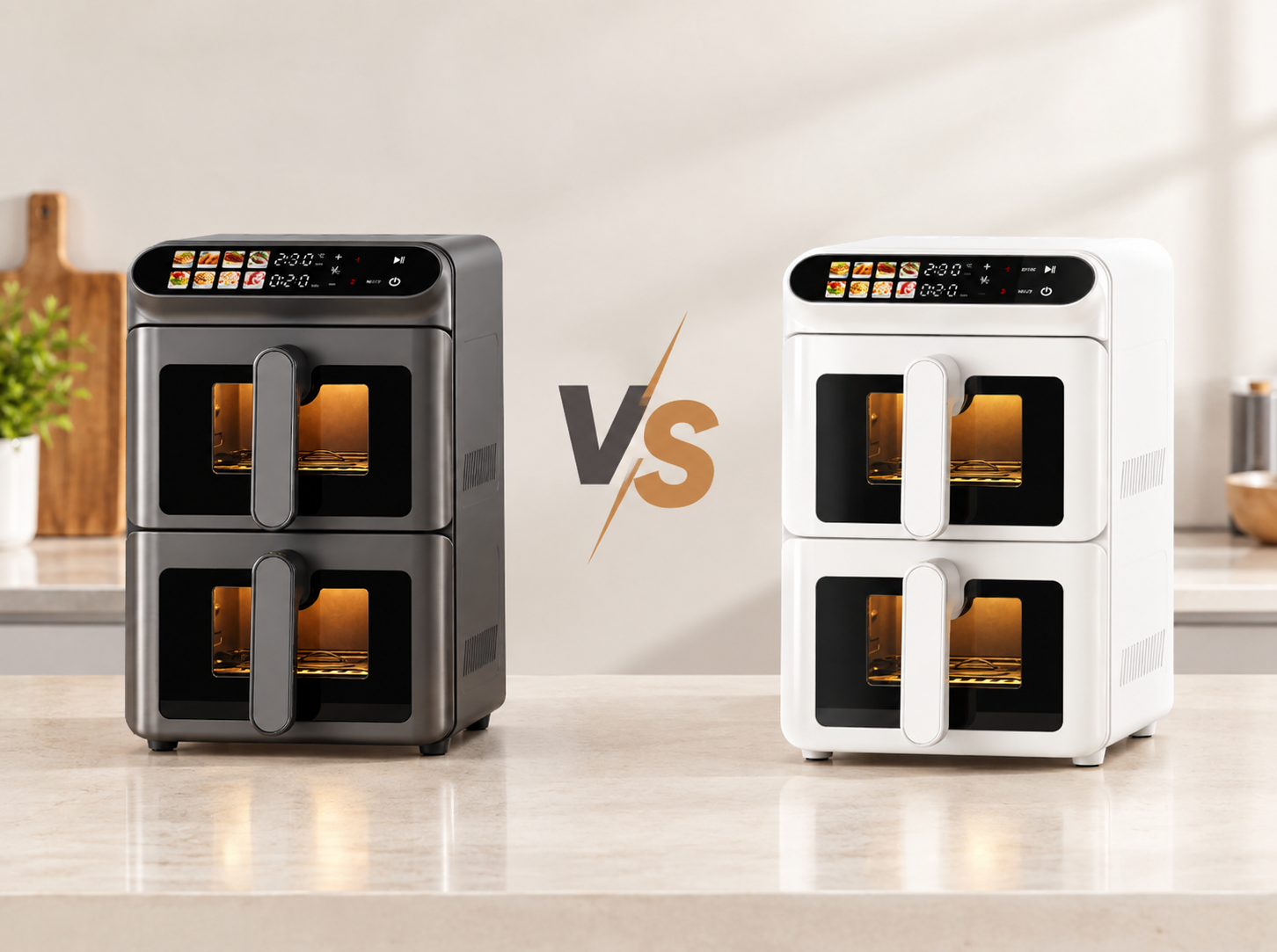
For example, a vertical dual-drawer air fryer has different space constraints from a conventional horizontal dual-basket model.
In such products, the heating system should be evaluated together with:
Product dimensions + drawer arrangement + airflow + heating power + component layout.
This is why the heating architecture should be selected as part of the overall product development process.
From a product-development perspective, maintenance is another factor worth considering.
Buyers should evaluate whether important components can be adequately protected and whether service access is practical if maintenance is required.
Questions worth asking an OEM/ODM supplier include:
· How is the heating element protected?
· How is the fan protected?
· How is grease accumulation controlled?
· Can key components be accessed for service?
· What thermal protection is used?
· How are motors protected?
· What durability testing has been conducted?
· What happens during abnormal temperature conditions?
These questions can help buyers evaluate the complete engineering solution rather than focusing on one specification.
Consideration | Top Heating | Rear Heating |
Heating position | Upper section | Rear section |
Airflow approach | Hot air generally directed downward/around the food | Hot air generally introduced from the rear |
Internal architecture | Heating system concentrated in upper section | Heating system concentrated toward rear |
Rear space | Potentially more flexible depending on design | More space may be required for rear components |
Grease exposure | Requires appropriate protection and shielding | Requires appropriate protection and airflow management |
Cleaning | Depends heavily on protective structure and accessibility | Depends heavily on protective structure and accessibility |
Product design | Can support different compact/vertical architectures | Well suited to various conventional architectures |
Maintenance | Depends on component accessibility | Depends on component accessibility |
Cooking performance | Depends on complete heating and airflow system | Depends on complete heating and airflow system |
The important point is that there is no universal winner.
A well-engineered rear-heating air fryer can perform very well.
A well-engineered top-heating air fryer can also perform very well.
The quality of the complete system matters more than the location of the heating element alone.
When comparing air fryer suppliers, we recommend evaluating at least seven areas:
Ask about:
· Heating element type
· Heating power
· Temperature range
· Temperature control
· Thermal protection
Check:
· Fan configuration
· Air circulation
· Cooking chamber design
· Air inlet/outlet
· Cooking uniformity
Consider:
· Internal cavity material
· External body material
· Heat resistance
· Surface durability
· Food-contact materials where applicable
Evaluate:
· Heating element protection
· Fan protection
· Grease accumulation
· Cleaning access
Ask about:
· Aging tests
· Continuous operation tests
· Thermal tests
· Motor durability
· Heating-element durability
Check applicable requirements for your target market, including relevant electrical, thermal and product safety requirements.
Perhaps most importantly, evaluate whether the supplier can explain why the chosen heating architecture is appropriate for the product.
A capable OEM/ODM supplier should be able to discuss the relationship between:
Heating → Airflow → Materials → Thermal management → Safety → Cleaning → Durability
rather than simply quoting a maximum temperature or wattage.
There is no single answer.
For a conventional air fryer, a rear-heating architecture may be a suitable solution depending on the product design.
For certain compact, vertical or specialized product architectures, a top-mounted heating system may offer different design possibilities.
The right choice depends on:
· Target capacity
· Product dimensions
· Basket configuration
· Cooking requirements
· Target price
· Retail positioning
· Cleaning expectations
· Safety requirements
· Target market
· Manufacturing considerations
For brands and importers, the best approach is to evaluate the complete product architecture, rather than selecting a heating position based on one specification.
An air fryer is not simply a heating element plus a fan.
Its performance depends on the interaction between:
Heating Element + Fan + Airflow + Cooking Chamber + Temperature Control + Materials + Thermal Protection
For example, two air fryers may both claim a maximum temperature of 230°C, but their actual cooking performance may differ because of differences in:
· Heating power
· Temperature accuracy
· Airflow
· Fan performance
· Cooking chamber geometry
· Heat distribution
· Control algorithm
· Insulation
Therefore, B2B buyers should avoid evaluating air fryer specifications in isolation.
Top heating and rear heating are two different approaches to air fryer engineering, and each can be suitable for different product architectures.
Top heating may offer advantages in certain compact or vertical designs, while rear heating can also provide effective cooking performance when properly engineered. Neither configuration should be considered universally superior.
For brands, importers and retailers, the better question is:
Which heating architecture provides the right balance of cooking performance, airflow, cleaning, safety, reliability, product design and cost for our target market?
When sourcing an air fryer, evaluate the complete system—not just the position of the heating element.
At FUNLOIV, we support OEM/ODM air fryer development with different product architectures and configurations. For buyers developing a new air fryer project, our engineering team can work with your target capacity, product positioning and market requirements to evaluate the appropriate heating and airflow solution.
Looking for an OEM/ODM air fryer supplier? Contact FUNLOIV to discuss your product requirements.

 + 86 181 3826 8709
 info@funloiv.com
 6/F., Guanglong Building, Pingxin North Road, Longgang, Shenzhen City, Guangdong, China


@ 2009-2026 Shenzhen Funloiv Electric Appliance Co., LtdAll rights reserved