Notice:

 search
search
search
Sep 14, 2026


When sourcing air fryers for a private label, retail brand, supermarket or distribution business, one of the first product decisions is often the housing material.
Should you choose a metal-body air fryer or a plastic-body air fryer?
There is no universal answer.
Plastic and metal can both be used successfully in air fryer design. The better choice depends on the product architecture, target retail price, consumer expectations, heat management, appearance, durability requirements and long-term market positioning.
For B2B buyers, therefore, the more useful question is not simply “Which material is better?”
It is:
Which housing material is more suitable for my product positioning, target market and customer expectations?
This guide compares metal-body and plastic-body air fryers from a procurement perspective.
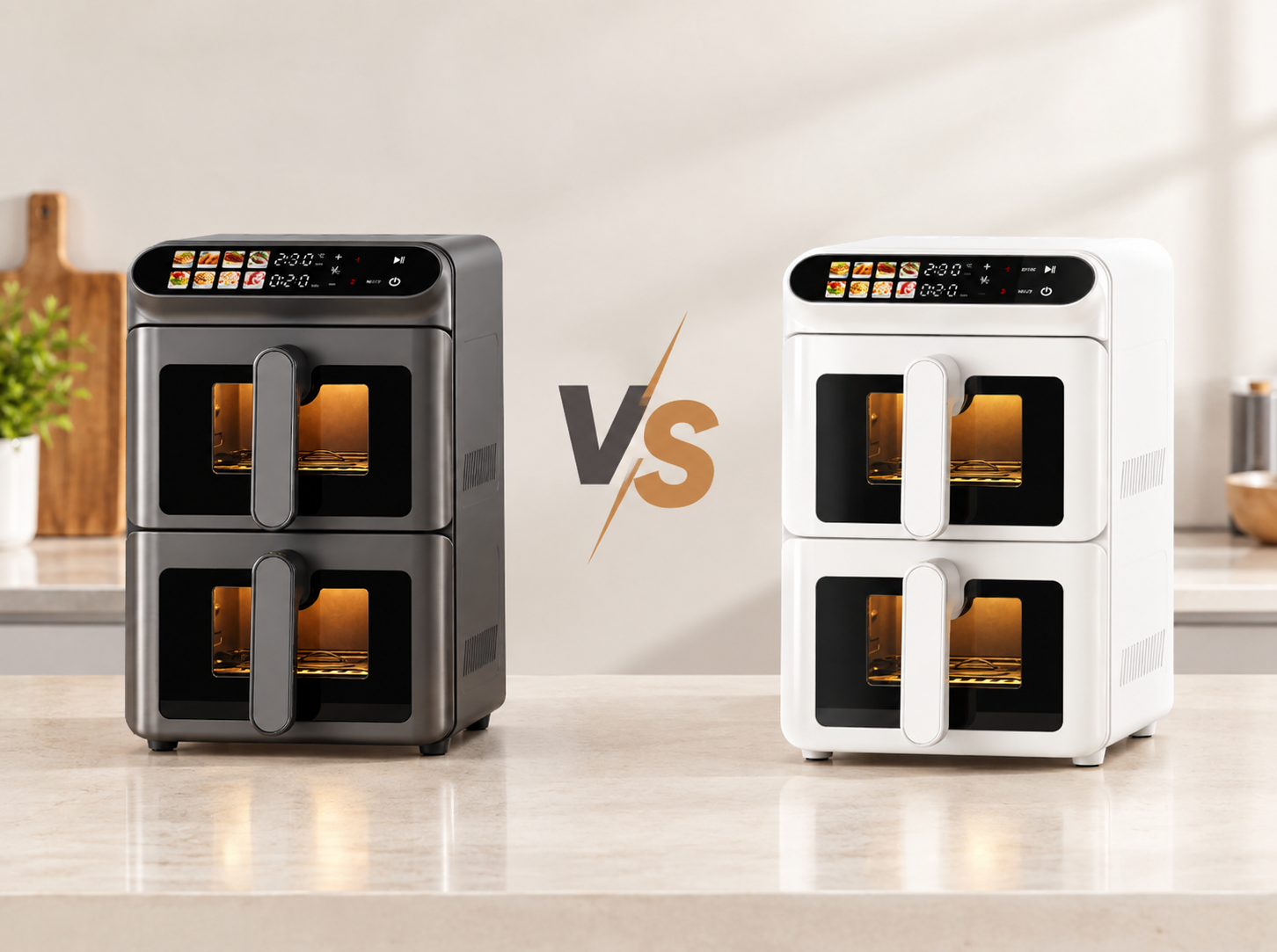
Factor | Metal-Body Air Fryer | Plastic-Body Air Fryer |
Retail positioning | Mid-range to premium | Entry-level to mainstream |
Perceived value | Generally higher | Generally lower to moderate |
Heat resistance | Strong, depending on material and construction | Depends heavily on plastic type and thermal design |
Appearance | Premium, durable and appliance-like | Lightweight and flexible for styling |
Durability perception | Generally stronger | Depends on construction and material quality |
Weight | Usually higher | Usually lighter |
Design flexibility | Good | Very high |
Cost positioning | Usually higher | Usually more cost-oriented |
Cleaning considerations | Depends on cavity and surface treatment | Depends on cavity and component design |
Best fit | Premium brands, quality-focused retailers | Value-focused and entry-level products |
The table is only a starting point.
A well-designed plastic air fryer can perform reliably, while a poorly designed metal air fryer does not automatically become a better product simply because it uses metal.
The complete product design remains the key factor.
For an air fryer, the housing material is not simply an aesthetic decision.
It can influence several aspects of the final product:
· Product appearance
· Perceived retail value
· Heat management
· Structural durability
· Surface finish
· Weight
· Manufacturing cost
· Product positioning
· Consumer expectations
· Long-term product lifecycle
This is particularly important for B2B buyers because an air fryer is not purchased only as a technical appliance.
It is also a retail product.
The material, appearance and construction all contribute to how consumers perceive the product when they see it on a shelf, e-commerce page or brand website.
One of the biggest differences between metal and plastic is perceived product positioning.
A metal exterior can give an air fryer a more substantial and appliance-oriented appearance. Stainless steel or coated metal surfaces are often associated with durability, robustness and higher-end kitchen appliances.
Plastic, on the other hand, provides more flexibility in shape, color and surface design. It can be particularly suitable when the primary objective is lightweight construction and competitive pricing.
For a buyer developing a private-label product, this distinction matters.
For example:
A plastic-body air fryer may be suitable when the primary priorities are:
· Competitive retail pricing
· Lightweight construction
· High-volume sales
· Simple product architecture
· Broad mainstream positioning
A metal-body air fryer may be more suitable when the priorities include:
· Higher perceived value
· More premium appearance
· Stronger appliance presence
· Differentiation from low-cost competitors
· Higher retail price positioning
· Long-term brand positioning
The correct decision should therefore start with the retail strategy, not simply the material itself.
In a highly competitive air fryer market, consumers often compare products that have similar basic functions.
Many products offer:
· Digital controls
· Multiple cooking presets
· Rapid air circulation
· Non-stick baskets
· Viewing windows
· Large capacities
When core functions become increasingly similar, material and construction can become part of the product differentiation.
A metal-body air fryer can create a stronger visual impression of:
Structure → Durability → Quality → Product Value
This does not mean that every metal air fryer should be positioned as premium.
However, for brands looking to move away from purely price-driven competition, metal construction can provide another way to communicate product value.
For B2B buyers, this can be particularly relevant when developing a product with a higher target retail price.
Heat resistance is another important reason why buyers evaluate metal and plastic differently.
Air fryers operate at elevated temperatures, and some models are designed for temperatures up to 230°C.
However, the temperature rating of the cooking chamber should not automatically be confused with the temperature experienced by every external component.
The actual thermal performance depends on:
· Heating element position
· Airflow design
· Internal insulation
· Heat shielding
· Material selection
· Component distance from the heating source
· Ventilation
· Structural design
· Temperature control
· Thermal protection
For plastic-body products, the engineering challenge is to ensure that the selected plastic materials and surrounding components remain suitable for their actual operating environment.
For metal-body products, the metal itself offers strong heat resistance, but the overall appliance still requires proper thermal management.
Material alone does not determine thermal safety or performance.
This is an important point for B2B buyers.
A buyer should also consider how the product is expected to perform over its intended lifecycle.
For products positioned for frequent household use, durability can become an important part of the product proposition.
Metal construction may provide advantages in areas such as:
· Structural rigidity
· Resistance to certain forms of surface damage
· Long-term appliance appearance
· Perceived robustness
Plastic can also provide good durability when the correct engineering plastics, wall thickness, reinforcement and thermal design are used.
Therefore, instead of asking:
“Is plastic durable enough?”
a better procurement question is:
“Has the complete product been validated for the expected operating conditions and product lifecycle?”
This should be verified through sample testing, thermal testing, functional testing and appropriate reliability testing.
Material also affects how a brand can design its product range.
Metal-body air fryers can work particularly well with:
· Stainless steel finishes
· Matte coatings
· Premium black finishes
· Brushed-metal effects
· Retro designs
· Minimalist European styling
Plastic provides greater freedom for:
· Bright colors
· Complex shapes
· Lightweight structures
· Two-tone designs
· Consumer-oriented styling
This means neither material is inherently more creative.
The difference is the type of design language each material can support.
For a brand owner, the important question is:
Does the material support the visual identity of the brand?
One advantage of plastic construction is weight.
A lighter air fryer can offer benefits in:
· Transportation
· Handling
· Consumer installation
· E-commerce logistics
· Packaging optimization
· Shelf handling
Metal construction generally adds weight, although the actual weight depends on the material, thickness and overall product architecture.
For B2B buyers, this means housing material should also be evaluated together with:
· Carton dimensions
· Gross weight
· Net weight
· Container loading
· Shipping cost
· Warehouse handling
A premium-looking product that becomes unnecessarily heavy may create additional logistics costs.
Therefore, material selection should be part of the total product cost calculation, rather than evaluated only on the unit FOB price.
A common assumption is:
Metal body = higher price = higher profit.
The relationship is not always that simple.
Metal components can increase:
· Material cost
· Processing cost
· Surface treatment cost
· Assembly requirements
· Product weight
· Packaging requirements
But a higher manufacturing cost only makes commercial sense if the market accepts the corresponding retail positioning.
For example, if a retailer’s target price is extremely aggressive, a metal-body design may make it difficult to maintain the desired margin.
On the other hand, if a brand is targeting a premium or mid-to-high retail segment, the additional material cost may be justified by:
· Higher perceived value
· Better differentiation
· Stronger visual identity
· Higher retail price potential
This is why B2B product development should begin with the target retail price and market positioning, then work backwards toward product architecture.
Instead of choosing one material universally, buyers should match the construction to the intended market.
· Competitive retail pricing
· Lightweight products
· High-volume mainstream sales
· Flexible styling
· Cost efficiency
· Entry-level or value-oriented positioning
· Premium appearance
· Higher perceived value
· Differentiation from low-cost products
· Stronger appliance aesthetics
· Higher retail positioning
· Quality-focused brand strategy
There can also be a third option:
Some air fryers combine metal and plastic components to balance:
· Cost
· Appearance
· Thermal requirements
· Weight
· Structural strength
· Design flexibility
For many OEM/ODM projects, this can be an effective way to optimize the overall product rather than choosing a material based on a single factor.
If you are considering a metal-body air fryer for your brand, do not evaluate the housing material alone.
Ask the supplier about the complete product architecture.
· What material is used for the external housing?
· What material is used for the cooking cavity?
· What is the material thickness?
· Which components are plastic?
· Where are the heating elements located?
· What is the maximum operating temperature?
· How is heat managed around the control panel?
· What insulation and heat shielding are used?
· How is overheating protected?
· Has the product completed aging tests?
· What functional tests are performed?
· What thermal tests are available?
· How is the heating system validated?
· Which components are produced in-house?
· What incoming quality controls are performed?
· What production QC processes are used?
· How is final inspection conducted?
· What is the MOQ?
· What is the sample lead time?
· What customization is available?
· What packaging options are available?
· What certifications are available for the target market?
These questions help buyers evaluate the supplier’s engineering and manufacturing capability, rather than simply comparing product photos and FOB prices.
It is important not to oversimplify the concept of a premium air fryer.
A metal housing by itself does not create a premium product.
A premium product normally requires a combination of:
Material + Thermal Design + Airflow + Cooking Performance + User Interface + Reliability + Appearance + Quality Control
For example, a metal-body air fryer with poor temperature control or inconsistent cooking performance will not become a high-quality product simply because its exterior is metal.
Similarly, a well-engineered plastic air fryer can deliver reliable performance and excellent value.
For B2B buyers, the objective should therefore be to select the right combination of specifications for the intended market.
For private-label brands, differentiation is becoming increasingly important.
If multiple competing products look similar and offer similar cooking functions, competing only on price can become difficult.
A metal-body air fryer can provide another product story:
· Premium material
· Stronger visual differentiation
· More substantial appliance appearance
· Higher perceived product value
· Potentially stronger premium positioning
This can be particularly useful for brands that do not want their products to compete exclusively with low-cost plastic air fryers.
However, the product should still be validated according to the requirements of the target market.
When comparing air fryer suppliers, we recommend evaluating seven areas:
1. Product Positioning
Does the product match your target retail segment?
2. Material Selection
Are the materials appropriate for the intended operating environment?
3. Thermal Design
Is heat properly managed throughout the appliance?
4. Cooking Performance
Does the complete heating and airflow system deliver the expected results?
5. Reliability
Has the product been tested for repeated use and expected lifecycle?
6. Manufacturing Capability
Can the supplier consistently reproduce the approved sample?
7. Commercial Fit
Does the MOQ, FOB cost, packaging and lead time work for your business?
This approach is more useful than simply asking:
“Is metal better than plastic?”
The better question is:
“Which construction delivers the right balance of performance, perceived value, cost and reliability for my target market?”
At FUNLOIV, we develop air fryer solutions for brands, importers, retailers and wholesalers looking for different combinations of product positioning, materials, capacity, heating configuration and user experience.
Our air fryer range includes metal-body and other configurations designed for different market requirements.
For buyers considering a metal-body air fryer, our development approach focuses on the complete product rather than the housing material alone.
Depending on the model, product development can involve:
· Metal-body construction
· Different capacity options
· Digital or mechanical controls
· Different heating configurations
· Temperature ranges according to model design
· Viewing-window options
· Single- or multi-basket configurations
· Customized appearance
· OEM branding
· Customized packaging
· Market-specific product development
For example, FUNLOIV has developed metal-body air fryer models featuring operating temperatures of up to 230°C, providing an alternative positioning to products commonly designed around a 200°C maximum setting.
The exact specifications, materials and certification requirements should always be evaluated according to the individual model and target market.
There is no universal winner between metal-body and plastic-body air fryers.
Plastic can provide advantages in cost, weight and design flexibility.
Metal can provide advantages in appearance, perceived value, structural feel and premium positioning.
The right choice depends on your:
· Target retail price
· Brand positioning
· Target consumer
· Market requirements
· Product lifecycle
· Performance expectations
· Logistics strategy
· Quality requirements
For B2B buyers, the most important step is therefore to evaluate the complete air fryer system, not just the exterior material.
If your brand is considering a metal-body air fryer for private label, OEM or ODM development, the next step is to compare the available configurations, specifications and target pricing with your market requirements.
Looking for a metal-body air fryer OEM & ODM supplier?
Explore the FUNLOIV Metal-Body Air Fryer Range or contact our team to discuss your target capacity, specifications, market and retail positioning.

 + 86 181 3826 8709
 info@funloiv.com
 6/F., Guanglong Building, Pingxin North Road, Longgang, Shenzhen City, Guangdong, China


@ 2009-2026 Shenzhen Funloiv Electric Appliance Co., LtdAll rights reserved