 Notice:

 search
search
search
Sep 17, 2026


For air fryer importers, brand owners, retailers and wholesalers, product quality is not only a manufacturing issue.
It is a business risk.
A small product problem can become a large customer-service problem when it is repeated across hundreds or thousands of units.
A loose handle may become a return.
An uneven cooking result may become a negative review.
An inaccurate temperature may lead to customer complaints.
A material or electrical problem can become a safety issue.
That is why buyers should understand the most common air fryer quality problems before approving a supplier or placing a bulk order.
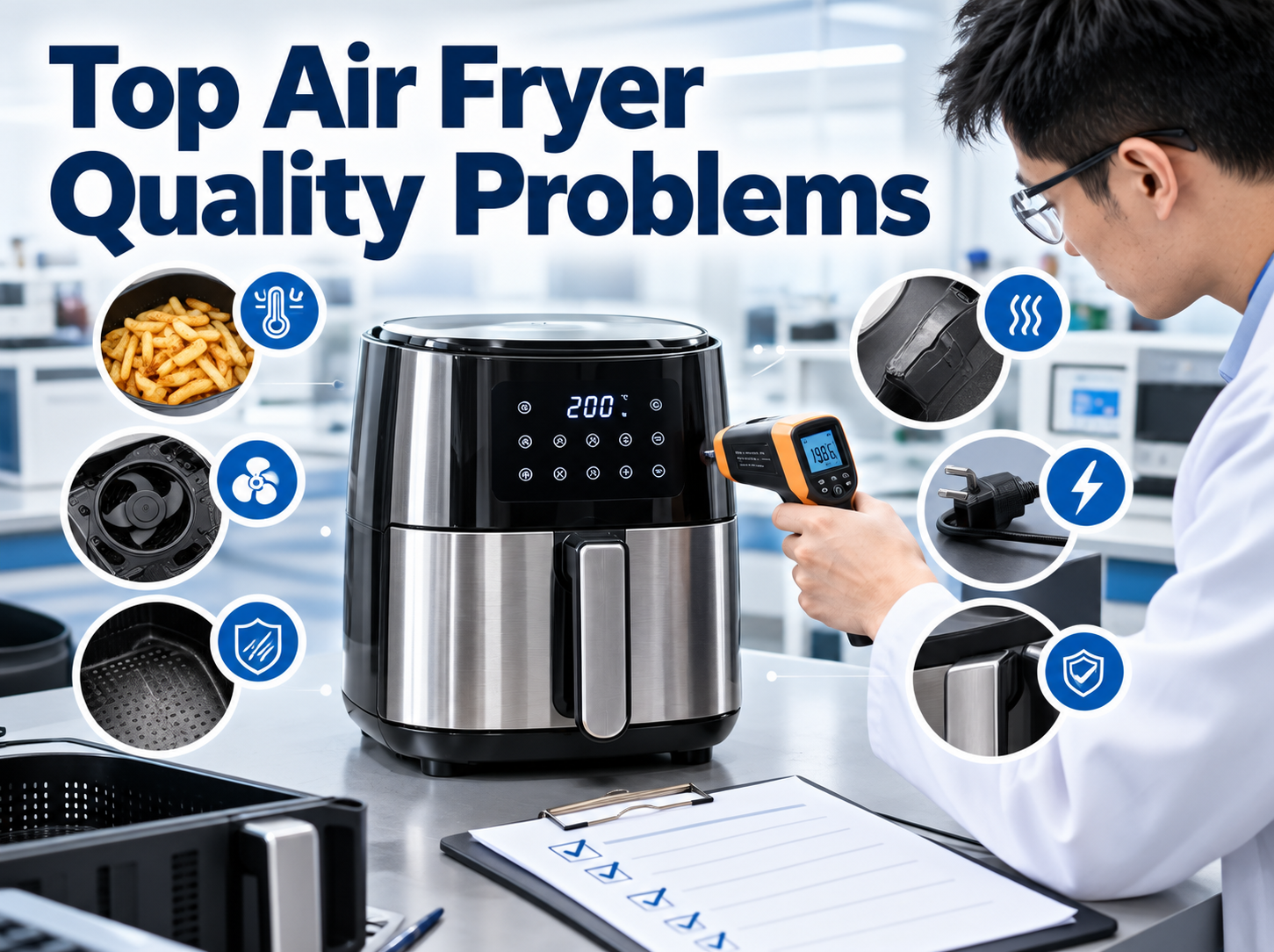
This guide covers 10 key quality areas that buyers should check during sample evaluation, factory quality control and mass production.
The following issues are among the key areas buyers should evaluate when sourcing air fryers:
1. Plastic deformation or heat-related material problems
2. Unpleasant odor
3. Uneven cooking
4. Temperature deviation
5. Timer or control problems
6. Excessive motor or fan noise
7. Fan or heating element failure
8. Basket and handle problems
9. Coating damage or peeling
10. Electrical and safety issues
Not every issue applies to every air fryer design.
The actual risk depends on the product structure, materials, heating system, components, manufacturing process and target market requirements.
Air fryers operate at relatively high temperatures, so material selection and thermal design are important.
Potential problems may include:
· Warping
· Softening
· Discoloration
· Cracking
· Deformation around high-temperature areas
· Loose components
· Changes in the appearance of plastic parts
These problems can become more noticeable after repeated heating cycles rather than during a short factory demonstration.
During sample evaluation, inspect plastic components:
· Before heating
· After maximum-temperature operation
· After repeated cooking cycles
· Around the heating system
· Around the basket and drawer
· Around handles and control panels
The objective is not to assume that plastic construction is unsuitable.
Instead, buyers should verify that the selected material, structure and temperature range are appropriate for the intended product design.
Odor is one of the easiest quality issues for consumers to notice.
A new air fryer may have some initial odor due to manufacturing residues or materials being exposed to heat for the first time. However, persistent or unusual odors require investigation.
Potential sources can include:
· Plastic components
· Coatings
· Manufacturing residues
· Grease or food residue
· Internal electrical components
· Materials located too close to high-temperature areas
Run the sample through several controlled heating cycles.
Record:
· When the odor appears
· Whether the odor decreases over time
· Whether it smells like plastic, coating, grease or electrical components
· Whether the odor returns during high-temperature operation
For private-label products, it is useful to establish an agreed acceptance standard before mass production.
A product can pass an electrical test and still disappoint consumers if it does not cook food consistently.
Uneven cooking may result in:
· Some food being overcooked
· Some food remaining undercooked
· Different browning levels
· Hot spots
· Poor airflow
· Insufficient heat distribution
Airflow, heating-element position, fan performance, chamber geometry, food quantity and basket design can all affect cooking results.
Use a repeatable test.
For example:
· Same food
· Same quantity
· Same starting temperature
· Same cooking temperature
· Same cooking time
· Same basket configuration
Then compare the results.
If you are comparing several suppliers, use the same test procedure for every sample.
This gives you a more meaningful comparison than simply asking which supplier claims better cooking performance.
Temperature accuracy is another important quality area.
For example, a product may display 200°C while the actual temperature inside the cooking chamber varies significantly from the displayed value.
This can affect:
· Cooking results
· Cooking time
· Browning
· Consumer expectations
· Energy consumption
· Product consistency
Use an appropriate temperature measurement method and compare:
Set temperature vs. actual temperature
Test multiple points within the specified operating range rather than checking only one temperature.
The acceptance criteria should be defined according to the product specification and applicable standards.
Timer problems may seem minor, but they directly affect the consumer experience.
Potential issues include:
· Timer deviation
· Incorrect countdown
· Program interruption
· Buttons not responding
· Touchscreen sensitivity problems
· Incorrect preset behavior
· Automatic shut-off problems
For digital products, buyers should also check whether the control system behaves consistently after repeated operation.
If the timer is set to 20 minutes, compare the actual operating time with the displayed countdown.
Repeat the test.
For automatic programs, verify:
· Temperature
· Time
· Heating behavior
· Fan operation
· End-of-cycle behavior
The goal is to confirm that the software and hardware work together as specified.
Every air fryer produces some fan noise.
The quality concern is whether the noise level is appropriate and whether abnormal noise develops during operation.
Watch for:
· Excessive humming
· Rattling
· Vibration
· Grinding sounds
· Unstable fan speed
· Noise that increases after repeated operation
A consumer may use an air fryer frequently in a kitchen or living environment.
A product that is technically functional but noticeably noisy can still generate negative customer feedback.
During sample evaluation, test the product at:
· Start-up
· Normal operation
· Maximum temperature
· Repeated cycles
· Shut-down
If possible, measure noise under controlled conditions rather than relying only on subjective judgment.
The fan and heating system are critical functional components.
Potential problems include:
· Fan does not start
· Fan speed instability
· Excessive vibration
· Heating element does not heat
· Slow heating
· Intermittent heating
· Uneven heating
· Heating element failure after repeated operation
These problems may not appear during a short product demonstration.
A reliable production process should include appropriate checks of major components before assembly, functional testing after assembly and suitable aging or reliability testing.
For buyers, it is important to ask the supplier:
· How are heating elements tested?
· How are motors tested?
· Is every unit function-tested?
· Is aging testing performed?
· How are defective components controlled?
The answers can tell you more about the supplier’s quality system than a product catalogue can.
The basket and handle are among the most frequently handled parts of an air fryer.
Common areas to check include:
· Loose handle
· Weak fixing points
· Poor basket alignment
· Difficult insertion
· Difficult removal
· Basket deformation
· Scratched surfaces
· Damaged coating
· Excessive movement
These issues can develop through repeated opening and closing rather than immediately after production.
Simulate repeated normal use.
Check whether:
· The handle remains secure
· The basket continues to slide correctly
· The locking mechanism works consistently
· There is excessive movement
· The coating remains intact
For mass production, the approved sample should be used as a reference for both appearance and function.
The basket and cooking tray are frequently exposed to:
· High temperatures
· Oil
· Food
· Moisture
· Washing
· Repeated mechanical contact
Poor coating performance can eventually lead to:
· Scratches
· Sticking
· Blistering
· Peeling
· Surface deterioration
Buyers should therefore look beyond the appearance of a brand-new sample.
· What coating is being used?
· What is the coating specification?
· What preparation process is used?
· How is coating adhesion controlled?
· What cleaning method is recommended?
· What durability testing is performed?
The exact coating requirements should be defined according to the product design and target-market requirements.
Electrical and thermal safety should be treated as a separate quality category.
Potential areas of concern include:
· Power cord problems
· Plug issues
· Insulation problems
· Grounding or earthing
· Leakage current
· Thermal protection
· Fuse operation
· Overheating
· Automatic shut-off
· Abnormal operation
The exact safety tests depend on the target market, product construction and applicable standards.
Do not only ask:
“Does this product have CE, GS, ETL or other certification?”
Also verify:
· Which exact model was tested?
· Does the certification cover the same product version?
· Are the components consistent with the tested version?
· Has the product design changed after certification?
· Are the test reports and technical documents available?
A certificate is useful, but traceability between the certified model and the production model is equally important.
Not every quality problem has the same commercial impact.
A useful way to evaluate risk is to divide problems into four categories.
Risk Category | Examples | Potential Business Impact |
Performance | Uneven cooking, temperature deviation | Complaints, poor reviews |
Durability | Handle, basket, coating, motor | Returns, warranty claims |
Appearance | Scratches, discoloration, deformation | Retail complaints |
Safety | Electrical, thermal, overheating | High compliance and liability risk |
For buyers, frequency is not the only consideration.
A problem that occurs rarely but creates a serious safety or compliance issue may require much more attention than a minor cosmetic defect.
The best time to identify a quality problem is before mass production.
A practical process is:
Document:
· Capacity
· Power
· Voltage
· Temperature range
· Cooking time
· Heating system
· Motor
· Materials
· Basket
· Control system
· Accessories
· Packaging
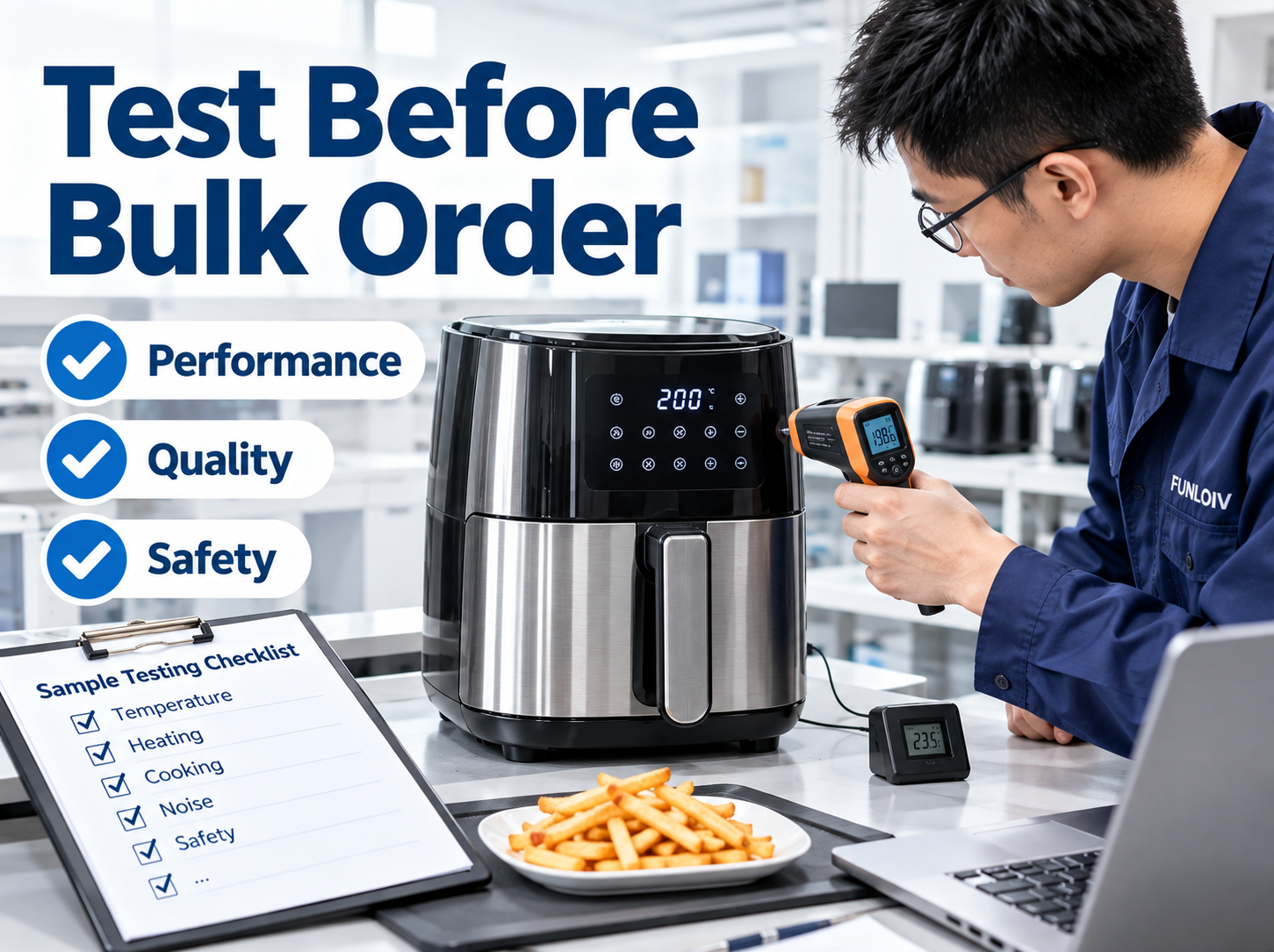
Test:
· Temperature
· Heating
· Cooking consistency
· Timer
· Noise
· Basket
· Handle
· Surface temperature
· Odor
· Electrical safety
· Continuous operation
· Cleaning
Not every specification needs the same level of control.
Identify the characteristics that could directly affect:
· Safety
· Performance
· Consumer complaints
· Certification
· Product returns
Keep a clearly identified reference sample.
The production version should match the approved sample in:
· Materials
· Components
· Functions
· Appearance
· Packaging
· Performance
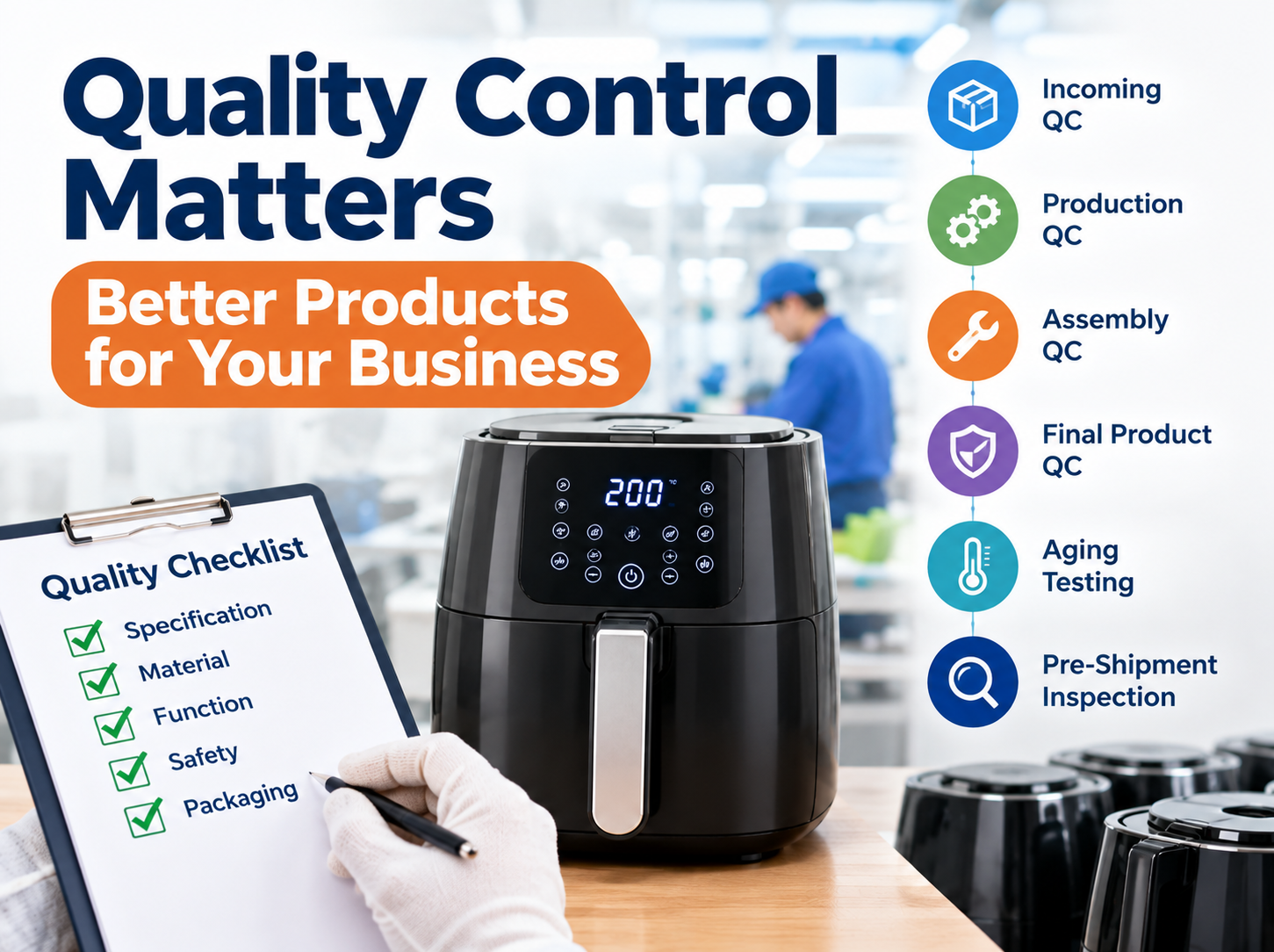
The supplier should have appropriate:
· Incoming Quality Control
· In-Process Quality Control
· Functional testing
· Aging or reliability testing
· Final Quality Control
· Pre-shipment inspection
A strong quality system should not depend only on final inspection.
Quality should be controlled throughout the production process.
A practical air fryer QC process may include:
Incoming Materials → Assembly → Electrical Testing → Functional Testing → Aging Testing → Final Inspection → Pre-Shipment Inspection
Each stage has a different purpose.
Check critical components and raw materials before assembly.
Monitor assembly quality and key production processes.
Confirm that the finished product operates correctly.
Operate selected units for an appropriate period to identify potential performance problems.
Check appearance, functions, accessories and packaging.
Confirm that the finished order meets the agreed requirements before shipment.
This approach is more effective than relying only on a final visual inspection.
Before placing a bulk order, ask the supplier:
· What are the critical quality points for this model?
· How do you test temperature accuracy?
· How do you test heating performance?
· How do you control cooking consistency?
· How do you test the motor and fan?
· How do you test the basket and handle?
· Are incoming components inspected?
· Is every finished unit function-tested?
· Is aging testing performed?
· Is pre-shipment inspection available?
· How are defective units handled?
· Which certifications apply to this model?
· Which laboratory issued the reports?
· Does the certified model match the production model?
· Are material and compliance documents available?
· What is the warranty period?
· What spare parts are available?
· How are warranty claims handled?
· What happens if a batch has a recurring defect?
A professional supplier should be able to answer these questions clearly.
A good sample does not automatically guarantee a good bulk order.
This is one of the most important points for B2B buyers.
There are actually three different questions:
This is product testing.
This is production consistency.
This is quality management.
Therefore, buyers should evaluate both:
Product Quality + Supplier Quality System
A supplier may provide an excellent sample but still have weak production controls.
Conversely, a supplier with a strong quality system should be able to explain how the approved sample will be translated into mass-production standards.
Some air fryer specifications look impressive on a catalogue but should be tested as part of the product evaluation.
Two examples are:
230°C maximum temperature
and
Metal-body construction.
Instead of simply asking whether the product has these features, buyers can include them in the sample-testing procedure.
· Actual temperature
· Temperature stability
· Heating time
· Heating element performance
· Fan operation
· External surface temperature
· Material behavior after repeated heating
· Body construction
· Surface quality
· Structural rigidity
· Heat behavior
· Assembly quality
· Cleaning
· Appearance after repeated operation
This turns a product specification into a verifiable quality requirement.
For example:
Instead of simply specifying “230°C maximum temperature,” define how the temperature will be measured and what performance the approved sample must demonstrate.
This is particularly useful for private-label and OEM/ODM projects.
The best strategy is to prevent recurring problems before shipment.
A useful quality-control chain is:
Product Design
↓
Component Selection
↓
Sample Testing
↓
Supplier Verification
↓
Mass Production QC
↓
Final Inspection
↓
Customer Feedback
↓
Corrective Action
This creates a feedback loop.
When a customer complaint appears, the supplier should be able to trace the issue back to:
· Product design
· Component
· Material
· Production process
· Testing
· Packaging
· Transportation
· User operation
The objective is not simply to replace a defective product.
The objective is to prevent the same problem from appearing again.
Before placing a bulk order, review the following:
☐ Temperature accuracy checked
☐ Heating performance tested
☐ Cooking consistency tested
☐ Timer accuracy checked
☐ Motor noise evaluated
☐ Continuous operation tested
☐ Body material verified
☐ Plastic parts inspected
☐ Basket tested
☐ Handle tested
☐ Coating checked
☐ Assembly quality inspected
☐ Electrical requirements confirmed
☐ Thermal protection verified
☐ Applicable certification confirmed
☐ Tested model matches production model
☐ Safety documentation available
☐ Approved sample identified
☐ Critical components documented
☐ Incoming inspection defined
☐ Functional testing defined
☐ Aging testing considered
☐ Final inspection defined
☐ Pre-shipment inspection available
☐ Warranty terms confirmed
☐ Spare parts policy confirmed
☐ Defect handling procedure confirmed
☐ Corrective-action process confirmed
For an air fryer buyer, the real cost of poor quality is not only the defective unit.
It can include:
· Product returns
· Warranty costs
· Replacement shipments
· Negative reviews
· Retailer complaints
· Lost shelf space
· Brand damage
· Additional inspection costs
· Customer-service workload
That is why air fryer quality should be evaluated before the bulk order rather than after products reach consumers.
A professional sourcing process should connect:
Sample Testing → Quality Requirements → Production QC → Final Inspection → After-Sales Feedback
For differentiated products, important selling points should also become measurable quality requirements.
For example, a 230°C maximum temperature should be tested.
A metal-body construction should be verified.
A quiet motor should be evaluated.
A dual-heating system should be tested for actual heating performance.
The more clearly a product requirement can be defined and verified, the easier it becomes to control quality during mass production.
If you are sourcing air fryers for your brand, retail business or distribution market, send us your target specifications, product requirements and target market.
We can discuss the key quality points that should be checked during sample evaluation and mass production.
Send us your product requirements and let us discuss the quality-control points for your project.

Air Fryer RFQ Checklist: 20 Specifications Buyers Should Include
What Quality-Control Standards Should I Require from an Air Fryer Supplier?

Kitchen Appliance Regulations In the European Union
What Are the Most Common Quality Problems with Air Fryers?
How Can I Test an Air Fryer Sample Before Placing a Bulk Order?

How to Compare Quotations from Different Air Fryer Suppliers?
 + 86 181 3826 8709
 info@funloiv.com
 6/F., Guanglong Building, Pingxin North Road, Longgang, Shenzhen City, Guangdong, China


@ 2009-2026 Shenzhen Funloiv Electric Appliance Co., LtdAll rights reserved


