 Notice:

 search
search
search
Sep 17, 2026


When sourcing air fryers, many buyers focus first on price, specifications, MOQ and delivery time.
But for an importer, retailer or appliance brand, product quality is ultimately what determines whether an order becomes a profitable business or a costly after-sales problem.
A low FOB price does not help if the finished products later develop problems such as:
· Plastic deformation
· Unpleasant odor
· Uneven cooking
· Temperature deviation
· Timer or control failure
· Excessive motor noise
· Fan failure
· Heating element failure
· Coating peeling
· Basket or handle problems
· Electrical or thermal safety issues
So what quality-control standards should you require from an air fryer supplier?
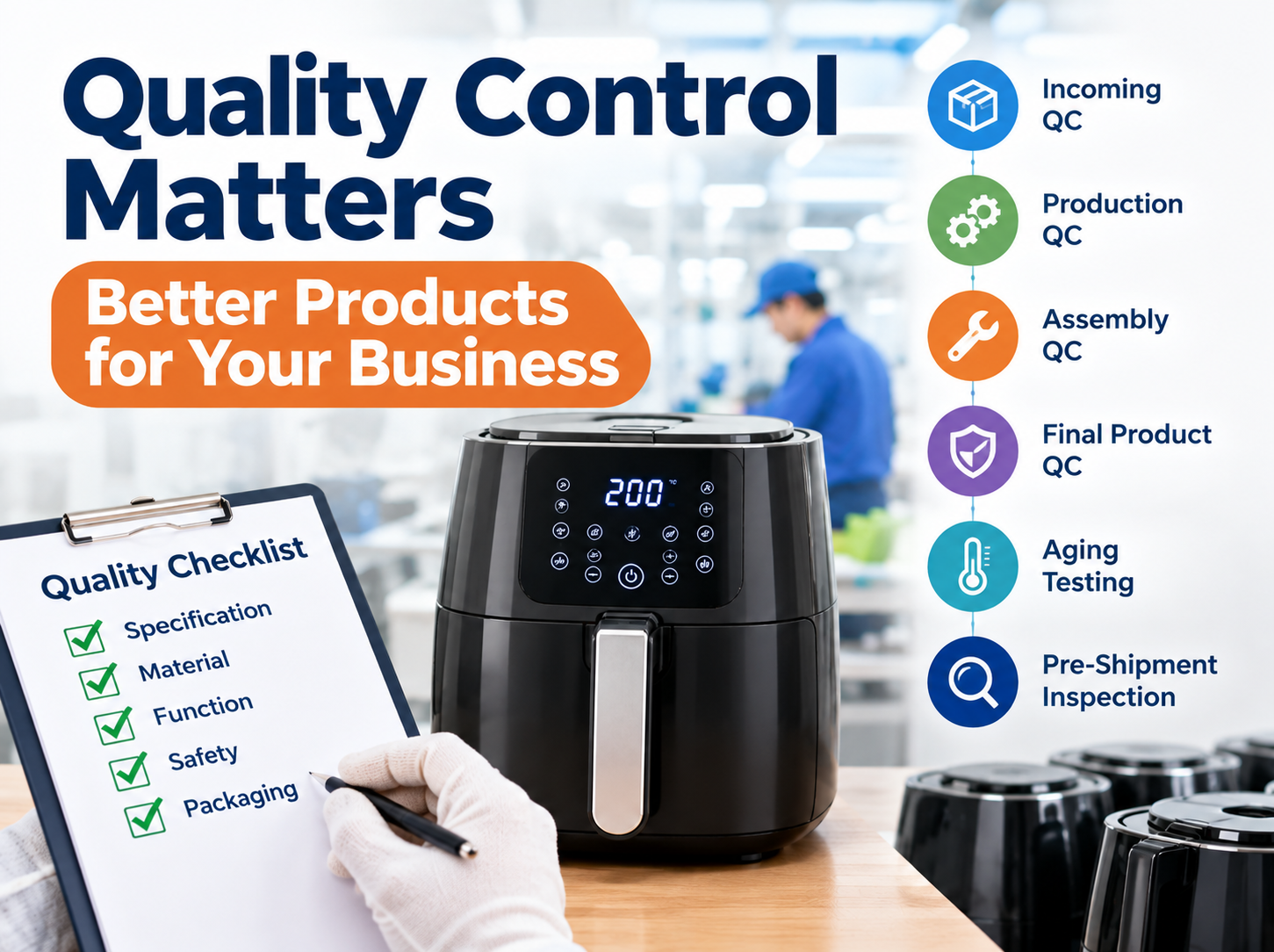
A professional supplier should not rely only on a final inspection. Quality should be controlled throughout the entire production process:
Incoming QC → Production QC → Assembly QC → Finished Product QC → Aging Testing → Pre-Shipment Inspection
This article explains the key quality-control standards B2B buyers should expect when sourcing air fryers.
Before production begins, the buyer and supplier should agree on a clear product specification.
A quality standard is difficult to control if the supplier does not have a defined target.
For an air fryer, the specification should normally include:
· Capacity
· Rated power
· Voltage and frequency
· Temperature range
· Timer range
· Heating system
· Motor and fan specifications
· Basket and tray materials
· Body material
· Coating requirements
· Control panel and display
· Preset programs
· Noise requirements
· Packaging requirements
· Applicable certifications
· Target market requirements
· Warranty requirements
For example, if an air fryer is specified to operate from 60°C to 230°C, the supplier should have a method to verify that the actual temperature performance matches the agreed specification.
A product specification should therefore be treated as a quality-control reference, not simply a sales document.
Quality problems can begin before the air fryer reaches the assembly line.
A professional supplier should inspect important incoming materials and components before they are used in production.
Plastic components
· Dimensions
· Color consistency
· Surface defects
· Deformation
· Material specification
Metal components
· Material
· Thickness
· Dimensions
· Surface finish
· Stamping quality
· Sharp edges
Heating elements
· Resistance
· Appearance
· Electrical characteristics
· Insulation requirements
Motors and fans
· Rated voltage
· Rotation
· Noise
· Vibration
· Electrical performance
Electronic components
· PCB specification
· Display
· Touch controls
· Sensors
· Wiring
· Connectors
Non-stick components
· Coating appearance
· Adhesion
· Surface defects
· Material requirements
The purpose of IQC is simple:
Do not allow defective or non-conforming components to enter mass production.
This is especially important for air fryers because a defect in a small component can later become a functional, durability or safety problem in the finished product.
Incoming inspection alone is not enough.
Even when all components are qualified, problems can occur during assembly.
For this reason, production should include quality-control checkpoints.
Typical production QC may cover:
· Correct component installation
· Wiring
· Screw tightening
· Heating-element installation
· Motor and fan installation
· Temperature-sensor positioning
· Insulation
· Grounding
· Control-board connection
· Basket and drawer assembly
· Housing alignment
· Handle installation
· Functional operation
For air fryers, wiring and thermal components deserve particular attention.
Incorrect wiring, poor connections or incorrect positioning of thermal components can potentially affect heating performance, temperature control or electrical safety.
The goal is not simply to find defective products at the end of production.
The goal is to prevent defects from moving to the next production stage.
An air fryer is not just a collection of individual components.
The heating system, fan, motor, temperature sensor, control system and cooking chamber must work together.
Assembly QC should therefore verify whether the complete product has been assembled according to the approved design.
Important checkpoints include:
· Heating element installed correctly
· Heating element operates correctly
· Heating response is stable
· No abnormal heating behavior
· Fan rotates correctly
· Airflow is stable
· No abnormal vibration
· No excessive mechanical noise
· Sensor is correctly positioned
· Temperature feedback is stable
· Control system responds correctly
· Smooth insertion and removal
· Correct locking
· Handle securely attached
· No excessive movement
· No interference with the heating system
· Correct assembly
· No excessive gaps
· No deformation
· No sharp edges
· Components correctly aligned
This stage is particularly important for OEM and ODM projects because a product may have customized structures, materials or control systems.
Every finished air fryer should be functionally tested before it is packed.
At minimum, the supplier should have a defined testing procedure for the main functions.
Depending on the product design, this may include:
· Power-on test
· Heating test
· Temperature-control test
· Timer test
· Display test
· Touch-button test
· Preset-program test
· Fan operation test
· Motor operation test
· Auto shut-off test
· Safety-device test
· Basket detection or switch test, where applicable
For example, if the product specification states a temperature range of 60°C–230°C, the supplier should be able to demonstrate how temperature performance is checked.
A number printed on a product specification sheet is not enough.
A quality specification should have a corresponding verification method.
Temperature performance is one of the most important quality factors for an air fryer.
Two products may both be labeled “200°C” or “230°C”, but their actual heating performance may be different.
Buyers should ask suppliers:
· How is temperature measured?
· Where is the temperature measured?
· What tolerance is acceptable?
· How long does the product take to reach the target temperature?
· Is the temperature stable during operation?
· How is overheating controlled?
· How are different heating elements controlled?
Temperature testing should be performed according to the product design and applicable testing requirements.
For example, FUNLOIV’s 8L metal-body air fryer is specified with a 60°C–230°C temperature range, upper and lower heating elements, a high-speed fan, an internal thermal fuse and an auto shut-off function. These specifications provide clear parameters that can be incorporated into a buyer’s product-quality checklist.
An air fryer can reach the target temperature and still produce inconsistent cooking results.
Why?
Because temperature and airflow work together.
Buyers should therefore consider:
· Airflow distribution
· Fan performance
· Heating-element position
· Cooking-chamber design
· Basket design
· Food loading conditions
· Distance between food and heating element
Testing should use a repeatable method rather than simply cooking one portion of fries and judging the result subjectively.
For OEM/ODM projects, the supplier should be able to establish a repeatable testing procedure based on the final product design.
The objective is to make sure that production units perform consistently—not just that one engineering sample performs well.
The fan and motor are critical components in an air fryer.
Common problems can include:
· Excessive noise
· Abnormal vibration
· Slow rotation
· Insufficient airflow
· Fan failure
· Motor overheating
· Short service life
A supplier’s QC process should therefore consider both electrical performance and mechanical performance.
Depending on the product and market requirements, testing may include:
· Starting performance
· Running performance
· Noise
· Vibration
· Continuous operation
· Temperature rise
· Long-duration operation
This is one reason why aging testing is valuable.
A product that operates normally for several minutes may behave differently after prolonged operation.
Air fryers operate in a high-temperature environment, so material selection and heat management are important.
For plastic-body models, buyers should pay attention to:
· Heat resistance
· Deformation
· Surface condition
· Odor
· Color stability
· Structural stability
For metal-body models, buyers should additionally check:
· Metal thickness
· Surface finish
· Stamping quality
· Edge treatment
· Joint quality
· Coating quality
· Corrosion resistance where applicable
The important point is not that metal is always better than plastic.
The correct question is:
Does the selected material and construction meet the intended temperature, durability, appearance and market-positioning requirements?
For example, FUNLOIV’s 8L model uses a metal housing and full metal cavity, with a specified temperature range up to 230°C.
The basket and tray are directly associated with food preparation, so their surface quality should be carefully controlled.
Buyers should establish requirements for:
· Coating appearance
· Adhesion
· Surface uniformity
· Scratches
· Peeling
· Blistering
· Edge quality
· Cleaning performance
· Food-contact material requirements
The supplier should also be able to provide relevant material or compliance documentation required for the target market.
For example, EU-market buyers should not assume that a material is compliant simply because it is commonly used in kitchen appliances. Specific materials and testing requirements may apply depending on the product and market.
For an electrical cooking appliance, safety should be treated as a core quality requirement rather than an additional feature.
The exact requirements depend on the target market, product configuration and applicable standards.
Typical safety-related checks can include:
· Insulation
· Grounding
· Leakage current
· Dielectric strength
· Power input
· Abnormal operation
· Temperature rise
· Thermal protection
· Fuse protection
· Auto shut-off
· Mechanical stability
· Wiring and terminal security
International standards should also be considered during product development.
For example, IEC 60335-2-9 covers safety requirements for portable cooking appliances, and the current 2026 pre-release specifically includes air fryers within its scope.
For export projects, the buyer and supplier should agree early on which standards, certifications and market-specific requirements apply.
A product can pass a basic functional test and still fail after extended operation.
This is why aging testing is an important part of quality control.
An aging test may help identify problems such as:
· Motor failure
· Fan failure
· Heating-element failure
· Abnormal noise
· Temperature instability
· Electronic-control problems
· Wiring problems
· Overheating
The exact test duration and conditions should be defined according to the product design and applicable requirements.
FUNLOIV states that approximately 10 units from each order are randomly selected for aging testing as part of its quality-assurance process.
For buyers, the important question is not simply:
“Do you perform aging testing?”
A better question is:
“Which products are tested, under what conditions, for how long, and what happens if a unit fails?”
Before shipment, the supplier should perform a final inspection against the agreed purchase-order and product requirements.
A pre-shipment inspection may include:
· Color
· Surface finish
· Scratches
· Gaps
· Printing
· Logo
· Assembly quality
· Power
· Heating
· Fan
· Controls
· Display
· Timer
· Presets
· Basket
· Tray
· Manual
· Measuring accessories
· Other specified components
· Inner packaging
· Carton condition
· Drop protection
· Product labeling
· Shipping marks
· Quantity
· Test records
· Inspection records
· Certification documents
· Packaging information
· Other agreed documents
FUNLOIV publicly states that pre-shipment inspection is conducted before shipment, including cases where the customer’s own inspection is cancelled.
For B2B buyers, a simple way to evaluate a supplier is to map the entire quality-control process:
QC Stage | What Should Be Checked? |
Incoming QC | Raw materials and key components |
Production QC | Assembly process and critical components |
Assembly QC | Wiring, heating, motor, fan and structure |
Functional QC | Power, heating, temperature, timer and controls |
Safety QC | Electrical and thermal safety |
Aging Testing | Reliability during extended operation |
Finished Product QC | Appearance, function and accessories |
Pre-Shipment Inspection | Final quantity, quality and packaging |
This is much more meaningful than asking a supplier:
“Do you have good quality?”
The better question is:
“Show me how you control quality from incoming materials to shipment.”
Before placing a bulk order, consider asking the supplier these questions:
1. Do you have an incoming quality inspection process?
2. Which components are inspected before production?
3. How do you control heating elements and motors?
4. How do you test temperature accuracy?
5. How do you test fan performance?
6. Do you perform electrical safety testing during production?
7. Do you perform aging testing?
8. How many units are tested from each production batch?
9. How do you control coating quality?
10. How do you check baskets and handles?
11. How do you control plastic deformation and heat-related problems?
12. Do you perform a final functional test on finished products?
13. Do you conduct pre-shipment inspection?
14. Can you provide inspection or test records?
15. What happens if a product fails inspection?
16. Can you follow a buyer’s customized QC checklist?
17. Can the approved sample be used as the mass-production reference?
18. Can a third-party inspection company inspect the order before shipment?
A capable OEM/ODM supplier should be able to answer these questions clearly.
One of the most important quality-control principles in OEM/ODM sourcing is the approved sample.
After the buyer completes sample testing and approves the final version, the approved sample should become the reference for mass production.
This should cover not only appearance but also:
· Materials
· Dimensions
· Color
· Function
· Temperature
· Noise
· Accessories
· Packaging
· User interface
· Performance
· Safety-related requirements
Otherwise, the buyer may approve one sample and receive a different product during mass production.
A professional supplier should have a clear process for controlling the transition from:
Engineering Sample → Revised Sample → Approved Sample → Mass Production
The strongest quality-control systems are not based entirely on final inspection.
They are designed to prevent problems at every stage.
The basic logic is:
Good Materials
↓
Controlled Production
↓
Controlled Assembly
↓
Functional Testing
↓
Safety Testing
↓
Aging Testing
↓
Final Inspection
↓
Pre-Shipment Inspection
This approach helps reduce the risk that a small component problem becomes a large customer complaint.
For an importer or brand owner, this matters because the real cost of poor quality is not only the defective product itself.
I
t can also include:
· Returns
· Replacement shipments
· Customer service costs
· Retailer complaints
· Negative reviews
· Lost shelf space
· Brand reputation problems
· Additional inspection costs
Quality control is therefore part of total sourcing cost, not simply a factory expense.
When evaluating an air fryer supplier, a practical minimum quality framework should include:
Clear and measurable product requirements.
Inspection of important raw materials and components.
Process control during manufacturing.
Control of wiring, heating, motor, fan, sensors and mechanical assembly.
Verification of the actual product functions.
Electrical and thermal safety according to the target market.
Aging and other appropriate durability tests.
Appearance, function, accessories and packaging.
Final verification before shipment.
Inspection records, test reports and applicable compliance documentation.
The approved sample should become a controlled production reference.
If a supplier cannot clearly explain these processes, buyers should ask more questions before placing a large order.
When sourcing air fryers, “good quality” is too general to be a useful purchasing standard.
Instead, ask:
How is quality controlled?
A professional air fryer supplier should be able to explain its quality-control process from
Incoming QC → Production QC → Assembly QC → Finished Product QC → Aging Testing → Pre-Shipment Inspection.
More importantly, the supplier should be able to connect each quality requirement with a specific testing or inspection method.
For OEM and ODM buyers, this is especially important because customized products require clear specifications, controlled samples and consistent mass production.
At FUNLOIV, quality control is integrated into the production process, from incoming materials and production-line testing to aging testing and pre-shipment inspection. Our goal is not simply to deliver an air fryer that passes a final inspection, but to establish a repeatable quality process for every production order.
Looking for an OEM/ODM air fryer supplier with a structured quality-control process?
Send us your target capacity, specifications, market requirements and quality standards. We can discuss the key QC checkpoints for your project before mass production.

Metal-Body vs. Plastic-Body Air Fryer
200°C vs 230°C Air Fryer:
How to Choose an OEM/ODM Air Fryer Supplier in China:
Can An Air Fryer Replace A Toaster Oven?
What Quality-Control Standards Should I Require from an Air Fryer Supplier?

Air Fryer for the Middle East: A GCC Buyer’s Guide to G-Mark, Specifications and Compliance
 + 86 181 3826 8709
 info@funloiv.com
 6/F., Guanglong Building, Pingxin North Road, Longgang, Shenzhen City, Guangdong, China


@ 2009-2026 Shenzhen Funloiv Electric Appliance Co., LtdAll rights reserved


