 Notice:

 search
search
search
Sep 15, 2026


If you are developing an air fryer for your own brand, one of the most important decisions is not the capacity, color or control panel.
It is choosing the right OEM/ODM air fryer supplier.
A supplier may offer a competitive FOB price, attractive product photos and a large catalog. But that does not necessarily mean the supplier can successfully support your project from the first sample to mass production.
For brands, importers, retailers and wholesalers, the real question is:
How do I find an OEM/ODM air fryer supplier that can develop the right product, meet quality requirements, support certification, control production and deliver consistently?
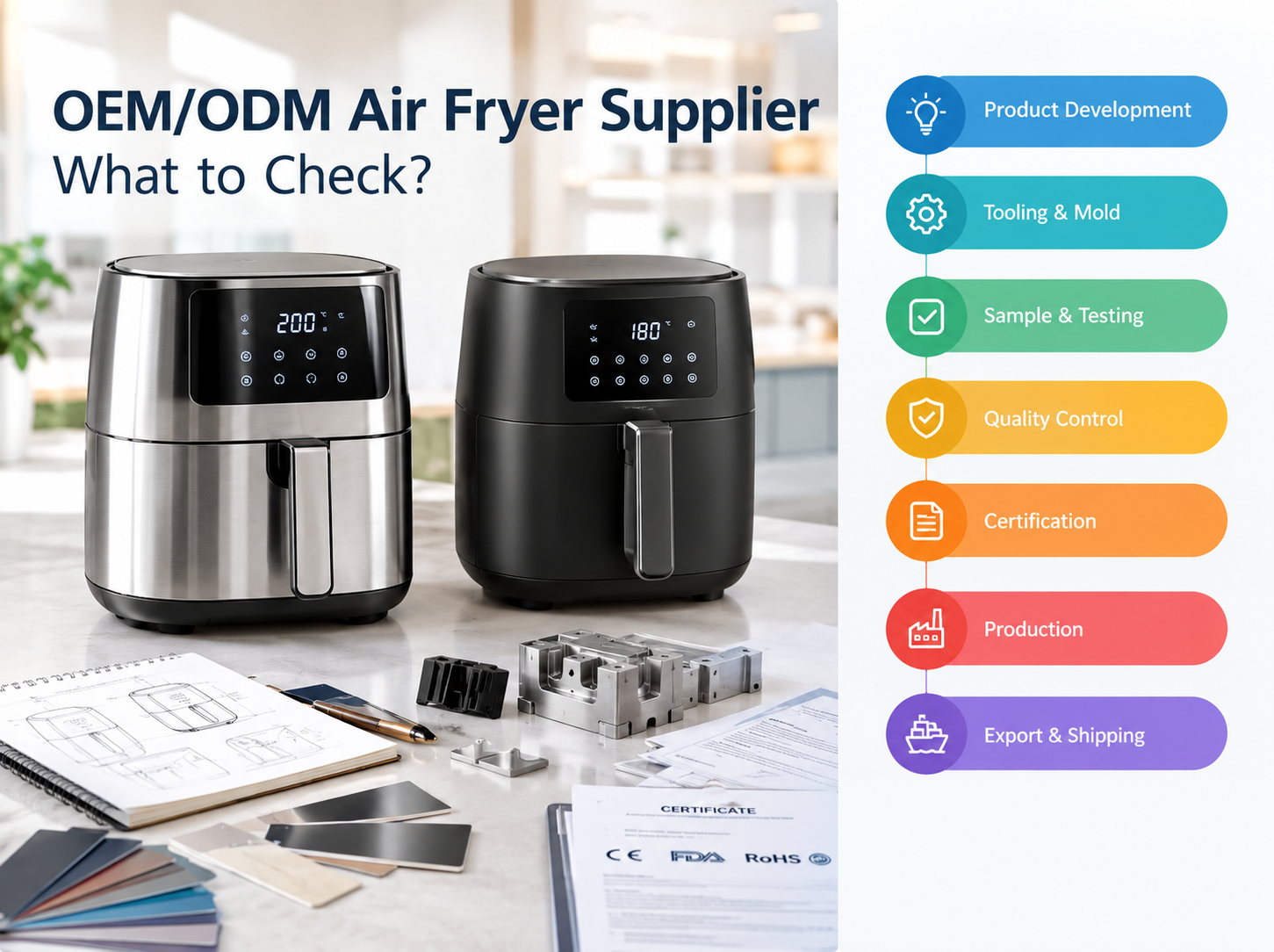
This guide explains the 10 key factors B2B buyers should evaluate before selecting an air fryer supplier in China.
Before contacting suppliers, it is useful to understand the difference between OEM and ODM.
OEM generally means the supplier manufactures a product according to the buyer’s specifications.
Your requirements may include:
· Your brand logo
· Your colors
· Your packaging
· Your control panel design
· Your capacity
· Your accessories
· Your market-specific requirements
· Your selected product configuration
OEM is often suitable when your brand already has a clear product specification or design direction.
ODM goes further.
An ODM supplier can support product development based on your market requirements, target price and product concept.
The supplier may help with:
· Product architecture
· Industrial design
· Product appearance
· Functional configuration
· Engineering development
· Tooling
· Prototype development
· Sample testing
· Production preparation
For brands entering the air fryer category or developing a new generation of products, ODM capability can be particularly valuable.
The key point is that OEM/ODM should not be judged only by whether a supplier can print your logo on an existing product.
A capable supplier should be able to support the development and manufacturing process behind the product.
The first question should be simple:
Does this supplier actually understand air fryers, or are they simply sourcing them from another factory?
Air fryers involve multiple engineering areas, including:
· Heating systems
· Airflow
· Temperature control
· Thermal protection
· Cooking chamber design
· Materials
· Electrical components
· Control systems
· Mechanical structure
· Product safety
· Food-contact components
· Manufacturing processes
A supplier that understands these areas can usually discuss your requirements in much greater detail than a trading company that only compares catalogs and prices.
When evaluating a supplier, ask:
· How many air fryer models have you developed?
· Do you have your own R&D or engineering team?
· Can you modify the internal structure?
· Can you develop a new appearance?
· Can you support different heating configurations?
· Can you provide engineering drawings or specifications?
· Who is responsible for sample development?
The quality of these answers can tell you a lot about the supplier’s actual capability.
There is a major difference between:
Logo customization
and
Product development.
Adding a logo and changing packaging may be enough for some projects.
But if you want your air fryer to be differentiated from products already available on Amazon or in retail stores, you may need deeper customization.
For example:
· Housing shape
· Color
· Surface finish
· Handle design
· Control panel
· Display
· Decorative elements
· Capacity
· Temperature range
· Cooking programs
· Heating configuration
· Motor
· Fan
· Basket configuration
· Viewing window
· Accessories
· Internal components
· Airflow structure
· Heating element configuration
· Cavity dimensions
· Component layout
· Thermal protection
A strong ODM supplier should be able to explain which changes are technically realistic, which require new tooling and which may affect cost or lead time.
Tooling is an important part of many OEM/ODM projects.
If your project requires a new housing, basket, handle or structural component, the supplier may need to develop new molds or tooling.
Ask:
· Who owns the tooling?
· Who manages mold development?
· How is tooling tested?
· How long does tooling development take?
· What happens if the design needs modification?
· Can the supplier maintain and repair the tooling?
· Is tooling stored and controlled properly?
A supplier with an established tooling management system can reduce the risk of delays during product development.
For private-label brands, tooling ownership and intellectual property should also be clearly agreed before development begins.
A good air fryer supplier should not only ask:
“What capacity do you want?”
A better supplier should also ask:
· Which country will you sell in?
· What is your target retail price?
· What type of consumer are you targeting?
· What is your expected annual volume?
· Which sales channel will you use?
· Do you need a premium or value-oriented product?
· What competitors are you comparing against?
· What certifications are required?
· What are your packaging requirements?
For example, an air fryer designed for a premium European brand may require a very different product proposition from a value-oriented model designed for a high-volume retail channel.
The supplier should therefore understand the commercial objective behind the product specification.
Never select an air fryer supplier based only on photos, videos or a quotation.
The sample is one of the most important stages of supplier evaluation.
A good sample evaluation process should allow you to check:
· Heating performance
· Temperature accuracy
· Cooking consistency
· Airflow
· Fan noise
· Cooking time
· Control response
· Housing quality
· Basket construction
· Handle strength
· Internal components
· Assembly quality
· Surface finish
· Control interface
· Door or drawer operation
· Basket removal
· Cleaning
· Noise
· Cooking visibility
· Thermal protection
· Automatic shut-off
· Overheating protection
· Electrical performance
FUNLOIV’s current customer FAQ states that samples can normally be provided free of charge and gives an indicative sample lead time of around 10 working days. For an actual project, however, buyers should confirm the specific model, sample configuration and development requirements with the supplier.
The important point is not simply how quickly a supplier can send a sample.
It is whether the supplier can explain how the sample should be evaluated and what can be modified after testing.
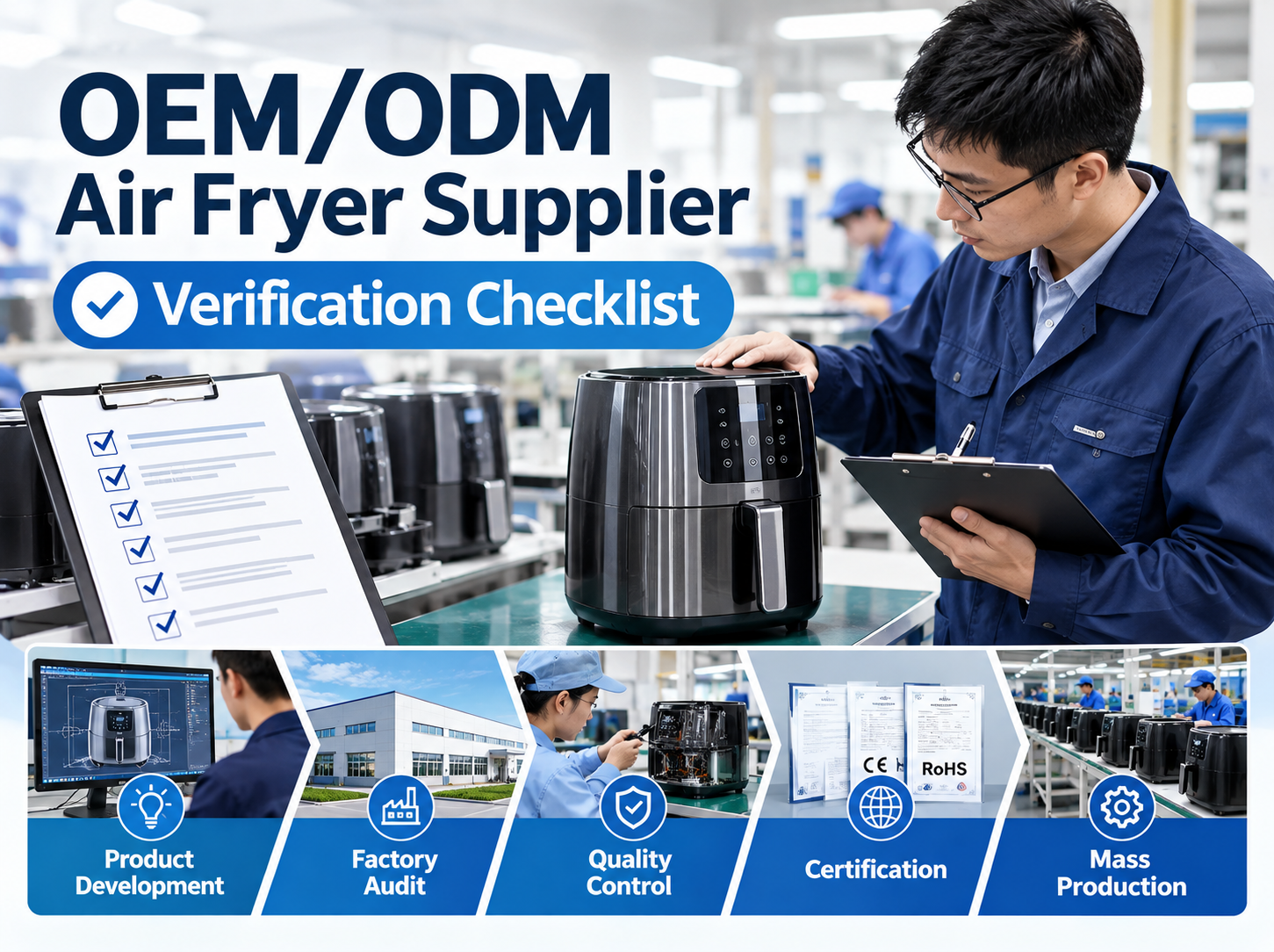
A supplier’s quality-control system should be evaluated before mass production, not after quality problems occur.
Ask the supplier to explain its QC process from incoming materials to shipment.
A typical process should include:
Incoming Quality Control → Production Control → Functional Testing → Aging Testing → Final Inspection → Pre-Shipment Inspection
For example, FUNLOIV describes incoming material inspection, production-line electrical testing, aging testing and pre-shipment inspection as part of its quality-control process.
The company also states that its technical organization includes QC personnel and laboratory staff, with testing capabilities covering areas such as safety, lifetime, function and drop testing.
For a buyer, the more important question is:
Can the supplier demonstrate the QC process for the specific air fryer you are buying?
Ask for:
· Inspection standards
· AQL requirements
· Test records
· Aging-test procedure
· Functional test procedure
· Final inspection checklist
· Defect classification
· Corrective-action process
A supplier’s quality system should be measurable and repeatable.
Air fryer compliance requirements vary by market.
Depending on where you plan to sell, you may need to consider requirements related to:
· Electrical safety
· EMC
· RoHS
· Food-contact materials
· Energy or environmental requirements where applicable
· Labeling
· User manuals
· Packaging
· Market-specific certification
A supplier should be able to tell you:
1. Which certifications are available for the specific model?
2. Which certifications belong to the factory and which belong to the product?
3. Which tests are model-specific?
4. Which documents can be provided?
5. Which requirements remain the importer’s responsibility?
This distinction is important.
A factory certificate does not automatically mean that every air fryer model manufactured by the factory has been certified for every market.
The specific model, configuration and target market should always be verified.
For example, FUNLOIV currently displays certifications and testing references covering markets such as Europe and the United States, but buyers should confirm the exact certification documents applicable to their selected air fryer model before placing an order.
A common B2B problem is:
The sample is good, but the mass-production units are different.
This can happen when the supplier does not have strong production control or when different components are substituted during mass production.
Before placing an order, ask:
· Is the approved sample retained as a production reference?
· How are BOM changes controlled?
· Can components be substituted without approval?
· Who approves engineering changes?
· How are incoming materials controlled?
· How is production monitored?
· How is the final product inspected?
This is especially important for private-label products.
Once you approve a sample, that sample should become a clear reference for mass production.
Product development is only one part of an OEM/ODM project.
A supplier also needs to manage the commercial process after production.
Check whether the supplier can support:
· Retail box design
· Master carton
· Drop-test considerations
· Product protection
· Shipping marks
· Barcode and labeling
· Commercial invoice
· Packing list
· Shipping documents
· Loading arrangements
· Export coordination
· Production schedule
· Inspection schedule
· Loading date
· Shipment updates
· Container planning
FUNLOIV’s factory information indicates dedicated production lines, warehouse capacity and shipping coordination, while its customer FAQ also provides information about loading ports, payment terms and sample procedures.
For a buyer, however, the most useful question is still:
How will you control my order from purchase order to shipment?
Ask the supplier to provide a clear order-follow-up process.
A technically capable factory may still be difficult to work with if it has limited export experience.
International buyers should evaluate whether the supplier understands:
· International shipping
· Export documentation
· Retail packaging
· Market-specific requirements
· Product labeling
· Certification documentation
· Customer communication
· Production schedules
· Inspection procedures
· After-sales support
This becomes even more important when the buyer is developing a new product rather than simply purchasing an existing SKU.
FUNLOIV states that it has exported small domestic appliances to markets including Europe, the United States, Australia, South America and the Middle East.
For buyers, the relevant question is not simply how many countries a supplier claims to serve.
Instead, ask:
Has the supplier worked with customers with requirements similar to mine?
Before choosing a supplier, you can use the following checklist:
Evaluation Area | Questions to Ask |
Air Fryer Experience | How many air fryer models have you developed? |
R&D | Do you have your own engineering team? |
OEM | Can you customize logo, color and packaging? |
ODM | Can you develop a new product or structure? |
Tooling | Can you manage new molds and tooling? |
Sample | What is the sample development process? |
Testing | What product testing can you perform? |
QC | How do you control incoming materials and production? |
Certification | Which documents are available for my market? |
Production | How do you control mass production against the approved sample? |
Packaging | Can you provide customized retail packaging? |
Export | Can you manage export and shipment coordination? |
Communication | How often will you update the production status? |
After-Sales | What warranty and spare-parts support are available? |
A supplier does not need to score perfectly in every category.
The purpose of the checklist is to identify where the supplier’s strengths and limitations are before you commit to the project.
The choice between OEM and ODM depends largely on how much product development your brand wants to control.
· You already have a clear product specification.
· You already have a product design.
· You want your own branding and packaging.
· You need manufacturing support rather than full product development.
· You have a market concept but not a final product.
· You want the supplier to contribute engineering expertise.
· You need a differentiated appearance.
· You want to modify product structure or functions.
· You are developing a new air fryer range.
For many brands, the most practical approach is a combination.
The buyer provides:
Market → Target Consumer → Price Position → Product Requirements
The supplier contributes:
Engineering → Product Development → Tooling → Samples → Manufacturing → QC
This collaborative approach can make the product development process much more efficient.
If you want to receive a useful quotation and development proposal, avoid sending only:
“Please send me your air fryer catalog and best price.”
A better initial inquiry should include as much of the following information as possible:
· Target capacity
· Single or dual basket
· Digital or mechanical control
· Desired temperature range
· Heating configuration
· Key functions
· Accessories
· Existing design or new design
· Reference products
· Preferred colors
· Brand logo
· Display requirements
· Packaging requirements
· Target country
· Sales channel
· Target consumer
· Required certifications
· Target retail price
· Estimated order quantity
· Target MOQ
· Target FOB price
· Sample requirement
· Expected launch date
The more useful information you provide, the more useful the supplier’s response is likely to be.
After contacting several suppliers, compare their responses rather than comparing FOB prices alone.
A strong supplier response should answer questions such as:
· Can they understand your product concept?
· Can they identify technical issues?
· Can they suggest alternatives?
· Can they explain the development process?
· Can they provide a realistic timeline?
· Can they clearly explain certification?
· Can they explain quality control?
· Can they identify what needs new tooling?
· Can they provide a sample plan?
· Can they communicate clearly?
One of the best indicators of supplier quality is often the quality of the questions they ask you.
If a supplier immediately sends a price list without asking about your market, product requirements or target positioning, you may want to investigate further.
FUNLOIV has been involved in small domestic appliances for more than 15 years, with its factory established in 2013.
Its development history includes air fryers and other small kitchen appliances, while the company’s technical organization includes R&D, engineering, QC and laboratory functions.
The factory information published by FUNLOIV includes dedicated plastic injection and metal stamping capabilities, assembly lines and laboratory testing capabilities.
For OEM/ODM projects, this type of integrated capability can help connect several stages of development:
Product Concept
↓
Industrial / Structural Development
↓
Tooling
↓
Prototype & Sample
↓
Testing
↓
Mass Production
↓
QC
↓
Packaging
↓
Export & Shipment
The objective is not simply to manufacture an air fryer.
It is to help turn a product requirement into a repeatable commercial product.
If you are currently looking for an OEM/ODM air fryer supplier in China, we recommend following a simple process:
Identify your target country, sales channel, consumer group and retail price.
Define capacity, design direction, functions, materials and other important specifications.
Compare suppliers based on R&D, manufacturing, QC, certification and export capabilities.
Evaluate the actual product rather than relying only on photos.
Identify technical, functional and user-experience improvements.
Freeze the approved sample, BOM, packaging and product requirements.
Use agreed QC standards and production controls.
Verify the finished products before shipment.
This process reduces the risk of selecting a supplier based only on price.
Finding an OEM/ODM air fryer supplier is not simply about finding the lowest quotation.
For a brand, the right supplier should be able to connect:
Product Development + Engineering + Tooling + Testing + Certification + QC + Production + Export
The supplier should also understand that your objective is not just to purchase air fryers.
You are developing a product for your brand, your customers and your target market.
Therefore, when comparing suppliers, ask yourself:
Can this supplier help me develop the right product, manufacture it consistently and support the project after the purchase order is placed?
If the answer is yes, you may have found a supplier worth developing a long-term relationship with.
If you are developing a new air fryer for your brand, importer, retail business or distribution channel, FUNLOIV can discuss your requirements from the product concept through sample development and mass production.
To help us evaluate your project, send us:
· Target capacity
· Product design or reference model
· Target market
· Required functions
· Target retail positioning
· Estimated order quantity
Looking for an OEM/ODM air fryer supplier?
Send us your target capacity, design and market requirements.


Why Personal Care Appliances Become Popular Globally?
Can An Air Fryer Replace A Toaster Oven?

Kitchen Appliance Regulations In the European Union
How To Verify Whether an Air Fryer Supplier Is Reliable?
How to Choose an OEM/ODM Air Fryer Supplier in China:
Top Heating vs. Rear Heating Air Fryer:
 + 86 181 3826 8709
 info@funloiv.com
 6/F., Guanglong Building, Pingxin North Road, Longgang, Shenzhen City, Guangdong, China


@ 2009-2026 Shenzhen Funloiv Electric Appliance Co., LtdAll rights reserved


