Notice:

 search
search
search
Sep 14, 2026


If you are comparing air fryers for your product range, is 230°C really better than 200°C?
The short answer is: sometimes—but the maximum temperature alone does not determine cooking performance.
A 230°C air fryer can provide an advantage when you want faster browning, a crispier exterior, or high-heat cooking for certain foods. However, simply increasing the maximum temperature from 200°C to 230°C does not automatically make an air fryer better.
For air fryer manufacturers, importers, and buyers, the more important question is:
How effectively can the air fryer turn higher temperature into real cooking performance?
Heating power, airflow, temperature stability, heating-element configuration, cavity design, and material selection all work together to determine the final result.
So, does 230°C actually matter? Let’s take a closer look.
A 30°C difference may not sound significant, but it can make a noticeable difference in certain cooking situations.
Most everyday air-frying tasks can be completed within the common 180–200°C range. At these temperatures, foods such as fries, chicken wings, nuggets, vegetables, and fish can develop a browned and crispy exterior.
Air frying works by circulating hot air rapidly around food. This hot airflow promotes moisture removal from the food surface while transferring heat to the food, helping create the dry, browned surface associated with air frying.
Moving from 200°C to 230°C gives the appliance an additional high-temperature range that can be useful for specific applications.
Air Fryer Temperature | Typical Advantage |
160–180°C | Gentle cooking, baking, reheating |
180–200°C | Everyday air frying |
200–220°C | Faster browning and crisping |
220–230°C | High-heat finishing and extra-crispy cooking |
However, higher temperature is not automatically better for every food.
It can—but temperature is only part of the equation.
Crispiness depends heavily on surface moisture, airflow, heat transfer, and cooking time.
When food is exposed to hot circulating air, moisture on the surface evaporates. As the surface becomes drier, browning reactions become more significant, contributing to the color, aroma, and texture associated with crispy food.
A higher air temperature can accelerate this process.
For example, when cooking:
· French fries
· Chicken wings
· Chicken skin
· Frozen snacks
· Breaded foods
· Roasted vegetables
· Small pieces of meat
230°C can provide additional high-temperature capability for the final crisping stage.
But there is an important limitation:
A poorly designed 230°C air fryer may perform worse than a well-designed 200°C air fryer.
If airflow is weak, heat distribution is uneven, or the heating system cannot maintain the target temperature, the extra 30°C on the specification sheet may have limited practical value.
One of the strongest advantages of a 230°C air fryer is high-heat finishing.
Instead of cooking an entire food at 230°C, users can cook most of the food at a moderate temperature and then increase the temperature toward the end.
For example:
Step 1: Cook the food thoroughly at 180–200°C.
Step 2: Increase the temperature to 220–230°C.
Step 3: Use the higher temperature for a short finishing period.
This approach can help create a more browned and crispy exterior without unnecessarily exposing the entire cooking process to maximum heat.
For product developers and buyers, this is an important distinction:
230°C is not necessarily about cooking everything at 230°C. It is about giving the user more temperature range and flexibility.
Not every food needs the extra temperature.
French fries
Higher heat can help accelerate surface dehydration and browning, particularly during the final stage.
Chicken wings
High-temperature finishing can help produce a more browned and crispy skin.
Frozen snacks
Products such as nuggets, breaded foods, and other frozen snacks can benefit from rapid surface heating.
Steak and meat
Higher temperatures can be useful for surface browning, although the ideal cooking method depends on the thickness and type of meat.
Roasted vegetables
High heat can encourage browning and caramelization on the surface.
For delicate foods, baking, reheating, or longer cooking processes, temperatures around 160–200°C may be more appropriate.
This is why a wide and stable temperature range is more useful than simply having a high maximum temperature.
This is one of the most important points for air fryer buyers.
Imagine two air fryers:
Air Fryer A
· Maximum temperature: 230°C
· Weak airflow
· Uneven heating
· Large temperature fluctuations
Air Fryer B
· Maximum temperature: 200°C
· Strong airflow
· Even heat distribution
· Stable temperature control
Which one will produce better food?
There is no automatic answer—but Air Fryer B can easily outperform Air Fryer A in real-world cooking.
The temperature displayed on a control panel is only the target setting. Actual cooking performance depends on how effectively the appliance generates, distributes, and maintains heat.
This is why professional air fryer evaluation should consider:
· Heating-element power
· Fan performance
· Airflow design
· Temperature sensor position
· Temperature control accuracy
· Cavity structure
· Basket design
· Heating-element configuration
· Thermal insulation
· Heat distribution
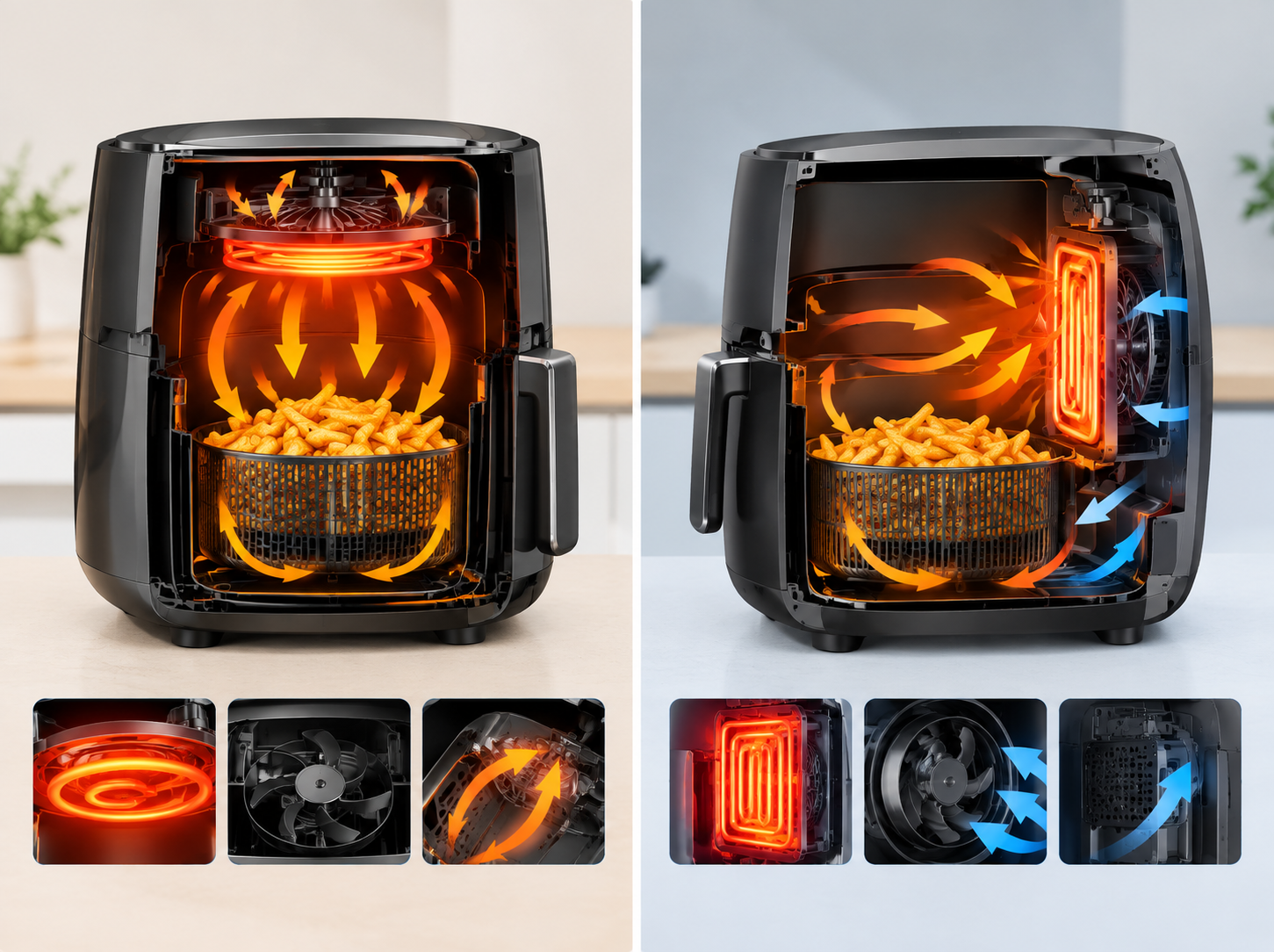
The heating system is one of the most important factors behind high-temperature performance.
A typical air fryer uses a heating element together with a fan to circulate hot air around the food.
But different heating configurations can produce very different results.
For example, a dual-heating design can combine upper and lower heating elements with forced hot-air circulation.
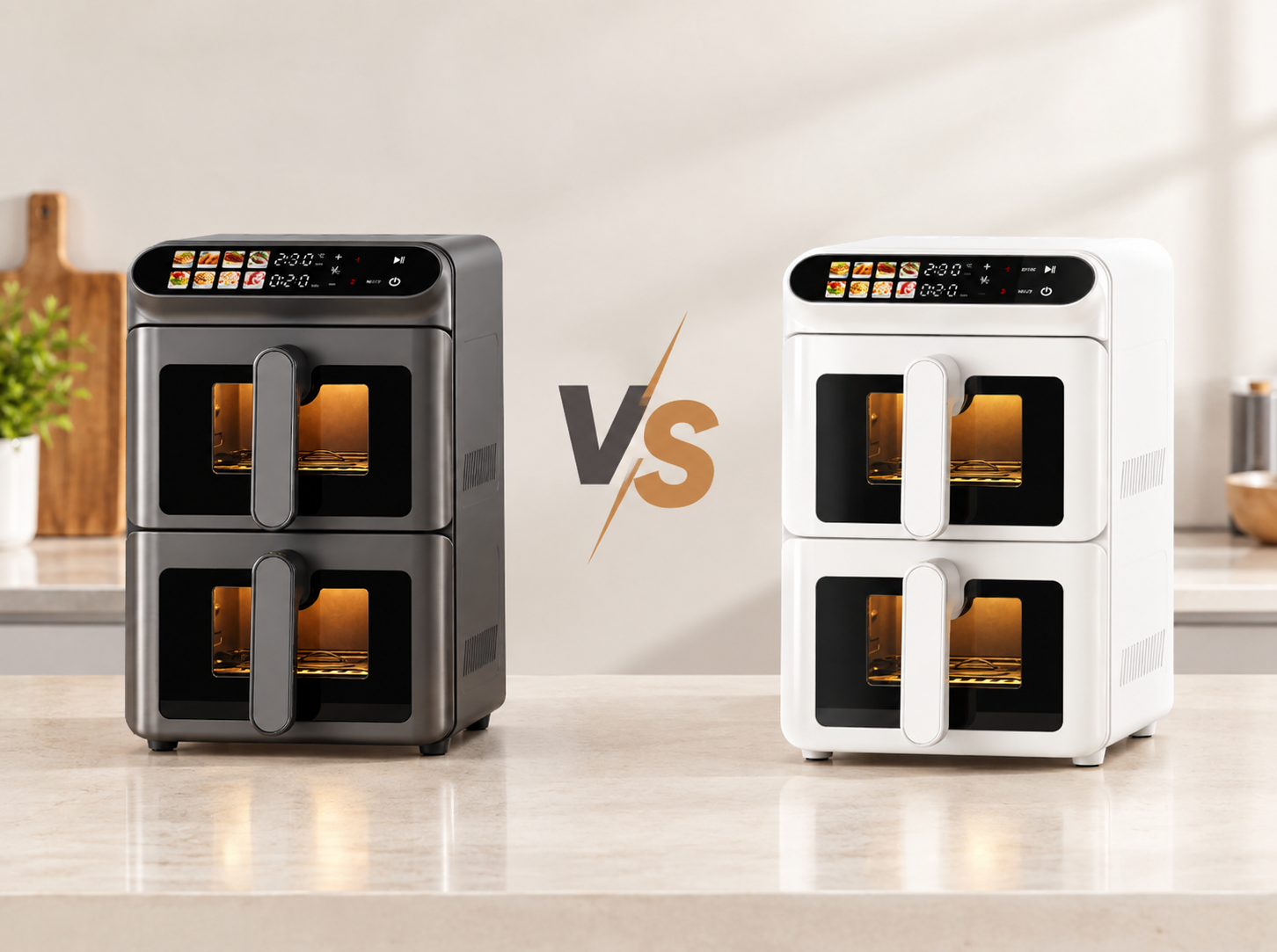
FUNLOIV’s FL-AF8081DWS, for example, uses a dual heating system with a 1500W upper halogen heating element and a 500W stainless-steel lower heating element, together with high-speed air circulation. The model supports a 60–230°C temperature range.
This type of configuration illustrates an important principle:
230°C becomes more meaningful when the heating system, airflow system, and temperature control are designed to work together.
Air frying is not simply about generating heat.
It is about moving hot air efficiently around the food.
Strong and well-distributed airflow helps:
· Remove surface moisture
· Transfer heat efficiently
· Improve browning
· Reduce cold spots
· Improve cooking consistency
· Reduce the need to turn or shake food
Research on hot-air frying describes the process as a combination of heat and mass transfer, where hot air circulates around food while moisture moves from the food into the surrounding air.
This means that an air fryer with a higher temperature but poor airflow may not deliver the expected improvement.
For buyers evaluating a new air fryer platform, it is therefore worth asking suppliers:
What is the airflow design?
Where is the fan located?
Where are the heating elements positioned?
How is temperature distributed inside the cavity?
These questions can be more valuable than simply asking:
“Is it 200°C or 230°C?”
When an air fryer operates at higher temperatures, material selection becomes increasingly important.
The cooking chamber, heating-element surroundings, basket, tray, coatings, seals, wiring, insulation, and external housing all need to be considered as part of the thermal design.
For example, major air fryer manufacturers use materials such as steel, aluminized steel, stainless steel, and food-contact coatings for different components. Philips states that its air fryer accessories can use steel, aluminized steel, stainless steel, chrome-plated steel, ceramic coatings, and food-contact PTFE coatings depending on the component and model.
For a 230°C product, buyers should therefore look beyond the headline specification and ask:
· What is the cavity material?
· What material is used around the heating elements?
· What coating is used on the basket?
· What are the food-contact materials?
· How are high-temperature components tested?
· How is thermal insulation designed?
· What safety protection is included?
Higher temperature capability should always be supported by appropriate engineering and material selection.
A metal body does not automatically make an air fryer cook better.
This is an important distinction.
The external housing material and the internal cooking system have different functions.
A premium metal-body design can provide advantages such as:
· Premium appearance
· Improved scratch resistance
· Greater perceived product quality
· Better fit for premium retail positioning
· A robust structure
But cooking performance still depends primarily on the heating system, airflow, cavity design, control system, and thermal management.
For example, FUNLOIV’s 8L FL-AF8081DWS is designed with a premium metal housing and full metal cavity, combined with dual heating and a 60–230°C adjustable temperature range.
This combination is more meaningful than simply putting “Metal Body” and “230°C” on a product specification sheet.
The real product story is:
High-temperature capability + controlled airflow + effective heating + appropriate materials.
For consumers, the answer depends on cooking habits.
For B2B buyers, however, there is another consideration:
A 230°C air fryer can give a brand more flexibility when developing a premium or performance-oriented product range.
It can support marketing claims and product positioning around:
· Extra-crispy cooking
· High-heat cooking
· Faster browning
· Professional-style cooking
· Wider temperature control
· Multi-function cooking
It can also help differentiate a model from products that are limited to 200°C.
However, the temperature specification should be backed by real engineering performance.
If you are sourcing air fryers for your brand, don’t stop at:
“What is the maximum temperature?”
Instead, ask the supplier these questions:
· What is the total heating power?
· Is the heating system single or dual?
· What type of heating element is used?
· What type of fan is used?
· How is hot air distributed?
· Is the airflow optimized for the basket/cavity design?
· What is the adjustable temperature range?
· How accurate is the temperature control?
· Where is the temperature sensor located?
· How stable is the actual cooking temperature?
· What material is used for the cooking cavity?
· What material is used for the basket and tray?
· What coating is used?
· Are food-contact materials tested for the target market?
· Is there an internal thermal fuse?
· Is there automatic shut-off?
· How is overheating controlled?
· What certifications and compliance documentation are available?
These questions give buyers a much clearer picture of product quality than the maximum-temperature number alone.
Here is the simplest way to look at it:
Feature | 200°C Air Fryer | 230°C Air Fryer |
Everyday cooking | Excellent | Excellent |
Fries & nuggets | Excellent | Excellent |
Chicken wings | Very good | Excellent for high-heat finishing |
Browning | Very good | Potentially stronger |
Extra-crispy cooking | Very good | Better flexibility |
High-heat finishing | Limited | Excellent |
Temperature flexibility | Good | Better |
Product differentiation | Standard | Stronger |
Engineering requirements | Moderate | Higher |
So, does 230°C make a real difference?
A 230°C specification can provide more cooking flexibility, particularly for crisping and browning. But temperature alone does not guarantee better results.
When comparing a 200°C vs 230°C air fryer, it is tempting to conclude:
230°C = better.
But that is too simple.
A better way to evaluate an air fryer is:
Temperature + Heating System + Airflow + Temperature Stability + Materials + Safety
These factors work together to determine actual cooking performance.
A well-engineered 230°C air fryer can offer meaningful advantages for high-heat cooking, crisping, browning, and product differentiation.
But the real question for buyers should not be:
“How hot can this air fryer get?”
It should be:
“How effectively can this air fryer control and distribute that heat?”
That is the difference between a high-temperature specification and a genuinely high-performance air fryer.
If you are developing or sourcing a 230°C air fryer for your brand, look for a product that combines:
✓ 60–230°C adjustable temperature control
✓ Effective heating-element configuration
✓ High-speed hot-air circulation
✓ Stable temperature control
✓ Appropriate high-temperature materials
✓ Reliable safety protection
✓ Well-designed cooking cavity
✓ Consistent cooking performance
At FUNLOIV, our air fryer product development focuses on combining these elements rather than treating maximum temperature as an isolated specification. Our current 8L premium metal-body air fryer combines a 60–230°C temperature range, dual heating system, high-speed air circulation, and full metal cavity design for a performance-oriented product platform.
For brands and importers looking for OEM/ODM air fryer solutions, metal-body air fryers, or 230°C high-temperature air fryers, these are the specifications worth discussing with your supplier before making a sourcing decision.
Explore FUNLOIV Air Fryer Solutions:
FUNLOIV Air Fryer Products https://www.funloiv.com/air_fryer/139.html
Not necessarily. 230°C provides a higher maximum temperature and can be useful for high-heat finishing, browning, and extra-crispy cooking. However, heating power, airflow, temperature stability, and cavity design are equally important.
It can reduce cooking time for some foods, particularly when high heat is appropriate. However, cooking time depends on the food, quantity, basket loading, airflow, heating system, and actual temperature maintained inside the cavity.
It can help with browning and crisping, especially during the final stage of cooking. However, crispiness also depends heavily on moisture removal and airflow.
Yes. 200°C is sufficient for most everyday air-frying applications, including fries, chicken, vegetables, fish, and frozen foods.
The main advantage is additional high-temperature flexibility. It can provide stronger high-heat finishing, browning, and crisping when the cooking system is designed to support it.
A metal body can provide a premium appearance, durability, and stronger product positioning, but it does not automatically guarantee better cooking performance. Heating elements, airflow, temperature control, cavity design, and thermal management remain critical.
Look beyond the maximum temperature. Check the heating system, airflow design, temperature stability, cavity and food-contact materials, safety protection, certifications, testing documentation, and actual cooking performance.
230°C is not simply a bigger number than 200°C.
It is an additional performance range that can be valuable when supported by the right heating system, airflow, temperature control, and materials.
For air fryer buyers, importers, and brand owners, the best question is therefore not:
“200°C or 230°C?”
It is:
“Which air fryer can use its temperature more effectively?”
That is where real product engineering makes the difference.

 + 86 181 3826 8709
 info@funloiv.com
 6/F., Guanglong Building, Pingxin North Road, Longgang, Shenzhen City, Guangdong, China


@ 2009-2026 Shenzhen Funloiv Electric Appliance Co., LtdAll rights reserved