Notice:

 search
search
search
Sep 15, 2026


Finding an air fryer supplier is only the first step. Verifying whether the supplier is reliable is what protects your product, investment, and market reputation.
When brands, importers, retailers, and wholesalers source air fryers from China, they need to evaluate much more than price.
A supplier may offer a competitive quotation, attractive product photos, and impressive specifications. But can the supplier actually develop the product, control quality, maintain sample consistency, meet production schedules, provide valid compliance documentation, and support the project when problems occur?
This is why a professional air fryer supplier verification process is essential before placing a bulk order.
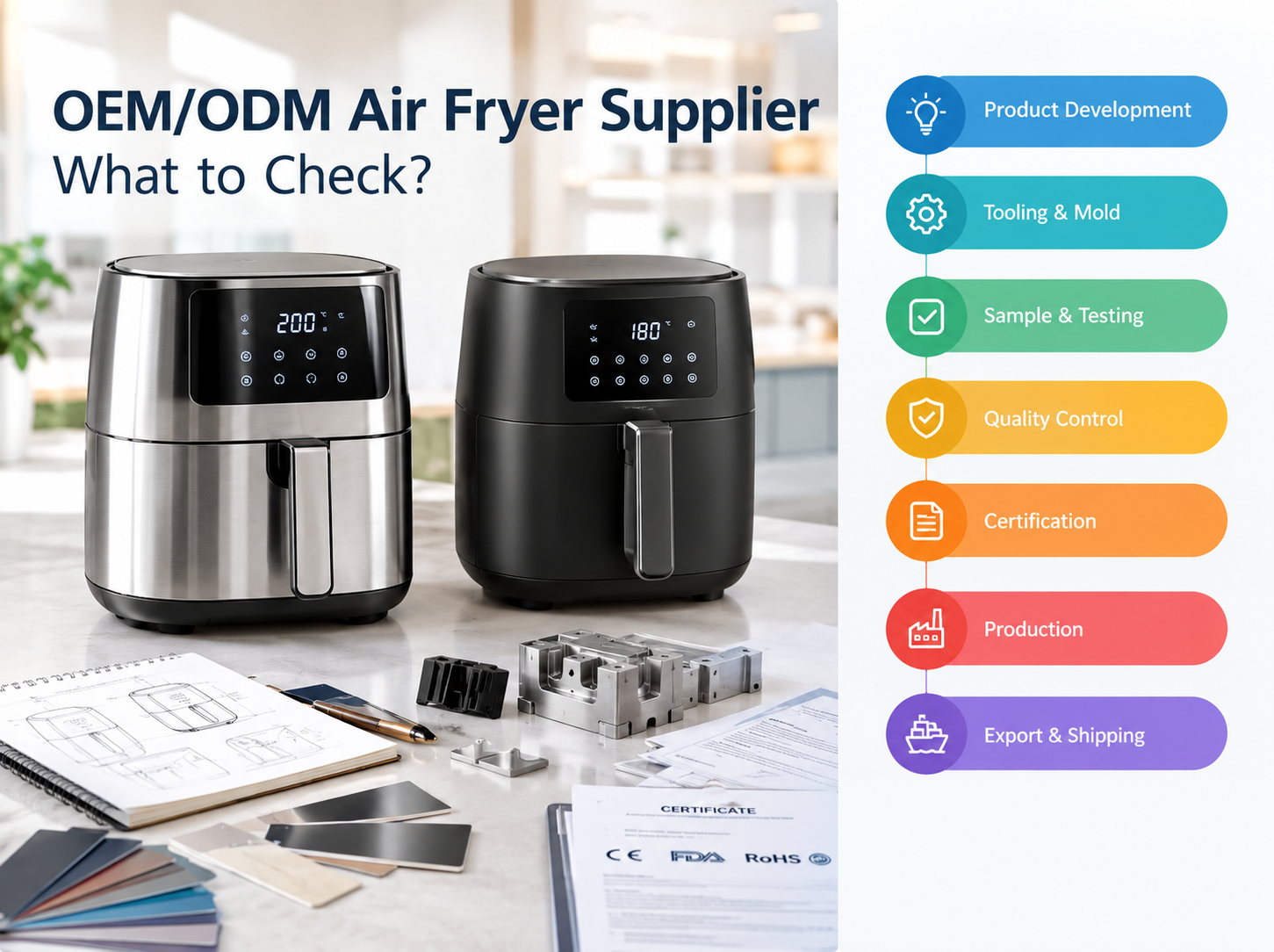
A reliable supplier should be evaluated across at least 10 areas:
1. Product development capability
2. Factory and production capability
3. Quality control system
4. Product certification and compliance
5. Sample-to-production consistency
6. Production capacity and lead time
7. Export experience
8. After-sales support
9. Communication and project management
10. Transparency and documentation
The first question is not simply:
“Can this supplier sell me an air fryer?”
Instead, ask:
“Can this supplier develop and manage the air fryer I need for my market?”
A reliable OEM/ODM air fryer supplier should be able to discuss more than basic specifications.
Look for experience in:
· Product structure
· Heating system
· Airflow design
· Temperature control
· Motor and fan selection
· Electronic control systems
· Materials and components
· Product appearance
· Tooling and mold development
· Safety requirements
· Packaging design
· Market-specific requirements
This is particularly important for private-label brands.
If the supplier only changes the logo and packaging of an existing product, its capability may be closer to simple trading or private labeling rather than genuine OEM/ODM development.
Ask the supplier:
· How many air fryer models have you developed?
· Do you have your own R&D team?
· Can you modify the product structure?
· Can you develop a new appearance?
· Can you customize functions?
· Who owns the tooling and intellectual property?
· Can you provide engineering support during sample development?
The quality of the answers can reveal much more than a company profile.
A reliable air fryer supplier should be able to clearly explain where and how the products are manufactured.
Do not evaluate a factory only from photographs.
Ask for evidence of:
· Factory address
· Production workshops
· Assembly lines
· Injection molding capability
· Metal stamping capability
· Tooling management
· Warehouse capacity
· Quality inspection areas
· R&D facilities
· Testing laboratory
· Production capacity
If possible, arrange a factory audit, either in person or through a professional third-party inspection company.
During a factory audit, pay attention to whether the supplier’s actual facilities match the information provided during the sales process.
For example:
Sales claim → Factory evidence → Production records → Inspection records
A reliable supplier should be able to connect these four elements.
A supplier saying “We have strict QC” is not enough.
You need to understand how quality is controlled.
A professional air fryer QC system should normally cover several stages.
Components and raw materials should be checked before entering production.
Important items may include:
· Heating elements
· Motors
· Fans
· Thermostats
· PCBs
· Power cords
· Plastic components
· Metal components
· Non-stick coatings
· Food-contact materials
Quality should also be controlled during assembly.
For example:
· Wiring
· Electrical connections
· Component installation
· Assembly accuracy
· Heating performance
· Control panel operation
· Safety functions
Finished products should be inspected before shipment.
Depending on the product and customer requirements, this may include:
· Appearance inspection
· Functional testing
· Electrical safety testing
· Temperature testing
· Packaging inspection
· Accessories checking
· Carton inspection
For larger orders, buyers may also arrange an independent third-party inspection before shipment.
A reliable supplier should be comfortable with transparent inspection procedures.
Certification is one of the most important parts of supplier verification.
But there is an important distinction:
A supplier having certificates does not automatically mean every air fryer model is certified for your market.
You should verify:
· Product model
· Certificate number
· Certificate holder
· Manufacturer information
· Testing laboratory
· Applicable standards
· Certification scope
· Certificate validity
· Whether the certificate actually covers your intended configuration
Depending on the target market, different requirements may apply.
For example, European buyers may need to consider requirements related to CE, RoHS, EMC, LVD, food-contact materials, and other applicable regulations.
US buyers may need to consider requirements such as ETL or UL depending on the product and market requirements.
Australian and other markets may have their own regulatory and electrical compliance requirements.
Do not simply ask:
“Do you have CE?”
Ask:
“Can you provide the compliance documents for this exact air fryer model and configuration?”
That is a much stronger verification question.
One of the most important risks in private-label sourcing is sample-to-production inconsistency.
The sample may look excellent, while the mass-production product uses different components or materials.
Before placing a bulk order, clearly define the approved sample.
Your approval documentation should ideally include:
· Product model
· Product specifications
· Material requirements
· Color
· Appearance
· Dimensions
· Heating components
· Motor/fan specifications
· Control functions
· Accessories
· Packaging
· Label requirements
· Approved artwork
· Approved sample photos
For customized products, you can also create a Golden Sample or approved reference sample.
The objective is simple:
The production product should match the approved specification and sample.
This is especially important for air fryers because changes to heating elements, motors, thermal components, materials, or control systems can affect actual performance.
A supplier may be able to produce samples quickly but struggle with mass production.
This is why you should separate:
Sample capability
from
Mass-production capability.
Ask the supplier:
· What is your monthly production capacity?
· How many assembly lines are available?
· What is the normal production lead time?
· What is the peak-season lead time?
· What is the MOQ?
· Can production capacity be reserved for promotion orders?
· What happens if the delivery schedule changes?
· How is production progress monitored?
You should also ask whether critical components are kept in stock or need to be ordered after receiving your purchase order.
For seasonal products such as air fryers, production planning can have a major impact on your retail launch date.
A supplier may be good at manufacturing but inexperienced in international business.
For overseas buyers, export experience matters because the supplier needs to understand more than production.
A supplier with international experience should be familiar with:
· Export documentation
· Shipping procedures
· Packaging requirements
· Country-specific compliance
· Product labeling
· Carton markings
· Loading requirements
· Container planning
· Inspection procedures
· Communication with overseas customers
You can ask:
“Which markets do you currently export air fryers to?”
You can also ask whether the supplier has experience working with:
· Brand owners
· Importers
· Retailers
· Supermarkets
· Distributors
· E-commerce businesses
The more closely the supplier’s previous experience matches your business model, the lower the communication and execution risk may be.
Supplier reliability becomes most visible when something goes wrong.
Before placing an order, clarify:
· Warranty period
· Defective product procedure
· Spare parts policy
· Replacement policy
· Technical support
· Complaint handling
· Response time
· Responsibility for quality issues
Do not only ask:
“Do you provide warranty?”
Ask:
“What happens if we find a quality problem after the products arrive?”
A professional supplier should be able to explain the process clearly.
FUNLOIV, for example, publishes a one-year warranty policy and describes its quality assurance process, including component inspection, production-line electrical testing, aging testing and pre-shipment inspection.
For buyers, the important point is not simply that a warranty exists.
The important point is whether the supplier has a defined process for handling quality problems.
Many sourcing problems are not caused by the factory itself.
They are caused by poor communication.
An OEM/ODM air fryer project may involve:
Concept → Design → Engineering → Sample → Testing → Modification → Packaging → Certification → Mass Production → Inspection → Shipment
If communication breaks down at any stage, the project can be delayed.
Evaluate whether the supplier:
· Answers technical questions clearly
· Provides documents on time
· Records specifications accurately
· Follows up sample modifications
· Provides production updates
· Communicates problems early
· Assigns a responsible project contact
· Coordinates engineering, QC and production teams
A reliable supplier should not simply say:
“No problem.”
A better supplier will explain:
What can be done, what needs to change, how long it will take, and what the potential risk is.
That difference is extremely important in OEM/ODM projects.
One of the easiest ways to evaluate a supplier is to observe how transparent they are before you become a customer.
Can they clearly provide:
· Company information?
· Factory information?
· Product specifications?
· Sample details?
· Certification documents?
· QC procedures?
· Production lead time?
· Packaging information?
· Export experience?
· Warranty terms?
· Contact information?
If a supplier avoids reasonable verification questions before receiving an order, it may become even more difficult to obtain information after the order is placed.
A reliable supplier should understand that supplier verification is a normal part of international procurement.
Before selecting an OEM/ODM air fryer supplier, buyers can use the following checklist:
Verification Area | What Buyers Should Check |
Product Development | R&D team, engineering capability, product experience |
Factory | Production facility, equipment, assembly lines |
Tooling | Mold development, tooling ownership, engineering support |
Quality Control | IQC, IPQC, FQC, testing and inspection |
Certification | Model-specific certificates and compliance documents |
Sample | Sample quality and approval process |
Production | Capacity, production planning and lead time |
Export | Export markets and international documentation |
After-Sales | Warranty, spare parts and complaint handling |
Communication | Project management and response quality |
You do not necessarily need the supplier with the lowest price.
You need the supplier with the lowest overall sourcing risk for your project.
A practical verification process can be divided into five stages.
Check:
· Company history
· Factory location
· Business scope
· Production facilities
· Export markets
· Main product categories
Check:
· Product specifications
· Materials
· Heating system
· Motor and fan
· Capacity
· Temperature range
· Control system
· Safety functions
Request a sample and test:
· Cooking performance
· Temperature accuracy
· Heating consistency
· Noise
· Appearance
· Materials
· Controls
· Accessories
· Cleaning
· Packaging
Request and verify:
· Test reports
· Certificates
· Declaration of Conformity where applicable
· Material compliance documents
· Food-contact documentation where applicable
· Market-specific requirements
Before mass production:
· Approve the final sample
· Confirm specifications
· Confirm packaging
· Confirm production schedule
· Confirm inspection requirements
· Confirm warranty terms
· Confirm shipping requirements
This five-stage process can significantly reduce the risk of selecting an unsuitable supplier.
If you are contacting a supplier for the first time, you can start with these questions:
1. Are you a manufacturer or trading company?
2. Where is your factory located?
3. How many air fryer models have you developed?
4. Do you offer OEM and ODM services?
5. Do you have an in-house R&D team?
6. Can you customize the product structure or appearance?
7. Can you develop new tooling?
8. What certifications are available for the target market?
9. What is your sample lead time?
10. What is your normal mass-production lead time?
11. What is your MOQ?
12. What QC procedures are used before shipment?
13. Can we arrange a factory audit?
14. Can we arrange third-party inspection?
15. What warranty and after-sales support do you provide?
A supplier that can answer these questions clearly gives you much more information than a supplier that only sends a price list.
FUNLOIV has developed its business around small domestic appliances and international B2B customers.
According to its published company information, FUNLOIV’s factory covers more than 30,000 square meters and includes production workshops, warehouses, an R&D building and laboratory facilities. Its technical team includes R&D, engineering, QC and laboratory personnel.
The factory also describes plastic injection, metal stamping and multiple assembly lines, with an annual production capacity stated at approximately 1.5 million units.
For product development, FUNLOIV states that it develops new models based on customer feedback and market research, and has experience developing small kitchen appliances including air fryers, coffee machines and toasters.
Its published quality process includes:
Incoming Material Inspection → Production Testing → Aging Testing → Pre-Shipment Inspection
The company also states that its products have been tested by international laboratories and that different market certifications are available depending on the specific product and market. Buyers should always confirm the applicable documents for their exact model and market before placing an order.
FUNLOIV also reports export experience across more than 50 countries, including markets in Europe, the United States, Australia, South America and the Middle East.
For buyers, these capabilities are not simply company-profile information.
They are part of the supplier verification process.
When comparing air fryer suppliers, it is tempting to focus on:
FOB Price → MOQ → Lead Time
But a better evaluation model is:
Product Capability + Quality Control + Compliance + Production + Export Experience + Service + Total Cost
A supplier with a lower unit price may create additional costs through:
· Product failures
· Delayed shipments
· Certification problems
· Rework
· Customer complaints
· Returns
· Replacement costs
· Missed promotions
· Damage to your brand reputation
For private-label air fryer brands, supplier reliability should therefore be considered part of the product strategy.
Before placing your first large order, ask yourself:
✓ Can they develop the product?
✓ Can they prove their production capability?
✓ Do they have a clear QC system?
✓ Can they provide valid, model-specific compliance documents?
✓ Can they maintain sample-to-production consistency?
✓ Can they meet your required production schedule?
✓ Do they understand international export requirements?
✓ Do they have a clear warranty and after-sales process?
✓ Can they manage an OEM/ODM project professionally?
✓ Are they transparent when you ask difficult questions?
If the answer to most of these questions is yes, you are moving from simply finding an air fryer supplier toward identifying a reliable long-term supply partner.
If you are developing a new air fryer for your brand, importing for retail, or looking for a long-term manufacturing partner, supplier verification should start before the first bulk order.
FUNLOIV can support projects from product development and sample evaluation through quality control, production and export coordination.
To help us understand your project, send us:
· Target capacity
· Product design or reference model
· Target market
· Required functions
· Target price or retail positioning
· Estimated order quantity
Looking for a reliable OEM/ODM air fryer supplier?
Send us your target capacity, design and market requirements.

 + 86 181 3826 8709
 info@funloiv.com
 6/F., Guanglong Building, Pingxin North Road, Longgang, Shenzhen City, Guangdong, China


@ 2009-2026 Shenzhen Funloiv Electric Appliance Co., LtdAll rights reserved