 Notice:

 search
search
search
Sep 18, 2026


Before an air fryer order leaves the factory, buyers need more than a visual inspection.
A product can look perfect on the outside and still have problems with temperature control, heating performance, motor noise, electrical safety, basket assembly, packaging or actual functionality.
For importers, retailers and appliance brands, a pre-shipment inspection is therefore an important final checkpoint before the products leave the factory.
But what exactly should be tested?
A professional air fryer pre-shipment inspection should verify that the finished products match the approved sample, purchase-order specifications, agreed quality requirements and applicable market requirements.
The inspection should normally cover:
Quantity → Appearance → Dimensions → Materials → Function → Heating → Temperature → Fan & Motor → Controls → Safety → Accessories → Packaging → Documentation
This article explains the key air fryer tests buyers should include in a pre-shipment inspection.
A pre-shipment inspection, often called a PSI, is a final quality inspection performed after production is sufficiently complete and before the goods are shipped.
Its purpose is to answer a simple question:
“Is this production batch ready to be shipped according to the agreed requirements?”
For an air fryer order, the inspection should compare the actual production units against:
· Approved sample
· Purchase order
· Product specification
· Technical drawings, where applicable
· Packaging specification
· Labeling requirements
· Certification and compliance requirements
· Agreed quality standards
· Buyer-specific inspection requirements
A PSI is not a replacement for product certification or laboratory testing.
Instead, it is a production-batch verification step.
This distinction is important.
A product may have a valid certification report, but the buyer still needs to confirm that the actual production batch is consistent with the approved product and does not contain obvious manufacturing defects.
The timing of the inspection matters.
If the inspection is performed too early, many finished products may not yet be available for inspection.
If it is performed after the goods have already been packed, loaded or shipped, there may be little opportunity to correct problems.
For most air fryer orders, the inspection should be scheduled when:
· Production is substantially complete
· A representative quantity is available
· Products are assembled
· Packaging is available
· Finished goods can be randomly selected
· The supplier still has enough time to correct problems before shipment
For large orders, buyers may also consider in-process inspections rather than relying entirely on one final inspection.
The larger or more important the order, the less sensible it is to depend on a single final checkpoint.
Buyers do not necessarily need to inspect every unit in a large production order.
A statistically based sampling plan can be used to determine the inspection quantity and acceptance criteria.
The ISO 2859 series provides sampling systems for inspection by attributes, including lot-by-lot acceptance sampling. ISO 2859-1:2026 is the current edition of the relevant Part 1 standard for sampling schemes indexed by AQL.
However, buyers should not simply tell a supplier:
“Please inspect according to AQL.”
The inspection specification should also define:
· Lot size
· Inspection level
· Sampling quantity
· Critical defects
· Major defects
· Minor defects
· Acceptance criteria
· Required functional tests
· Special tests
· Packaging requirements
For electrical appliances, some safety or functional checks may require specific testing beyond ordinary visual sampling.
A sampling plan is a method of selecting units for inspection. It does not automatically define what constitutes an acceptable air fryer.
The first check is surprisingly simple:
Is the correct quantity ready for shipment?
The inspector should verify:
· Total cartons
· Units per carton
· Total units
· Carton markings
· Model number
· SKU
· Variant
· Color
· Voltage/frequency version
· Accessories
For multi-model orders, the quantities should be checked separately by model.
A quantity problem can create significant commercial issues even when the products themselves are perfect.
Visual quality is usually the first thing an end consumer notices.
The inspection should check the air fryer’s:
· Scratches
· Dents
· Deformation
· Color variation
· Surface defects
· Uneven gaps
· Assembly alignment
· Fingerprints or contamination
· Flash
· Sink marks
· Cracks
· Warping
· Color inconsistency
· Poor surface finish
· Scratches
· Dents
· Sharp edges
· Uneven stamping
· Poor polishing
· Surface defects
· Coating problems
· Logo position
· Printing quality
· Label position
· Warning labels
· Model information
· Rating label
· Serial number, where applicable
The important principle is:
Appearance requirements should be defined before production rather than judged differently by different inspectors.
For premium-positioned air fryers, appearance standards may need to be considerably stricter than for entry-level products.
A pre-shipment inspection should confirm that the finished product matches the agreed specifications.
Depending on the product, measurements may include:
· Product dimensions
· Basket dimensions
· Cooking chamber dimensions
· Basket capacity
· Power rating
· Cable length
· Plug type
· Weight
· Component thickness
· Handle dimensions
For OEM/ODM projects, dimensional inspection becomes particularly important when molds or customized components have been developed specifically for the buyer.
A small dimensional change can affect:
· Basket fit
· Drawer movement
· Packaging
· Assembly
· Airflow
· Product appearance
· Compatibility with accessories
An air fryer is an electrical heating appliance, so electrical performance should be part of the inspection.
Depending on the agreed inspection procedure and applicable requirements, checks may include:
· Power-on operation
· Rated voltage
· Power input
· Current
· Frequency
· Plug configuration
· Power cord
· Switch operation
· Electrical connections
· Grounding where applicable
· Insulation-related checks
· Leakage-related checks
· Dielectric strength or other safety tests where required
The exact electrical safety tests should be determined according to the applicable market requirements and testing standard.
For example, IEC 60335-2-9:2026 covers household and similar portable cooking appliances and explicitly includes air fryers within its scope. It also contains specific provisions concerning portable air fryers.
A PSI should therefore be aligned with the product’s applicable compliance requirements rather than using a generic checklist for every air fryer.
The heating system is one of the most important functional areas of an air fryer.
The inspection should verify that:
· Heating starts correctly
· Heating elements operate as designed
· Heating cycles respond correctly to the control system
· No abnormal noise or electrical behavior occurs
· The heating system shuts down correctly
· Heating components are correctly positioned
· There is no obvious abnormal heating condition
For products with multiple heating elements, each relevant heating function should be verified.
For example, some air fryers use upper and lower heating elements, while others use a different heating configuration.
The PSI should test the actual production configuration, not assume that all air fryers operate in the same way.
Temperature is one of the most important performance parameters for an air fryer.
The inspector should verify whether the product reaches and controls the agreed temperature range according to the defined test method.
Important points include:
· Set temperature
· Actual measured temperature
· Temperature tolerance
· Heating time
· Temperature stability
· Temperature sensor response
· Control response
· Over-temperature protection
For example, if a product specification states:
60°C–230°C
the buyer should define how this specification is verified.
The test method should specify:
· Measuring instrument
· Measurement location
· Test condition
· Stabilization time
· Test temperature
· Acceptable tolerance
This is especially important when a product is marketed with a higher maximum temperature.
A claim such as “230°C maximum temperature” should be measurable and repeatable.
An air fryer is not simply a heating appliance.
The fan and airflow system are essential to cooking performance.
The inspection should check:
· Fan starts normally
· Fan rotates correctly
· No abnormal vibration
· No abnormal noise
· Airflow is stable
· Fan operates throughout the relevant cooking cycle
· No obvious interference between fan and surrounding components
Where the product design makes it practical, airflow or cooking-performance verification can also be included.
This is important because a heating element can function correctly while the overall cooking performance is still poor if airflow is inadequate.
Excessive noise is one of the problems that can quickly become a customer complaint.
During operation, the inspector should listen and observe for:
· Abnormal motor noise
· Fan rubbing
· Mechanical vibration
· Loose components
· Resonance
· Unstable rotation
· Noise that changes abnormally during operation
If the buyer has specified a maximum noise level, the inspection should use an agreed measurement method rather than relying only on subjective judgment.
If no numerical specification exists, the approved sample should be used as an important reference.
The objective is consistency.
The production unit should not sound significantly different from the approved sample without an agreed engineering reason.
Electronic air fryers require systematic control-function testing.
The inspector should verify:
· Power button
· Touch panel
· Display
· Temperature adjustment
· Timer adjustment
· Preset programs
· Start/pause function
· Cancel function
· Indicator lights
· Error indicators
· Memory functions, if applicable
The timer should also be checked for basic accuracy according to the agreed specification.
For mechanical models, the inspection should instead focus on:
· Knob operation
· Scale markings
· Timer mechanism
· Temperature-control mechanism
· Smoothness
· End-of-cycle behavior
Every function shown in the user interface should correspond to an actual product function.
Basket and drawer problems are particularly important because consumers interact with these components frequently.
The inspection should check:
· Correct dimensions
· Smooth insertion
· Smooth removal
· No deformation
· No sharp edges
· Coating condition
· Correct locking
· Smooth movement
· Correct alignment
· Correct engagement with safety switches where applicable
· No excessive looseness
· No interference
· Secure attachment
· No looseness
· No cracking
· Correct alignment
· Comfortable operation
· Resistance to normal use
For dual-basket or vertical multi-layer air fryers, the inspection should also verify that each drawer or cooking compartment operates independently as specified.
The cooking basket and tray are important quality points because they are exposed to repeated heating, cleaning and food contact.
The inspection should look for:
· Scratches
· Peeling
· Blistering
· Uneven coating
· Exposed substrate
· Surface contamination
· Edge defects
· Poor coating adhesion
The buyer should define acceptable limits in advance.
For premium products, it may also be appropriate to establish additional durability or cleaning tests during sample qualification or product validation rather than relying only on a visual PSI check.
A visual pre-shipment inspection can identify obvious coating defects, but it cannot replace every laboratory or durability test.
For plastic-body air fryers, the inspection should pay particular attention to components located near high-temperature areas.
Inspect for:
· Warping
· Deformation
· Discoloration
· Softening
· Cracking
· Abnormal gaps
· Distortion around the heating area
· Handle deformation
This is one reason why the approved sample should be retained as a production reference.
The inspector can compare the mass-produced product against the approved construction and appearance.
For metal-body products, inspection should instead focus more heavily on:
· Metal deformation
· Surface finish
· Edge treatment
· Welding or joining quality where applicable
· Coating
· Assembly accuracy
The correct inspection points depend on the product’s actual construction.
Air fryers operate at high temperatures, so thermal protection should be treated as an important safety-related function.
Depending on the product design, relevant functions may include:
· Thermal fuse
· Thermal cutoff
· Temperature sensor
· Over-temperature protection
· Auto shut-off
· Door/drawer safety switch
· Abnormal-operation protection
The inspection should verify the functions that are designed to be tested during production inspection.
However, buyers should distinguish between:
Functional verification
and
formal safety certification testing.
A PSI should not be presented as a substitute for the complete safety testing required for certification.
An air fryer should remain stable during normal use.
The inspection should check:
· Anti-slip feet
· Base stability
· Handle strength
· Basket stability
· Drawer engagement
· Product center of gravity
· Mechanical integrity
For products with large baskets or multiple drawers, stability deserves particular attention because the mechanical behavior can change when drawers are extended.
The latest IEC 60335-2-9:2026 pre-release specifically includes changes concerning the position of doors, drawers and lids during stability testing, as well as additional requirements relevant to portable air fryers.
For a market-compliance project, the applicable formal test method should be confirmed with the relevant laboratory or certification body.
Unusual odor can become a significant customer complaint, especially for products containing plastic components or coatings.
During inspection, buyers may check for:
· Abnormal plastic odor
· Burning smell
· Electrical odor
· Chemical odor
· Odor after heating
· Abnormal smell from the cooking chamber
A mild initial odor can have different causes from an electrical or material failure.
Therefore, the inspection should define:
· Test condition
· Heating duration
· Whether the unit is new or pre-conditioned
· Acceptable observations
· Escalation procedure for abnormal odor
For serious or persistent odor problems, further material or safety investigation may be required.
For air fryers, it is useful to include at least a practical cooking-performance check where appropriate.
The purpose is not to judge whether the food tastes “good.”
The purpose is to verify whether the production unit behaves consistently with the approved product.
Possible checks include:
· Heating response
· Fan operation
· Cooking time
· Temperature control
· Air circulation
· Food loading
· Cooking consistency
· Automatic program behavior
The test conditions should be standardized.
For example:
· Same food type
· Same food quantity
· Same starting temperature
· Same basket position
· Same cooking program
· Same temperature
· Same cooking time
Without standardized conditions, different inspectors can reach completely different conclusions.
A product that passes the factory inspection but arrives damaged at the customer’s warehouse is still a quality problem.
The PSI should therefore include packaging inspection.
Check:
· Inner packaging
· Foam or molded protection
· Plastic bag
· Accessories placement
· User manual
· Carton strength
· Carton dimensions
· Shipping marks
· Product labels
· Model number
· Barcode
· Quantity per carton
Where required by the agreed packaging test plan, drop or transportation testing may be performed.
FUNLOIV’s factory information states that its laboratory can conduct drop testing among other routine tests.
However, a laboratory drop test and a routine PSI packaging inspection serve different purposes and should not be treated as identical.
A surprising number of customer complaints are caused by missing accessories rather than major product failures.
The inspector should verify:
· Basket
· Tray
· Rack
· Manual
· Recipe book, if applicable
· Measuring accessories
· Power cord
· Plug
· Warranty card
· Other specified accessories
Documentation should also be checked for:
· Correct language
· Correct model
· Correct voltage
· Correct temperature range
· Correct safety instructions
· Correct certification markings
· Correct company/brand information
A product specification change should always trigger a review of the relevant packaging and documentation.
For B2B shipments, logistics accuracy is part of product quality.
The inspection should verify:
· Carton model
· Quantity
· Net weight
· Gross weight
· Carton dimensions
· Barcode
· SKU
· Shipping marks
· Country-of-origin information where required
· Buyer-specific labels
· Pallet markings where applicable
This is particularly important for retailers and distributors handling multiple SKUs.
A labeling error can cause receiving problems even when the product itself is correct.
A professional pre-shipment inspection should generate records.
Depending on the project, useful records may include:
· Inspection report
· Functional test records
· Electrical test records
· Aging-test records
· Production batch information
· Serial numbers
· Component traceability
· Photos
· Non-conformity records
· Corrective-action records
· Certification documents
· Packing list
· Final quantity
The exact documentation should be agreed before production.
The key principle is:
If a quality requirement matters commercially, it should ideally be measurable, recorded and traceable.
Not every defect has the same commercial impact.
A professional inspection system should distinguish between different levels of non-conformity.
Potential safety or regulatory issues that could create unacceptable risk.
Examples may include:
· Serious electrical safety failure
· Exposed dangerous electrical parts
· Incorrect safety-critical construction
· Serious overheating or abnormal operation
Critical defects should normally have very strict acceptance criteria.
Defects that can significantly affect product functionality, durability or customer satisfaction.
Examples:
· Heating failure
· Fan failure
· Incorrect temperature control
· Broken handle
· Serious coating damage
· Control-panel failure
· Major deformation
Defects that do not normally affect core function but may affect appearance or perceived quality.
Examples:
· Small cosmetic marks
· Minor printing defects
· Slight surface imperfections
The buyer should define acceptance criteria before inspection.
A PSI should not simply produce a report saying:
“Failed.”
There should be a defined corrective-action process.
For example:
Inspection → Non-Conformity Identified → Root-Cause Analysis → Rework/Replacement → Re-Inspection → Approval → Shipment
The supplier should also identify whether the problem is:
· Isolated
· Component-related
· Process-related
· Design-related
· Supplier-related
· Batch-related
If the same defect appears repeatedly, replacing individual units may not solve the underlying problem.
The production process itself may need to be corrected.
These two stages are related but not interchangeable.
Usually asks:
“Is this product design suitable for my market and requirements?”
It can include deeper testing of:
· Performance
· Temperature
· Cooking consistency
· Noise
· Durability
· Usability
· Materials
· Safety-related characteristics
Usually asks:
“Does this production batch match the approved product and agreed requirements?”
It focuses more on:
· Production consistency
· Quantity
· Appearance
· Function
· Packaging
· Defects
· Random sampling
· Shipment readiness
This is why a buyer should ideally complete both.
Sample approval validates the product.
Pre-shipment inspection verifies the production batch.
A practical checklist can be organized into eight major categories:
Category | Key Checks |
Quantity | Cartons, units, model and SKU |
Appearance | Housing, color, gaps, scratches, printing |
Dimensions | Product, basket, key components |
Electrical | Power, voltage, current, cord, plug |
Performance | Heating, temperature, fan, controls, timer |
Mechanical | Basket, drawer, handle, feet |
Safety | Thermal protection, electrical safety-related checks |
Packaging | Carton, accessories, manual, labels, shipping marks |
For more advanced projects, add:
· Noise
· Vibration
· Cooking-performance checks
· Coating inspection
· Material verification
· Aging records
· Traceability
· Buyer-specific tests
Before shipment, buyers should be able to answer the following questions:
· Does the model match the approved sample?
· Is the capacity correct?
· Is the rated power correct?
· Is the voltage/frequency correct?
· Are the materials correct?
· Does the product power on?
· Does heating work?
· Does the fan operate?
· Does the timer work?
· Does temperature control work?
· Do all buttons and programs work?
· Does auto shut-off work where specified?
· Does the basket fit correctly?
· Does the drawer operate smoothly?
· Is the handle secure?
· Are the feet stable?
· Are there sharp edges or deformation?
· Are safety-related functions operating as designed?
· Are electrical connections and components consistent with the approved construction?
· Are required safety tests or records available?
· Is the surface acceptable?
· Is the color consistent?
· Is the logo correct?
· Are there scratches, dents or gaps?
· Are all accessories included?
· Is the manual correct?
· Is the carton correct?
· Are labels and barcodes correct?
· Is the quantity correct?
· Are inspection records available?
· Are relevant test reports available?
· Are compliance documents current and applicable to the actual product?
If any critical requirement cannot be verified, the buyer should clarify it before authorizing shipment.
A supplier’s quality system should not begin on the day of final inspection.
It should start much earlier.
FUNLOIV states that major components and raw materials are checked before assembly, products are electrically tested on the production line after assembly, approximately 10 units from each order undergo aging testing, and pre-shipment inspection is conducted before shipment.
The company’s factory information also states that its technical department includes QC and laboratory personnel, with laboratory capabilities covering safety, lifetime, function, drop and salt-spray testing. It operates eight assembly lines and conducts IQC inspection before raw materials are stocked for production.
For buyers, the important point is not simply that a supplier says:
“We have QC.”
The more useful question is:
“Which quality checkpoints exist, what is tested at each checkpoint, and how are the results controlled?”
That is the difference between a quality claim and a quality system.
A good air fryer pre-shipment inspection should provide reasonable evidence that:
1. The correct quantity has been produced.
2. The products match the approved model.
3. Major components and materials are consistent with the agreed specification.
4. The products operate correctly.
5. Heating and temperature functions meet the defined requirements.
6. Fan and motor performance are acceptable.
7. Controls and timer functions work correctly.
8. Basket, drawer and handle assemblies are secure.
9. There are no unacceptable cosmetic or structural defects.
10. Relevant safety-related functions are checked according to the agreed procedure.
11. Accessories and documentation are complete.
12. Packaging is suitable for shipment.
13. Non-conformities are identified and corrected before shipment.
14. Inspection results are documented and traceable.
The purpose of pre-shipment inspection is not to guarantee that no product will ever fail after entering the market.
No inspection can provide that guarantee.
Its purpose is to reduce the risk of shipping a production batch that does not meet the agreed requirements.
For air fryer buyers, the strongest quality-control approach is therefore a combination of:
Supplier Qualification → Product Specification → Sample Testing → Production QC → Aging Testing → Pre-Shipment Inspection → After-Sales Feedback
This creates a continuous quality loop rather than relying on a single final inspection.
If you are sourcing air fryers for your brand, retail business or distribution market, define your PSI requirements before production starts.
A capable OEM/ODM supplier should be able to review your checklist, identify the critical quality points and incorporate them into the production and inspection process.
Looking for an OEM/ODM air fryer supplier with structured quality control?
Send us your target capacity, product specifications, market requirements and inspection standards. We can help define the key testing points before your next air fryer order goes into mass production.

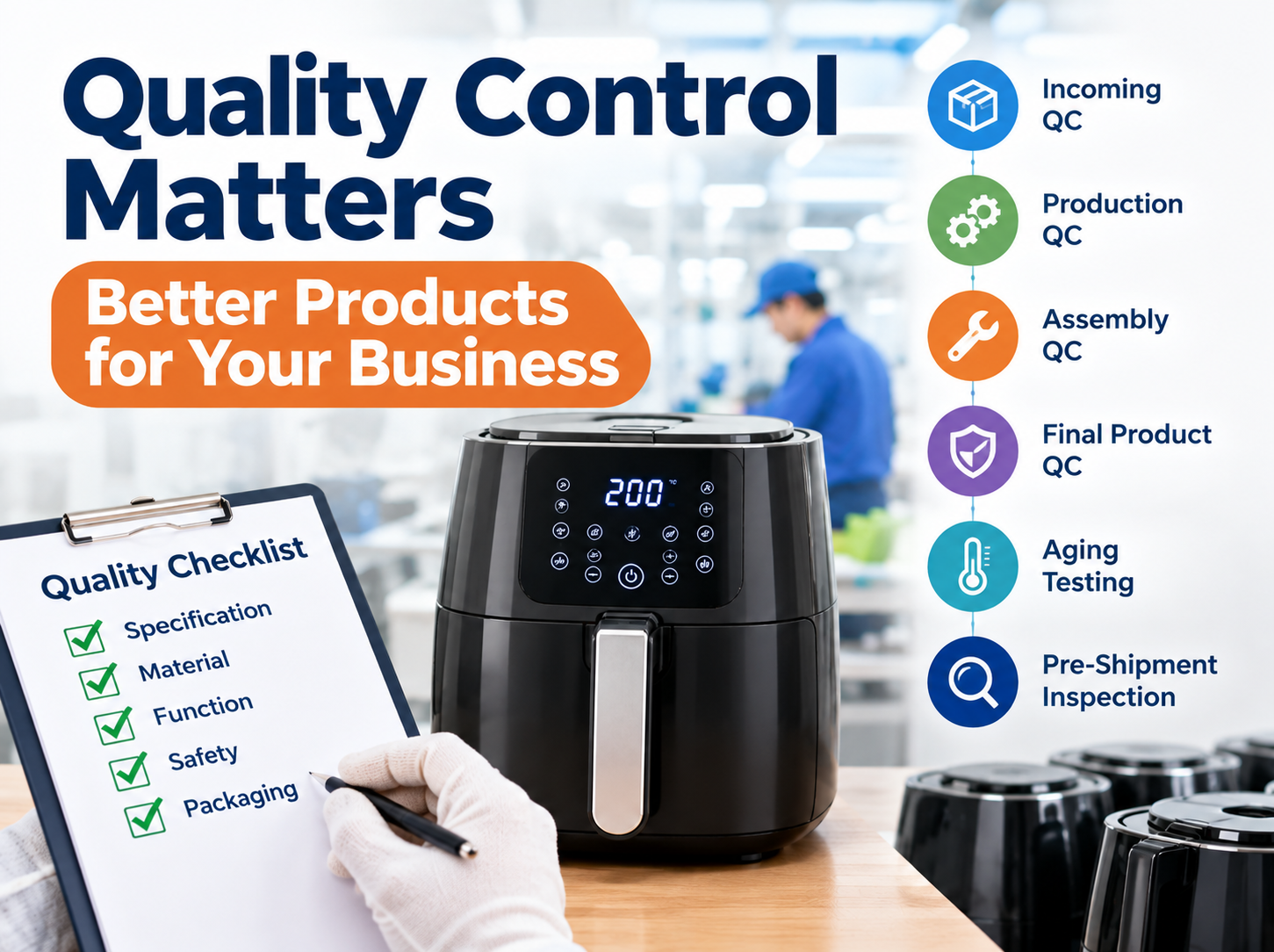
What Quality-Control Standards Should I Require from an Air Fryer Supplier?
200°C vs 230°C Air Fryer:
Can An Air Fryer Replace A Toaster Oven?
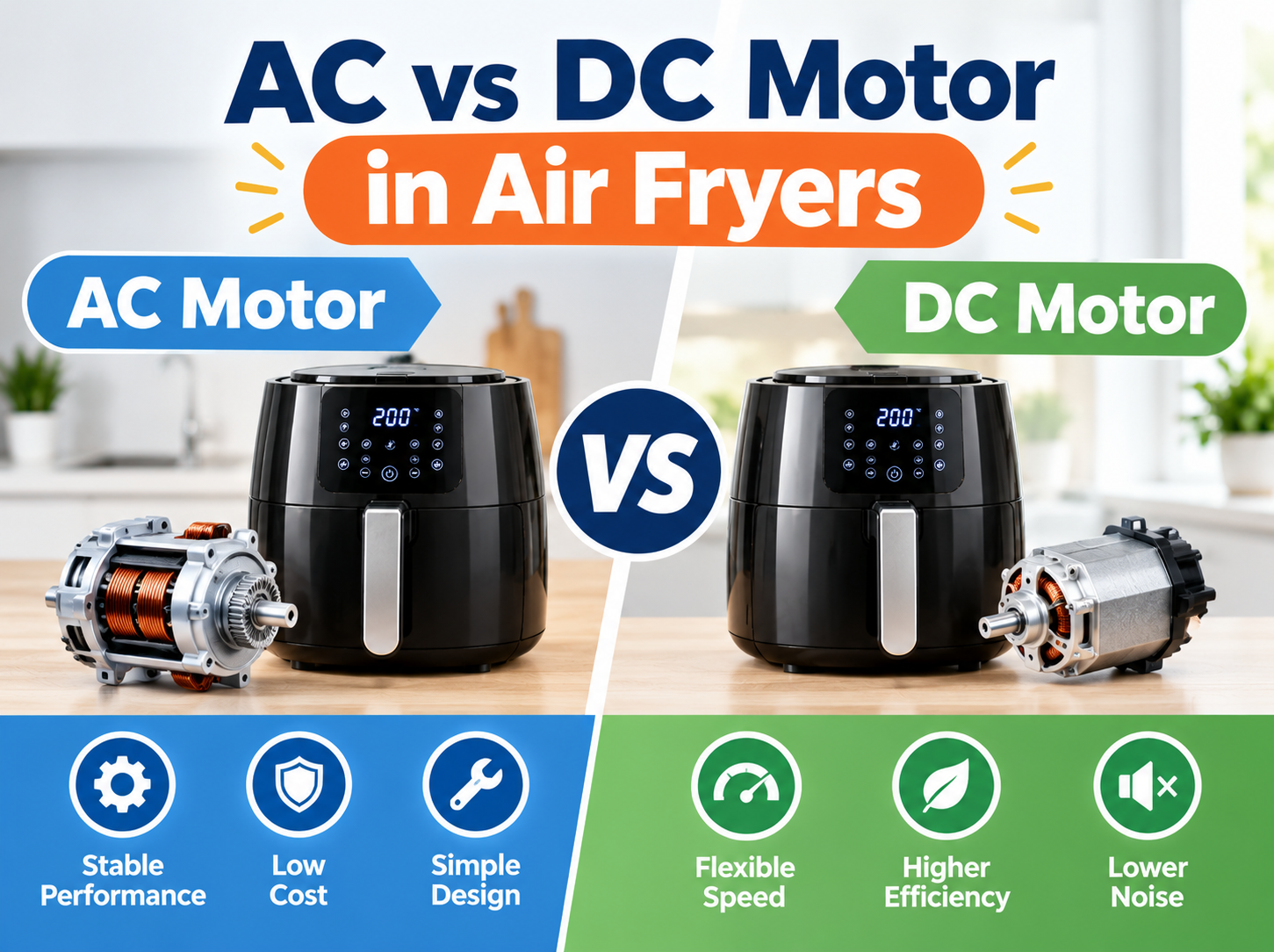
What Is the Difference Between AC and DC Motors in Air Fryers?
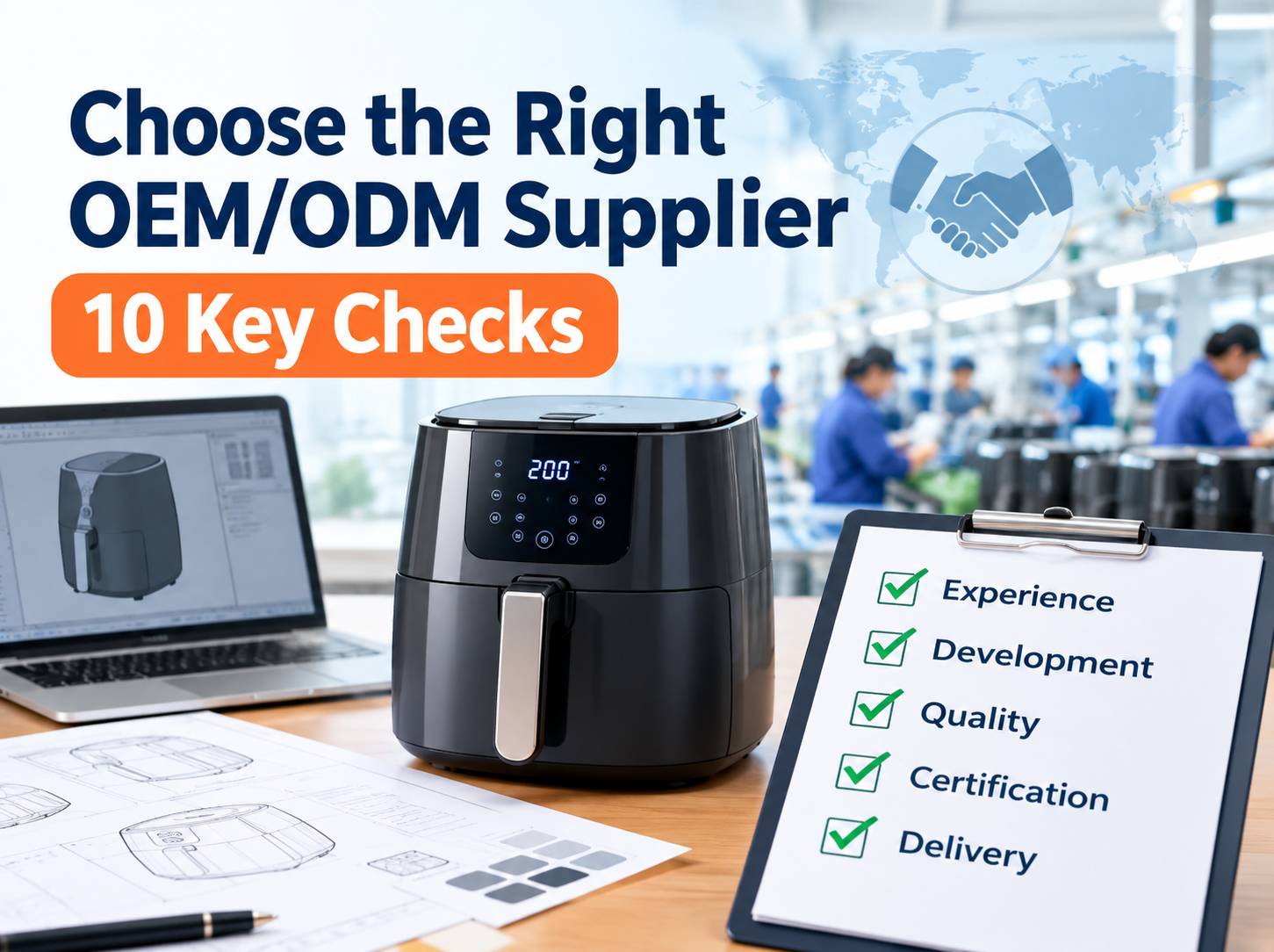
How to Choose an OEM/ODM Air Fryer Supplier in China:

Wilko collapse - What Went Wrong With The High Street Retailer?
 + 86 181 3826 8709
 info@funloiv.com
 6/F., Guanglong Building, Pingxin North Road, Longgang, Shenzhen City, Guangdong, China


@ 2009-2026 Shenzhen Funloiv Electric Appliance Co., LtdAll rights reserved


