Notice:

 search
search
search
Sep 18, 2026


The Middle East, particularly the Gulf Cooperation Council (GCC) region, offers opportunities for air fryer brands, importers, distributors, supermarkets and online retailers. However, an air fryer designed for one market may not be suitable for every GCC country.
Before placing an order, B2B buyers should evaluate more than capacity and FOB price. Electrical safety, GSO conformity, G-Mark requirements, voltage, plug type, product materials, packaging, warranty and after-sales support can all affect whether an air fryer is ready for commercial launch.
This guide explains the main considerations when sourcing an air fryer for the Middle East, with a particular focus on the GCC markets: Saudi Arabia, the United Arab Emirates, Kuwait, Qatar, Bahrain and Oman.
1. What Is GSO G-Mark?
GSO and the GCC conformity system
GSO stands for the Gulf Cooperation Council Standardization Organization. It develops and coordinates technical regulations, standards and conformity-related requirements for products sold in the GCC region.
For applicable electrical products, the relevant framework includes the GCC Technical Regulation for Low Voltage Electrical Equipment and Appliances, commonly referred to as the GSO Low Voltage Technical Regulation.
An air fryer is an electrical kitchen appliance. Therefore, its design, electrical safety, electromagnetic compatibility and conformity documentation must be evaluated against the requirements applicable to the destination market and product category.
What is the G-Mark?
The G-Mark, also known as the Gulf Conformity Marking, indicates that an applicable product has completed the required conformity assessment process under the relevant Gulf technical regulations.
Depending on the product and the applicable conformity route, the process may involve:
l Technical documentation
l Product safety testing
l Electromagnetic compatibility testing
l Risk assessment
l Manufacturer’s Declaration of Conformity
l Assessment by an approved or notified conformity assessment body
l Registration or tracking through the relevant GCC conformity system
l Correct marking and product information
The G-Mark is not simply a decorative logo that can be added to the packaging. It represents a conformity process supported by technical evidence.
Does every air fryer automatically need the same G-Mark process?
Not necessarily. Requirements can depend on:
l Product classification
l Rated voltage and electrical design
l Applicable GCC technical regulations
l Destination country
l Product configuration
l Whether the model has additional functions
l Importer and local authority requirements
l Changes to applicable standards or conformity procedures
For this reason, buyers should not rely on a generic statement such as “This model has CE, so it is ready for the GCC market.”
A professional supplier should help identify the applicable requirements for the exact model, but the importer remains responsible for confirming the final import and market-entry requirements in the destination country.
2. Which GCC Markets Should Buyers Consider?
The main GCC markets are:
l Saudi Arabia
l United Arab Emirates
l Kuwait
l Qatar
l Bahrain
l Oman
Although these markets share many regional technical frameworks, buyers should not assume that one document automatically satisfies every national requirement.
Before production, the importer and supplier should confirm:
l The exact country or countries of sale
l The applicable product regulations
l The required conformity route
l Local registration or customs procedures
l Required product markings
l Language requirements
l Plug and power specifications
l Warranty and after-sales obligations
l Packaging and labeling requirements
l Any retailer-specific compliance conditions
If the same air fryer will be sold in several GCC countries, it is important to confirm whether one configuration can serve all target markets or whether different versions are required.
3. Choosing the Right Air Fryer Capacity
Capacity is one of the first specifications considered by buyers. However, the stated capacity should be evaluated together with the internal cooking space, basket structure and target consumer.
Common capacity segments
Capacity range | Typical positioning | Possible target users |
2–4 liters | Compact or entry-level | Small households, individuals, compact kitchens |
5–7 liters | Mainstream household | Couples and small-to-medium families |
8–10 liters | Large household | Families, frequent cooking, larger portions |
10–12 liters or more | Large-capacity or multifunctional | Large families, entertaining, premium retail |
These categories are only general positioning guidelines. Actual demand may vary by country, retailer, household size, cooking habits and price segment.
What should buyers verify?
A supplier quotation should clearly state:
l Nominal capacity
l Usable cooking capacity
l Basket or drawer configuration
l Single-basket or dual-basket design
l Internal dimensions
l Number of cooking zones
l Whether the stated capacity includes both drawers
l Whether the product is a vertical, horizontal or oven-style design
l Recommended food quantity
l Product dimensions and carton dimensions
For example, an air fryer described as “10L dual basket” may have two separate cooking compartments, while a “10L oven-style air fryer” may offer a different internal layout. These products should not be compared only by the number of liters.
Is a dual-basket air fryer suitable for GCC consumers?
A dual-basket model may be attractive for households that want to:
l Cook two foods at the same time
l Prepare different foods at different temperatures
l Separate meat, vegetables and snacks
l Reduce the need to use a conventional oven
l Prepare larger family meals more efficiently
For a vertical dual-basket model, buyers should also evaluate:
l Drawer accessibility
l Stability during operation
l Heat distribution between the upper and lower compartments
l Ease of cleaning
l Handle strength
l Whether both zones can operate simultaneously
l Total power consumption when both zones are used
4. Price Positioning: Do Not Compare FOB Prices Alone
Air fryer prices in the GCC market can vary significantly. The retail price is influenced by product configuration, brand positioning, materials, features, certification, packaging, distribution costs and retailer margins.
A lower FOB price does not necessarily mean a lower total sourcing cost.
Factors that influence an air fryer’s FOB price
The main cost drivers may include:
l Product capacity
l Body material
l Heating system
l Rated power
l Motor and fan design
l Control panel and display
l Number of presets
l Basket structure
l Non-stick coating
l Viewing window
l Dual-basket configuration
l Packaging requirements
l Certification and testing
l Tooling and mold development
l OEM or ODM customization
l Order quantity
l Spare parts and warranty support
Metal body versus plastic body
Plastic-body air fryers may support an entry-level price position and can offer flexibility in exterior design. Metal-body or stainless-steel models may require different materials, forming processes, surface treatment and assembly methods.
A metal-body air fryer may be suitable for buyers targeting:
l Premium or mid-to-premium retail
l Consumers who prefer a more solid appearance
l Retailers seeking product differentiation
l Brands emphasizing durability and heat-related material performance
l Markets where product appearance strongly influences perceived value
However, “metal body” should be defined precisely. Buyers should ask whether the supplier means:
l Full external metal housing
l Metal front panel only
l Metal cooking chamber
l Stainless-steel internal cavity
l Metal decorative parts
l A plastic body with a metal-colored finish
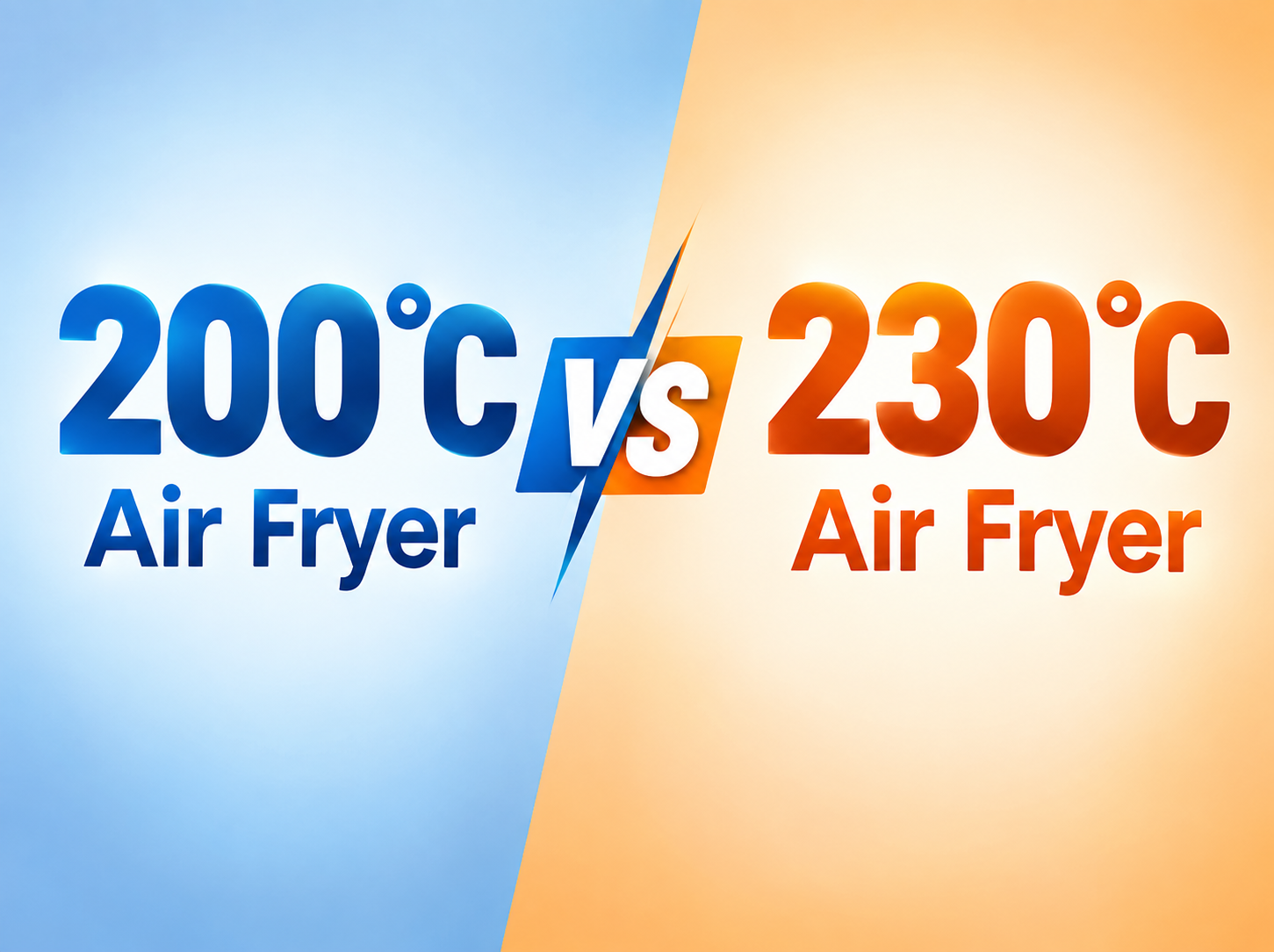
Why can a 230°C air fryer cost more?
A higher maximum temperature may affect the product’s:
l Heating elements
l Thermal insulation
l Internal materials
l Control system
l Thermal protection
l Wiring and connectors
l Housing design
l Testing requirements
l Product reliability validation
A model rated up to 230°C should not be compared directly with a model rated up to 200°C without checking the complete technical configuration.
Buyers should request evidence of the claimed operating temperature, including:
l Temperature setting range
l Actual temperature measurement method
l Temperature tolerance
l Test conditions
l Heating performance
l Thermal protection design
l Whether the 230°C rating applies to the complete product or only a specific function
5. Electrical Safety: A Critical Requirement for GCC Buyers
Electrical safety is one of the most important considerations when importing air fryers into the Middle East.
An air fryer combines:
l High-power heating elements
l An electric motor and fan
l Electronic controls
l Power wiring
l Thermal protection components
l A plastic or metal enclosure
l A food-contact cooking chamber
l High operating temperatures
A supplier should be able to explain how these parts are evaluated and controlled.
Important safety areas
Buyers should discuss:
l Protection against electric shock
l Insulation performance
l Earthing or grounding, where applicable
l Leakage current
l Dielectric strength
l Overheating protection
l Thermal fuse configuration
l Automatic shut-off
l Abnormal operation testing
l Motor safety
l Power cord and plug safety
l Resistance to heat and deformation
l Mechanical stability
l Protection against accidental contact with hot components
Thermal protection
An air fryer should include an appropriate protection system to reduce the risk of overheating.
Depending on the design, this may include:
l Thermal fuses
l Temperature limiters
l Independent temperature controls
l Over-temperature protection
l Software-based protection
l Automatic shut-off
l Protection against abnormal operation
The exact safety architecture should be confirmed through the product’s technical documentation and applicable testing.
A buyer should not accept a general statement such as “The product is safe” without asking for relevant test reports and conformity documents.
6. GSO, CE, CB, EMC and Other Certification Documents
One of the most common sourcing mistakes is treating all certificates as interchangeable.
GSO or G-Mark conformity
GSO-related conformity documentation addresses the applicable Gulf technical requirements. For a relevant electrical appliance, this may involve safety and electromagnetic compatibility requirements, along with the applicable conformity assessment process.
CE marking
CE marking is associated with the European Economic Area regulatory framework. It may demonstrate compliance with applicable European requirements when correctly supported by technical documentation.
However:
CE marking does not automatically mean that an air fryer is ready for sale in every GCC country.
CB Scheme documents
CB test reports and certificates can be useful because they may provide an internationally recognized technical testing basis. However, the buyer should confirm:
l The exact product model
l The applicable standard edition
l The rated voltage and frequency
l The included components
l The test report scope
l Whether national deviations are covered
l Whether additional GCC conformity steps are required
EMC testing
Electromagnetic compatibility is important because the air fryer contains electronic controls, switching components and a motor.
EMC evaluation may consider:
l Electromagnetic emissions
l Immunity to electromagnetic disturbances
l Conducted disturbances
l Radiated disturbances
l Voltage fluctuations or related effects, where applicable
Other documents buyers may request
Depending on the market and product configuration, the buyer may need:
l Safety test report
l EMC test report
l GSO or G-Mark conformity documentation
l Manufacturer’s Declaration of Conformity
l Bill of materials
l Critical component list
l Product technical specification
l User manual
l Product label artwork
l Packaging artwork
l Factory quality-control records
l Food-contact material documentation
l RoHS-related documentation, where required by the buyer or market
l Warranty statement
l Spare-parts policy
The documents should refer to the correct model and configuration. A report for a visually similar model may not be sufficient.
7. Voltage and Frequency for the GCC Market
Many GCC markets use a nominal supply of approximately 220–240V, with 50Hz commonly used. However, the importer should confirm the exact requirements for the destination country and product version before production.
For a GCC air fryer, buyers should specify:
l Rated voltage
l Rated frequency
l Rated power
l Plug type
l Power cord length
l Plug certification requirements
l Earthing configuration
l Product label information
l Compatibility with the target country’s electrical supply
Why voltage and frequency matter
An air fryer’s heating performance depends heavily on its electrical design. Incorrect voltage or frequency specifications can affect:
l Heating speed
l Maximum temperature
l Motor performance
l Product lifetime
l Electrical safety
l Power consumption
l Warranty claims
A supplier should not simply change the label from “220V” to “240V” without confirming that the internal electrical system, heating elements, motor, control board and safety components are suitable for the new rating.
8. Plug Type: Confirm the Exact Country Version
Plug requirements should be confirmed before mass production.
Different GCC markets may use different plug configurations, and retailers may also have their own requirements. In particular, the buyer should confirm whether the target market requires:
l A British-style three-pin plug
l A two-pin plug
l A grounded plug
l A specific national plug standard
l A retailer-approved plug and cable configuration
For Saudi Arabia, the UAE, Kuwait, Qatar, Bahrain and Oman, the required plug should be confirmed against the final destination and the importer’s compliance instructions.
What should be included in the purchase specification?
A complete electrical specification should state:
Rated voltage / frequency / power / plug type / cable length / grounding requirement / applicable plug standard.
The supplier should provide a sample with the final plug configuration before mass production.
A plug adapter should not be treated as an automatic substitute for a correctly designed and approved product version.
9. Product Materials and Heat Resistance
The Middle East climate can include high ambient temperatures, intensive air-conditioning use and long-distance transportation in hot conditions. Buyers should therefore consider both operating temperature and storage or transportation conditions.
Plastic components
For plastic-body air fryers, buyers should evaluate:
l Heat resistance
l Deformation resistance
l Odor performance
l Material consistency
l Flame-retardant requirements, where applicable
l Strength of handles and structural parts
l Resistance to repeated heating and cooling
l Long-term appearance
Metal components
For metal-body air fryers, buyers should evaluate:
l Metal grade
l Thickness
l Surface treatment
l Corrosion resistance
l Edge finishing
l Heat transfer
l Insulation
l Fingerprint resistance
l Coating performance
l Structural strength
Food-contact components
The basket, tray, cooking chamber and coating should be assessed according to the applicable food-contact requirements for the destination market and the materials used.
Buyers should ask for clear information about:
l Basket material
l Coating type
l Coating adhesion
l Coating durability
l Food-contact declarations
l Cleaning instructions
l Dishwasher compatibility
l Restrictions on metal utensils
l Recommended temperature limits
A product’s maximum air temperature and the permitted temperature of its food-contact coating should not be assumed to be identical.
10. User Interface, Language and Retail Requirements
An air fryer intended for the GCC region should be designed for the target consumer and retail channel.
Buyers should determine whether the product requires:
l English user interface
l Arabic user interface
l English and Arabic manuals
l Arabic safety warnings
l Bilingual packaging
l Arabic product descriptions
l Local warranty information
l Retailer-specific labels
l QR codes or traceability information
A digital control panel may be attractive for mid-range and premium products, while mechanical controls may be suitable for entry-level products or consumers who prefer simple operation.
The buyer should evaluate:
l Button visibility
l Display readability
l Touch-panel responsiveness
l Preset naming
l Timer accuracy
l Temperature-setting increments
l Child-safety considerations
l Power recovery behavior
l Ease of operation for first-time users
11. Warranty and After-Sales Support
Warranty is particularly important for importers and retailers because air fryers contain heating elements, motors, electronic controls and moving parts.
A supplier’s warranty offer should be clearly defined rather than described only as “one year warranty.”
Questions buyers should ask
l What is the standard warranty period?
l When does the warranty begin?
l Does it begin from shipment, arrival or retail sale?
l Which components are covered?
l Are heating elements covered?
l Is the motor covered?
l Is the control board covered?
l Are baskets, trays and coatings covered?
l What defects are excluded?
l How are warranty claims evaluated?
l What is the response time?
l Are replacement parts available?
l Can the supplier provide spare parts?
l Who pays for replacement parts and transportation?
l Is technical support available after shipment?
Spare parts
For the GCC market, buyers may wish to stock selected spare parts such as:
l Heating elements
l Fans or motors
l Control boards
l Temperature sensors
l Thermal fuses
l Handles
l Baskets
l Trays
l Power cords
l Touch panels
l Silicone or heat-resistant components
The required spare-parts list will depend on the model and the importer’s after-sales strategy.
12. Packaging and Transportation Considerations
Packaging should be designed for the complete logistics route, not only for the factory-to-port stage.
An air fryer may experience:
l Container handling
l Port operations
l Long-distance transportation
l High temperatures
l Humidity changes
l Repeated loading and unloading
l Retail warehouse storage
l Last-mile delivery
Buyers should check:
l Inner protection
l Carton strength
l Foam or molded-pulp protection
l Protection for the display and control panel
l Basket and tray fixation
l Protection against scratches
l Drop-test requirements
l Carton dimensions
l Gross and net weight
l Shipping marks
l Barcode and SKU information
l Pallet requirements
l Retail-ready packaging requirements
For metal-body products, surface protection is especially important because scratches, dents and fingerprints can affect retail presentation.
13. Quality Control Before Mass Production
A sample approval should not be the only quality-control step.
Before placing a bulk order, buyers should establish a quality-control process covering:
l Approved technical specification
l Approved golden sample
l Incoming material inspection
l Heating-element inspection
l Motor and fan inspection
l Electrical safety checks
l Assembly inspection
l Functional testing
l Temperature and timer verification
l Aging testing
l Appearance inspection
l Packaging inspection
l Pre-shipment inspection
Sample-to-production consistency
The mass-produced air fryer should match the approved sample in terms of:
l Appearance
l Materials
l Color
l Dimensions
l Power
l Heating performance
l Temperature range
l Control functions
l Basket construction
l Plug and cable
l Packaging
l Accessories
l User manual
If the supplier changes a critical component after sample approval, the buyer should be informed and the change should be evaluated before production continues.
14. How Should GCC Buyers Compare Two Air Fryer Suppliers?
A useful quotation comparison should include more than unit price.
Evaluation area | Questions to ask |
Product capacity | Is the capacity nominal or usable? |
Heating system | What heating elements and airflow design are used? |
Maximum temperature | Is the stated temperature verified? |
Body material | Is the body fully metal, partly metal or plastic? |
Electrical rating | Is the model suitable for the destination market? |
Plug | Is the correct national plug included? |
Certification | Are the documents valid for the exact model? |
Quality control | What inspections are performed before shipment? |
Warranty | Which components and defects are covered? |
Spare parts | Are replacement parts available? |
Packaging | Is the packaging suitable for long-distance shipping? |
MOQ | Is the MOQ suitable for the buyer’s launch plan? |
Lead time | Does the lead time include testing and packaging approval? |
Customization | Can the supplier support branding and bilingual packaging? |
Total cost | Are testing, tooling, packaging and spare parts included? |
The buyer should compare equivalent specifications. An 8-liter plastic-body air fryer with a 200°C maximum temperature should not be compared directly with an 8-liter metal-body model featuring a different heating system and a 230°C temperature range.
15. A Practical GCC Air Fryer RFQ Checklist
When requesting a quotation, a buyer should provide or confirm the following information:
l Target GCC country or countries
l Sales channel
l Target retail positioning
l Required capacity
l Single or dual basket
l Preferred body material
l Maximum temperature
l Rated power
l Voltage and frequency
l Plug type
l Control type
l Display language
l Arabic packaging requirement
l Required certifications
l Target MOQ
l Target FOB price
l Required sample quantity
l Sample deadline
l Mass-production deadline
l Warranty expectation
l Spare-parts requirement
l Packaging requirements
l Product branding
l User manual language
l Retail barcode and carton marking requirements
The more complete the RFQ, the easier it becomes for suppliers to provide comparable and accurate quotations.
16. Why Choose an Experienced Air Fryer Supply Partner?
A supplier supporting GCC buyers should ideally provide more than a product catalogue.
The supplier should be able to support:
l Product selection
l Technical specification confirmation
l OEM and ODM development
l Electrical configuration
l Plug selection
l Certification coordination
l Sample preparation
l Packaging development
l Quality-control planning
l Production follow-up
l Pre-shipment inspection
l Spare-parts planning
l Export documentation
l After-sales communication
For buyers entering a new market, the ability to identify potential compliance and specification problems before mass production can be as important as the initial product price.
Conclusion: What Should Buyers Confirm Before Ordering an Air Fryer for the Middle East?
When sourcing an air fryer for the GCC market, buyers should evaluate the complete product and supply chain rather than focusing only on capacity or FOB price.
The most important points include:
l Confirm the target GCC countries.
l Understand the applicable GSO and G-Mark conformity requirements.
l Verify the exact model covered by the technical documents.
l Select the correct capacity and basket configuration.
l Compare body materials and heating systems carefully.
l Confirm voltage, frequency and plug type.
l Evaluate electrical safety and thermal protection.
l Check food-contact materials and coating performance.
l Prepare suitable English and Arabic documentation where required.
l Define warranty and spare-parts responsibilities.
l Confirm packaging and transportation protection.
l Approve a golden sample before mass production.
l Establish quality-control and pre-shipment inspection requirements.
l Compare complete specifications instead of comparing FOB prices alone.
A reliable GCC air fryer sourcing project begins with the right technical specification, clear compliance planning and transparent communication between the buyer and supplier.
Looking for an air fryer supplier for Saudi Arabia, the UAE or other GCC markets? Send us your target capacity, product positioning, electrical requirements and destination country. Our team can help you evaluate suitable air fryer configurations for your market.

 + 86 181 3826 8709
 info@funloiv.com
 6/F., Guanglong Building, Pingxin North Road, Longgang, Shenzhen City, Guangdong, China


@ 2009-2026 Shenzhen Funloiv Electric Appliance Co., LtdAll rights reserved