 Notice:

 search
search
search
Sep 20, 2026


When buyers compare air fryers, they often look at capacity, wattage, temperature range and cooking programs.
But one of the most important questions is often harder to answer:
What makes an air fryer cook more evenly?
An air fryer may have a powerful heating element and a high-speed fan, but that does not automatically guarantee uniform cooking.
Cooking consistency depends on how several parts of the system work together:
Heating Element + Fan + Airflow + Basket + Cooking Chamber + Temperature Control
The goal is to distribute heat and airflow effectively across the food load while removing moisture from the food surface.
For consumers, this affects whether fries, chicken wings or vegetables are evenly browned and crispy.
For brands, importers and OEM/ODM buyers, cooking uniformity is also a product-development and quality-control issue.
This article explains the main factors that influence even cooking and what buyers should evaluate when comparing air fryer designs.
What Does "Even Cooking" Mean in an Air Fryer?
Before discussing the technical factors, it is useful to define what "even cooking" actually means.
An air fryer cooks more evenly when food placed in different areas of the cooking basket receives relatively consistent heat transfer and airflow.
In practical terms, good cooking uniformity means:
l Similar browning across the food load
l Similar crispiness
l Fewer overcooked pieces
l Fewer undercooked pieces
l Consistent cooking time
l Stable cooking temperature
l Effective moisture removal
l Similar results from one batch to another
For example, if fries in the center of the basket are crisp and golden while fries around the edges remain soft, the problem may not simply be insufficient temperature.
It could be related to airflow distribution, basket geometry, food loading or temperature recovery.
This is why cooking uniformity should be evaluated as a complete system.
1. Airflow: The Foundation of Even Cooking
Airflow is one of the most important factors in an air fryer's cooking performance.
The basic thermal system can be represented as:
Heating Element → Fan → Airflow → Heat Transfer → Moisture Removal → Cooking Result
The heating element generates heat.
The motor drives the fan.
The fan moves heated air through the cooking chamber.
The airflow then transfers heat to the food and helps remove surface moisture.
If airflow is well distributed, hot air can reach more areas of the food surface.
If airflow is poorly distributed, some areas may receive more heat while others receive less.
This can lead to differences in:
l Browning
l Crispiness
l Cooking time
l Moisture loss
l Surface temperature
However, more airflow is not automatically better.
The objective is not:
Maximum airflow
The objective is:
Optimized airflow for the heating power, chamber size, basket design and cooking application.
For a deeper explanation, see:
Why Does Airflow Matter in an Air Fryer?
2. Heating Element Position and Heat Distribution
The position of the heating element also affects how heat enters the cooking chamber.
Common configurations include:
l Top heating
l Rear heating
l Bottom heating
l Top and bottom heating
l Multiple heating elements
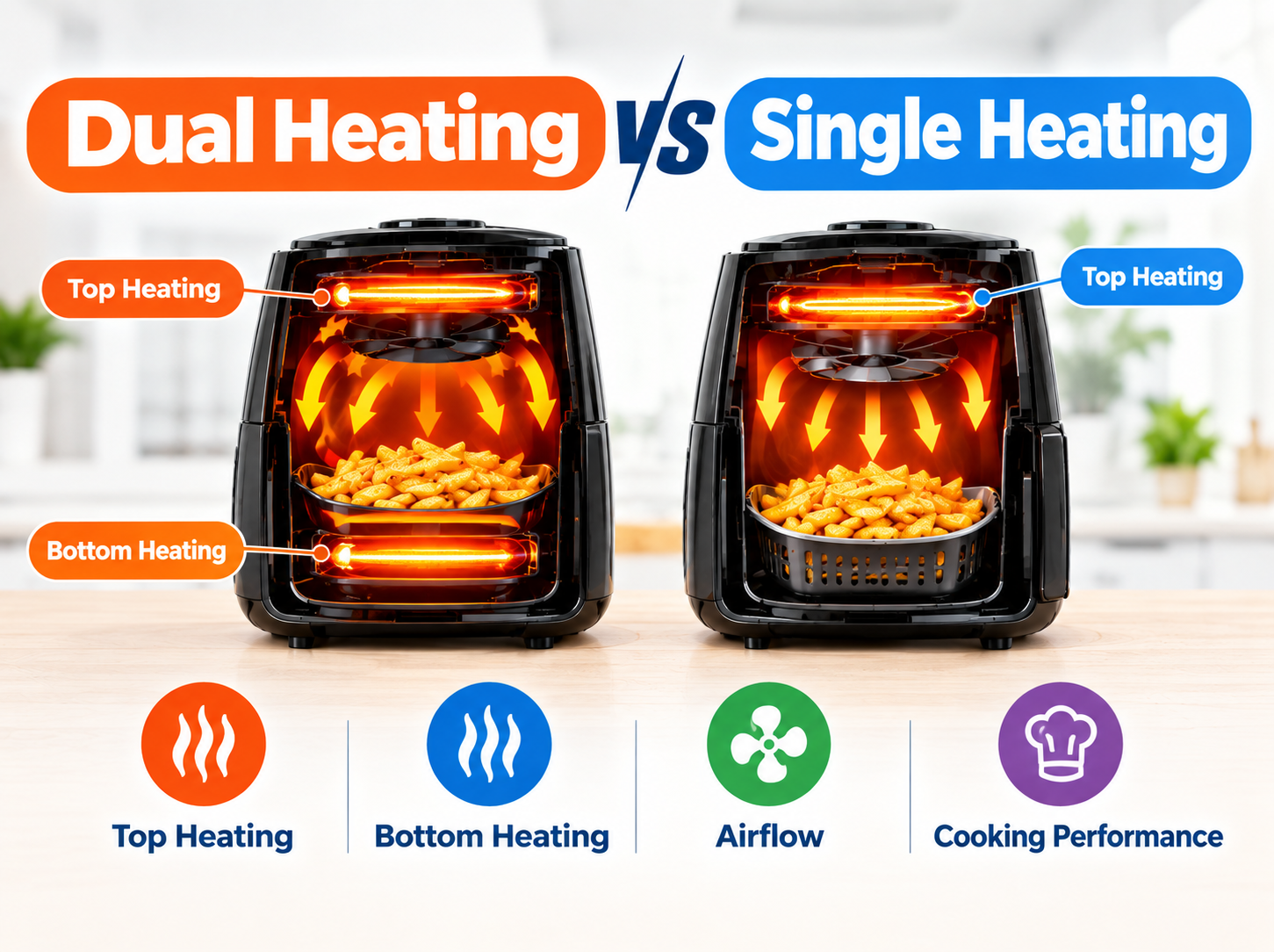
A conventional top-heating air fryer introduces most of its thermal energy from above the basket.
The airflow system then distributes that heated air around the food.
A dual-heating system can introduce heat from more than one position.
For example:
Upper Heating Element + Lower Heating Element + Fan
This can provide additional flexibility in thermal design.
However, an important point should be made:
More heating elements do not automatically mean more even cooking.
If the airflow is poorly designed, simply adding another heating element may not solve temperature-distribution problems.
Cooking uniformity still depends on how the heating elements work together with:
l Fan performance
l Airflow path
l Chamber geometry
l Basket design
l Temperature control
l Food loading
This is why heating architecture should always be evaluated as part of the complete cooking system.
3. Fan and Motor Performance
The fan is responsible for moving air through the cooking system, while the motor provides the mechanical power required to rotate the fan.
The relationship can be simplified as:
Motor → Fan → Airflow
But motor RPM alone does not tell the whole story.
Other factors include:
l Fan diameter
l Blade design
l Fan geometry
l Motor torque
l Airflow resistance
l Air pressure
l Fan position
l Air outlet design
A higher fan speed does not necessarily produce better cooking.
If airflow becomes too strong relative to the available heating power, the air may not reach the desired temperature before contacting the food.
On the other hand, insufficient airflow may reduce heat transfer and moisture removal.
Therefore, the engineering objective should be to match:
Motor + Fan + Heating Power + Airflow Path
rather than simply maximizing RPM.
For more information, see:
What Is the Difference Between AC and BLDC Motors in Air Fryers?
4. Heating Power and Temperature Recovery
Heating power is another important factor in cooking uniformity.
An air fryer needs sufficient thermal power not only to preheat the chamber, but also to maintain the target cooking temperature after cold food is added.
This creates two different performance questions.
Preheating
How quickly can the air fryer reach the selected temperature?
Temperature Recovery
How quickly can the air fryer recover after the temperature drops?
Temperature recovery is particularly important when cooking:
l Frozen food
l Large quantities of food
l Thick meat
l High-moisture ingredients
For example:
Food Added → Chamber Temperature Drops → Heating System Recovers → Stable Cooking Conditions
If temperature recovery is slow, cooking conditions can change significantly during the process.
However, higher wattage does not automatically guarantee better cooking.
The effectiveness of heating power depends on:
l Cooking chamber volume
l Heating element design
l Airflow
l Fan performance
l Thermal insulation
l Temperature sensor position
l Control strategy
l Food load
Therefore, buyers should evaluate temperature recovery, not just the wattage printed on the specification sheet.
5. Basket Surface Area Matters More Than Capacity Alone
When comparing air fryers, buyers often focus on liters or quarts.
For example:
l 6L
l 8L
l 10L
l 12L
But nominal capacity does not tell the whole story.
For even cooking, the usable cooking surface area can be more important.
Why?
Because food needs enough space for hot air to move around it.
If the basket is too crowded:
More Food → More Overlap → Restricted Airflow → Less Even Cooking
For example, imagine two 8L air fryers.
One may have a relatively wide cooking surface that allows fries to spread into a single layer.
Another may have a deeper and narrower basket that encourages food to pile up.
Although both products have the same nominal capacity, their cooking behavior can be different.
For product developers, therefore, capacity should be evaluated together with:
l Cooking surface area
l Basket dimensions
l Basket depth
l Food-loading height
l Airflow access
6. Basket Perforation Is Part of the Airflow System
The cooking basket is not simply a container for food.
It is also part of the air circulation system.
A perforated basket allows hot air to move around the food from different directions.
Important design factors include:
l Hole size
l Hole distribution
l Hole density
l Basket bottom design
l Distance between basket and heating area
l Airflow path underneath the basket
If the perforation pattern is poorly matched to the airflow system, some areas of the basket may receive less effective airflow.
This can affect cooking uniformity.
Therefore:
Basket design should be developed together with airflow design.
A basket cannot be evaluated independently from the cooking chamber and fan system.
7. Cooking Chamber Geometry
The shape of the cooking chamber can also influence how air moves.
Important design variables include:
l Chamber height
l Chamber width
l Chamber depth
l Distance between heating element and food
l Air inlet position
l Air outlet position
l Internal airflow channels
l Corners and dead zones
A well-designed chamber should help guide hot air around the food rather than create areas where airflow becomes weak.
What is an airflow dead zone?
An airflow dead zone is an area where air movement and heat transfer are relatively weak compared with other areas of the chamber.
Dead zones can potentially occur:
l Behind heavily loaded food
l Around corners
l Between tightly packed food
l In areas far from the primary airflow path
This is why simply increasing heating power may not solve uneven cooking.
If the hot air cannot reach the food effectively, additional thermal energy may not translate into better cooking uniformity.
8. Temperature Sensor Position and Control
Even if the hardware is well designed, the control system also matters.
An air fryer typically uses a temperature sensor to monitor the cooking environment and control the heating system.
The sensor position is important because:
The temperature measured by the sensor may not be identical to the temperature experienced by the food.
For example, a sensor located close to the heating element may detect a different temperature from one located closer to the food.
The control system needs to manage:
l Heater activation
l Temperature fluctuations
l Heating cycles
l Temperature recovery
l Over-temperature protection
This leads to an important principle:
Even cooking is not only a hardware problem. It is also a control-system problem.
A well-designed air fryer therefore needs the heating system, airflow system and temperature control system to work together.
9. Food Loading Also Affects Cooking Uniformity
Even a well-engineered air fryer can produce uneven results if the basket is overloaded.
Common causes include:
Ø Overloading
Too much food restricts airflow.
Ø Overlapping
Food covering other food reduces direct airflow and heat transfer.
Ø Different food sizes
Large and small pieces may require different cooking times.
Ø Different moisture levels
High-moisture food can release more steam into the chamber.
Ø Incorrect food placement
Placing food directly against certain areas of the basket may restrict airflow.
This is why product capacity should not be evaluated only by how much food can physically fit inside the basket.
A better question is:
How much food can be loaded while maintaining effective airflow and consistent cooking?
10. How Heating, Airflow and Basket Design Work Together
The most important point in air fryer design is that these factors should not be evaluated independently.
Consider the complete system:
Ø Heating Element
Provides thermal energy.
↓
Ø Motor
Provides mechanical power.
↓
Ø Fan
Moves air.
↓
Ø Airflow
Distributes heated air.
↓
Ø Basket
Allows air to contact the food.
↓
Ø Cooking Chamber
Guides the airflow.
↓
Ø Temperature Sensor
Monitors the thermal environment.
↓
Ø Control System
Adjusts heating and temperature.
↓
Ø Food
Receives heat and loses moisture.
The final cooking result is therefore the result of the whole system, not one individual component.
Does Dual Heating Always Make an Air Fryer Cook More Evenly?
Not necessarily.
Dual heating can provide heat from different positions and may offer additional flexibility in thermal design.
However, even cooking still depends on:
l Airflow distribution
l Fan performance
l Heating power
l Basket geometry
l Cooking chamber design
l Temperature control
l Food loading
For example, a dual-heating air fryer with poorly distributed airflow may still have uneven cooking.
Conversely, a well-designed single-heating air fryer can achieve consistent results when its heating element, fan and airflow system are properly matched.
Therefore:
The number of heating elements is only one part of cooking uniformity.
For a detailed comparison of heating architectures, see:
A Dual Heating vs. Single Heating Air Fryer: Which Is Better?
FUNLOIV Example: Combining Heating and Airflow Design
FUNLOIV's FL-AF8081DWS provides an example of a dual-heating air fryer architecture.
The 8L model uses:
l 1500–2000W rated power
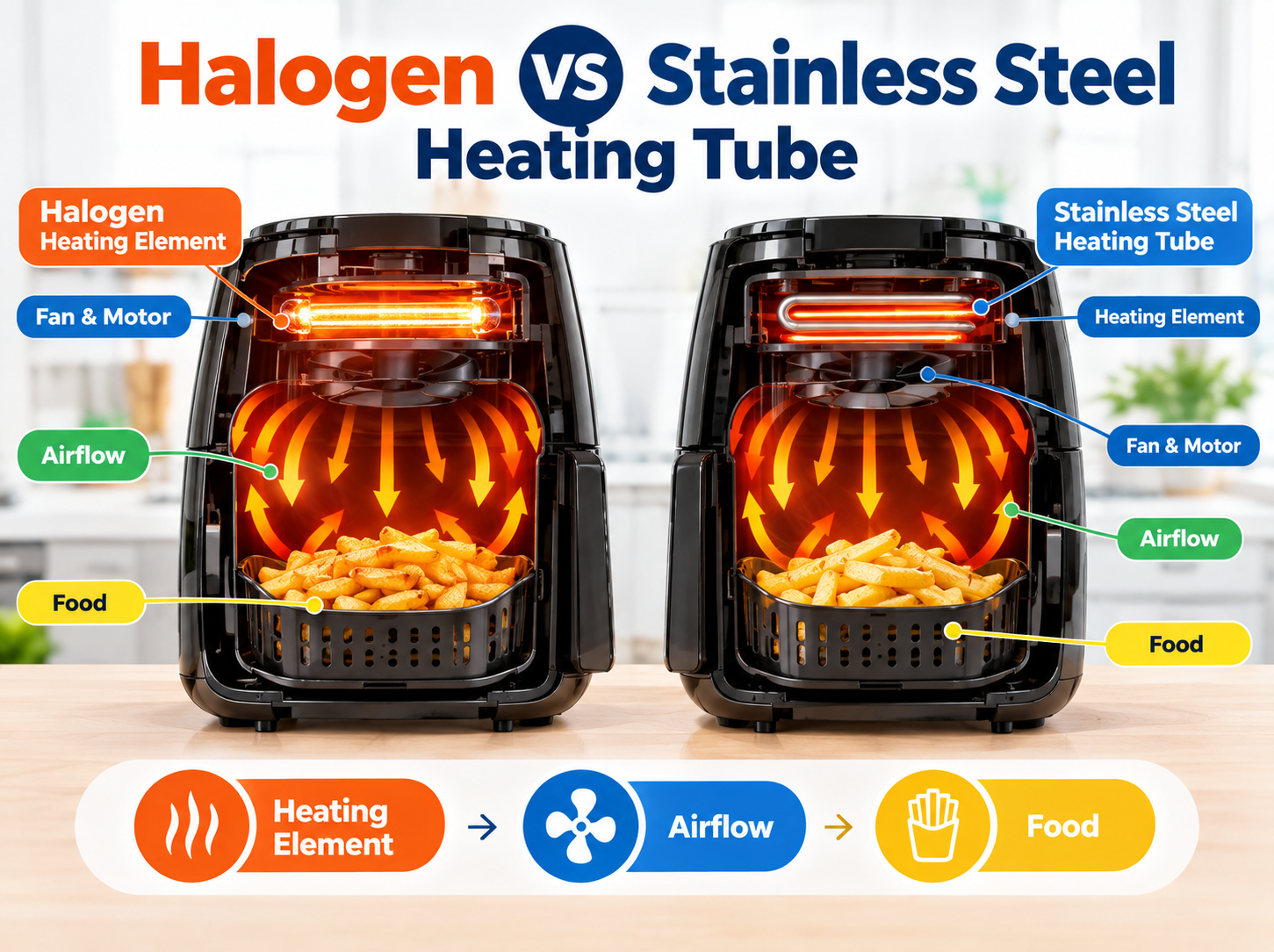
l 1500W upper halogen heating element
l 500W bottom S/S304 heating element
l 60–230°C temperature control
l High-speed fan
l Full metal cooking cavity
l Dual-layer rack
l 12 preset cooking functions
The upper and lower heating elements are designed to work together with the fan and cooking chamber to create a multi-source heating system.
The important point is not simply that the product has two heating elements.
The product illustrates a broader engineering principle:
Heating elements, airflow and cooking-chamber design need to be developed as one integrated thermal system.
For OEM and ODM buyers, this is an important distinction when comparing different air fryer suppliers.
How Should Buyers Test Cooking Uniformity?
For brands and importers, cooking uniformity should be tested with actual samples rather than evaluated from specifications alone.
A practical test program can include the following.
1. French Fries Test
Use the same type, weight and quantity of frozen fries.
Check:
l Browning
l Crispiness
l Undercooked pieces
l Overcooked pieces
l Differences between basket areas
2. Chicken Wing Test
Evaluate:
l Surface browning
l Crispiness
l Internal doneness
l Differences between pieces
3. Single-Layer Test
Spread food evenly across the basket.
This helps evaluate basic airflow and heat distribution.
4. Higher-Load Test
Increase the food load.
This helps determine how well the air fryer performs when airflow becomes more restricted.
5. Temperature Recovery Test
Measure the temperature before and after adding cold food.
Then record how quickly the system returns to the target temperature.
6. Repeatability Test
Run the same test more than once.
A reliable product should provide reasonably consistent results across repeated tests.
7. Position Comparison
Place similar food in:
l Center
l Front
l Rear
l Left
l Right
Then compare the cooking results.
This can help identify potential airflow or temperature-distribution differences.
What Should B2B Buyers Ask an Air Fryer Supplier?
When evaluating an air fryer supplier, buyers can ask:
l What type of heating element is used?
l Where is the heating element positioned?
l What is the total heating power?
l What motor type is used?
l What is the fan speed?
l How is airflow distributed through the cooking chamber?
l What is the basket's usable cooking surface area?
l How is the basket perforation designed?
l Where is the temperature sensor located?
l How does the product control temperature recovery?
l Has cooking uniformity been tested?
l What food was used during testing?
l How much food was used during testing?
l Are repeated cooking tests performed?
l How is sample performance verified before mass production?
These questions help buyers move beyond basic specifications and evaluate the supplier's actual product-development capability.
Common Misconceptions About Even Cooking
Myth 1: Higher wattage always means more even cooking.
Not necessarily.
Higher heating power can help maintain temperature, but airflow, basket design and chamber geometry also matter.
Myth 2: A faster fan always produces better results.
Not necessarily.
Fan speed needs to be matched to heating power and airflow resistance.
Myth 3: Dual heating automatically means more even cooking.
Not necessarily.
The complete thermal system determines the result.
Myth 4: Larger capacity always means better cooking.
Not necessarily.
A larger basket can provide more usable cooking surface, but the actual design and airflow distribution still matter.
Myth 5: More presets mean better cooking performance.
Not necessarily.
Presets mainly affect user convenience. Cooking performance still depends on the underlying heating, airflow and temperature-control system.
A Practical Formula for Air Fryer Cooking Uniformity
When evaluating an air fryer, it can be useful to think about cooking uniformity as the interaction of six major factors:
Ø Heating Power
Ø Airflow
Ø Fan Performance
Ø Basket Design
Ø Cooking Chamber
Ø Temperature Control
=
Cooking Uniformity
No single specification can fully describe cooking performance.
This is particularly important when comparing OEM or ODM air fryer samples from different suppliers.
Frequently Asked Questions
Ø What makes an air fryer cook more evenly?
The main factors include heating power, airflow distribution, fan performance, basket surface area, basket perforation, cooking chamber geometry, temperature control and food loading.
Ø Does airflow affect cooking uniformity?
Yes. Airflow determines how heated air moves around the food and contributes to heat transfer and moisture removal. Poor airflow distribution can contribute to uneven cooking.
Ø Does a bigger air fryer cook more evenly?
Not automatically. A larger cooking surface can provide more space for food to spread out, but cooking uniformity still depends on airflow, heating power and chamber design.
Ø Does dual heating make an air fryer more even?
Dual heating can provide heat from different positions, but it does not automatically guarantee more even cooking. The heating elements need to work effectively with the airflow and temperature-control system.
Ø Does a higher fan speed make food cook more evenly?
Not necessarily. Fan speed needs to be appropriately matched with heating power, basket size and airflow resistance.
Ø Why are some fries crispy while others remain soft?
Possible causes include uneven airflow, overloaded baskets, overlapping food, differences in food position, insufficient temperature recovery or differences in food size and moisture.
Ø How can I test whether an air fryer cooks evenly?
Use standardized food, consistent food weight and repeatable cooking settings. Compare browning, crispiness and doneness at different basket positions and under different food loads.
Ø What should an OEM buyer check for cooking uniformity?
OEM buyers should evaluate the complete thermal system, including heating elements, fan and motor, airflow path, basket geometry, chamber design, temperature control and repeatability during sample testing.
Conclusion
An air fryer does not cook evenly simply because it has a powerful heater, a high-speed fan or a large capacity.
Consistent cooking comes from the interaction of the entire thermal system.
The key factors are:
Ø Heating Element
→ provides thermal energy
Ø Motor & Fan
→ generate airflow
Ø Airflow System
→ distributes heated air
Ø Basket Design
→ allows air to reach the food
Ø Cooking Chamber
→ guides and manages airflow
Ø Temperature Control
→ maintains stable cooking conditions
Ø Food Loading
→ determines how effectively air can circulate around the food
The most important principle is:
An air fryer cooks more evenly when its heating power, airflow, fan performance, basket design, chamber geometry and temperature control are properly matched.
For brands and importers, this means that cooking uniformity should be evaluated through product design, sample testing and quality control, rather than by comparing a single specification.
If you are developing a new air fryer or looking for an OEM/ODM supplier, FUNLOIV can support product configuration, heating and airflow design, sample development, quality control and production follow-up.
Send us your target capacity, heating configuration, temperature range and market requirements, and we can discuss a suitable air fryer solution for your project.

Kitchen Appliance Regulations In the European Union

How to Choose an OEM/ODM Air Fryer Supplier in China:
A Dual Heating vs. Single Heating Air Fryer: Which Is Better?
Air Fryer RFQ Checklist: 20 Specifications Buyers Should Include
Air Fryer Heating Element: Halogen vs Stainless Steel Tube

What Factors Affect the FOB Price of an Air Fryer?
 + 86 181 3826 8709
 info@funloiv.com
 6/F., Guanglong Building, Pingxin North Road, Longgang, Shenzhen City, Guangdong, China


@ 2009-2026 Shenzhen Funloiv Electric Appliance Co., LtdAll rights reserved


