 Notice:

 search
search
search
Sep 19, 2026


The heating element is one of the most important components in an air fryer. It converts electrical energy into heat, which is then transferred to the cooking chamber and food through a combination of radiant heat and forced hot-air circulation.
However, an air fryer's heating element should not be evaluated on its own.
The actual cooking system typically involves several components working together:
Heating Element → Fan & Motor → Airflow → Temperature Control → Cooking Chamber → Food
A higher-powered heater does not automatically mean better cooking performance, just as a faster fan does not automatically produce more evenly cooked food. The heating element, airflow, chamber design, temperature control and food load need to be properly matched.
For air fryer manufacturers, importers, and brand owners, two heating technologies are particularly relevant:
l Halogen heating elements
l Stainless steel tubular heating elements
So, what is the difference between them?
Halogen heating elements generally provide very fast thermal response and strong radiant heat, while stainless steel tubular heating elements provide stable resistive heating and are widely used in conventional air fryer designs. Neither technology is automatically better for every air fryer.
The right choice depends on the product's capacity, target temperature, cooking performance, product positioning, cost target and overall heating-and-airflow system.
1. What Is an Air Fryer Heating Element?
An air fryer heating element is an electrical resistance heater that converts electrical energy into thermal energy.
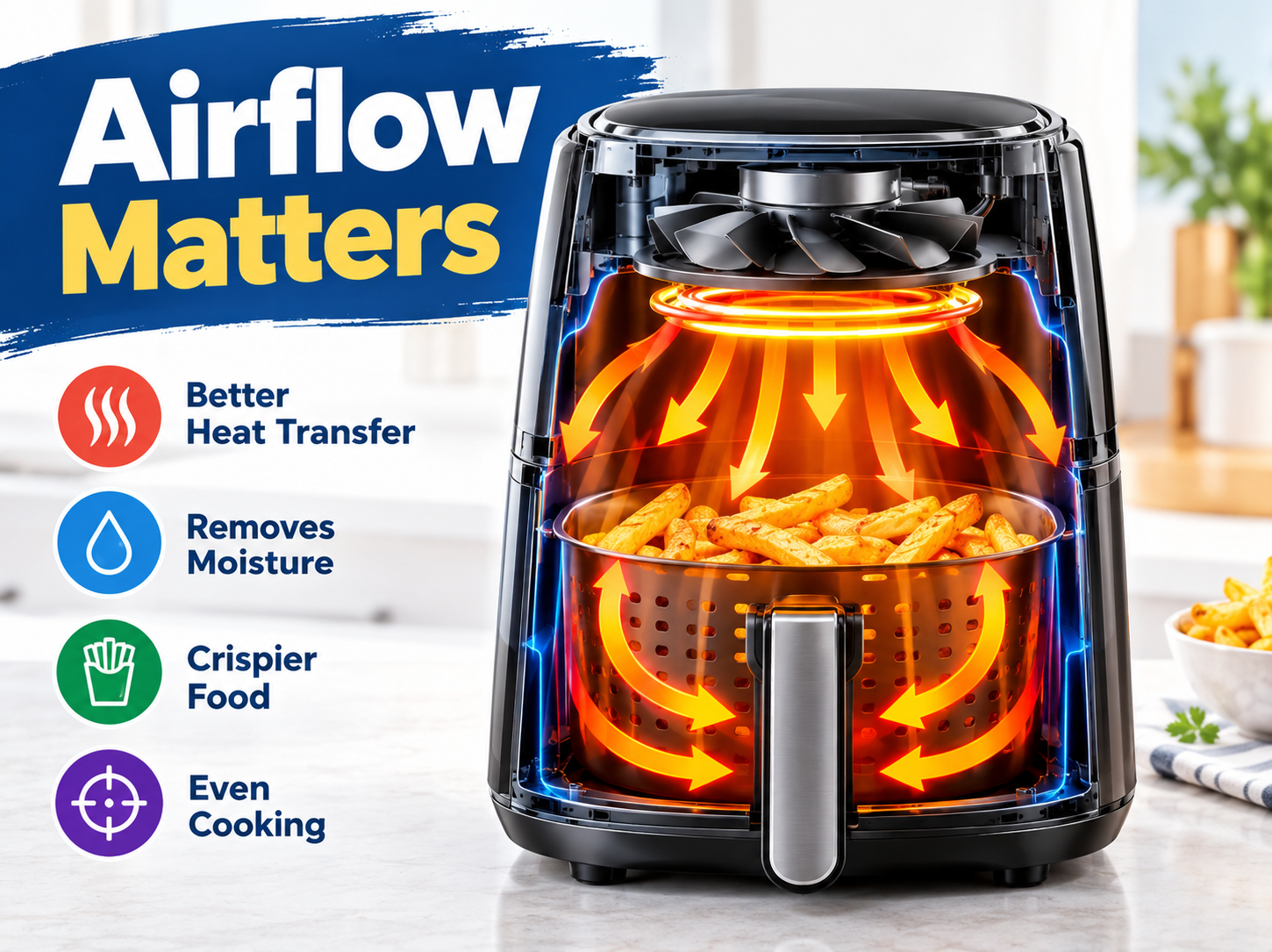
In a typical basket-style air fryer, the heating element is positioned near the top of the cooking chamber, with a fan and motor located nearby. The fan circulates air around the heating element and through the cooking chamber.
The hot air then moves around the food, helping transfer heat and remove surface moisture.
This is why air frying performance depends on more than heater wattage.
Three major factors are closely connected:
l Heating power
l Airflow
l Temperature control
Independent air fryer testing has also found that heating element power and fan speed need to be properly matched to the cooking chamber and food load. Too little heating power can result in slow temperature recovery, while excessive airflow without sufficient heating power can reduce the ability of the system to maintain the target temperature.
For OEM and ODM buyers, the key question should therefore be:
How does the heating element work together with the fan, airflow system and cooking chamber?
2. What Is a Halogen Heating Element?
A halogen heating element typically uses a quartz tube containing a tungsten filament and halogen gas.
When electrical current passes through the filament, it becomes extremely hot and produces both infrared radiation and visible light.
One of the main characteristics of halogen heating is its rapid thermal response.
Compared with a conventional tubular heating element, a halogen element can reach a high operating temperature very quickly. This makes it attractive for applications where rapid heating response and strong radiant heat are important.
Typical characteristics of halogen heating elements include:
l Fast heat-up response
l Strong radiant heat
l High operating temperature
l Compact heating structure
l Visible glow during operation
l Rapid response to power changes
However, a fast-response heating element does not automatically produce better overall air frying performance.
The fan, airflow path, cooking chamber and temperature-control system still determine how effectively the generated heat reaches the food.
3. What Is a Stainless Steel Heating Tube?
A stainless steel heating tube is a tubular resistive heating element.
A typical tubular heater consists of a metal outer sheath, an internal resistance wire and electrically insulating material between the wire and the sheath.
The electrical resistance wire generates heat, and the heat is transferred through the metal sheath to the surrounding air and other components.
Stainless steel tubular heating elements are widely used in heating appliances because their tubular construction allows manufacturers to create different shapes and configurations.
Common designs may include:
l U-shaped heating tubes
l M-shaped heating tubes
l Circular or ring-shaped elements
l Customized tubular heating structures
For air fryers, the heating tube can be positioned above or below the food basket depending on the product architecture.
The main characteristics are generally:
l Stable heating
l Robust tubular construction
l Flexible mechanical design
l Suitable for continuous heating
l Broad OEM/ODM application
l Relatively straightforward integration into conventional designs
4. Halogen vs. Stainless Steel Heating Tube: How Are They Different?
The fundamental difference is how the heating element generates and transfers heat.
Feature | Halogen Heating Element | Stainless Steel Heating Tube |
Heating technology | Filament-based radiant heating | Tubular resistance heating |
Main heat transfer | Strong radiant heat + convection | Mainly convection through heated air |
Thermal response | Very fast | More gradual |
Visible glow | Usually visible | Usually not visible |
Structure | Quartz tube + filament | Metal sheath + resistance wire + insulation |
Mechanical structure | More sensitive to physical damage | Robust tubular construction |
Design flexibility | Suitable for compact/high-response designs | Highly flexible tubular shapes |
Product positioning | Can support premium/fast-response designs | Suitable for mainstream and customized designs |
Airflow dependence | High | High |
Overall cooking performance | Depends on complete system | Depends on complete system |
The important point is that the heating element does not work independently.
An air fryer with a powerful heater but poorly designed airflow may perform worse than a model with a well-balanced heating and airflow system.
5. Heat-Up Speed: Which Heating Element Responds Faster?
One of the biggest differences between the two technologies is thermal response.
Halogen Heating
Halogen elements can heat up extremely quickly because the filament reaches a high temperature rapidly.
This can be useful for:
l Rapid preheating
l Fast surface heating
l Browning
l High-temperature cooking
l Products emphasizing quick thermal response
Stainless Steel Heating Tube
Tubular heating elements generally have more thermal mass and a more gradual heating response.
However, this does not mean they are unsuitable for air fryers.
A properly designed tubular heating system can provide stable and consistent heat over the cooking cycle.
Important distinction: preheating speed vs. cooking performance
A fast preheat does not necessarily mean that the air fryer cooks food faster.
Once food is added to the basket, the system must recover the heat lost to the food and maintain the target temperature.
Therefore:
Fast heat-up and fast temperature recovery are related, but they are not exactly the same thing.
For B2B buyers, temperature recovery after adding cold or frozen food can be more meaningful than preheating time alone.
6. Radiant Heat vs. Convective Heat
Another important difference is the way heat reaches the food.
Halogen: Strong Radiant Heating
Halogen elements produce strong infrared radiation.
This radiant energy can directly heat surfaces exposed to the heating element.
In an air fryer, this can contribute to:
l Surface browning
l Rapid color development
l High-temperature cooking
l Fast thermal response
Stainless Steel Tube: Strong Role in Convection
A tubular heating element primarily heats the surrounding air.
The fan then moves the heated air around the cooking chamber.
The process can be simplified as:
Heating Element → Hot Air → Fan → Airflow → Food
This makes the fan and airflow design particularly important.
Does radiant heating automatically mean better cooking?
No.
The final result depends on the balance between:
l Heating power
l Radiant heat
l Airflow
l Fan speed
l Cooking chamber geometry
l Food load
l Temperature control
Therefore, the best heating element is not necessarily the one that produces the most heat.
It is the one that provides the right heat in the right place at the right time.
7. Does a Halogen Heating Element Make an Air Fryer Crispier?
This is one of the questions buyers may ask.
The short answer is:
A halogen element can contribute to strong surface heating and browning, but it does not automatically make an air fryer crispier.
Crisping depends heavily on moisture removal and convective heat transfer.
The fan needs to circulate sufficiently hot air around the food while carrying moisture away from the food surface.
This means:
Heating Element + Fan + Airflow + Temperature = Crisping Performance
For example, an air fryer with a powerful halogen element but weak airflow may generate strong surface radiation while failing to remove moisture efficiently.
Conversely, a conventional tubular heater with a well-designed airflow system can deliver strong air-frying performance.
For this reason, B2B product development should evaluate the complete heating system, rather than focusing on the heating element alone.
8. Heating Uniformity: Is Halogen or Stainless Steel Better?
Heating uniformity is another area where simple comparisons can be misleading.
Uniform cooking depends on several factors:
l Heating element position
l Fan position
l Fan blade design
l Airflow direction
l Basket geometry
l Distance between heater and food
l Cooking chamber size
l Food quantity
l Temperature sensor position
A heating element can provide strong heat while still producing uneven results if the airflow pattern is poorly designed.
This is especially important for:
l Large-capacity air fryers
l Dual-basket air fryers
l Vertical air fryers
l Multi-layer cooking systems
l Products with high food loads
Therefore:
Heating uniformity is a system-design issue, not simply a heating-element issue.
For OEM/ODM projects, prototype testing should evaluate temperature distribution at different positions inside the cooking chamber.
9. Durability and Thermal Cycling
Heating elements repeatedly experience heating and cooling during normal use.
This creates thermal expansion and contraction.
For B2B buyers, the durability of a heating system should therefore be evaluated under repeated operating cycles rather than by looking at the material name alone.
Halogen Heating Element
Key considerations include:
l Quartz tube construction
l Filament stability
l Mechanical protection
l Mounting method
l Thermal cycling
l Electrical connections
l Protection from impact during assembly and transportation
Stainless Steel Heating Tube
Key considerations include:
l Stainless steel sheath material
l Resistance wire
l Insulation
l Tube geometry
l Welding and terminals
l Mounting structure
l Thermal cycling
l Corrosion resistance
Neither technology should automatically be described as “more durable.”
Actual service life depends on the component design, operating temperature, electrical parameters, thermal cycling, mechanical mounting and quality-control process.
10. Safety and Compliance Considerations
For an air fryer supplier or brand owner, heating-element selection is also a safety and compliance issue.
Important areas include:
l Electrical insulation
l Leakage current
l Dielectric strength
l Thermal protection
l Over-temperature protection
l Thermal fuse
l Abnormal operation
l Component spacing
l Surface temperature
l Material compliance
l Mechanical stability
The relevant international safety framework should be checked according to the target market and product configuration.
As of September 2026, IEC lists IEC 60335-2-9:2026 PRV as a pre-release version covering portable cooking appliances including air fryers. The document includes new or revised requirements relating to portable air fryers, forced-air circulation and simultaneous activation of heating elements and motors. It is currently a pre-release version during its 2026-09-04 to 2026-10-16 voting period, so buyers should not treat it as the final published edition yet.
For OEM/ODM projects, certification requirements should therefore be confirmed based on:
l Target country
l Rated voltage
l Product architecture
l Heating system
l Motor system
l Control system
l Applicable certification scheme
11. Cost and Product Positioning
Heating-element selection also affects product cost.
However, comparing only the unit price of a halogen tube with a stainless steel tube is not enough.
The total cost may include:
l Heating element
l Mounting components
l Wiring
l Connectors
l Thermal protection
l Control components
l PCB requirements
l Assembly
l Testing
l Tooling
l Quality control
l Certification
Halogen Heating Element
A halogen-based design may be considered for:
l Premium positioning
l Fast thermal response
l Strong radiant heating
l High-temperature product concepts
l Differentiated cooking performance
Stainless Steel Heating Tube
A tubular heating system may be considered for:
l Mainstream products
l Cost-sensitive projects
l Conventional air fryer architectures
l Stable continuous heating
l Customized tubular configurations
The final product cost depends on the complete product specification rather than the heating element alone.
12. Can an Air Fryer Use Both Halogen and Stainless Steel Heating Elements?
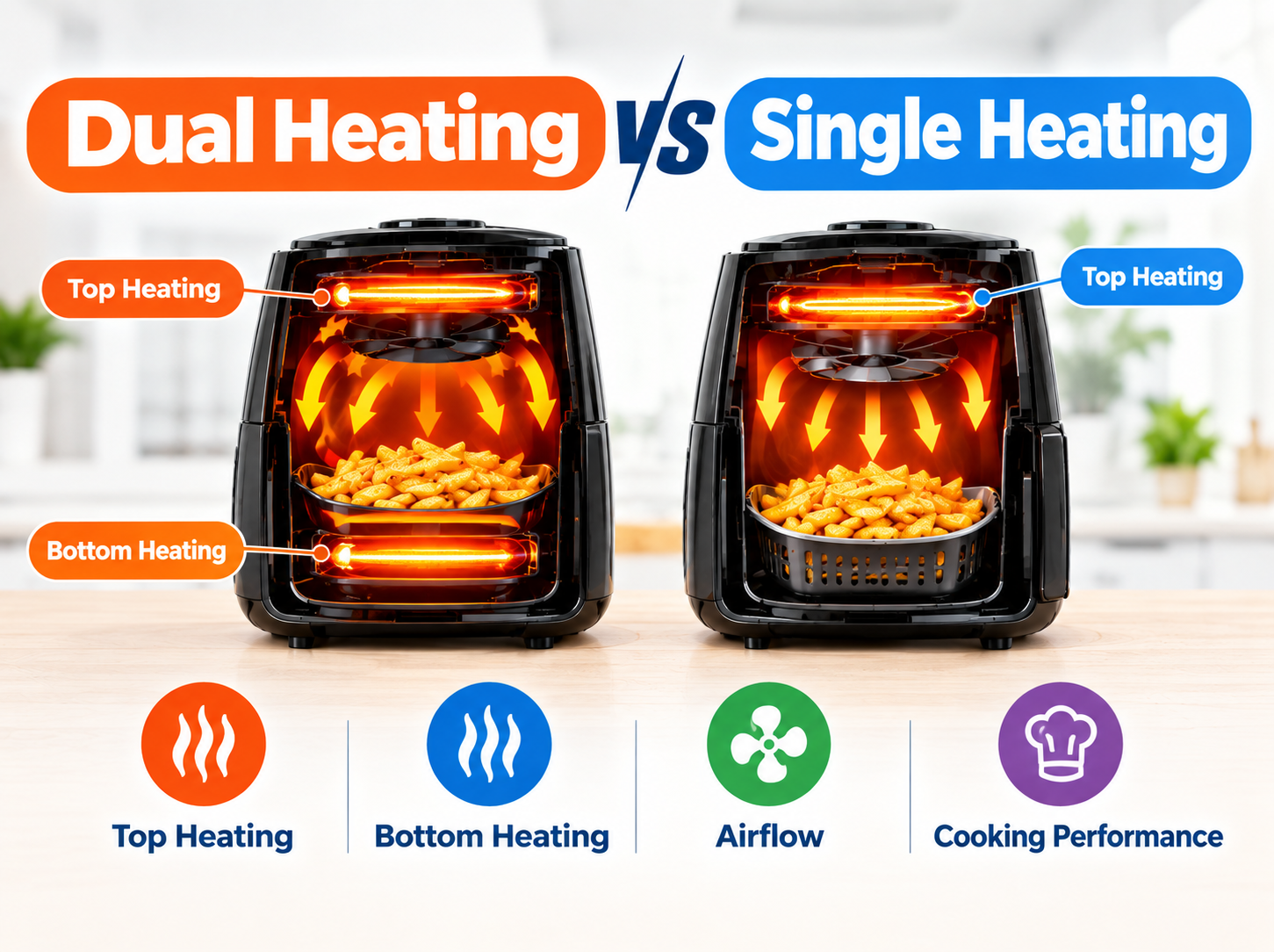
Yes. A product can be designed with both technologies.
A dual-heating system can assign different roles to different heating elements.
For example:
Upper Halogen Heating Element
→ Fast radiant heating and surface browning
Lower Stainless Steel Heating Element
→ Additional bottom heating
Fan & Motor
→ Forced hot-air circulation
Temperature Sensor & Controller
→ Temperature monitoring and control
This type of architecture can provide manufacturers with more flexibility when developing a specific cooking profile.
However, adding a second heating element does not automatically improve performance.
The power distribution, airflow, control logic, thermal balance and cooking chamber design must all be optimized together.
13. FUNLOIV Case Study: Dual Heating with Halogen and S/S 304
A practical example is FUNLOIV's FL-AF8081DWS 8L Premium Metal-Body Air Fryer.
Its published specifications include:
l 8.0L capacity
l 1500–2000W total power
l 1500W upper halogen heating element
l 500W bottom S/S 304 heating element
l 60–230°C temperature control
l High-speed fan
l Full metal cavity
l 12 preset cooking functions
l Transparent viewing window
The product uses the two heating technologies as part of one heating system rather than treating them as competing alternatives.
The basic concept can be illustrated as:
1500W Upper Halogen Element
↓
Rapid radiant heating
500W Bottom S/S 304 Element
↓
Additional bottom heating
High-Speed Fan
↓
Forced hot-air circulation
Cooking Chamber
↓
Heat distribution around food
This illustrates an important point for OEM/ODM buyers:
Halogen and stainless steel heating tubes do not always have to be alternatives. They can also be combined when the product architecture requires different heating functions.
The actual performance of such a system still needs to be validated through prototype and cooking tests.
14. Which Heating Element Should OEM/ODM Buyers Choose?
There is no universal answer.
Instead, buyers should start with the product requirements.
Product Requirement | Design Consideration |
Fast thermal response | Consider halogen |
Strong radiant heat | Consider halogen |
Stable conventional heating | Consider tubular heating |
Cost-sensitive positioning | Evaluate tubular heating solutions |
Premium positioning | Evaluate halogen or hybrid heating |
Large-capacity air fryer | Evaluate heater + fan + chamber together |
Dual-heating design | Consider different heating elements for different zones |
High-temperature cooking | Evaluate element temperature capability and protection |
Customized OEM/ODM | Select based on target cooking performance and market |
The correct question is therefore not:
“Which heating element is better?”
A better question is:
“Which heating element configuration is best matched to our target capacity, cooking performance, temperature range, price positioning and market requirements?”
15. What Should Buyers Ask an Air Fryer Supplier About the Heating Element?
Before approving a sample, B2B buyers should ask the supplier for specific technical information.
Heating Element
l What type of heating element is used?
l What is the rated wattage?
l What material is used?
l Where is the heating element positioned?
l Is the element upper, lower or dual heating?
Airflow
l What motor type is used?
l What is the fan diameter?
l What is the approximate fan speed?
l How is the airflow distributed?
l How does the airflow interact with the heating element?
Temperature
l What is the maximum temperature?
l Where is the temperature sensor positioned?
l How accurate is temperature control?
l What is the temperature recovery time after food is added?
Safety
l Is a thermal fuse included?
l What over-temperature protection is used?
l What abnormal-operation tests are performed?
l Which certifications are available for the target market?
Reliability
l How is the heating element tested?
l What thermal-cycle testing is performed?
l How is sample-to-production consistency controlled?
l What is the failure rate during production testing?
A reliable supplier should be able to explain not only what heating element is used, but also why it was selected for the specific air fryer design.
16. How Should Buyers Test the Heating System Before Bulk Production?
A supplier's specification sheet is only the starting point.
Before placing a bulk order, buyers should test the actual sample.
Recommended tests include:
Ø Preheating Test
Measure the time required to reach the selected temperature.
Ø Temperature Recovery Test
Add a defined food load and measure how quickly the cooking chamber returns toward the target temperature.
Ø Temperature Distribution Test
Measure temperatures at different locations inside the cooking chamber.
Ø Cooking Performance Test
Use standardized food loads such as frozen fries, chicken wings or other representative products.
Ø Airflow Test
Evaluate whether hot air reaches different areas of the basket consistently.
Ø Continuous Operation Test
Run repeated cooking cycles to evaluate thermal stability.
Ø Thermal Protection Test
Verify the operation of thermal protection components under abnormal conditions according to the applicable test requirements.
Ø Sample-to-Production Consistency
The heating performance of the approved golden sample should be compared with mass-production units.
This is particularly important for OEM/ODM projects because changing the heating element supplier, resistance value, mounting structure or fan system during production can affect the final cooking performance.
17. Frequently Asked Questions
Is halogen better than stainless steel heating tubes in an air fryer?
Not necessarily. Halogen heating elements offer fast thermal response and strong radiant heating, while stainless steel tubular elements offer stable resistive heating and flexible mechanical designs. The better choice depends on the complete heating, airflow and temperature-control system.
Does a halogen heating element make an air fryer cook faster?
It can provide a faster thermal response, but total cooking speed depends on heating power, airflow, temperature recovery, chamber design and food load.
Does halogen make food crispier?
Not automatically. Halogen can provide strong radiant heat that supports surface browning, but crisping also depends heavily on airflow and moisture removal.
Are stainless steel heating tubes more durable?
Not automatically. Durability depends on the heating element's construction, materials, mounting, operating temperature, thermal cycling and manufacturing quality.
Can an air fryer use both halogen and stainless steel heating elements?
Yes. A dual-heating design can use different heating technologies for different heating zones or functions.
Which heating element is better for a premium air fryer?
A premium product can use halogen, stainless steel tubular heating, or a combination of both. Product positioning alone should not determine the heating element; cooking requirements, thermal performance, safety, reliability and target cost should also be considered.
What should I ask an air fryer supplier about the heating element?
Ask about the heating technology, wattage, material, position, temperature range, thermal protection, airflow system, testing procedures, certification and sample-to-production consistency.
Conclusion: The Best Air Fryer Heating Element Depends on the Complete System
Halogen and stainless steel tubular heating elements have different characteristics.
Halogen heating elements can provide rapid thermal response and strong radiant heating, making them suitable for certain premium, high-response and differentiated air fryer designs.
Stainless steel heating tubes provide stable resistive heating and flexible mechanical configurations, making them suitable for a wide range of conventional and customized air fryer products.
But the heating element is only one part of the system.
For an air fryer, the final cooking performance depends on the relationship between:
Heating Element → Motor → Fan → Airflow → Temperature Control → Cooking Chamber → Food
For OEM and ODM buyers, the objective should not be to select the most advanced-looking heating technology.
The objective should be to select the right heating system for the target product.
At FUNLOIV, we can support air fryer projects based on target capacity, temperature range, heating configuration, airflow requirements, product positioning and market requirements.
If you are developing a new air fryer, send us your target capacity, heating requirements and market specifications. We can help evaluate the appropriate heating-element configuration for your OEM/ODM project.
Key Takeaways
l Halogen heating elements provide very fast thermal response and strong radiant heat.
l Stainless steel tubular heating elements provide stable resistive heating and flexible designs.
l Neither heating technology is automatically better for every air fryer.
l Heating-element performance must be evaluated together with fan speed, airflow and temperature control.
l Fast preheating does not necessarily mean faster overall cooking.
l Crisping performance depends heavily on heat transfer and moisture removal.
l Both heating technologies can be used in the same air fryer.
l OEM/ODM buyers should evaluate heating performance through actual sample testing before mass production.

How to Choose an OEM/ODM Air Fryer Supplier in China:
Top Heating vs. Rear Heating Air Fryer:
Why Does Airflow Matter in an Air Fryer?
A Dual Heating vs. Single Heating Air Fryer: Which Is Better?

Why Personal Care Appliances Become Popular Globally?
Can An Air Fryer Replace A Toaster Oven?
 + 86 181 3826 8709
 info@funloiv.com
 6/F., Guanglong Building, Pingxin North Road, Longgang, Shenzhen City, Guangdong, China


@ 2009-2026 Shenzhen Funloiv Electric Appliance Co., LtdAll rights reserved


