Notice:

 search
search
search
Sep 19, 2026


When buyers compare air fryers, they often focus on capacity, wattage, temperature range and cooking programs.
However, another component plays a critical role in cooking performance:
Airflow.
Airflow is what moves heated air around the food and helps transfer heat from the heating system to the cooking chamber and food.
A simplified air fryer system can be described as:
Heating Element → Motor → Fan → Airflow → Food → Moisture Removal
The heating element generates heat, while the motor drives the fan that moves the air. The airflow then carries heat through the cooking chamber and around the food.
This means an air fryer is not simply a heating appliance.
It is a heating + airflow + temperature-control system.
So, why does airflow matter in an air fryer?
Airflow affects heat transfer, moisture removal, cooking uniformity, temperature recovery and ultimately the cooking performance of the appliance.
However, there is an important point for product developers and B2B buyers:
More airflow does not automatically mean better air frying. The goal is optimized airflow, not maximum airflow.
The fan, heating element, cooking chamber and food load need to be properly matched.
1. What Is Airflow in an Air Fryer?
Airflow refers to the movement and circulation of air inside the air fryer's cooking chamber.
In a typical basket-style air fryer, a motor drives a fan. The fan moves air through or around the heating element before directing the heated air toward the food.
A simplified airflow path is:
Fan → Heating Element → Hot Air → Cooking Chamber → Food → Recirculation
The exact airflow path varies according to the product architecture.
Factors such as fan position, heating-element position, basket geometry, air inlets, air outlets and chamber shape all influence how air moves inside the appliance.
For a B2B air fryer project, therefore, it is not enough to specify:
"Use a high-speed fan."
The more important question is:
How is the airflow distributed throughout the cooking chamber?
2. Why Does Airflow Matter in an Air Fryer?
Airflow matters because it helps transfer heat from the heating element to the food and removes moisture from the food surface.
There are four major areas where airflow influences performance:
Ø Heat Transfer
Moving hot air transfers thermal energy to the food.
Ø Moisture Removal
Airflow carries moisture away from the food surface, supporting browning and crisping.
Ø Cooking Uniformity
A well-designed airflow system can distribute heat more consistently around the food.
Ø Temperature Recovery
Airflow works together with heating power to restore the cooking environment after cold or frozen food is added.
Therefore:
Airflow is one of the key links between the heating element and the food.
Without sufficient and properly distributed airflow, an air fryer may generate plenty of heat but still fail to transfer that heat effectively to the food.
3. How Does an Air Fryer Airflow System Work?
Although air fryer structures vary, many basket-style designs use a fan located close to the heating element.
The basic process is:
Ø Step 1: The Heating Element Generates Heat
The heating element converts electrical energy into thermal energy.
Ø Step 2: The Motor Drives the Fan
The motor rotates the fan at a specified speed.
Ø Step 3: The Fan Moves Air
The fan draws and pushes air through the heating area.
Ø Step 4: Heated Air Enters the Cooking Chamber
The hot air is directed toward the food basket.
Ø Step 5: Air Moves Around the Food
The airflow passes around and through the perforated basket or cooking tray.
Ø Step 6: Moisture Is Carried Away
Water vapor released from the food is carried away with the moving air.
Ø Step 7: Air Recirculates
Much of the air can be recirculated through the heating system, while some air is exhausted from the appliance.
This creates a continuous thermal cycle.
Heating → Airflow → Food → Moisture Removal → Recirculation
The effectiveness of this cycle depends heavily on the design of the fan, heating element, chamber and airflow path.
4. How Does Airflow Affect Heat Transfer?
One of the most important functions of airflow is to improve convective heat transfer.
The heating element generates thermal energy, but the food does not simply "receive" that heat automatically.
The moving air acts as the carrier.
In simplified terms:
Heating Element → Heated Air → Moving Air → Food Surface
When air moves over the food, it transfers heat to the food surface.
At the same time, the moving air can carry moisture away from the surface.
This is one reason air fryer performance depends on both:
l Heating power
l Airflow
Increasing only one of these variables may not produce the expected improvement.
For example, if the fan moves a large amount of air but the heating element cannot provide enough energy to maintain the target temperature, the additional airflow may not improve cooking performance.
Therefore:
The heating element and airflow system should be designed as one thermal system.
5. Does Higher Airflow Make an Air Fryer Cook Faster?
Not necessarily.
This is one of the most important points for air fryer product development.
Higher airflow can improve heat transfer under the right conditions. However, airflow needs to be balanced with:
l Heating power
l Cooking chamber volume
l Fan size
l Fan speed
l Airflow resistance
l Temperature-control strategy
l Food load
If airflow is too low, heat and moisture may not be moved effectively.
If airflow is too high relative to the available heating power, the system may struggle to maintain the target temperature.
Independent testing of air fryers has demonstrated this relationship: increasing fan speed without increasing available heating power can reduce temperature recovery, while matching increased airflow with sufficient heater power can improve overall heat transfer.
Therefore, the objective should not be:
Maximum Airflow
It should be:
Optimized Airflow
6. How Does Airflow Affect Crispiness?
Crispiness is one of the main reasons consumers buy air fryers.
But crisping is not simply a matter of increasing temperature.
The process also involves removing moisture from the food surface.
A simplified process is:
Hot Air + Airflow → Heat Transfer + Moisture Removal → Browning and Crisping
When food is heated, moisture moves toward the surface.
If the surrounding air is already humid and relatively stagnant, moisture removal becomes less effective.
Strong, well-directed airflow can continuously move drier hot air across the food surface and carry away moisture.
This can help create a drier surface that is more suitable for browning and crisping.
Therefore:
Airflow contributes to crisping by supporting both heat transfer and surface moisture removal.
But again, more airflow is not automatically better.
The airflow must be appropriate for the heating power and cooking chamber.
7. Does More Airflow Always Make Food Crispier?
No.
This is an important distinction for both consumers and product developers.
Too little airflow can result in:
l Slow heat transfer
l High humidity
l Poor moisture removal
l Uneven cooking
l Softer food surfaces
But excessive airflow can also create problems if the heating system cannot supply enough energy to maintain the required air temperature.
In addition, very high fan speeds can introduce:
l Higher motor load
l More noise
l More vibration
l Greater airflow resistance
l Potential food movement in extreme cases
Therefore:
The best air fryer airflow is not necessarily the strongest airflow. It is the airflow that is correctly matched to the heating system and cooking chamber.
8. How Does Airflow Affect Cooking Uniformity?
Another important function of airflow is distributing heat throughout the cooking chamber.
Imagine two areas inside an air fryer:
Zone A: Strong airflow
Zone B: Weak airflow
Even if the average chamber temperature is correct, food located in these two zones may cook differently.
This can create:
l Uneven browning
l Different cooking times
l Overcooked areas
l Undercooked areas
l Inconsistent product results
This is why airflow distribution matters as much as airflow volume.
Several design factors affect airflow uniformity:
l Fan position
l Fan diameter
l Fan blade geometry
l Heating-element position
l Basket design
l Basket perforation
l Chamber geometry
l Air inlet position
l Air outlet position
l Food load
A well-designed airflow system should minimize low-airflow or "dead" zones around the food.
9. Does Higher Fan Speed Always Mean Better Airflow?
No. Fan speed is only one factor that affects airflow.
Actual airflow depends on multiple variables, including:
l Fan RPM
l Fan diameter
l Fan blade design
l Blade angle
l Motor torque
l Air pressure
l Airflow resistance
l Housing geometry
l Air inlet and outlet design
For example, a larger fan operating at a lower RPM can produce a different airflow pattern from a smaller fan operating at a higher RPM.
This is especially important for large-capacity air fryers.
As cooking chambers become larger, the airflow system may need to be redesigned rather than simply increasing fan RPM.
Therefore, OEM/ODM buyers should not evaluate an air fryer fan only by its maximum RPM.
A better specification approach considers:
Motor + Fan + Airflow + Heating Power + Chamber Volume
10. What Is the Relationship Between the Motor, Fan and Airflow?
The motor is the power source for the fan.
The fan converts the motor's rotational energy into air movement.
The airflow then transfers heat through the cooking chamber.
The basic relationship is:
Motor → Fan → Airflow → Heat Transfer
This is why motor selection is important in air fryer development.
Different motor technologies may provide different options for:
l Speed
l Torque
l Control
l Noise
l Efficiency
l Reliability
l Product cost
For example, BLDC motors can offer greater flexibility for electronic speed control when properly designed with the appropriate controller.
However, the motor type alone does not determine the final airflow performance.
The fan geometry and complete airflow system remain equally important.
Related Guide:
What Is the Difference Between AC and BLDC Motors in Air Fryers?
11. How Should Airflow Match the Heating Element?
The heating element and airflow system should be selected together.
Consider a simplified example.
Heating Element
Provides:
1500W of thermal power
Fan
Creates:
A specific volume and velocity of airflow
The airflow carries the generated heat toward the food.
If the fan is too weak:
l Heat transfer may be limited
l Moisture removal may be slower
l Cooking may become less uniform
If the fan is too strong:
l Air may move too quickly
l The heater may not supply enough energy to maintain air temperature
l Noise may increase
l Temperature recovery may suffer
Therefore:
Airflow and heating power need to be balanced rather than optimized independently.
This principle is particularly important when changing the heating element.
For example, switching from a conventional tubular heater to a high-response halogen heater may change the thermal behavior of the system. The fan, control strategy and temperature sensing may need to be evaluated at the same time.
Related Guide:
Air Fryer Heating Element: Halogen vs. Stainless Steel Heating Tube
12. How Does Airflow Change with Air Fryer Capacity?
Air fryer capacity has a direct impact on airflow requirements.
A 3L air fryer and an 8L air fryer do not have the same:
l Cooking chamber volume
l Food load
l Basket area
l Airflow path
l Heating requirements
As capacity increases, the airflow system may need:
l A larger fan
l A stronger motor
l Different fan geometry
l Higher airflow volume
l Improved air distribution
l More heating power
However, simply increasing motor speed is not always the right solution.
The larger chamber may also require changes to:
l Air inlet design
l Air outlet design
l Basket perforation
l Heating-element position
l Fan shroud
l Internal airflow channels
For large-capacity air fryers, the entire thermal system should therefore be evaluated during product development.
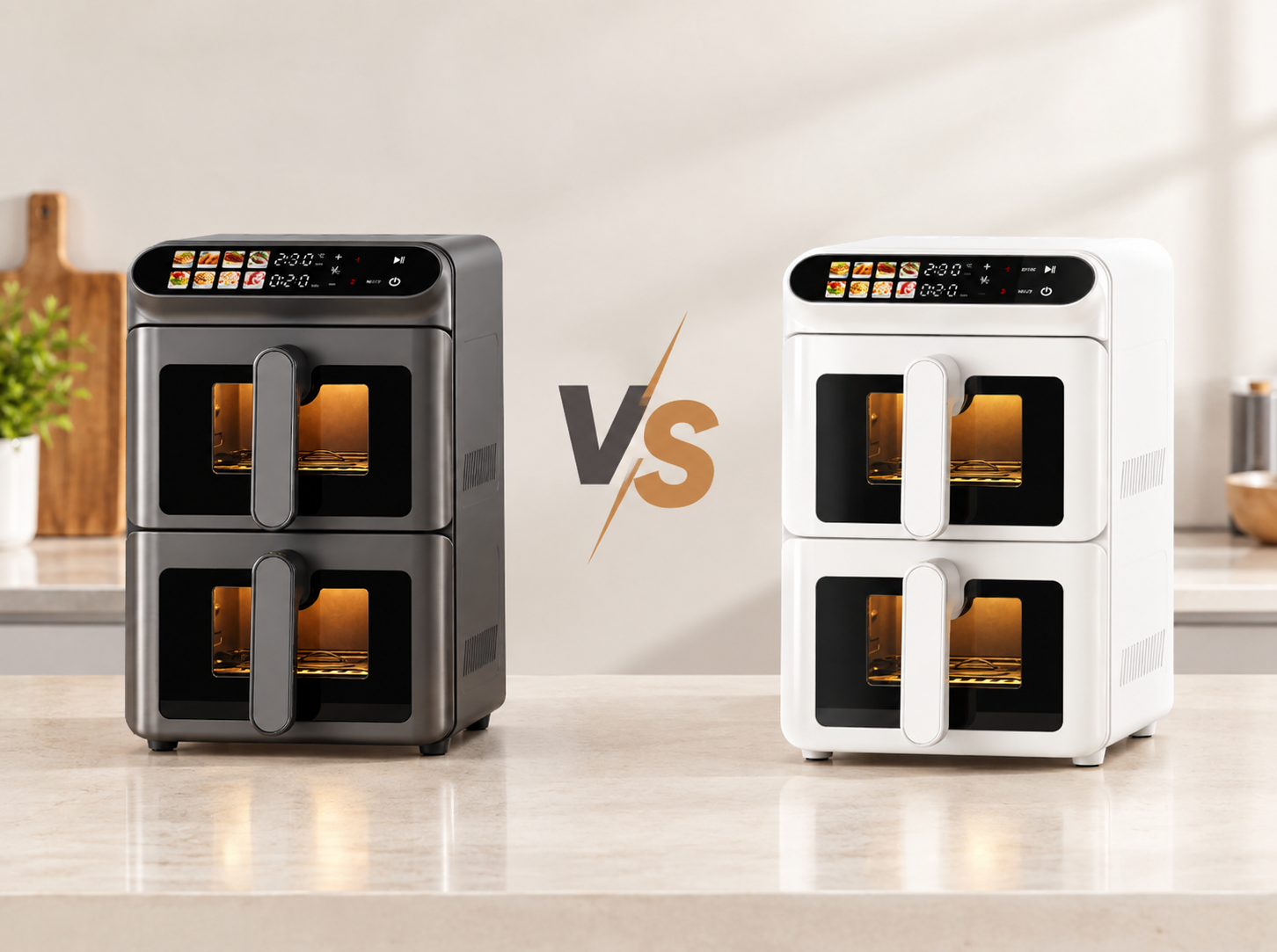
13. Why Is Airflow Especially Important in Dual-Basket and Vertical Air Fryers?
Dual-basket and vertical air fryers introduce additional airflow challenges.
A conventional single-basket air fryer has one primary cooking chamber.
A dual-basket model may have:
l Two separate cooking zones
l One shared heating system
l Multiple heating elements
l Multiple fans
l Independent airflow paths
A vertical air fryer may introduce another challenge:
How does hot air reach both the upper and lower cooking zones?
The design needs to consider:
l Airflow distribution between levels
l Pressure differences
l Airflow resistance
l Food load
l Heating-zone balance
l Temperature differences
l Potential dead zones
For these products, airflow should be validated under both:
Empty-basket conditions
and
Full-load cooking conditions
because food can significantly change the airflow resistance inside the chamber.
14. Airflow, Noise and Vibration
Airflow performance should also be balanced against acoustic performance.
A stronger airflow system may require:
l Higher fan speed
l Larger fan
l Higher motor output
But these changes can also affect:
l Fan noise
l Motor noise
l Vibration
l Mechanical resonance
A good air fryer airflow system therefore needs to balance:
Airflow Performance + Cooking Performance + Noise + Reliability
For OEM/ODM buyers, noise should be tested at the actual operating condition rather than judged only from the motor specification.
The fan blade, housing, mounting structure and airflow path can all contribute to the final sound level.
15. Airflow and Energy Consumption
It is tempting to assume that stronger airflow automatically means higher energy consumption.
However, energy performance should be evaluated at the appliance level.
The main energy-consuming components include:
l Heating element
l Motor
l Control electronics
The heating element usually represents a much larger portion of total appliance power than the fan motor.
At the same time, an optimized airflow system may help the appliance transfer heat effectively and reach the desired cooking result within an appropriate cooking time.
Therefore:
Airflow efficiency should be evaluated together with heating power, cooking time and temperature control rather than by motor power alone.
16. How Should B2B Buyers Test Airflow in an Air Fryer?
For OEM and ODM buyers, airflow should be tested rather than evaluated only from a specification sheet.
Here is a practical checklist.
Ø Temperature Distribution Test
Measure temperatures at different locations inside the cooking chamber.
Ø Airflow Distribution Test
Evaluate whether air reaches different parts of the basket consistently.
Ø Temperature Recovery Test
Preheat the appliance, add a defined food load and measure how quickly the system recovers toward the target temperature.
Ø Cooking Uniformity Test
Place standardized food samples in different basket positions and compare the results.
Ø Crisping Test
Use a standardized food load to evaluate browning and moisture loss.
Ø Full-Load Test
Test the appliance with the intended maximum or representative food load.
Ø Noise Test
Measure sound levels during normal operation and different cooking modes.
Ø Vibration Test
Check the fan and motor assembly for abnormal vibration.
Ø Continuous Operation Test
Run repeated cooking cycles to evaluate thermal stability.
Ø Sample-to-Production Test
Compare mass-production units with the approved golden sample.
For a new OEM/ODM project, these tests can help identify airflow problems before mass production.
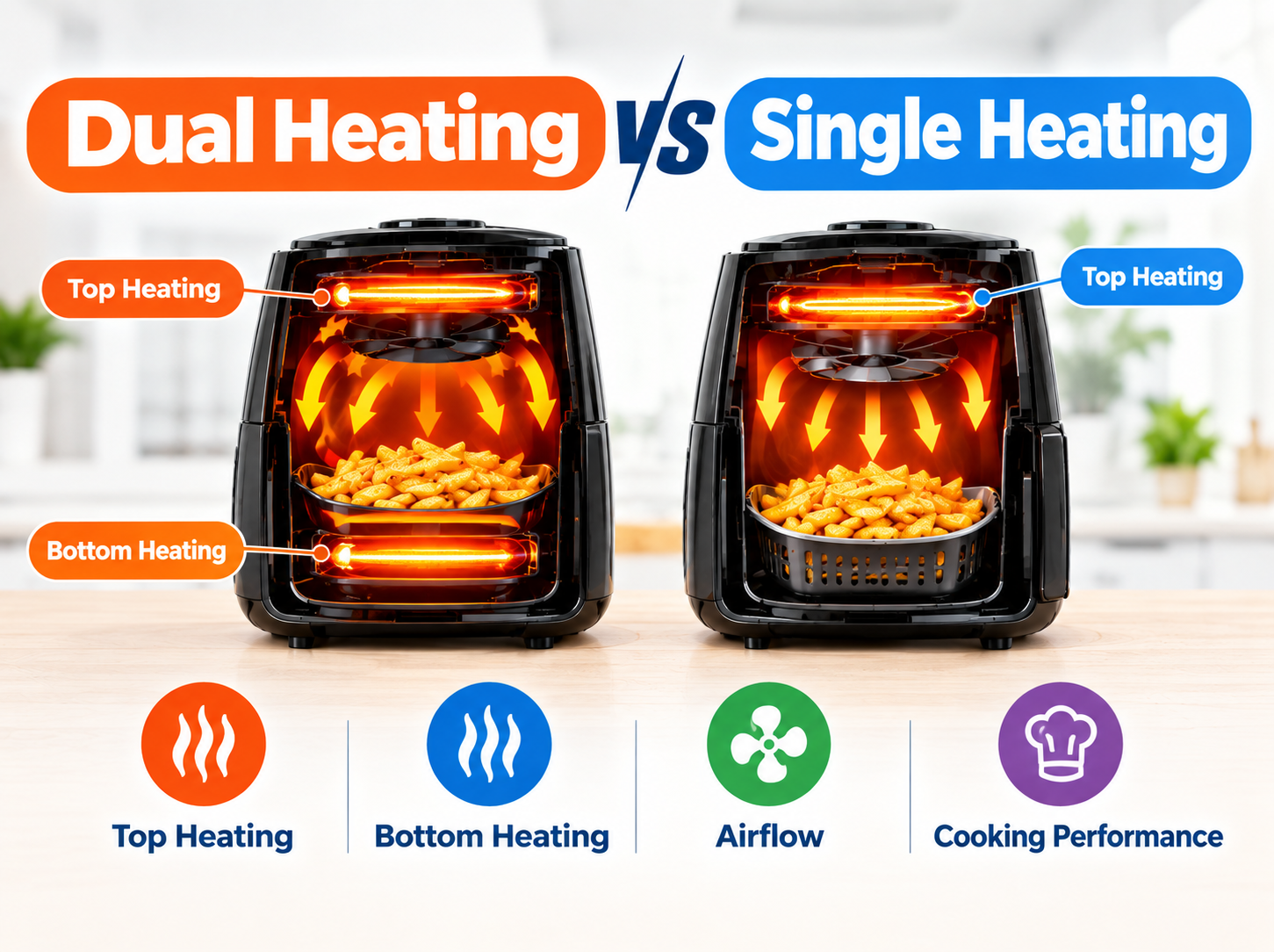
17. FUNLOIV Case Study: Heating Element + Fan + Airflow
A practical example can be found in FUNLOIV's FL-AF8081DWS 8L premium metal-body air fryer.
The published configuration includes:
l 8L capacity
l 1500–2000W power
l 1500W upper halogen heating element
l 500W bottom S/S 304 heating element
l 60–230°C temperature range
l High-speed fan
l Full metal cavity
l 12 preset cooking functions
The important point is not simply the total wattage.
The product combines:
Ø Upper Halogen Heating Element
↓
Rapid heat generation and radiant heating
Ø Bottom S/S 304 Heating Element
↓
Additional heating from the lower area
Ø High-Speed Fan
↓
Forced hot-air circulation
Ø Cooking Chamber
↓
Heat distribution around the food
This demonstrates an important OEM/ODM principle:
Heating elements, motors, fans and airflow should be considered as one integrated cooking system.
A change to one major component can affect the performance of the other components.
For example, changing the fan, heating element or cooking chamber size may require the airflow and temperature-control system to be re-evaluated.
18. What Should Buyers Ask an Air Fryer Supplier About Airflow?
Before approving an air fryer sample, B2B buyers should ask the supplier specific technical questions.
Motor and Fan
l What type of motor is used?
l What is the fan diameter?
l What is the operating fan speed?
l Is fan speed fixed or variable?
l What is the expected motor service life?
Airflow
l How is the airflow distributed?
l Where is the fan positioned?
l Where are the air inlets and outlets?
l How was the airflow system validated?
l Are there potential dead zones?
Heating System
l What type of heating element is used?
l What is the rated heating power?
l Where is the heating element positioned?
l How is the heating element matched to the fan?
Performance
l How quickly does the product recover temperature?
l How is temperature uniformity tested?
l How is cooking uniformity validated?
l Has the product been tested at full food load?
Reliability
l What continuous-operation tests are performed?
l How is fan vibration tested?
l How is motor noise controlled?
l How is sample-to-production consistency verified?
A capable OEM/ODM supplier should be able to explain not only what fan and motor are used, but also why that airflow system was selected for the specific cooking chamber and heating configuration.
19. Frequently Asked Questions About Air Fryer Airflow
Ø Why does airflow matter in an air fryer?
Airflow helps transfer heat from the heating element to the food and removes moisture from the food surface. It therefore affects heat transfer, crisping, cooking uniformity and temperature recovery.
Ø Does more airflow make an air fryer better?
Not necessarily. Airflow must be balanced with heating power, cooking chamber volume and temperature control. Excessive airflow without sufficient heating power may reduce temperature recovery.
Ø Does higher fan speed mean better air frying?
No. Fan speed is only one factor. Fan diameter, blade design, motor capability, chamber geometry and heating power also affect airflow performance.
Ø Does airflow make food crispier?
Airflow can support crisping by improving heat transfer and removing surface moisture. However, crisping also depends on heating power, temperature, food load and cooking time.
Ø Can weak airflow make food soggy?
Yes. Insufficient airflow can reduce heat transfer and moisture removal, potentially resulting in slower cooking and less crisp food.
Ø How does airflow affect cooking uniformity?
A well-distributed airflow can help deliver heat more consistently around the food. Poor airflow distribution may create hot spots and low-airflow zones.
Ø Does a larger air fryer need more airflow?
Generally, larger cooking chambers and heavier food loads require the airflow system to be evaluated accordingly. Fan size, motor capability, heating power and chamber geometry should be considered together.
Ø How does the motor affect air fryer airflow?
The motor drives the fan. Its speed, torque and control characteristics affect the fan's ability to generate the required airflow, but final airflow performance also depends on fan geometry and the cooking chamber.
Ø Is BLDC better for air fryer airflow?
Not automatically. A BLDC motor can provide flexible electronic speed control in an appropriately designed system, but the final airflow depends on the motor, controller, fan, chamber and heating system together.
Ø How should an OEM buyer test air fryer airflow?
Test airflow distribution, temperature distribution, temperature recovery, cooking uniformity, crisping performance, noise, vibration and full-load performance using a representative sample.
Conclusion: Optimize Airflow, Don't Simply Maximize It
Airflow is one of the fundamental elements of air fryer performance.
It connects the heating system to the food:
Heating Element → Motor → Fan → Airflow → Heat Transfer → Moisture Removal → Cooking Result
Good airflow can help:
l Transfer heat efficiently
l Remove surface moisture
l Improve crisping
l Support cooking uniformity
l Improve temperature recovery
But stronger airflow does not automatically produce better results.
The airflow system needs to be matched with:
l Heating power
l Heating-element type
l Motor capability
l Fan design
l Cooking chamber size
l Basket geometry
l Temperature control
l Food load
For OEM and ODM projects, the key question is therefore not:
“How powerful is the fan?”
A more useful question is:
“Is the airflow system correctly matched to the heating power, cooking chamber and target cooking performance?”
At FUNLOIV, we evaluate air fryer development from the complete system perspective, including heating elements, motor and fan configuration, airflow, temperature control, cooking chamber design and target market requirements.
If you are developing a new air fryer, send us your target capacity, heating configuration and cooking requirements. We can help evaluate the appropriate heating and airflow system for your OEM/ODM project.
Key Takeaways
l Airflow is essential for heat transfer and moisture removal in an air fryer.
l Airflow affects crisping, cooking uniformity and temperature recovery.
l More airflow does not automatically mean better cooking performance.
l Fan speed must be matched with heating power and cooking chamber volume.
l Fan diameter, blade design and chamber geometry are also important.
l Motor, fan and heating element should be designed as an integrated system.
l Large-capacity, dual-basket and vertical air fryers require additional airflow considerations.
l B2B buyers should test airflow and cooking performance before approving mass production.

 + 86 181 3826 8709
 info@funloiv.com
 6/F., Guanglong Building, Pingxin North Road, Longgang, Shenzhen City, Guangdong, China


@ 2009-2026 Shenzhen Funloiv Electric Appliance Co., LtdAll rights reserved