 Notice:

 search
search
search
Sep 20, 2026


A 230°C air fryer can be an attractive product proposition for importers, private-label brands and retailers looking to differentiate their air fryer range.
A higher maximum temperature can support different cooking applications and may provide a clear specification difference from models with lower maximum temperature settings.
However, 230°C on a specification sheet does not tell the whole story.
Before importing a 230°C air fryer, buyers should verify whether the product can actually reach and control the claimed temperature, how the heating system and airflow system work together, whether the materials are suitable for high-temperature operation, and whether the supplier has appropriate safety and quality-control processes.
In other words:
A 230°C air fryer should be evaluated as a complete cooking system, not simply by its maximum temperature number.
This guide explains the key areas B2B buyers should check before placing an OEM, ODM or bulk order.
1. What Does “230°C Air Fryer” Actually Mean?
The first question buyers should ask is simple:
What exactly does the 230°C specification represent?
A maximum temperature setting of 230°C does not necessarily mean that every point inside the cooking chamber remains at exactly 230°C throughout the cooking cycle.
Several different temperature-related parameters can affect actual performance:
l Maximum temperature setting
l Actual cooking-chamber temperature
l Temperature at the heating element
l Temperature sensor reading
l Temperature stability
l Heat-up time
l Temperature recovery after food is added
l Temperature variation at different positions inside the chamber
For example, an air fryer may allow the user to select 230°C, but its actual chamber temperature can fluctuate around the set point depending on the heating element, airflow, sensor location, control algorithm, food load and ambient conditions.
Therefore, buyers should ask the supplier:
How is the 230°C temperature specification measured and verified?
This is much more useful than simply asking whether the product “can reach 230°C.”
2. Why Are Buyers Looking for 230°C Air Fryers?
For an importer or brand owner, 230°C can serve as a product-positioning feature as well as a technical specification.
Potential commercial applications include:
Higher-temperature product positioning
A 230°C maximum setting can help create a differentiated specification for a premium or upper-mid-range air fryer.
More cooking flexibility
A wider temperature range gives product developers more flexibility when designing cooking programs for different foods.
Browning and crisping applications
Higher temperatures can contribute to surface browning and crisping when combined with appropriate airflow, heating power and cooking-chamber design.
Product differentiation
If competing products in a particular retail segment mainly offer lower maximum temperatures, 230°C can become an easy-to-understand specification for buyers and consumers.
However, buyers should avoid treating temperature as an isolated performance indicator.
230°C does not automatically mean better cooking performance.
Heating power, airflow, basket design, temperature control and food loading all affect the final cooking result.
3. Check the Heating System — Not Just the Temperature Number
A 230°C air fryer needs a heating system capable of delivering sufficient and controllable heat.
Buyers should therefore ask about:
l Heating element type
l Heating element position
l Heating element wattage
l Total rated power
l Single or dual heating configuration
l Heating element material
l Temperature control method
l Thermal protection
l Heating element cycling during operation
Different heating technologies can produce different thermal characteristics.
For example, a halogen heating element can provide rapid thermal response and strong radiant heating, while a stainless steel tubular heating element provides resistive heating through a metal-sheathed structure.
The important question is not simply:
“Which heating element is better?”
Instead, buyers should ask:
Is the heating element correctly matched to the cooking chamber, airflow system and temperature-control system?
A 230°C air fryer with a well-balanced heating system can perform very differently from another model with the same 230°C specification.
4. Verify Whether 230°C Is Actually Achievable and Stable
This is one of the most important checks before importing.
A supplier may specify:
Temperature Range: 60–230°C
But buyers should determine how that specification was established.
Ask the supplier:
l How was the 230°C temperature tested?
l Where was the temperature measured?
l What temperature sensor or measuring equipment was used?
l How long does the air fryer take to reach 230°C?
l What is the temperature fluctuation around the set point?
l How quickly does the air fryer recover after opening the basket?
l Can the system maintain the target temperature under a realistic food load?
l Was the test performed on one sample or multiple production samples?
A practical temperature verification checklist
Parameter | What Buyers Should Check |
Maximum temperature | Can the system reach 230°C? |
Measurement method | Where and how was temperature measured? |
Heat-up time | How quickly does it reach the target? |
Temperature stability | How much does temperature fluctuate? |
Temperature recovery | How quickly does it recover after loading food? |
Full-load performance | Does performance change under realistic loading? |
Repeatability | Do different samples produce similar results? |
A useful supplier test should therefore go beyond:
“Yes, it reaches 230°C.”
The better question is:
“Can you provide test data showing how the product reaches, controls and maintains 230°C?”
5. Check Airflow and Fan Performance
Temperature alone does not determine air-frying performance.
Airflow is equally important because the fan moves heated air around the food and helps transfer heat while removing moisture from the cooking environment.
The basic system can be viewed as:
Heating Element → Motor → Fan → Airflow → Heat Transfer → Moisture Removal → Cooking Result
If the airflow is too weak, heat transfer and moisture removal may be insufficient.
If airflow is too strong for the available heating power, the system may struggle to maintain the target temperature.
Therefore:
More airflow is not automatically better. The goal is optimized airflow, not maximum airflow.
Buyers should ask suppliers about:
l Motor type
l Fan design
l Fan speed
l Airflow direction
l Air inlet and outlet design
l Cooking-chamber airflow
l Relationship between fan performance and heating power
l Noise and vibration
l Temperature recovery after food loading
Fan performance should always be evaluated together with heating power and cooking-chamber volume.
This is particularly important for large-capacity and multi-layer air fryers.
6. Check the Heating Element and Airflow as One System
A common purchasing mistake is evaluating the heating element and fan separately.
In reality, they work together.
Consider two hypothetical air fryers:
Model A
l Higher fan speed
l Lower heating power
Model B
l Moderate fan speed
l Higher heating power
It would not be correct to assume that Model A will automatically cook faster or more evenly.
The heating system must provide enough energy to heat the moving air, while the airflow system must distribute that heat effectively.
The relationship can be simplified as:
Heating Power + Airflow + Chamber Design + Temperature Control = Thermal Performance
Therefore, buyers should ask suppliers:
How were the heating power and airflow parameters selected for this model?
This question can reveal much more about the product design than asking about maximum fan RPM alone.
7. Check the Materials and Internal Structure
Operating at a higher temperature places greater demands on the product's materials and internal components.
Buyers should evaluate the entire thermal structure, including:
Housing
Check whether the external housing uses:
l Plastic
l Metal
l Stainless steel
l A combination of materials
Cooking chamber
Check:
l Chamber material
l Coating
l Heat resistance
l Surface durability
l Food-contact materials
Basket and tray
Check:
l Basket material
l Coating type
l Coating durability
l Deformation resistance
l Cleaning requirements
l Dishwasher compatibility where applicable
Internal components
Also consider:
l Wire insulation
l Connectors
l Thermal protection
l Temperature sensors
l Motor surroundings
l Plastic components close to heat sources
The key question is:
Is the entire product engineered for its claimed operating temperature?
A high-temperature specification should not be treated as an isolated software or control-panel feature.
8. Does a 230°C Air Fryer Need a Metal Body?
Not necessarily.
A 230°C air fryer does not automatically have to use a full-metal external housing.
However, material selection becomes an important part of product design when higher operating temperatures, premium positioning and long-term durability are considered.
For buyers comparing plastic-body and metal-body products, consider:
l External surface temperature
l Heat insulation
l Structural durability
l Appearance
l Scratch resistance
l Perceived product value
l Internal thermal structure
l Cost
l Target retail price
The more useful question is not:
“Is metal always better?”
Instead:
Is the selected material appropriate for the intended temperature, product positioning and target market?
For some products, a hybrid construction may be appropriate. For others, a metal-body structure may support a specific premium positioning.
The complete thermal design matters more than the material label alone.
9. Check External Surface Temperature and User Safety
A cooking chamber operating at 230°C does not mean every accessible surface should become excessively hot.
Buyers should pay attention to:
l Handle temperature
l Control panel temperature
l External housing
l Basket handle
l Door or drawer area
l Accessible surfaces
l Ventilation areas
This is particularly relevant when evaluating metal-body air fryers.
The supplier should be able to explain how the product manages heat between the cooking chamber and accessible external surfaces.
Buyers should also ask what safety tests are performed during certification and production testing.
A useful principle is:
High internal temperature and controlled accessible surface temperature need to be considered together.
10. Check Safety and Compliance for Your Target Market
Before importing a 230°C air fryer, buyers should identify the applicable safety and regulatory requirements for the destination market.
Depending on the market, buyers may need to consider areas such as:
l Electrical safety
l EMC
l RoHS
l Food-contact materials
l Thermal protection
l Over-temperature protection
l Insulation
l Abnormal operation
l Mechanical stability
l External surface temperature
l Applicable certification and test reports
Buyers should not simply ask:
“Does this product have CE?”
Instead, ask:
l Which standards were used for testing?
l Which model number appears on the report?
l Does the report match the actual production model?
l Which market was the product tested for?
l Are the heating system and electrical configuration the same as the production version?
l Are the test reports current and traceable?
For European-market products, buyers should also keep track of relevant standard updates.
For example, IEC 60335-2-9:2026 PRV currently identifies air fryers within its scope and includes additional requirements related to portable air fryers, forced-air circulation and simultaneous activation of heating elements and motors. As of September 2026, this is a pre-release version in its voting period, rather than a final published edition. Buyers should therefore confirm the applicable edition and national requirements for their specific market before placing an order.
11. Check Long-Term Reliability at High Temperature
Passing a one-time temperature test is not the same as demonstrating long-term reliability.
For an importer placing thousands of units, a more important question is:
Can production units repeatedly operate at high temperature without premature failure?
Ask the supplier about:
Ø Aging tests
How long are finished products operated before shipment?
Ø Thermal cycling
Are products repeatedly heated and cooled to evaluate component stress?
Ø Heating element reliability
How is heating-element performance validated?
Ø Temperature sensor reliability
How is sensor accuracy and stability checked?
Ø Thermal protection
Does the product include appropriate thermal fuses or other protection mechanisms?
Ø Motor and fan durability
Can the motor and fan operate reliably in the intended temperature environment?
Ø Component deformation
Are nearby plastic or insulating components checked after high-temperature operation?
High-temperature reliability is therefore a system-level issue, not simply a heating-element issue.
12. Test Cooking Performance — Not Just Temperature
A buyer may confirm that an air fryer reaches 230°C and still receive a product with disappointing cooking performance.
Why?
Because cooking performance depends on multiple factors.
A practical sample test should evaluate:
Ø Preheating
How long does the product take to reach the target temperature?
Ø Temperature stability
Does the chamber remain reasonably close to the selected temperature?
Ø Temperature recovery
How quickly does the temperature recover after food is added or the drawer is opened?
Ø Cooking uniformity
Are foods cooked consistently across different positions?
Ø Crisping
Does the airflow remove sufficient moisture from the food surface?
Ø Different load levels
Does the product perform similarly with a light load and a realistic full load?
Ø Repeatability
Can multiple samples produce similar results?
A standardized test approach is useful because performance can otherwise be difficult to compare.
Independent air-fryer testing methodologies commonly evaluate factors such as preheating, temperature stability, cooking speed and cooking results rather than relying only on the advertised temperature range.
13. Check Basket Design and Cooking Surface Area
Capacity is another specification that should not be considered in isolation.
An air fryer advertised as 8L does not necessarily provide the same usable cooking area as another 8L model.
Buyers should check:
l Basket dimensions
l Cooking surface area
l Basket depth
l Perforation pattern
l Distance between food and heating element
l Usable cooking area
l Food loading recommendations
l Single-layer cooking performance
l Multi-layer cooking performance
For air frying, food arrangement can have a significant effect on airflow and heat transfer.
Therefore, an importer should evaluate:
How much usable cooking area does the consumer actually get?
rather than simply comparing nominal liters.
14. Does Dual Heating Automatically Make a 230°C Air Fryer Better?
No.
Dual heating can provide additional flexibility in heat distribution, but the result depends on the complete system design.
Buyers should examine:
l Upper heating element power
l Lower heating element power
l Heating element position
l Activation logic
l Airflow path
l Temperature sensor position
l Cooking-chamber geometry
l Control algorithm
For example, a product with upper and lower heating elements may have different thermal characteristics from a conventional top-heating air fryer.
The important question is:
How does the dual-heating system improve heat distribution and temperature control in this specific design?
This is more useful than simply comparing “single heating” and “dual heating” as product labels.
15. What Should Buyers Ask a 230°C Air Fryer Supplier?
Before ordering samples, buyers can use the following checklist.
Product Specification
l What is the maximum temperature?
l What is the complete temperature range?
l What is the rated power?
l What is the capacity?
l What heating elements are used?
l Where are the heating elements positioned?
l What motor and fan are used?
Temperature Performance
l How is 230°C measured?
l What is the heat-up time?
l What is the temperature tolerance?
l How stable is the temperature?
l What is the temperature recovery time?
l Has the product been tested under load?
Materials
l What material is used for the housing?
l What material is used for the cooking chamber?
l What material is used for the basket?
l What coating is used?
l What materials are close to the heating elements?
Safety
l What safety standards apply?
l Which certifications are available?
l Is there a thermal fuse?
l How is over-temperature protection implemented?
l Have external surface temperatures been tested?
Quality Control
l How is the heating system tested during production?
l Is an aging test performed?
l Is temperature performance checked on finished products?
l How is sample-to-mass-production consistency controlled?
l Is pre-shipment inspection available?
16. What Should Buyers Test on the Sample?
Before placing a bulk order, a buyer should ideally conduct a structured sample evaluation.
A practical test can include:
Ø Test 1 — Maximum Temperature
Set the product to 230°C and record the temperature profile.
Ø Test 2 — Heat-Up Time
Measure how long it takes to reach the target temperature.
Ø Test 3 — Temperature Stability
Monitor temperature variation during continuous operation.
Ø Test 4 — Temperature Recovery
Open the basket, add food and measure how quickly the system returns toward the target temperature.
Ø Test 5 — Cooking Uniformity
Cook the same food at different positions within the basket.
Ø Test 6 — Different Food Loads
Compare light, medium and higher-load conditions.
Ø Test 7 — Continuous Operation
Operate the product through repeated cooking cycles.
Ø Test 8 — Surface Temperature
Measure relevant accessible external surfaces.
Ø Test 9 — Noise and Vibration
Check whether the motor and fan remain acceptable during operation.
Ø Test 10 — Repeatability
Test more than one sample whenever possible.
The purpose is not simply to prove that one sample can reach 230°C.
The goal is to understand whether the complete product system performs consistently.
17. How Can Buyers Verify a Supplier's 230°C Claim?
A supplier's ability to provide information is itself part of the supplier evaluation.
A professional supplier should be able to discuss:
l Heating-system design
l Temperature-control strategy
l Motor and fan configuration
l Materials
l Safety protection
l Testing procedures
l Quality-control checkpoints
l Certification
l Sample testing
l Mass-production control
Be cautious if a supplier can only answer:
“Yes, 230°C.”
but cannot explain:
l How it is achieved
l How it is tested
l How it is controlled
l How it is protected
l How production consistency is verified
For B2B purchasing, technical transparency can be just as important as the specification itself.
18. FUNLOIV Example: A 230°C Air Fryer Designed as a Complete System
FUNLOIV's FL-AF8081DWS provides an example of how a 230°C air fryer can be developed around multiple coordinated specifications.
The model features:
l 8.0L capacity
l 1500–2000W rated power
l 60–230°C temperature control
l 1500W upper halogen heating element
l 500W lower S/S304 heating element
l Full-metal cooking cavity
l Premium metal housing
l High-speed fan
l Transparent viewing window
l Digital touch controls
l 12 preset cooking functions
l Internal thermal fuse
l Auto shut-off
The important point is not simply the 230°C maximum temperature.
The product combines heating power, upper and lower heating elements, airflow, temperature control, materials and safety protection as part of one cooking system.
For B2B buyers, this illustrates an important principle:
When comparing 230°C air fryers, compare the complete technical configuration behind the temperature specification.
19. 230°C Air Fryer Importing Checklist
Before approving a 230°C air fryer for import, buyers can use this quick checklist:
Temperature
l Maximum temperature verified
l Temperature measurement method confirmed
l Heat-up time tested
l Temperature stability tested
l Temperature recovery tested
Heating System
l Heating element type confirmed
l Heating element position confirmed
l Heating power confirmed
l Single/dual heating configuration confirmed
Airflow
l Motor type confirmed
l Fan configuration confirmed
l Airflow path evaluated
l Noise and vibration tested
Materials
l Housing material confirmed
l Cooking chamber material confirmed
l Basket material confirmed
l Coating specifications confirmed
l High-temperature components reviewed
Safety & Compliance
l Applicable standards identified
l Certification/test reports reviewed
l Thermal protection verified
l External surface temperatures tested
l Production model matches certification documentation
Quality
l Sample tested
l Aging test confirmed
l Thermal cycling considered
l Golden sample approved
l Production consistency controlled
l Pre-shipment inspection defined
Commercial
l Target market confirmed
l Required certification confirmed
l MOQ confirmed
l Packaging confirmed
l Warranty terms confirmed
l Spare-parts policy confirmed
20. Final Takeaway: Don't Import the Temperature — Import the Complete System
A 230°C specification can be a useful differentiator for an air fryer, but it should not be the only specification an importer evaluates.
Before placing a bulk order, buyers should verify five areas:
Ø Temperature capability
Can the product actually reach and control 230°C?
Ø Heating system
Are the heating elements and power correctly matched to the product?
Ø Airflow system
Can the fan and airflow effectively transfer heat and remove moisture?
Ø Materials and safety
Are the internal and external materials, thermal protection and safety systems appropriate?
Ø Production consistency
Can the supplier reproduce the same performance across mass production?
The most important question is therefore not:
“Does this air fryer reach 230°C?”
It is:
“Can this supplier consistently produce a safe, stable and well-controlled 230°C air fryer at production scale?”
For importers, brand owners and retailers, that is the difference between evaluating a specification and evaluating a product.
Looking for a 230°C Air Fryer OEM/ODM Supplier?
If you are evaluating a 230°C air fryer for your market, share your target capacity, temperature range, heating configuration, materials, certification requirements and target market with our team.
FUNLOIV can support OEM/ODM air fryer projects from product development and sample evaluation through quality control and production follow-up.
Contact us to discuss your 230°C air fryer project.
FAQ: 230°C Air Fryers
Ø Is a 230°C air fryer better than a 200°C air fryer?
Not necessarily. A higher maximum temperature provides a different operating range, but cooking performance also depends on heating power, airflow, basket design, temperature control and food loading.
Ø Can an air fryer really reach 230°C?
A product can be designed with a 230°C maximum temperature setting, but buyers should verify how the temperature is measured, how quickly it reaches the target and how stable it remains during actual operation.
Ø What should I check when importing a 230°C air fryer from China?
Check the heating system, airflow, temperature control, materials, safety protection, certifications, sample performance, quality-control procedures and production consistency.
Ø Does a 230°C air fryer need a metal body?
Not necessarily. The appropriate housing material depends on the complete thermal design, product positioning, target market and safety requirements.
Ø What heating element is suitable for a 230°C air fryer?
There is no single answer for every design. Halogen and stainless steel tubular heating elements can both be used. Buyers should evaluate heating response, power, placement, thermal control, durability and the overall airflow system.
Ø Does higher temperature automatically make food crispier?
No. Crisping depends on heat transfer and moisture removal as well as temperature. Heating power, airflow, basket design and food loading all influence the result.
Ø What should I ask an air fryer supplier before ordering samples?
Ask about the maximum temperature, heating elements, rated power, motor and fan, temperature-control method, materials, safety protection, certifications, test procedures, aging tests and production quality control.
Ø How should I test a 230°C air fryer sample?
Test maximum temperature, heat-up time, temperature stability, temperature recovery, cooking uniformity, different food loads, continuous operation, accessible surface temperature and repeatability.
Related Articles
l Air Fryer Heating Element: Halogen vs. Stainless Steel Heating Tube
l Why Does Airflow Matter in an Air Fryer?
l What Is the Difference Between AC and BLDC Motors in Air Fryers?
l What Makes an Air Fryer Cook More Evenly?
l How Can I Test an Air Fryer Sample Before Placing a Bulk Order?
l What Quality-Control Standards Should I Require from an Air Fryer Supplier?
l What Air Fryer Tests Should Be Included in a Pre-Shipment Inspection?
l What Factors Affect the FOB Price of an Air Fryer?
l How to Compare Quotations from Different Air Fryer Suppliers

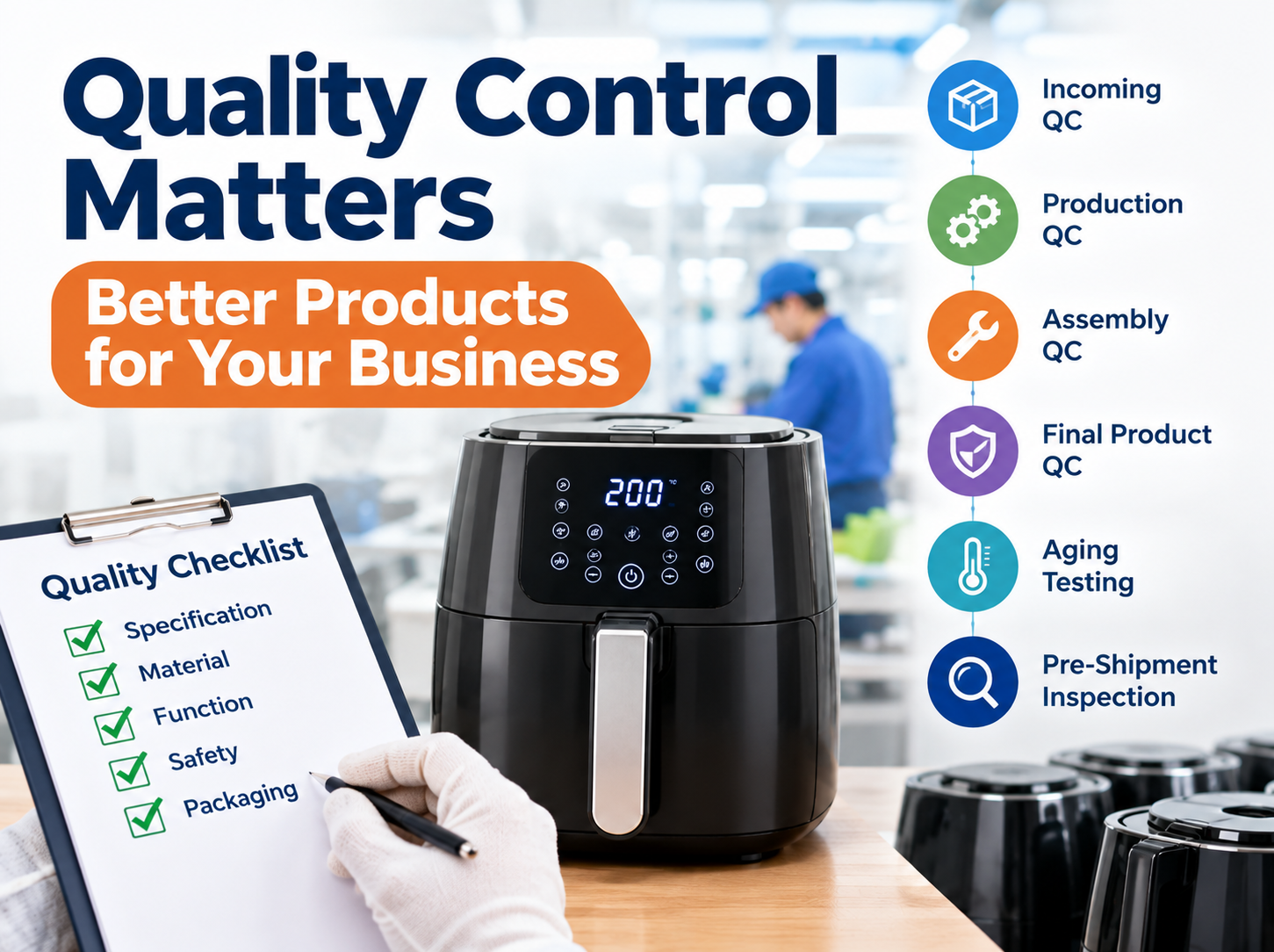
What Quality-Control Standards Should I Require from an Air Fryer Supplier?

Kitchen Appliance Regulations In the European Union
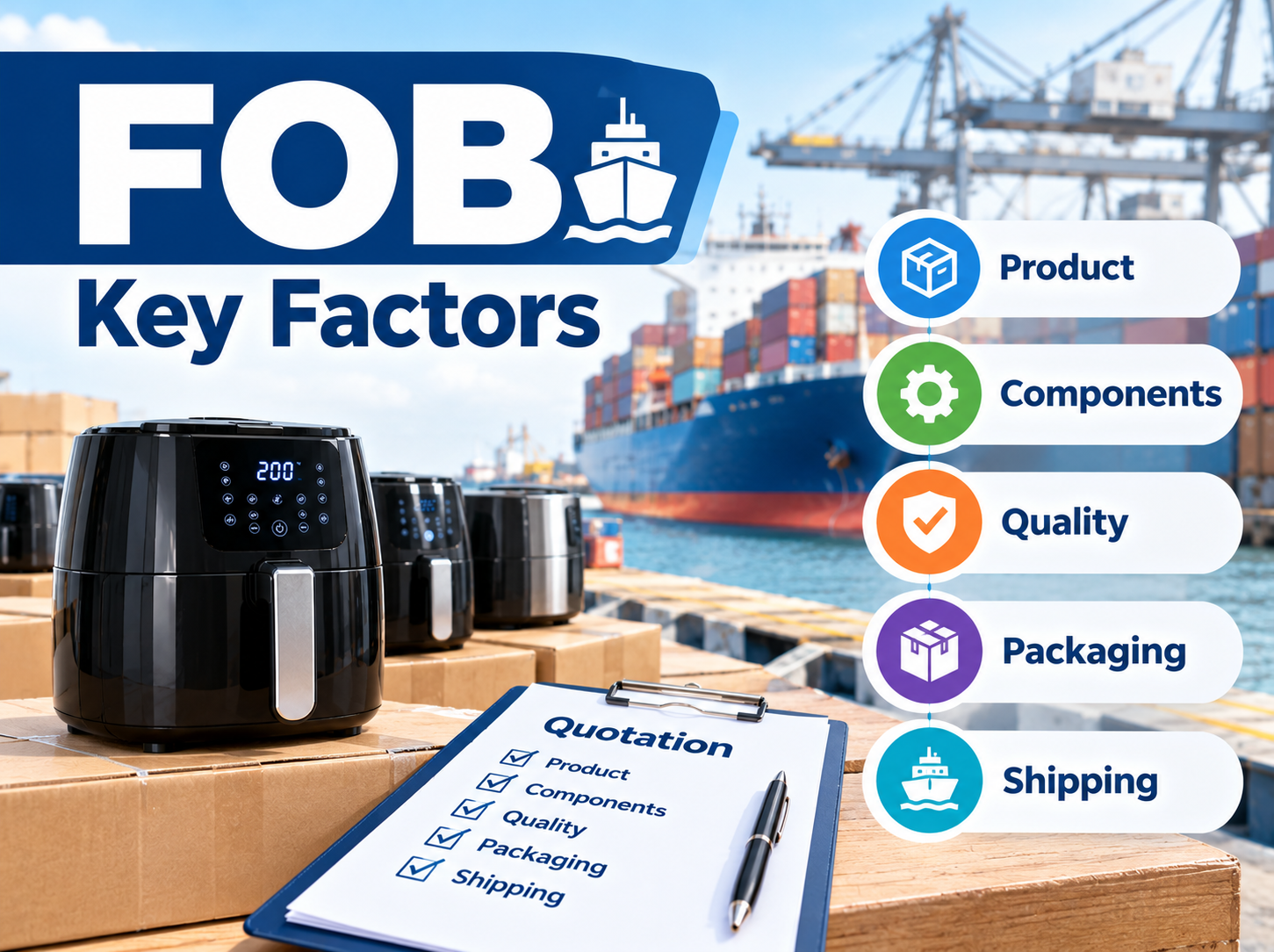
What Factors Affect the FOB Price of an Air Fryer?
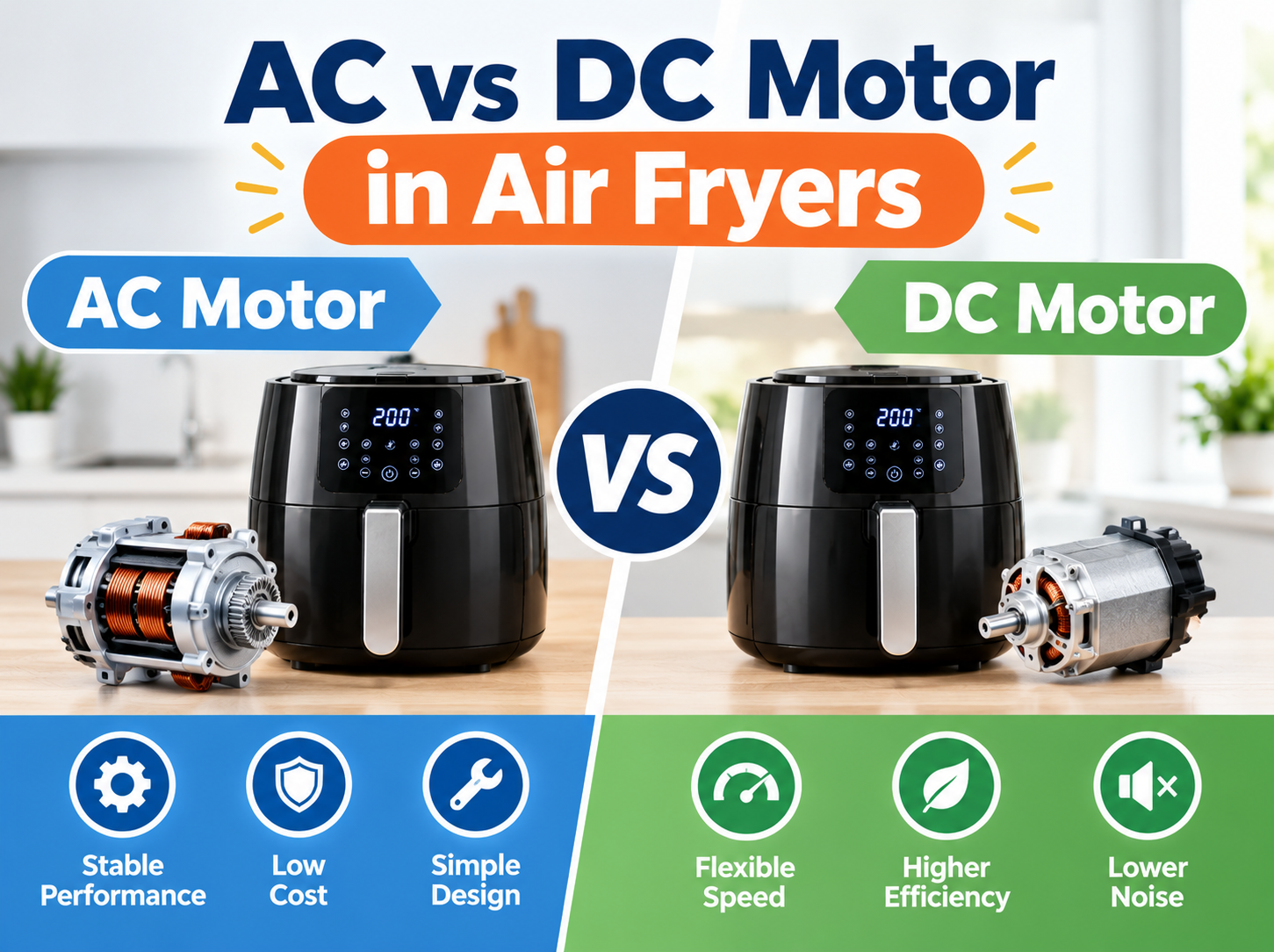
What Is the Difference Between AC and DC Motors in Air Fryers?
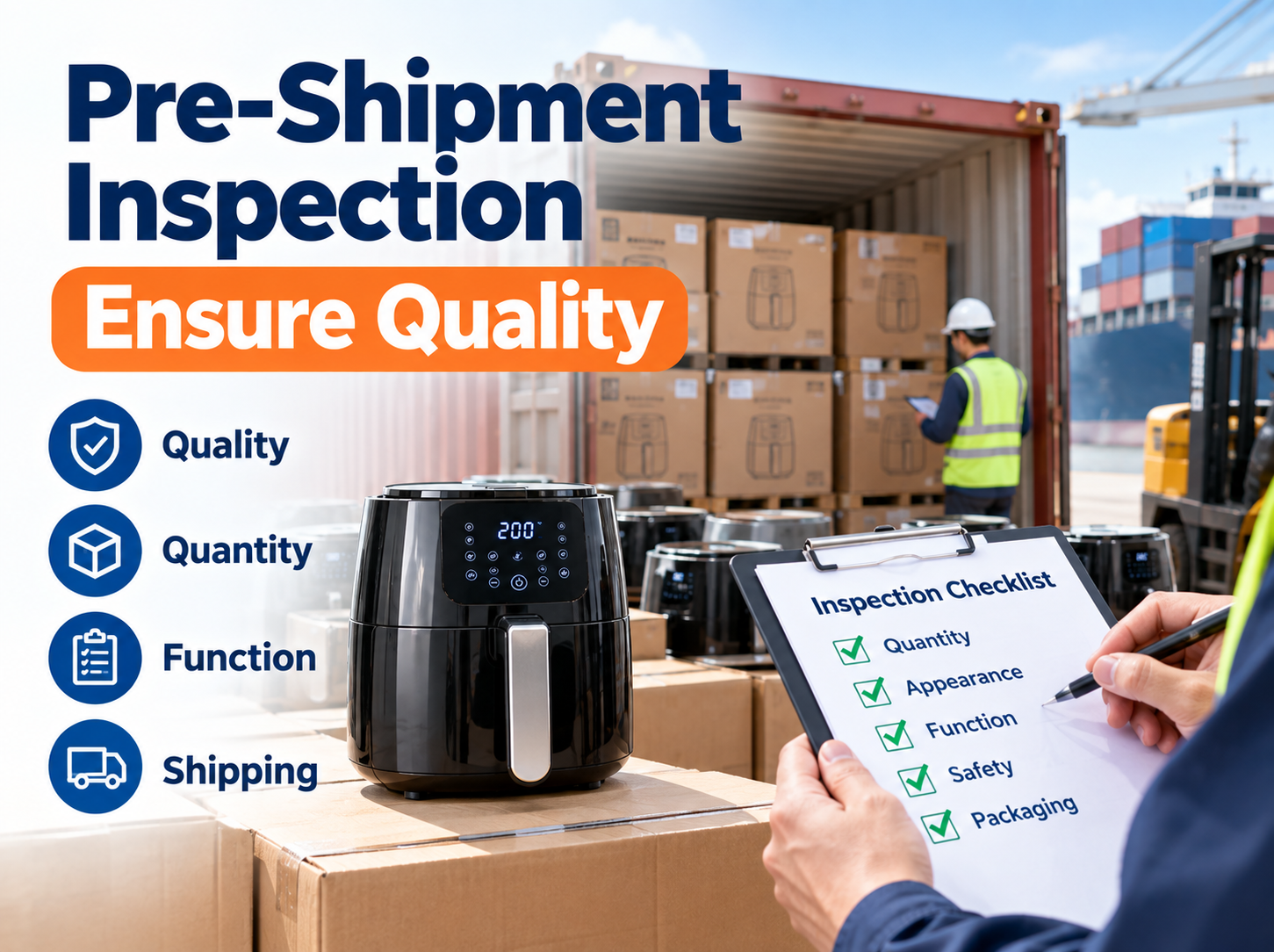
What Air Fryer Tests Should Be Included in a Pre-Shipment Inspection?

Wilko collapse - What Went Wrong With The High Street Retailer?
 + 86 181 3826 8709
 info@funloiv.com
 6/F., Guanglong Building, Pingxin North Road, Longgang, Shenzhen City, Guangdong, China


@ 2009-2026 Shenzhen Funloiv Electric Appliance Co., LtdAll rights reserved


