 Notice:

 search
search
search
Sep 20, 2026


As dual-drawer air fryers become increasingly popular, many consumers and retailers face the same challenge:
Large capacity often means a larger appliance footprint.
Traditional dual-drawer air fryers typically place two cooking baskets side by side, which can require considerable countertop width.
To solve this problem, a new product category has emerged:
Vertical dual-drawer air fryers, also called stacked air fryers.
Instead of placing two baskets horizontally, the drawers are arranged vertically, allowing brands to offer large cooking capacity while reducing the width of the appliance. This concept has become increasingly visible in products such as Ninja DoubleStack and Salter VertiCook.
But does a vertical dual-drawer air fryer really save kitchen space?
The answer is:
Yes—but it saves a different type of space.
This article explains how vertical air fryer designs work, their advantages and trade-offs, and what importers and brand owners should evaluate before choosing a vertical dual-drawer model.
1. What Is a Vertical Dual-Drawer Air Fryer?
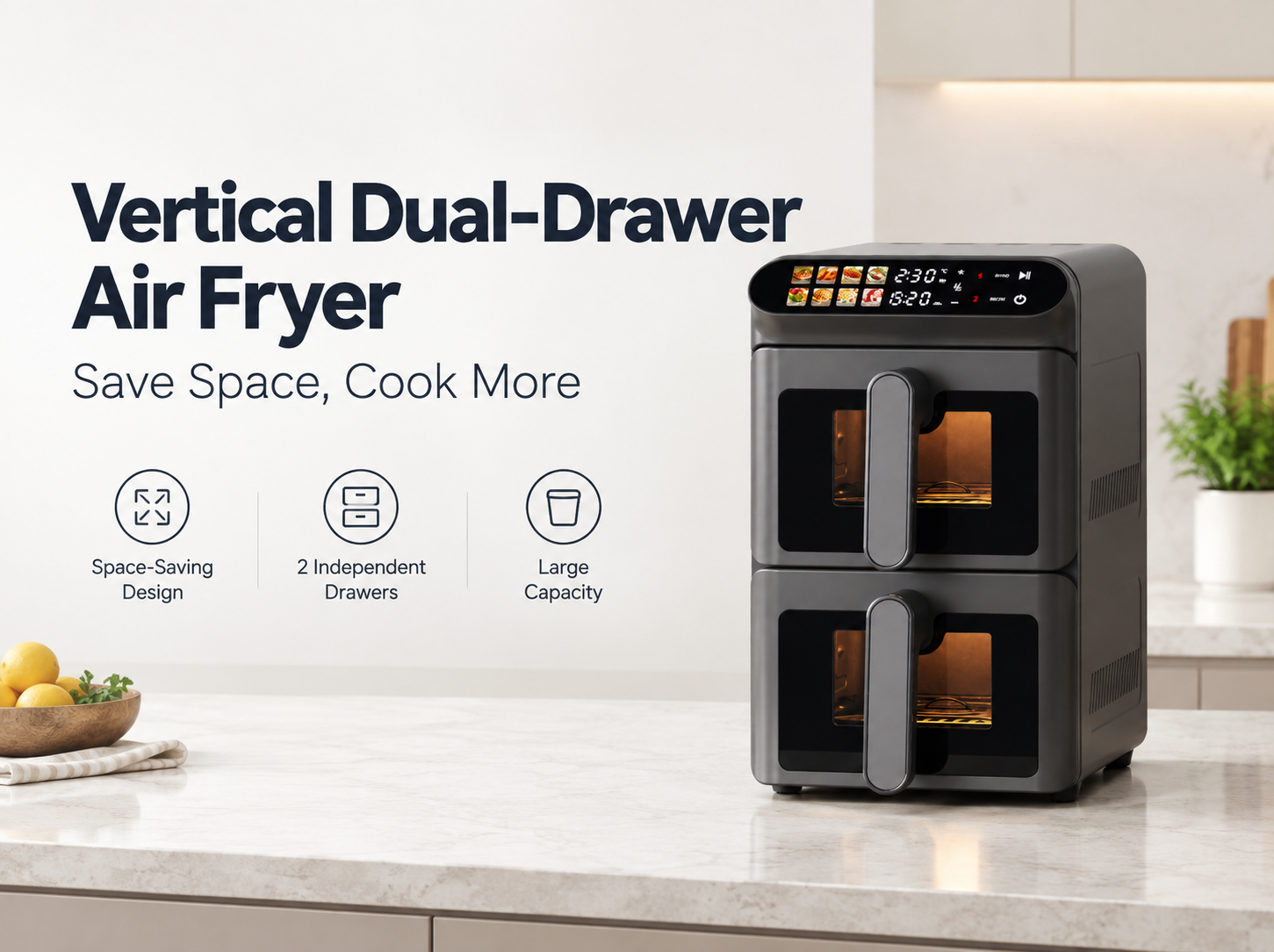
A vertical dual-drawer air fryer is an appliance that arranges two independent cooking drawers one above the other rather than side by side.
Traditional Dual Drawer
Drawer + Drawer
Vertical Dual Drawer
Drawer
Drawer
Both designs can provide:
l Two independent cooking zones
l Different temperatures
l Different cooking times
l Simultaneous cooking
l Family-size capacity
The key difference is:
How the appliance occupies kitchen space.
Vertical designs reduce horizontal width by using unused vertical space above the countertop. This has become a major selling point for recent stacked air fryer products.
2. Does a Vertical Design Really Save Kitchen Space?
The short answer is:
Yes, but mainly in terms of width.
Many dual-drawer air fryers become very wide because two baskets sit next to each other.
A vertical structure changes this by stacking the drawers.
This means:
Space Saved:
✓ Countertop width
Space Still Required:
l Depth
l Height
l Drawer opening space
l Ventilation area
A useful way to think about it is:
Vertical stacking trades horizontal space for vertical space.
For households with narrow countertops, apartments or compact kitchens, this can be a significant advantage. Several stacked air fryer brands claim reductions of 30–40% in appliance width compared with traditional side-by-side designs.
However, buyers should avoid assuming:
Smaller width = smaller appliance.
The total product volume may remain similar—the shape simply changes.
3. Width, Depth and Height: The Three Dimensions Buyers Should Compare
When evaluating a vertical air fryer, buyers should not look at width alone.
Three dimensions matter:
Width
This is where vertical air fryers offer their biggest advantage.
Suitable for:
l Small kitchens
l Apartments
l Narrow countertops
l Limited side space
Depth
Some stacked air fryers remain relatively deep because the cooking chambers extend backward.
Therefore:
A narrower air fryer is not necessarily shallower.
Height
This is the main trade-off.
Because two drawers are stacked, the appliance becomes taller.
Buyers should check:
l Cabinet height
l Shelf clearance
l Drawer accessibility
l Ventilation requirements
Some manufacturers specifically design stacked models to fit under standard kitchen cabinets.
4. Vertical vs Side-by-Side: Which Uses Space More Efficiently?
Design | Width | Height | Depth | Main Advantage | Trade-Off |
Single Basket | Low | Medium | Medium | Simple footprint | One cooking zone |
Side-by-Side Dual Drawer | High | Medium | Medium | Easy basket access | Requires more width |
Vertical Dual Drawer | Lower | Higher | Medium–High | Saves countertop width | Requires more height |
The important point is:
The better design depends on how space is available in the kitchen.
If width is the main limitation:
Vertical design may be advantageous.
If cabinet height is limited:
Traditional dual drawers may fit better.
This balanced approach helps buyers evaluate products based on actual use rather than marketing claims.
5. Does Two Drawers Mean More Cooking Capacity?
Not always.
For example:
10L total capacity may mean:
l 5L + 5L
rather than:
l One continuous 10L cooking area.
However, two independent drawers provide benefits such as:
l Different foods
l Different temperatures
l Different cooking times
l Simultaneous cooking
For example:
Upper Drawer:
l Chicken
l 180°C
l 20 min
Lower Drawer:
l Fries
l 200°C
l 15 min
This flexibility is one reason dual-drawer air fryers continue to grow in popularity.
6. Independent Drawers Can Improve Kitchen Efficiency
A vertical dual-drawer design is not only about saving space.
It also improves:
l Meal preparation
l Multi-food cooking
l Family cooking
l Cooking flexibility
Functions may include:
l Independent controls
l Sync Finish
l Match Cook
l Different cooking programs
This allows consumers to prepare multiple foods without using two separate appliances.
For retailers and brands, this creates a stronger value proposition than simply increasing capacity.
7. Does Vertical Design Affect Airflow and Cooking Performance?
This is an important technical consideration.
Changing drawer position changes:
l Heating structure
l Fan location
l Airflow path
l Exhaust position
l Heat distribution
Therefore, buyers should ask:
l Is each drawer independently heated?
l Is airflow balanced?
l Does the upper drawer cook differently from the lower drawer?
l Is cooking performance consistent?
Independent reviews of stacked air fryers have noted that airflow design becomes particularly important in vertical structures because heat distribution can differ from conventional side-by-side products.
For suppliers, this means:
Vertical design requires more than simply rearranging the baskets.
Heating systems, fans and airflow paths must be optimized together.
8. Is a Vertical Dual-Drawer Air Fryer Easy to Clean?
Consumers increasingly consider cleaning convenience when selecting appliances.
Buyers should evaluate:
l Basket removal
l Drawer access
l Dishwasher compatibility
l Non-stick coating
l Grease management
l Internal accessibility
Many current vertical air fryers use dishwasher-safe baskets and removable accessories to simplify cleaning.
Ease of cleaning is not only a consumer benefit—it can also reduce after-sales complaints.
9. What Should Buyers Check Before Importing a Vertical Dual-Drawer Air Fryer?
For importers and brand owners, product dimensions are only one part of the evaluation.
Dimensions
l Width
l Depth
l Height
l Drawer opening distance
Cooking
l Total capacity
l Individual drawer size
l Usable cooking area
Heating System
l Heating element type
l Heating position
l Power
Airflow
l Motor type
l Fan design
l Air circulation
User Experience
l Handle design
l Drawer access
l Cleaning
Safety
l Thermal protection
l Surface temperature
l Stability
Quality Control
l Sample testing
l Aging tests
l Production consistency
l Pre-shipment inspection
This transforms the discussion from:
"Does it save space?"
to:
"Can this product consistently deliver cooking performance, safety and user convenience?"
10. What Are the Trade-Offs of a Vertical Air Fryer?
No product design is perfect.
Vertical air fryers offer advantages, but also require consideration.
Advantages
l Smaller horizontal footprint
l Two independent cooking zones
l Better use of narrow countertops
l Family-size cooking
l Modern product positioning
l Potential premium differentiation
Trade-Offs
l Taller appliance
l More cabinet clearance required
l Different airflow design challenges
l Upper drawer accessibility
l Deeper appliance body in some designs
Therefore:
Vertical air fryers do not eliminate space requirements—they reorganize space more efficiently.
This is perhaps the most important point for buyers.
11. Who Is a Vertical Dual-Drawer Air Fryer Best For?
A vertical dual-drawer air fryer may be particularly suitable for:
Consumers
l Small kitchens
l Apartments
l Narrow countertops
l Families
l Meal preparation
Retailers
l Premium products
l Space-saving product lines
l Modern kitchen collections
Brand Owners
l Product differentiation
l Higher-value positioning
l New product development
12. FUNLOIV Vertical Dual-Drawer Air Fryer Solutions
FUNLOIV offers vertical dual-drawer air fryer solutions designed for modern kitchens and OEM/ODM projects.
Available features may include:
l 11L total capacity
l Two independent drawers
l Space-saving vertical structure
l Optimized airflow
l Metal body options
l 230°C temperature range
l Viewing window
l Touch controls
l OEM/ODM customization
For brands and importers, a vertical air fryer is not simply a different appearance.
It is a different way of balancing:
l Capacity
l Countertop space
l Cooking flexibility
l Product positioning
Final Thoughts
Is a vertical dual-drawer air fryer better for saving kitchen space?
The answer depends on:
l Kitchen layout
l Available width
l Cabinet height
l Cooking habits
l Product positioning
Vertical designs can reduce countertop width and provide large cooking capacity without making appliances excessively wide.
However:
The best design is the one that matches how consumers actually use their kitchen space.
For importers and brands, evaluating airflow, heating systems, cleaning, usability and production quality is just as important as evaluating dimensions.
Looking for a Vertical Dual-Drawer Air Fryer OEM/ODM Supplier?
If you are developing a space-saving dual-drawer air fryer project, share your target capacity, design requirements, certifications and market needs with our team.
FUNLOIV supports OEM/ODM projects from product development and sample evaluation to quality control and mass production.
Contact us to discuss your vertical air fryer project.
FAQ
Ø Does a vertical air fryer save space?
Yes. Vertical air fryers mainly save countertop width by stacking two drawers instead of placing them side by side.
Ø Is a vertical air fryer smaller?
Not necessarily. It is narrower, but may be taller or deeper.
Ø Is a vertical dual-drawer air fryer good for small kitchens?
It can be suitable for kitchens where width is limited.
Ø Does a vertical air fryer cook evenly?
Cooking performance depends on heating systems, airflow design and product engineering.
Ø What should buyers check before importing a vertical air fryer?
Dimensions, heating system, airflow, cleaning, certifications, quality control and production consistency.
Related Articles
l Air Fryer Heating Element: Halogen vs. Stainless Steel Heating Tube.
l Why Does Airflow Matter in an Air Fryer?
l What Is the Difference Between AC and BLDC Motors in Air Fryers?
l What Makes an Air Fryer Cook More Evenly?
l How Can I Test an Air Fryer Sample Before Placing a Bulk Order?
l What Quality-Control Standards Should I Require from an Air Fryer Supplier?
l What Air Fryer Tests Should Be Included in a Pre-Shipment Inspection?
l What Factors Affect the FOB Price of an Air Fryer?
l How to Compare Quotations from Different Air Fryer Suppliers?
l 230°C Air Fryer: What Buyers Should Check Before Importing?
l A Dual Heating vs Single Heating Air Fryer- Which Is Better?
l What Is the Difference Between AC and DC Motors in Air Fryers?
l Air Fryer for the Middle East - A GCC Buyer’s Guide to G-Mark, Specifications and Compliance?
l What Are the Most Common Quality Problems with Air Fryers?
l Air Fryer RFQ Checklist: 20 Specifications Buyers Should Include.
l How To Verify Whether an Air Fryer Supplier Is Reliable?
l How to Choose an OEM-ODM Air Fryer Supplier in China?
l 200°C vs 230°C Air Fryer: Which one is better?
l Metal-body vs plastic-body air fryer: which is better for a premium brand?
l Top Heating vs. Rear Heating Air Fryers: Which one is better for a B2B buyer?


What Makes an Air Fryer Cook More Evenly?

Is it Worth Getting an Air Fryer?

230°C Air Fryer: What Buyers Should Check Before Importing
What Is the Difference Between AC and BLDC Motors in Air Fryers?

Why Does Airflow Matter in an Air Fryer?
Is a Vertical Dual-Drawer Air Fryer Better for Saving Kitchen Space?
 + 86 181 3826 8709
 info@funloiv.com
 6/F., Guanglong Building, Pingxin North Road, Longgang, Shenzhen City, Guangdong, China


@ 2009-2026 Shenzhen Funloiv Electric Appliance Co., LtdAll rights reserved


