 Notice:

 search
search
search
Sep 21, 2026


Dual-basket air fryers have become an important product format for retailers looking for higher-capacity cooking and more flexible meal preparation.
But when choosing between a vertical dual-basket air fryer and a horizontal dual-basket air fryer, the question is not simply:
Which design is better?
For a retailer or brand owner, the more useful question is:
Which layout is better suited to the target consumer, kitchen space, cooking requirements, retail environment and product positioning?
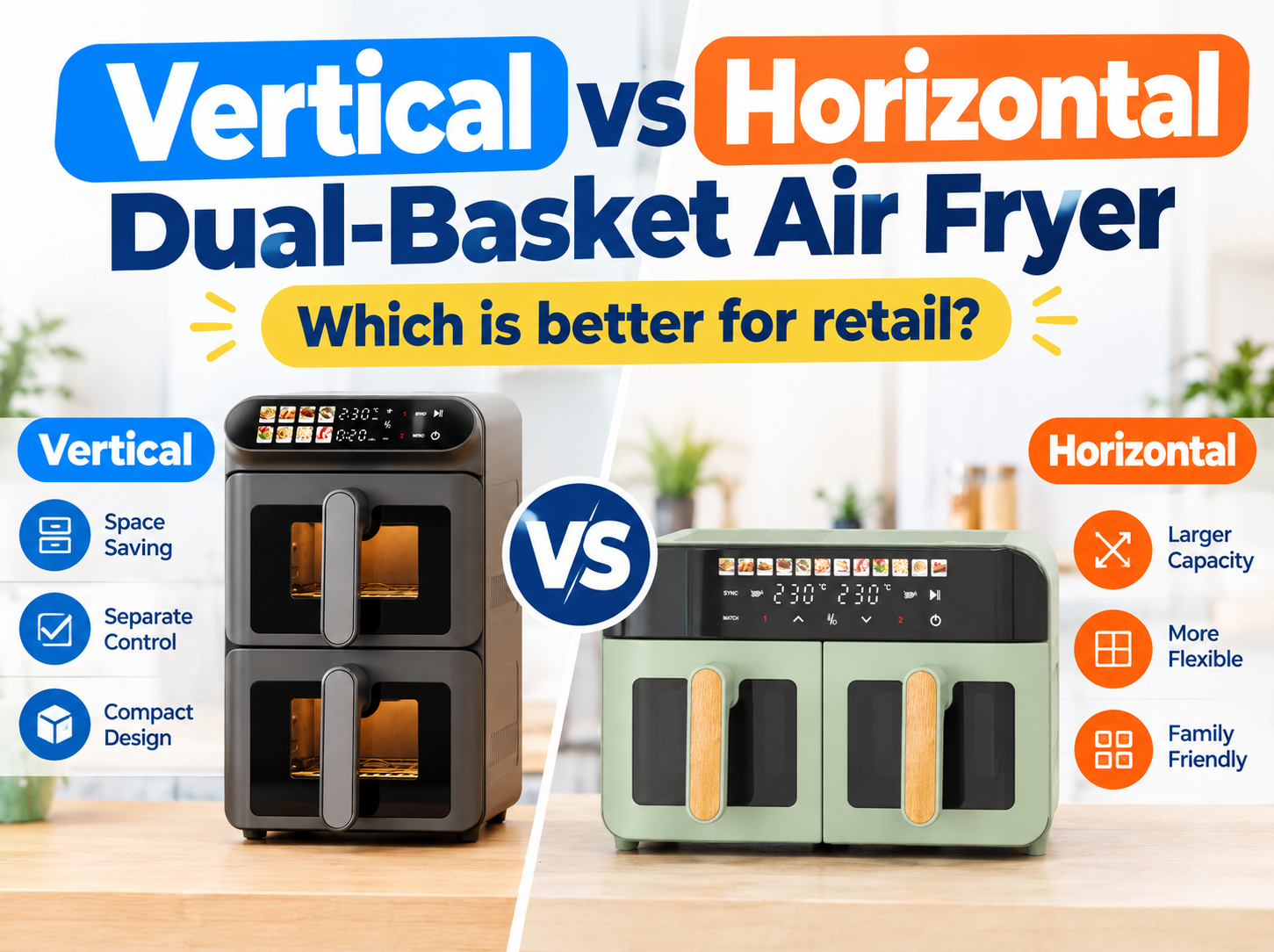
A horizontal dual-basket air fryer places two cooking zones side by side, while a vertical dual-basket air fryer stacks the cooking zones vertically.
The two designs can offer similar total capacity and independent cooking, but they use countertop space differently and can create different retail propositions.
This guide compares the two formats from a B2B retail perspective, including:
l Countertop footprint
l Cooking capacity
l Basket geometry
l Cooking flexibility
l Airflow and heating
l Ease of use
l Cleaning
l Retail merchandising
l Packaging and logistics
l Consumer positioning
l Product differentiation
l OEM/ODM considerations
The goal is not to identify one universal winner. It is to help retailers choose the layout that best matches their product strategy.
1. What Is the Difference Between Vertical and Horizontal Dual-Basket Air Fryers?
The basic difference is the physical arrangement of the two cooking zones.
Horizontal Dual-Basket Air Fryer
A horizontal or side-by-side dual-basket air fryer places the two drawers next to each other.
Basket 1 | Basket 2
This layout typically creates:
l Greater product width
l Lower overall height
l Side-by-side access
l Easy visibility of both baskets
l A familiar dual-basket appearance
The format has become a recognizable design for family-size dual-zone air fryers.
Vertical Dual-Basket Air Fryer
A vertical or stacked dual-basket air fryer places the cooking zones one above the other.
Basket 1
Basket 2
This creates:
l A narrower product width
l Greater overall height
l Stacked cooking zones
l A more distinctive visual design
l A smaller horizontal footprint
The vertical concept essentially changes the direction in which the product uses countertop space.
The Basic Difference
Feature | Vertical Dual-Basket | Horizontal Dual-Basket |
Basket arrangement | Stacked | Side by side |
Product width | Usually narrower | Usually wider |
Product height | Usually higher | Usually lower |
Countertop width | Lower | Higher |
Vertical clearance | More important | Less important |
Basket visibility | Stacked | Side by side |
Product differentiation | High | More familiar |
Main retail story | Space efficiency | Conventional dual-zone format |
The most important point is:
Vertical design changes how space is used; it does not eliminate the space required by the product.
2. Does a Vertical Dual-Basket Air Fryer Really Save Countertop Space?
For many retail products, the strongest selling point of a vertical dual-basket design is its narrower footprint.
Instead of using more horizontal width, the design uses additional vertical space.
This can be valuable for consumers with:
l Narrow kitchen countertops
l Small apartments
l Compact kitchens
l Limited preparation areas
l Multiple countertop appliances
However, retailers should avoid describing vertical products simply as "smaller."
A vertical air fryer may have a similar or even larger overall volume than a horizontal model. What changes is the distribution of that volume.
Width vs. Height
For example:
Vertical
Lower width
Higher height
versus:
Horizontal
Higher width
Lower height
Therefore, a vertical product can create a stronger:
Space-saving countertop story
while a horizontal product can create a:
Low-profile, side-by-side access story
The actual footprint should always be compared using the product's width × depth, while cabinet clearance and overall height should be considered separately.
3. Is a 10L Vertical Air Fryer the Same as a 10L Horizontal Air Fryer?
Not necessarily.
This is an important issue for retail buyers.
Two air fryers can both have:
10L total capacity
but use that capacity very differently.
For example:
Vertical
5L + 5L
Horizontal
5L + 5L
The total volume may be similar, but the:
l Basket width
l Basket depth
l Basket height
l Cooking surface
l Usable cooking area
l Food-loading pattern
can be different.
Total Capacity Is Not the Whole Story
A retailer should therefore compare:
Total Capacity + Individual Basket Dimensions + Usable Cooking Area
rather than looking only at the number printed on the packaging.
This is especially important for foods that need to be spread across a relatively large surface area.
Examples include:
l French fries
l Chicken wings
l Vegetables
l Fish fillets
l Breaded foods
l Larger food portions
A 10L product does not automatically provide the same cooking experience as another 10L product.
Buyer Question
Before selecting a model, ask:
How much usable cooking area does each basket provide?
This can be more meaningful than total liters alone.
4. How Does Basket Geometry Affect Cooking Performance?
The orientation of the air fryer is only one part of the cooking system.
Cooking performance also depends on:
l Heating element position
l Heating power
l Motor
l Fan
l Airflow distribution
l Cooking chamber geometry
l Basket perforation
l Food loading
l Temperature control
l Temperature recovery
Therefore:
Vertical does not automatically mean better cooking, and horizontal does not automatically mean better cooking.
The actual design of the heating and airflow system matters more than orientation alone.
Basket Shape Matters
A wide and shallow basket provides a different cooking surface from a narrow and deep basket.
Retailers should therefore compare the actual basket dimensions rather than assuming that the same total capacity means the same cooking performance.
For product development, the design target should be:
Optimized airflow + appropriate heating power + suitable basket geometry
rather than simply maximizing fan speed or heating power.
5. Independent Cooking Zones: What Matters to Consumers?
The main consumer value of a dual-basket air fryer is not simply having two baskets.
It is having two cooking zones.
For example:
Basket 1
Chicken
180°C
20 minutes
Basket 2
Vegetables
170°C
12 minutes
The consumer can prepare different foods with different cooking requirements.
This creates several important retail features:
l Independent temperature control
l Independent timer
l Sync function
l Match function
l Separate cooking programs
Sync Function
A Sync function can allow two baskets with different cooking times to finish at approximately the same time.
For example:
Basket A: 20 minutes
Basket B: 12 minutes
The system can delay the shorter cooking cycle so both dishes are ready together.
Match Function
A Match function can copy the same settings to both baskets.
This is useful when consumers want to prepare a larger quantity of the same food.
Therefore, the retail value proposition becomes:
Two cooking zones, more flexibility.
Not simply:
Two baskets, more capacity.
6. Vertical vs. Horizontal: Which Is Easier to Use?
Ease of use is an important retail consideration because consumers interact with the physical basket every time they cook.
Horizontal Layout
The two drawers are positioned side by side.
Potential advantages include:
l Both drawers are easy to see
l Both handles are at a similar height
l Easy comparison between cooking zones
l Familiar operating concept
Vertical Layout
The drawers are stacked.
Potential advantages include:
l Narrower countertop footprint
l Distinctive product appearance
l Efficient use of horizontal space
However, vertical products require careful consideration of:
l Upper basket accessibility
l Lower basket accessibility
l Product height
l Cabinet clearance
l Handle position
l Control-panel position
A Useful Retail Principle
A narrower footprint should not come at the expense of everyday accessibility.
This is why retailers should evaluate physical prototypes rather than judging the product only from product drawings or specifications.
7. How Does the Layout Affect Airflow and Cooking Performance?
This is one of the most important technical considerations for an air fryer buyer.
An air fryer is a system:
Heating Element
↓
Motor
↓
Fan
↓
Airflow
↓
Cooking Chamber
↓
Food
The vertical or horizontal orientation changes the physical arrangement of the cooking zones, but it does not by itself determine cooking performance.
Questions Retailers Should Ask Suppliers
For a vertical dual-basket air fryer:
l How is airflow distributed between the two cooking zones?
l Does each drawer have independent airflow?
l Where is the heating element located?
l Where is the fan located?
l What type of motor is used?
l How is temperature controlled?
l How is temperature recovery managed?
l Has cooking uniformity been tested in both drawers?
l Are the upper and lower cooking zones tested under different loads?
For a horizontal dual-basket air fryer, similar questions should be asked for the left and right cooking zones.
The Key Point
The goal is not maximum airflow. The goal is optimized airflow for the heating system, basket geometry and cooking load.
A well-designed vertical air fryer can perform effectively, just as a well-designed horizontal air fryer can.
The supplier's engineering and testing process matter more than the product orientation alone.
8. Cleaning and Maintenance Considerations
Cleaning is an important part of consumer satisfaction and can influence product returns and reviews.
Both vertical and horizontal designs can use removable cooking drawers, racks and trays.
However, retailers should examine the complete cleaning experience.
Check:
l Are baskets removable?
l Are racks removable?
l Are components dishwasher safe?
l Is the cooking chamber easy to access?
l Can grease accumulate around difficult-to-clean areas?
l Are heating-element areas reasonably accessible for cleaning?
l Can food residue enter gaps around the drawers?
l Are the drawer handles easy to clean?
Vertical Design
A stacked structure can provide two independent cooking drawers while keeping the overall width narrow.
Horizontal Design
The side-by-side layout provides direct access to both cooking zones at the same height.
Neither design should automatically be considered easier to clean.
Cleaning performance depends on the actual construction, removable components and access to cooking areas.
This is another reason retailers should inspect samples before finalizing an OEM or ODM project.
9. Retail Footprint and Product Merchandising
For a product sold through retail channels, physical dimensions are not only a consumer issue.
They also affect:
l Shelf presentation
l Product photography
l Packaging
l Display space
l E-commerce images
l In-store positioning
l Product differentiation
Vertical Design
A vertical air fryer creates a strong visual identity.
The tower-like structure can communicate:
Dual cooking in a compact footprint
It may also stand out from conventional side-by-side dual-basket products.
Horizontal Design
A horizontal dual-basket air fryer has a familiar visual format.
The two drawers are immediately visible, which can make the dual-zone proposition easy to understand.
For Retailers
The question is not simply:
"Which one looks better?"
Instead:
Which design communicates the product's value proposition more clearly to the target consumer?
A vertical product can make space saving and product differentiation central to the retail story.
A horizontal product can make familiarity, side-by-side access and conventional dual-zone cooking central to its positioning.
10. Packaging, Shipping and Logistics
This is an area that consumers rarely consider, but retailers and importers should.
A narrower product does not automatically mean a smaller shipping carton.
A vertical product may have:
l Lower width
l Similar depth
l Greater height
The packaging therefore needs to be evaluated separately.
Compare:
l Product dimensions
l Carton dimensions
l Gross weight
l Net weight
l Master carton quantity
l Pallet configuration
l Container loading
l Warehouse storage
l Retail shelf dimensions
l Drop-test requirements
Why This Matters
Suppose a vertical air fryer saves 10 cm of product width but adds significant height.
The product may have a smaller countertop footprint while its shipping carton does not provide the same proportional logistics benefit.
Therefore:
Product footprint and packaging efficiency should be evaluated separately.
For B2B buyers, this can affect the final landed cost and retail margin.
11. Which Design Is Better for Different Target Consumers?
Instead of asking which design is universally better, retailers should identify the consumer segment first.
Vertical Dual-Basket Air Fryer May Suit:
l Space-conscious consumers
l Small kitchens
l Apartment living
l Urban households
l Consumers looking for differentiated designs
l Consumers who want dual-zone cooking without a wide countertop footprint
The main retail message can be:
More cooking flexibility in a narrower footprint.
Horizontal Dual-Basket Air Fryer May Suit:
l Consumers with more countertop width
l Consumers familiar with conventional dual-basket designs
l Consumers who prefer side-by-side access
l Retailers targeting a more familiar product format
l Products where wider basket geometry is an important design objective
The retail message can be:
Two side-by-side cooking zones with familiar access.
Neither positioning is universally superior.
The appropriate choice depends on the target market and product strategy.
12. Product Differentiation: Which Design Creates a Stronger Retail Story?
Product differentiation is particularly important in a crowded air fryer category.
Many conventional dual-basket models share a similar appearance.
A vertical dual-basket design can provide a different visual proposition.
For example:
l Traditional Dual-Basket Story
l Two Baskets
l Large Capacity
l Independent Cooking
l Vertical Dual-Basket Story
l Two Baskets
l Large Capacity
l Independent Cooking
l Space-Saving Footprint
l Distinctive Tower Design
This does not mean vertical products are automatically easier to sell.
It means the product gives the retailer a different story to communicate.
For private-label brands, this can be particularly relevant when looking for:
l Product differentiation
l New category positioning
l Retail-exclusive designs
l New product launches
l Space-saving product concepts
13. Vertical vs. Horizontal Dual-Basket Air Fryer: Retail Comparison
Retail Consideration | Vertical Dual-Basket | Horizontal Dual-Basket |
Countertop width | Usually lower | Usually higher |
Overall height | Usually higher | Usually lower |
Cabinet clearance | More important | Less critical |
Basket arrangement | Stacked | Side by side |
Basket visibility | Upper + lower | Left + right |
Independent cooking | Yes, depending on model | Yes, depending on model |
Space-saving positioning | Strong | Less central |
Product differentiation | Strong visual differentiation | More familiar |
Basket accessibility | Depends on design | Generally straightforward |
Cooking performance | Depends on airflow and heating design | Depends on airflow and heating design |
Total capacity | Model dependent | Model dependent |
Usable cooking area | Must be checked | Must be checked |
Packaging efficiency | Must be evaluated | Must be evaluated |
Retail merchandising | Tower-style presentation | Conventional dual-zone presentation |
Target consumer | Space-conscious users | Users comfortable with wider format |
OEM/ODM potential | Strong for differentiated designs | Strong for conventional formats |
The table highlights an important principle:
Product orientation is only one part of the retail decision.
14. What Should Retailers Check Before Choosing a Dual-Basket Air Fryer?
Before selecting a model for a retail program, buyers should evaluate five areas.
A. Product Dimensions
l Width
l Depth
l Height
l Product footprint
l Cabinet clearance
l Handle clearance
B. Cooking Capacity
l Total capacity
l Individual basket capacity
l Basket dimensions
l Usable cooking surface
l Cooking levels
l Maximum food load
C. Cooking System
l Heating element
l Heating power
l Motor
l Fan
l Airflow
l Temperature control
l Temperature recovery
l Cooking uniformity
D. Consumer Experience
l Independent controls
l Sync function
l Match function
l Viewing window
l Internal light
l Basket access
l Cleaning
l Noise
l Control interface
E. Retail and Supply Chain
l Target retail price
l Product differentiation
l Packaging dimensions
l Master carton
l Container loading
l MOQ
l Certification
l OEM/ODM requirements
l Lead time
l After-sales requirements
15. Questions to Ask an Air Fryer OEM/ODM Supplier
Before choosing between a vertical and horizontal dual-basket design, retailers should ask the supplier:
Product Design
l What is the total capacity?
l What is the capacity of each basket?
l What are the actual basket dimensions?
l What is the usable cooking surface?
l What are the product dimensions?
Cooking Performance
l How are the heating elements positioned?
l How is airflow distributed?
l What motor and fan system is used?
l Are the two cooking zones independently controlled?
l Has cooking uniformity been tested?
Consumer Experience
l Can the two baskets use different temperatures?
l Is there a Sync function?
l Is there a Match function?
l Are viewing windows available?
l Are the baskets dishwasher safe?
Quality and Compliance
l Which safety standards apply?
l What certifications are available?
l Can the supplier provide test reports?
l How are critical components controlled?
l Can the supplier provide a production sample before bulk order?
These questions help move the sourcing process from:
"Which product looks better?"
to:
"Which product is technically, commercially and operationally suitable for our retail program?"
16. Vertical vs. Horizontal: How Should a Retailer Make the Final Decision?
A practical decision framework can be built around six questions.
Ø How much countertop width does the target consumer typically have?
If horizontal space is a major constraint, a vertical concept may be worth considering.
Ø Is product height acceptable?
A vertical product requires sufficient clearance under cabinets and around the appliance.
Ø What foods are consumers expected to cook?
Basket dimensions and cooking surface may matter more than total capacity.
Ø How important is product differentiation?
If the retailer needs a visually different dual-basket product, vertical architecture may provide a stronger design platform.
Ø What is the target retail price?
The design, materials, heating system, controls, viewing windows, motor and other components all affect the final product cost.
Ø What is the complete supply-chain impact?
Compare:
Product → Packaging → Shipping → Warehouse → Retail Display → Consumer
not just the product itself.
17. Vertical vs. Horizontal Dual-Basket Air Fryer: Which Is Better for Retail?
There is no universal answer.
A vertical dual-basket air fryer can provide a strong proposition when the retail strategy emphasizes:
l Narrow countertop footprint
l Space-conscious consumers
l Product differentiation
l Stacked cooking
l Modern product design
l Dual-zone flexibility
A horizontal dual-basket air fryer can be attractive when the retail strategy emphasizes:
l Familiar side-by-side design
l Easy visual access to both baskets
l Wider cooking surfaces
l Conventional dual-zone positioning
l Lower overall product height
The key is to match the product architecture with the consumer, channel and retail proposition.
The Retail Decision Can Be Summarized As:
Vertical
Use vertical space to reduce horizontal footprint.
Horizontal
Use horizontal space to provide side-by-side access.
Neither design automatically provides better cooking performance.
The actual result depends on:
Heating + Motor + Fan + Airflow + Basket Geometry + Cooking Chamber + Temperature Control
18. Frequently Asked Questions
Ø Is a vertical dual-basket air fryer better than a horizontal one?
Not universally. Vertical and horizontal layouts solve different design and retail requirements. Vertical models generally focus more on reducing horizontal footprint, while horizontal models provide a wider side-by-side layout. The better choice depends on the target consumer, kitchen space, basket geometry, cooking requirements and retail strategy.
Ø Does a vertical air fryer save counter space?
A vertical air fryer can reduce the amount of horizontal countertop width required compared with some horizontal dual-basket designs. However, it uses more vertical space, so cabinet clearance and product height must also be considered.
Ø Is vertical or horizontal better for cooking?
The orientation alone does not determine cooking performance. Heating power, heating-element position, motor, fan, airflow, basket geometry, chamber design and temperature control all affect cooking results.
Ø Is a 10L vertical air fryer the same as a 10L horizontal air fryer?
Not necessarily. Two products can have the same total capacity but different basket dimensions, cooking surfaces and food-loading patterns. Retailers should compare usable cooking area in addition to total capacity.
Ø What is the main advantage of a vertical dual-basket air fryer?
The main potential advantage is using vertical space instead of as much horizontal countertop width while maintaining two independent cooking zones.
Ø What is the main advantage of a horizontal dual-basket air fryer?
The side-by-side format provides a familiar dual-zone layout and allows consumers to access and view both cooking zones at similar heights.
Ø Are vertical dual-basket air fryers suitable for small kitchens?
They can be particularly relevant for consumers with limited countertop width. However, retailers should check product height and cabinet clearance before positioning the product as a compact solution.
Ø What should retailers compare besides air fryer capacity?
Retailers should compare basket dimensions, usable cooking area, product footprint, heating system, airflow, controls, noise, cleaning, packaging, certification, price and target consumer.
Ø Can a vertical dual-basket air fryer have independent temperature controls?
Yes. Vertical architecture does not prevent independent controls. The exact functionality depends on the product design and control system.
Ø Can vertical and horizontal air fryers use the same heating technology?
Potentially, yes. Both formats can use different heating-element, motor and airflow configurations. The final design depends on the product architecture and engineering requirements.
Conclusion: Choose the Layout That Fits the Retail Strategy
For retailers and brand owners, choosing between a vertical and horizontal dual-basket air fryer should not be based on product orientation alone.
The better sourcing question is:
Which architecture creates the best combination of consumer value, cooking functionality, product differentiation, retail positioning and supply-chain efficiency?
A vertical dual-basket air fryer can turn limited countertop width into a product opportunity.
A horizontal dual-basket air fryer can provide a familiar side-by-side cooking experience.
Both formats can support independent cooking, large capacity and flexible meal preparation when properly designed.
For OEM and ODM projects, retailers should evaluate the complete system:
Product Architecture
l Basket Geometry
l Heating System
l Airflow
l Cooking Performance
l Consumer Experience
l Retail Positioning
l Packaging & Logistics
l Compliance & Quality
The right dual-basket air fryer is therefore not simply the one with the most capacity or the smallest footprint.
It is the one that fits the target consumer, retail channel and product strategy.
Looking for a Dual-Basket Air Fryer OEM/ODM Supplier?
If you are developing a vertical, horizontal or customized dual-basket air fryer for your retail market, the product should be evaluated beyond capacity and appearance.
Discuss your target market, product architecture, cooking requirements, certification needs and retail positioning with an experienced air fryer OEM/ODM supplier before moving to mass production.
Contact FUNLOIV to discuss your next dual-basket air fryer project.
Related Articles
l Air Fryer Heating Element: Halogen vs. Stainless Steel Heating Tube.
l Why Does Airflow Matter in an Air Fryer?
l What Is the Difference Between AC and BLDC Motors in Air Fryers?
l What Makes an Air Fryer Cook More Evenly?
l How Can I Test an Air Fryer Sample Before Placing a Bulk Order?
l What Quality-Control Standards Should I Require from an Air Fryer Supplier?
l What Air Fryer Tests Should Be Included in a Pre-Shipment Inspection?
l What Factors Affect the FOB Price of an Air Fryer?
l How to Compare Quotations from Different Air Fryer Suppliers?
l 230°C Air Fryer: What Buyers Should Check Before Importing?
l A Dual Heating vs Single Heating Air Fryer- Which Is Better?
l What Is the Difference Between AC and DC Motors in Air Fryers?
l Air Fryer for the Middle East - A GCC Buyer’s Guide to G-Mark, Specifications and Compliance?
l What Are the Most Common Quality Problems with Air Fryers?
l Air Fryer RFQ Checklist: 20 Specifications Buyers Should Include.
l How To Verify Whether an Air Fryer Supplier Is Reliable?
l How to Choose an OEM-ODM Air Fryer Supplier in China?
l 200°C vs 230°C Air Fryer: Which one is better?
l Metal-body vs plastic-body air fryer: which is better for a premium brand?
l Top Heating vs. Rear Heating Air Fryers: Which one is better for a B2B buyer?
l Is a Vertical Dual-Drawer Air Fryer Better for Saving Kitchen Space?
l Air Fryer Certifications & Compliance by Market- A Safety Guide for Importers.

200°C vs 230°C Air Fryer: Which one is better?
What Is the Difference Between AC and DC Motors in Air Fryers?

How to Compare Quotations from Different Air Fryer Suppliers?
Vertical vs. Horizontal Dual-Basket Air Fryer: Which Is Better for Retail?

What Are the Most Common Quality Problems with Air Fryers?
Metal-Body vs. Plastic-Body Air Fryer: : which is better for a premium brand?
 + 86 181 3826 8709
 info@funloiv.com
 6/F., Guanglong Building, Pingxin North Road, Longgang, Shenzhen City, Guangdong, China


@ 2009-2026 Shenzhen Funloiv Electric Appliance Co., LtdAll rights reserved


