 Notice:

 search
search
search
Sep 22, 2026


For air fryer importers, private-label brands, retailers and wholesalers, product quality does not end when the shipment leaves the factory.
The real test often begins after the products reach the market.
An air fryer may work normally during factory inspection but later develop problems such as heating failure, abnormal fan noise, control-panel malfunction, temperature deviation, basket deformation or coating damage.
When this happens, the issue is no longer only a product-quality problem.
It can become a warranty claim, replacement cost, spare-parts requirement, customer-service issue and potential reputation risk for the importer or brand owner.
That is why buyers should evaluate not only the air fryer itself, but also the supplier's warranty terms and after-sales support system before placing a bulk order.
A reliable after-sales system should answer several practical questions:
l What problems are covered by the warranty?
l Which components are covered?
l What problems are excluded?
l How should warranty claims be submitted?
l Who pays for spare parts and transportation?
l How quickly will the supplier respond?
l What happens if the same defect occurs repeatedly?
l Can the supplier provide root-cause analysis and corrective action?
This guide explains the most common warranty and after-sales problems with air fryers and what B2B buyers should check before selecting a supplier.
1. What Do Warranty and After-Sales Support Mean?
Warranty and after-sales support are related, but they are not exactly the same.
Warranty
A warranty defines the supplier's responsibility when a product has a covered manufacturing or material defect within an agreed period.
After-sales support
After-sales support is broader. It can include:
l Technical support
l Troubleshooting
l Spare parts
l Replacement units
l Warranty claim handling
l Root-cause analysis
l Corrective actions
l Product documentation
l Communication with the importer or distributor
Therefore, a supplier saying "We provide a one-year warranty" does not necessarily tell a buyer how the supplier will actually handle problems.
A stronger question is:
What exactly is covered, and what happens when a warranty problem occurs?
2. What Are the Most Common Warranty Problems with Air Fryers?
The exact failure pattern depends on the model, components, usage conditions and production quality. However, B2B buyers commonly need to pay attention to several major areas.
2.1 Heating Element Failure
The heating element is one of the most important functional components.
Possible customer complaints include:
l Air fryer does not heat
l Heating takes too long
l Heating is intermittent
l Temperature cannot reach the specified level
l Temperature recovery is poor
l Heating element becomes abnormal during operation
A heating problem may involve the heating element itself, wiring, thermal protection, control components or temperature control.
Therefore, replacing the heating element without identifying the root cause may not always solve a recurring problem.
2.2 Fan or Motor Problems
The motor and fan are responsible for moving hot air through the cooking chamber.
Potential complaints include:
l Fan does not rotate
l Abnormal fan noise
l Excessive vibration
l Reduced airflow
l Intermittent fan operation
l Motor failure
l Fan blade deformation
Because airflow is directly related to cooking performance, a motor or fan problem can also result in complaints such as uneven cooking or longer cooking times.
The simplified system can be viewed as:
Heating Element → Motor → Fan → Airflow → Heat Transfer → Cooking Result
This is why after-sales diagnosis should consider the complete system rather than looking at individual components in isolation.
3. What Other Air Fryer Problems Can Lead to Warranty Claims?
Warranty claims are not limited to heating and motors.
Other common areas include:
Control and Electronic Components
l Display failure
l Touch panel failure
l Buttons not responding
l Incorrect temperature or timer operation
l Error codes
l PCB malfunction
Temperature Control
l Temperature deviation
l Sensor failure
l Inconsistent temperature control
l Unexpected shutdown
Basket and Drawer
l Basket deformation
l Drawer difficult to insert or remove
l Handle becoming loose
l Poor fitting
l Damaged coating
Housing and Materials
l Plastic deformation
l Cracking
l Abnormal odor
l Surface damage
l Coating peeling or bubbling
Electrical Components
l Power failure
l Power cord problems
l Thermal fuse failure
l Loose electrical connection
l Abnormal electrical behavior
These areas should be included in the buyer's product specification and quality-control requirements before mass production.
FUNLOIV's published QC guidance, for example, identifies heating elements, fan failure, temperature deviation, control failure, coating, baskets, handles and electrical/thermal safety among the areas buyers should evaluate.
4. Which Air Fryer Problems Should Be Covered by Warranty?
There is no single universal warranty coverage standard for every air fryer supplier.
Buyers should ask suppliers to define the warranty coverage in writing.
Typical areas that may need clarification include:
Component / Problem | Question to Ask |
Heating element | Is heating failure covered? |
Motor | Is motor failure covered? |
Fan | Is abnormal noise or failure covered? |
PCB | Is electronic failure covered? |
Temperature sensor | Is sensor failure covered? |
Thermal fuse | Is premature failure covered? |
Control panel | Is display/touch failure covered? |
Basket | Is structural deformation covered? |
Handle | Is breakage covered? |
Coating | What coating problems are covered? |
Housing | Is deformation or cracking covered? |
Power cord | Is electrical failure covered? |
The important point is that "one-year warranty" is not a sufficiently detailed warranty specification.
A buyer should know:
Warranty period + covered components + covered defects + exclusions + claim procedure + supplier responsibility
FUNLOIV currently publishes a one-year warranty policy and states that if the defective rate of an order exceeds 1% within one year, it will provide support through spare parts or replacement units as applicable under its policy. These terms should still be confirmed for the specific project and quotation.
5. What Air Fryer Problems Are Usually Excluded from Warranty?
Warranty exclusions are another important area for B2B buyers.
Depending on the supplier's written warranty terms, exclusions may include problems caused by:
l Improper use
l Accidental damage
l Dropping
l Unauthorized repair
l Incorrect voltage
l Improper cleaning
l Physical impact
l Water entering electrical components
l Unauthorized modification
l Normal wear and tear
l Cosmetic damage
For example, gradual surface wear may be treated differently from premature coating failure caused by a manufacturing defect.
The important point is not to assume that a particular problem is automatically covered or excluded.
Instead, ask the supplier:
Is this condition covered by the written warranty?
This can prevent disagreements after the goods have already entered the market.
6. How Should Buyers Handle an Air Fryer Warranty Claim?
A clear warranty claim process can significantly reduce communication time.
A practical process is:
Customer Complaint
↓
Evidence Collection
↓
Supplier Diagnosis
↓
Root-Cause Analysis
↓
Responsibility Confirmation
↓
Corrective Action / Replacement / Spare Parts
↓
Claim Closure
For example, if an importer reports:
"The air fryer does not heat."
That information alone may not be enough to identify the cause.
The supplier may need to know:
l Model number
l Production batch
l Quantity affected
l Error code
l Whether the fan works
l Whether the display works
l Whether the heating element activates
l Whether the problem is repeatable
l Whether the unit has been modified
l Photos or videos of the problem
A structured claim process allows the supplier to identify the problem more efficiently.
7. What Evidence Should Buyers Provide for a Warranty Claim?
Before contacting the supplier, the buyer should ideally collect:
Product Information
l Model number
l Production batch
l Serial number, if applicable
l Order number
l Shipment information
Problem Information
l Detailed failure description
l Frequency of the problem
l Number of affected units
l When the problem occurred
l Whether the problem can be reproduced
Visual Evidence
l Photos
l Videos
l Error codes
l Damaged components
l Product label
l Packaging, if relevant
Operating Information
l Local voltage
l Frequency
l Usage conditions
l Cleaning method
l Whether the product has been repaired or modified
The better the information, the easier it is for the supplier to determine whether the problem is related to manufacturing, component quality, transportation, installation, usage or another cause.
8. Who Should Pay for Spare Parts and Transportation?
This is one of the areas that should be agreed before an order is placed.
A warranty claim can involve several different costs:
l Spare parts
l Replacement products
l Courier charges
l Air freight
l Sea freight
l Local transportation
l Repair labor
l Return shipping
l Customs-related costs
A supplier may provide spare parts free of charge while the buyer pays transportation.
Another supplier may provide replacement products under specific conditions.
Therefore, buyers should not assume:
"Free warranty" = "all after-sales costs are free."
Instead, clarify the responsibility for each cost.
A useful question is:
If a confirmed manufacturing defect occurs, which costs will the supplier cover and which costs will the buyer cover?
9. What Spare Parts Should an Air Fryer Supplier Provide?
Spare-parts planning is particularly important for importers and distributors.
Depending on the model, commonly required spare parts may include:
l Heating elements
l Motors
l Fans
l Temperature sensors
l Thermal fuses
l PCBs
l Touch panels
l Power cords
l Handles
l Baskets
l Trays
l Silicone components
l Other heat-resistant components
The required spare-parts list should depend on the actual product design and expected after-sales requirements.
For example, a complex electronic air fryer may require more electronic spare parts than a simple mechanical model.
FUNLOIV currently states that it provides 1% free spare parts to support after-sales service, particularly for easy-to-break or easy-to-replace parts. Buyers should confirm the applicable spare-parts policy for each specific project.
10. Replacement Unit vs. Spare Parts: Which Solution Should Be Used?
Not every warranty problem should be handled in the same way.
Minor component failure
For example:
l Handle
l Thermal fuse
l Temperature sensor
l Certain electrical components
A spare-part solution may be practical if local repair capability is available.
Major component failure
For example:
l PCB
l Motor
l Heating system
The appropriate solution may depend on product structure, repair cost and local service capability.
Serious or repeated product failure
If a significant number of units have the same defect, repeatedly replacing individual components may not be enough.
The supplier should investigate whether the issue is related to:
l Component selection
l Product design
l Production process
l Assembly
l Quality control
l Transportation
l User instructions
The goal should be to solve the root cause, not simply close individual complaints.
11. How Should Suppliers Handle Recurring Warranty Problems?
This is one of the most important differences between basic after-sales support and a more structured quality-management approach.
Imagine that an importer receives 500 units and 20 units develop the same motor problem.
The supplier can either:
Approach A
Send replacement motors.
Or:
Approach B
Investigate:
Complaint Data → Root Cause → Corrective Action → Production Verification → Follow-Up
Approach B is more useful when the problem is recurring because it addresses the possibility of a batch-level or systemic issue.
For B2B buyers, a good question is:
If the same defect occurs repeatedly, can the supplier provide a root-cause analysis and corrective action?
This connects after-sales service directly to quality management.
FUNLOIV's published QC process describes incoming inspection, production-line electrical testing, aging testing and pre-shipment inspection, which are intended to identify problems before products reach customers.
12. Response Time and Resolution Time Are Different
Buyers should distinguish between response time and resolution time.
Ø Response Time
How quickly does the supplier acknowledge the complaint?
Ø Diagnosis Time
How long does it take to identify the probable cause?
Ø Solution Time
How long does it take to agree on the solution?
Ø Replacement Lead Time
How long does it take to provide spare parts or replacement units?
A supplier may respond quickly but still require several days to identify the cause.
Therefore, an effective after-sales agreement should not focus only on:
"We will reply within 24 hours."
It should also clarify how warranty cases are investigated and resolved.
13. What Should Buyers Ask About Warranty Before Placing an Order?
Before approving an air fryer supplier, buyers should ask at least the following questions.
Warranty
l What is the standard warranty period?
l When does the warranty start?
l Does it start from shipment, arrival or retail sale?
l Which components are covered?
l Which defects are excluded?
Warranty Claims
l How should warranty claims be submitted?
l What evidence is required?
l How quickly will the supplier respond?
l Who determines whether the problem is a manufacturing defect?
l What happens if the buyer and supplier disagree about responsibility?
Spare Parts
l Which spare parts are available?
l Are free spare parts included?
l What percentage of spare parts is included?
l How long will spare parts remain available?
l What is the lead time for spare parts?
Replacement
l When will a replacement unit be provided?
l Who pays for transportation?
l What happens if the same defect occurs repeatedly?
Technical Support
l Can the supplier provide technical troubleshooting?
l Can the supplier provide root-cause analysis and corrective action?
These questions can help buyers compare suppliers beyond the FOB price.
14. How Can Buyers Reduce Warranty Problems Before Mass Production?
The best after-sales strategy starts before the first bulk shipment.
A practical B2B quality process can be structured as:
Supplier Verification
↓
Product Specification
↓
Sample Testing
↓
Golden Sample Approval
↓
Production QC
↓
Aging Testing
↓
Pre-Shipment Inspection
↓
Spare Parts Planning
↓
After-Sales Support
This is important because a good sample alone does not guarantee that the entire production batch will have the same quality.
There are actually three separate questions:
Ø Does the sample work?
This is product testing.
Ø Can the supplier reproduce the approved sample?
This is production consistency.
Ø Can the supplier maintain quality across the entire order?
This is quality management.
Therefore, buyers should evaluate both:
Ø Product Quality + Supplier Quality System
This is also consistent with FUNLOIV's existing quality-control guidance, which recommends controlling quality from incoming materials through production, aging testing and pre-shipment inspection.
15. How Should Buyers Compare Air Fryer Suppliers' Warranty and After-Sales Support?
When comparing suppliers, do not look only at the warranty period.
For example:
Supplier A: 1-year warranty
Supplier B: 2-year warranty
The second supplier may appear to offer longer protection, but this information alone does not tell you how the warranty actually works.
A better comparison should include:
Factor | Questions to Compare |
Warranty period | How long is it? |
Warranty start | When does the period begin? |
Coverage | Which components are covered? |
Exclusions | What is excluded? |
Claim procedure | Is the process clearly defined? |
Response | How quickly does the supplier respond? |
Spare parts | Are spare parts available? |
Free spare parts | Are any included with the order? |
Replacement | When is a replacement provided? |
Shipping | Who pays transportation? |
Technical support | Is troubleshooting available? |
Root-cause analysis | Is it available for recurring problems? |
Corrective action | Will production be improved if needed? |
Spare-parts availability | How long can parts be supplied? |
The key principle is:
Do not compare suppliers only by warranty length. Compare the complete after-sales system.
Air Fryer Warranty & After-Sales Checklist for B2B Buyers
Before placing a bulk order, buyers should be able to answer the following:
Product
l Complete product specification approved
l Critical components identified
l Sample tested
l Golden sample approved
l Applicable safety requirements confirmed
Quality
l Incoming QC defined
l Production testing defined
l Aging testing defined
l Pre-shipment inspection defined
l Defect criteria agreed
Warranty
l Warranty period confirmed
l Warranty start date confirmed
l Covered components confirmed
l Exclusions confirmed
l Claim procedure confirmed
Spare Parts
l Spare-parts list prepared
l Free spare-parts policy confirmed
l Spare-parts quantity confirmed
l Spare-parts availability confirmed
l Replacement lead time confirmed
After-Sales
l Complaint response process confirmed
l Technical support available
l Replacement policy confirmed
l Transportation responsibility confirmed
l Recurring-defect procedure confirmed
l Root-cause analysis available
Frequently Asked Questions
Ø What are the most common air fryer warranty problems?
Common warranty-related problems can include heating-element failure, motor or fan problems, temperature-control issues, PCB or control-panel failure, basket or handle problems, coating issues and certain electrical or thermal failures. Actual warranty coverage depends on the supplier's written terms.
Ø How long should an air fryer warranty be?
There is no single universal warranty period for every supplier or market. Buyers should evaluate the warranty period together with coverage, exclusions, spare-parts support and claim procedures.
Ø Does a one-year air fryer warranty cover everything?
No. A one-year warranty normally defines a warranty period, but it does not automatically mean that every component or every type of damage is covered. Buyers should obtain written details of covered defects and exclusions.
Ø What spare parts should an air fryer supplier provide?
Depending on the product design, common spare parts can include heating elements, motors, fans, temperature sensors, thermal fuses, PCBs, touch panels, handles, baskets, trays and power cords.
Ø Who pays for air fryer warranty replacement shipping?
This depends on the supplier's warranty agreement and the specific claim. Buyers should clarify responsibility for spare parts, replacement units, courier charges, freight and other related costs before placing the order.
Ø What should I do if the same air fryer problem occurs repeatedly?
If multiple units show the same failure, the buyer should provide batch information and failure data to the supplier and request root-cause analysis and corrective action rather than treating every complaint as an isolated case.
Ø How can I reduce air fryer warranty claims?
The most effective approach is to control quality before mass production through supplier verification, complete product specifications, sample testing, golden-sample approval, production QC, aging testing and pre-shipment inspection.
Final Takeaway
For air fryer importers, warranty and after-sales support should not be treated as an issue that only matters after products fail.
They should be evaluated before the purchase order is placed.
The most common after-sales issues can involve:
l Heating elements
l Motors and fans
l Temperature sensors
l Control boards
l Displays and touch panels
l Baskets and handles
l Coatings
l Electrical components
l Product materials
l Packaging and transportation damage
However, the more important B2B question is not simply:
"What happens when an air fryer fails?"
It is:
"How does the supplier prevent failures, diagnose warranty claims, provide spare parts, handle replacements and correct recurring problems?"
A reliable sourcing decision therefore requires more than comparing FOB price, MOQ and warranty period.
Buyers should evaluate the complete chain:
Product Design → Sample Testing → Production QC → Pre-Shipment Inspection → Warranty → Spare Parts → Technical Support → Root-Cause Analysis → Corrective Action
For brands, importers and distributors, a well-defined after-sales system can help reduce unexpected costs and make the long-term supplier relationship easier to manage.
Related Air Fryer Buyer Guides
For a complete air fryer sourcing process, buyers may also want to review:
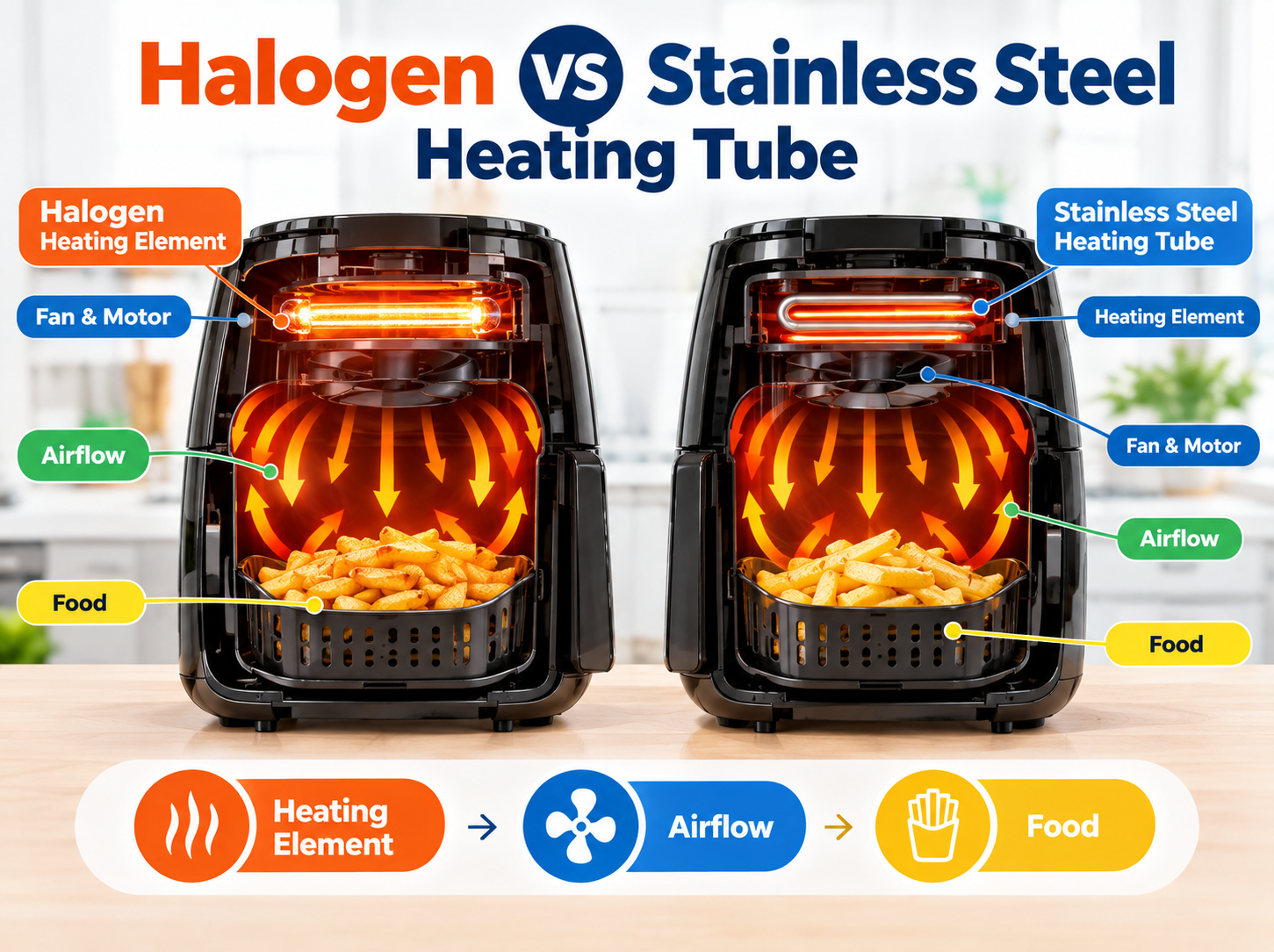
l Air Fryer Heating Element: Halogen vs. Stainless Steel Heating Tube.
l Why Does Airflow Matter in an Air Fryer?
l What Is the Difference Between AC and BLDC Motors in Air Fryers?
l What Makes an Air Fryer Cook More Evenly?
l How Can I Test an Air Fryer Sample Before Placing a Bulk Order?
l What Quality-Control Standards Should I Require from an Air Fryer Supplier?
l What Air Fryer Tests Should Be Included in a Pre-Shipment Inspection?
l What Factors Affect the FOB Price of an Air Fryer?
l How to Compare Quotations from Different Air Fryer Suppliers?
l 230°C Air Fryer: What Buyers Should Check Before Importing?
l A Dual Heating vs Single Heating Air Fryer- Which Is Better?
l What Is the Difference Between AC and DC Motors in Air Fryers?
l Air Fryer for the Middle East - A GCC Buyer’s Guide to G-Mark, Specifications and Compliance?
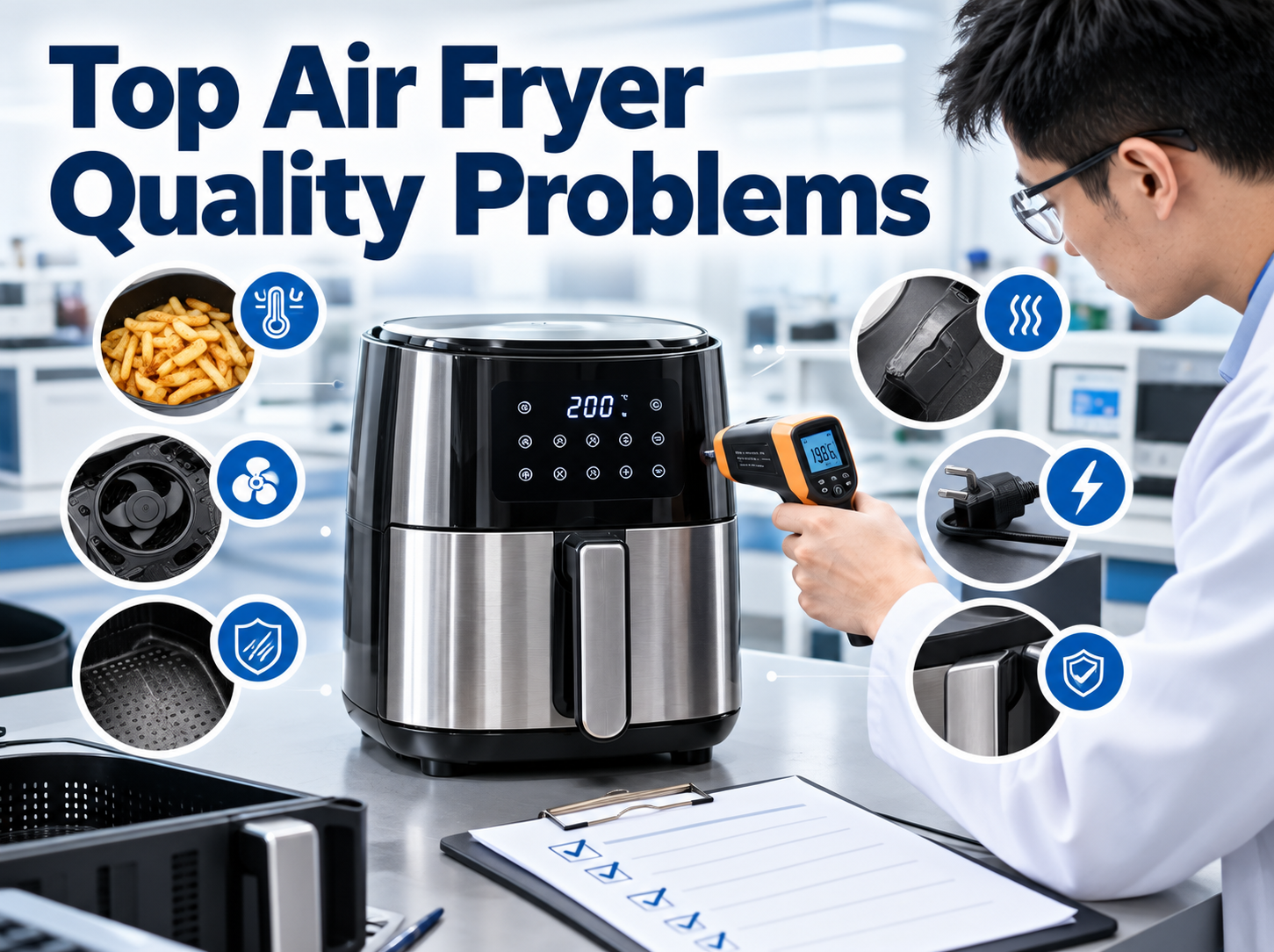
l What Are the Most Common Quality Problems with Air Fryers?
l Air Fryer RFQ Checklist: 20 Specifications Buyers Should Include.
l How To Verify Whether an Air Fryer Supplier Is Reliable?
l How to Choose an OEM-ODM Air Fryer Supplier in China?
l 200°C vs 230°C Air Fryer: Which one is better?
l Metal-body vs plastic-body air fryer: which is better for a premium brand?
l Top Heating vs. Rear Heating Air Fryers: Which one is better for a B2B buyer?
l Is a Vertical Dual-Drawer Air Fryer Better for Saving Kitchen Space?
l Air Fryer Certifications & Compliance by Market- A Safety Guide for Importers.
l Vertical vs. Horizontal Dual-Basket Air Fryer- Which Is Better for Retail?
FUNLOIV already has related content covering supplier verification, QC, quotation comparison and warranty, so this article can serve as the after-sales/warranty hub connecting those buyer-intent pages.
Suggested CTA
Looking for an air fryer OEM/ODM supplier with a structured quality-control and after-sales process?
If you are sourcing air fryers for a private-label brand, retail chain, importer or distribution business, send us your target specifications and market requirements.
FUNLOIV can help you evaluate product configuration, quality requirements, sample testing, spare-parts planning and after-sales support before mass production.
Contact FUNLOIV to discuss your air fryer project.

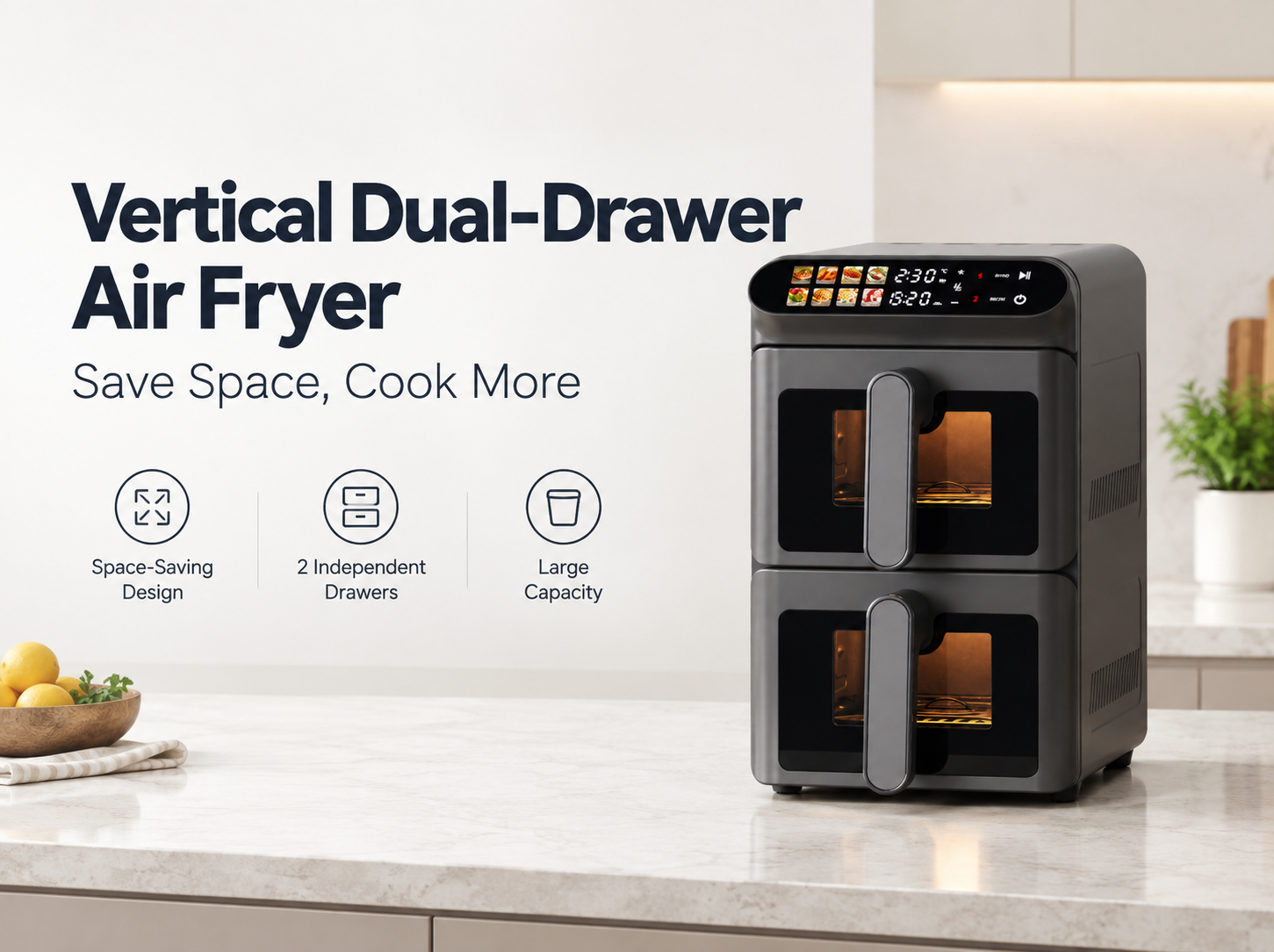
Is a Vertical Dual-Drawer Air Fryer Better for Saving Kitchen Space?
Can An Air Fryer Replace A Toaster Oven?
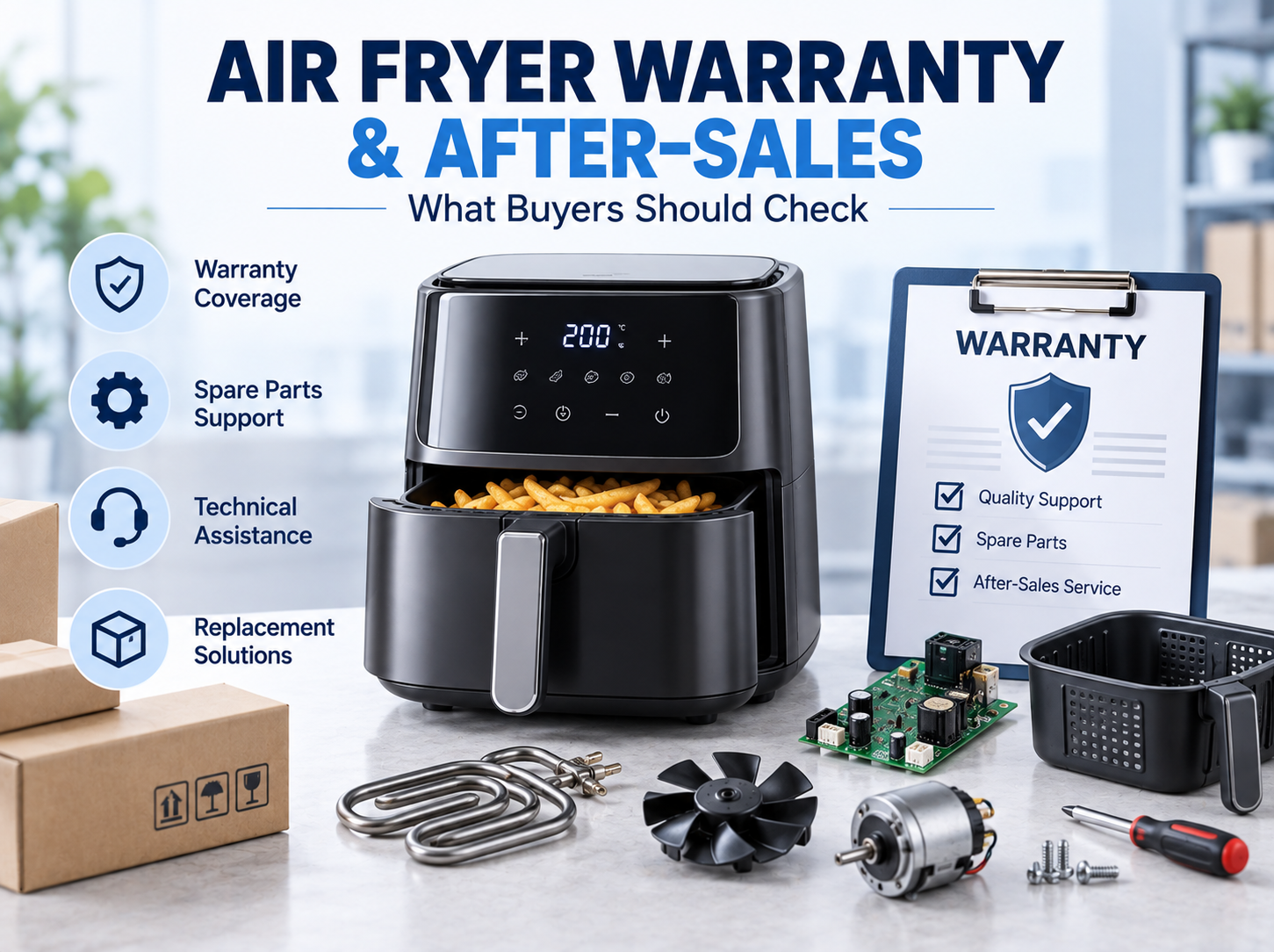
What Are the Common Warranty and After-Sales Problems with Air Fryers?
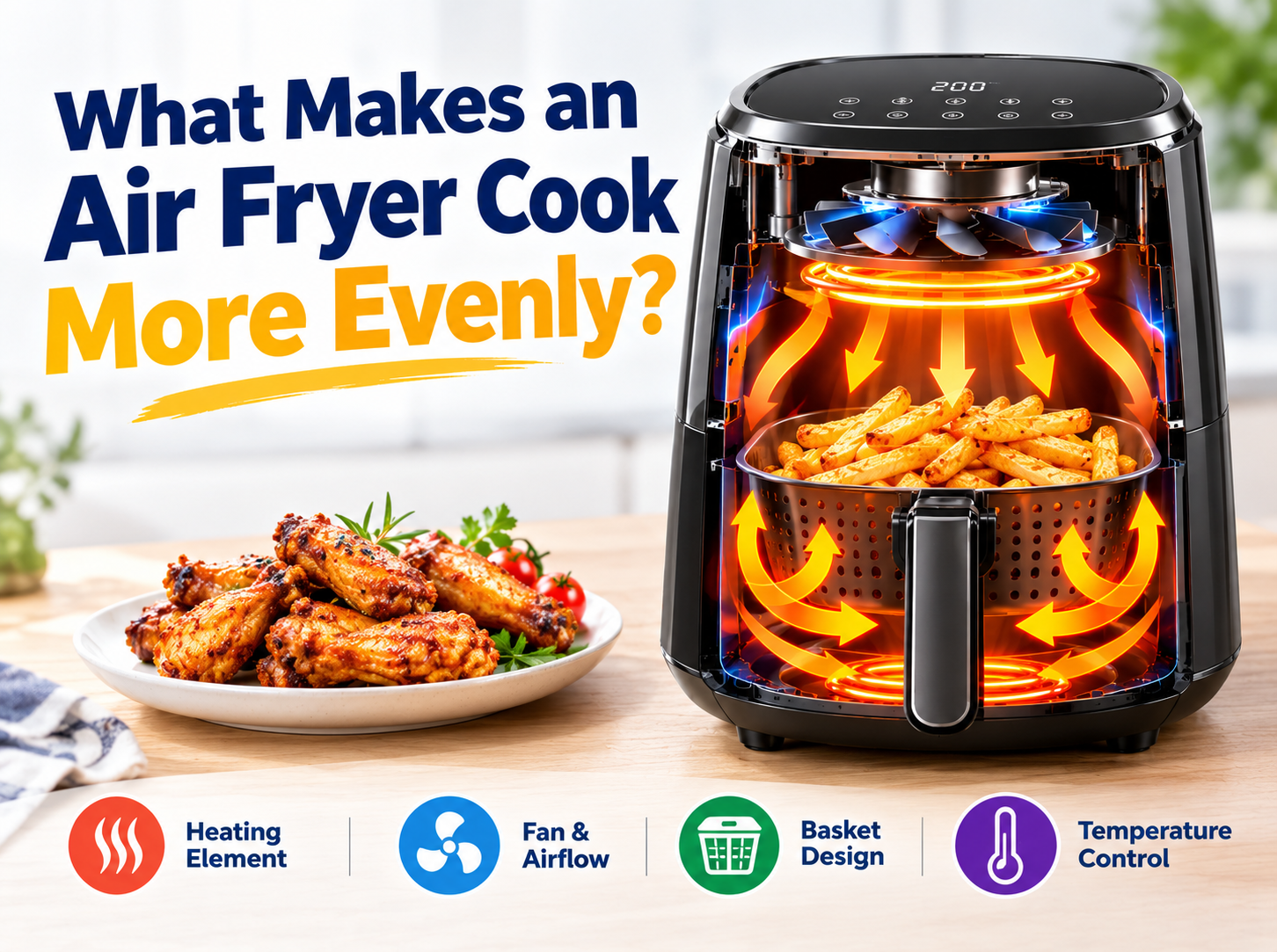
What Makes an Air Fryer Cook More Evenly?
Air Fryer Heating Element: Halogen vs Stainless Steel Tube
What Are the Most Common Quality Problems with Air Fryers?
 + 86 181 3826 8709
 info@funloiv.com
 6/F., Guanglong Building, Pingxin North Road, Longgang, Shenzhen City, Guangdong, China


@ 2009-2026 Shenzhen Funloiv Electric Appliance Co., LtdAll rights reserved


