 Notice:

 search
search
search
Sep 23, 2026


Plastic melting or deformation is one of the quality problems that air fryer brands and importers need to consider during product development.
When a plastic handle becomes soft, a housing starts to warp, a control panel deforms, or an internal plastic component shows heat damage, the problem is not necessarily caused by the plastic alone.
In many cases, material selection, heating element position, airflow, heat shielding, component clearance, temperature control, and manufacturing consistency all contribute to the final result.
So, how can buyers prevent plastic melting or deformation in an air fryer?
The most effective approach is to control the entire thermal system:
Material Selection → Thermal Design → Heating Element Position → Airflow → Heat Shielding → Temperature Testing → Thermal Cycling → Mass-Production Control
A suitable plastic material is important, but it is only one part of the solution.
For B2B buyers, the key question should therefore not simply be “Is this air fryer made of plastic or metal?” Instead, buyers should ask:
“Are the materials, structure, airflow and thermal protection designed and validated for the intended operating conditions?”
1. What Causes Plastic to Melt or Deform in an Air Fryer?
Plastic deformation in an air fryer can have several different causes.
The most common ones include:
l Excessive local temperature
l Insufficient heat resistance of the material
l Plastic components positioned too close to the heating element
l Poor heat shielding
l Inadequate airflow
l Poor heat dissipation
l Hot spots inside the appliance
l Incorrect temperature control
l Insufficient clearance between hot and plastic components
l Thermal aging after repeated heating cycles
l Material changes during mass production
l Manufacturing or assembly problems
It is also important to distinguish between different types of thermal damage.
A plastic component may experience:
l Softening
l Warping
l Dimensional deformation
l Discoloration
l Cracking
l Surface damage
l Loss of mechanical strength
l Melting
These conditions do not necessarily occur at the same temperature or under the same circumstances.
Therefore, simply checking the maximum cooking temperature of an air fryer is not enough.
The temperature of each critical component under actual operating conditions should be considered.
2. Which Plastic Parts Are Most at Risk?
Not every plastic component in an air fryer is exposed to the same thermal conditions.
Components located closer to the heating element, hot-air path or exhaust area generally require more careful thermal evaluation.
Typical components that buyers should review include:
Plastic Component | Potential Thermal Concern |
Handle | Softening or deformation |
Front housing | Warping or discoloration |
Control panel | Deformation or appearance changes |
Drawer frame | Dimensional changes |
Decorative trim | Heat deformation |
Internal brackets | Softening or cracking |
Fan housing | Thermal aging |
Wire supports | Heat-related degradation |
Insulation components | Loss of performance |
Plastic feet | Deformation under heat |
This is why a simple specification such as “plastic body” does not provide enough information for a technical evaluation.
An air fryer with a plastic external housing may still contain many different plastic components internally.
Conversely, a metal-body air fryer can still contain plastic components that require thermal validation.
For buyers, the more useful question is:
Which plastic materials are used, where are they located, and what temperatures will they experience during normal and abnormal operation?
3. How Should Plastic Materials Be Selected for an Air Fryer?
Material selection should be based on the actual application environment rather than a single nominal temperature value.
When selecting a plastic component for an air fryer, suppliers and product engineers should consider:
Operating temperature
What temperature will the component experience during normal operation?
Peak temperature
Could the component experience a short-term temperature significantly higher than the average operating temperature?
Exposure time
Is the component exposed to heat for several minutes, one hour, or repeated cycles over the product's lifetime?
Distance from the heating element
A plastic part located close to a heating element may experience much higher thermal stress than a component farther away.
Airflow
Hot air can transfer heat to plastic components depending on the airflow path.
Thermal cycling
Repeated heating and cooling can gradually affect dimensional stability and mechanical properties.
Mechanical load
A plastic handle, bracket or structural component may experience both heat and mechanical stress.
Therefore:
Heat resistance should be evaluated in the context of the complete application, not simply by comparing one temperature number with another.
4. Why Can Plastic Deform Even When the Rated Temperature Seems Safe?
This is one of the most important points for air fryer buyers.
Suppose an air fryer has a maximum cooking temperature of 230°C.
That does not mean every component inside the appliance reaches 230°C.
At the same time, it does not automatically mean that every plastic component is safe simply because its nominal heat-resistance specification appears higher than the appliance's average temperature.
Why?
Because air fryer temperature distribution is not uniform.
Localized heat
A component close to a heating element may experience substantially more thermal exposure than another component elsewhere in the appliance.
Radiant heat
Heating elements can transfer heat through radiation even when a plastic component does not directly contact the heating element.
Hot-air exposure
A plastic component positioned directly in a high-temperature airflow path can experience continuous thermal exposure.
Heat accumulation
Poor internal ventilation or insufficient heat dissipation can increase the temperature around sensitive components.
Thermal cycling
Repeated:
Heating → Cooling → Heating → Cooling
can gradually cause dimensional changes, aging or mechanical deterioration.
For this reason, product validation should examine actual component temperatures, not only the programmed cooking temperature.
5. How Do Airflow and Internal Structure Affect Plastic Temperature?
Airflow is another important factor in preventing plastic deformation.
An air fryer is essentially a thermal system consisting of:
Heating Element → Fan → Airflow → Heat Transfer → Cooking Chamber → Exhaust
The airflow needs to distribute heat effectively while also preventing excessive heat accumulation around sensitive components.
Poor airflow design can contribute to:
l Local hot spots
l Excessive temperature around the control area
l Higher housing temperatures
l Increased heat exposure to plastic components
l Poor heat dissipation
l Uneven thermal loading
This is why more airflow is not automatically better.
The objective is to create an appropriate airflow pattern for the complete appliance design.
For B2B buyers, this means the airflow system should be evaluated together with:
l Fan performance
l Heating element position
l Air inlet
l Air outlet
l Internal cavity structure
l Heat shielding
l Component placement
l Exhaust direction
A supplier should be able to explain how these elements work together.
6. Why Do Heating Element Position and Heat Shielding Matter?
The position of the heating element can significantly affect the thermal environment around plastic components.
When designing an air fryer, engineers should consider:
l Distance between the heating element and plastic components
l Direction of heat radiation
l Hot-air circulation
l Heat shields
l Metal barriers
l Insulation
l Air gaps
l Exhaust paths
A plastic component should not simply be placed wherever there is available space.
Its location should be evaluated based on the expected thermal conditions.
For example, if a plastic structural component is located close to a heating element, the design may require:
l Greater clearance
l A metal heat shield
l Improved insulation
l Modified airflow
l Relocation of the component
l A different material
This is also why heating-element position should not be evaluated independently from the rest of the thermal system.
A top-heating design and a rear-heating design, for example, may use different airflow paths and component layouts. The relevant question is not which position is universally better, but whether the complete design properly manages heat exposure to all critical components.
7. How Should Buyers Test Plastic Heat Resistance Before Mass Production?
For importers and brand owners, one of the most important steps is to test the actual production-intent sample before approving mass production.
A recommended evaluation can include the following steps.
Step 1: Record the original condition
Before testing, record:
l Component dimensions
l Appearance
l Color
l Assembly position
l Gaps
l Handle alignment
l Drawer operation
l Control-panel condition
This provides a baseline for comparison.
Step 2: Test at the maximum intended operating condition
If the product is designed for a high maximum temperature, testing should include the applicable maximum operating condition.
The exact test conditions should be defined according to the product specification, target market and applicable safety requirements.
Do not test only at a convenient or typical temperature if the product will be marketed for higher-temperature operation.
Step 3: Measure critical component temperatures
Temperature mapping can be useful for identifying potential hot spots.
Measurements may include:
l Plastic housing
l Handle
l Control panel
l Drawer frame
l Internal brackets
l Components near the heating element
l Areas around the airflow path
The purpose is to understand the actual thermal environment of the product.
Step 4: Perform repeated heating cycles
A single heating cycle may not reveal long-term thermal problems.
Where appropriate, testing should include repeated:
Heating → Cooling → Heating → Cooling
cycles.
This helps identify potential:
l Warping
l Cracking
l Dimensional changes
l Loosening
l Discoloration
l Material degradation
Step 5: Inspect the product after testing
After thermal testing, inspect both appearance and function.
Check:
l Plastic deformation
l Surface condition
l Color changes
l Cracks
l Loose components
l Gaps
l Handle alignment
l Drawer operation
l Control operation
Step 6: Re-test key functions
Thermal testing should not end with a visual inspection.
After testing, verify whether the appliance still operates correctly.
For example:
l Does the drawer open and close normally?
l Does the handle remain firmly attached?
l Does the control panel work correctly?
l Does the fan operate normally?
l Does temperature control remain stable?
l Do safety devices continue to function?
This is the difference between simply checking appearance and validating product performance.
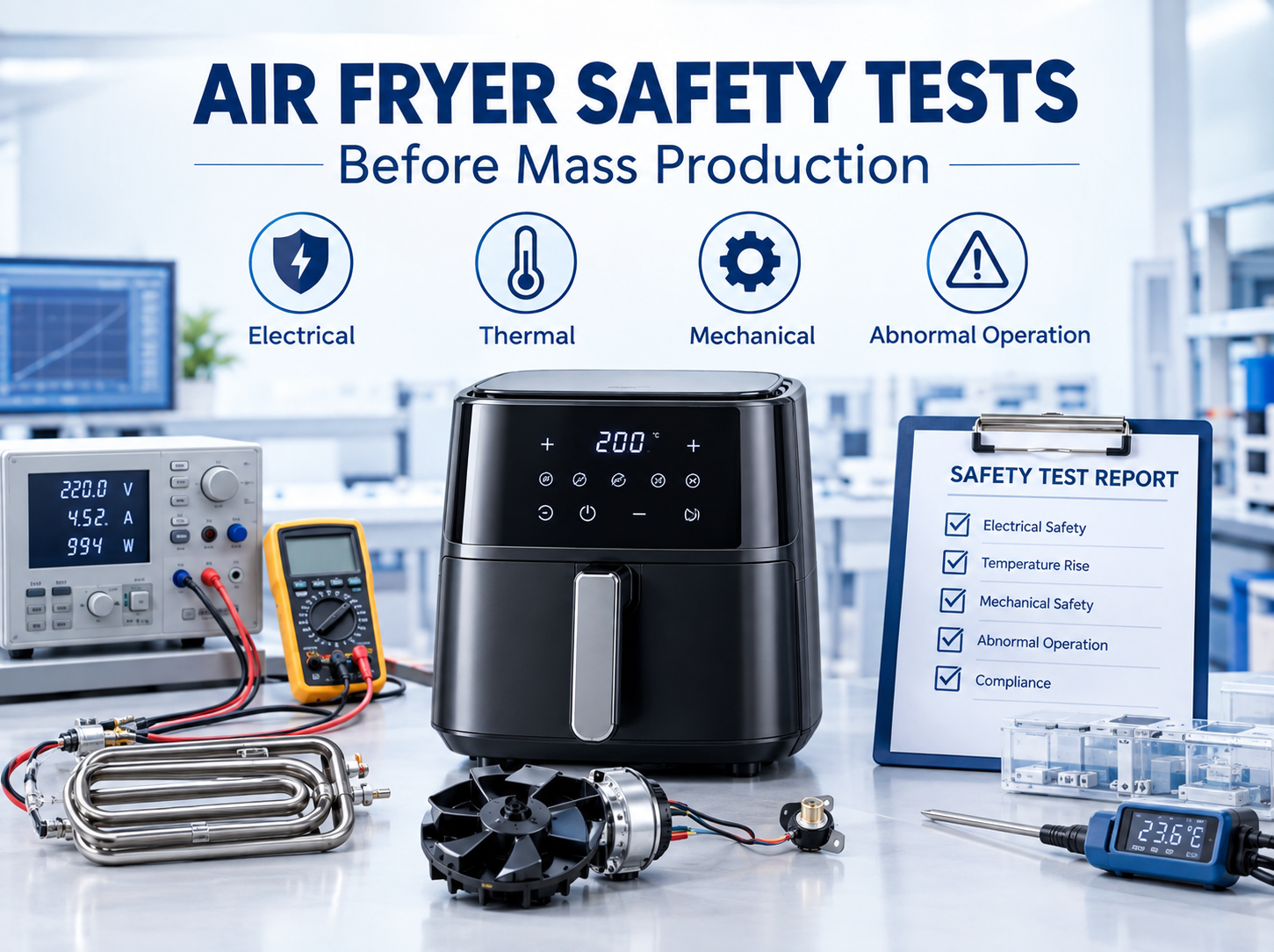
8. What Safety and Thermal Tests Should Suppliers Complete?
Plastic deformation should also be considered as part of the wider air fryer safety and compliance process.
For household cooking appliances, applicable safety requirements depend on the product design and target market.
IEC 60335-2-9 is the relevant IEC particular standard covering grills, toasters and similar portable cooking appliances. The 2019 edition is the published seventh edition and is used together with the applicable edition of IEC 60335-1.
As of September 2026, IEC also has an IEC 60335-2-9:2026 pre-release version in the voting period. Importantly, this is a pre-release/FDIS version rather than the final published edition; it specifically adds requirements for portable air fryers and addresses, among other changes, temperature-rise limits for external surfaces.
Depending on the product design and market, a supplier's test program may therefore need to consider areas such as:
l Temperature rise
l Surface temperature
l Electrical safety
l Insulation
l Leakage current
l Dielectric strength
l Grounding
l Abnormal operation
l Mechanical safety
l Stability
l Heating-system protection
l Motor and fan safety
l Thermal protection
l Material and construction requirements
The exact applicable test plan should be confirmed for the specific model and destination market rather than assuming that one test list applies to every air fryer.
9. Can Real-World Air Fryer Problems Be Related to Overheating?
Real-world recalls demonstrate why thermal and safety validation should not be treated as a paperwork exercise.
For example, the U.S. Consumer Product Safety Commission reported a 2022 recall involving Insignia air fryers and air fryer ovens after reports of units catching fire, burning or melting. The affected products included models with plastic or plastic-and-stainless-steel bodies.
In another case, CPSC reported a 2023 recall of approximately two million Cosori air fryers because a wire connection could overheat and create fire and burn hazards; the agency reported incidents involving overheating, melting, smoking and fire.
These examples do not mean that plastic-body air fryers are inherently unsafe, nor do they establish that plastic deformation was the root cause of those recalls.
Instead, they illustrate a broader B2B lesson:
Thermal management, electrical design, material selection and safety validation need to be considered as an integrated system.
A visible melted plastic component may sometimes be the symptom of a deeper thermal, electrical or structural problem.
10. How Can Brands Prevent Material Changes During Mass Production?
A product can pass sample testing and still develop problems after mass production if the production configuration changes.
This is why buyers should control the transition from:
Prototype → Approved Sample → Pilot Production → Mass Production
Important controls include:
Material consistency
Verify that mass-production materials match the approved specification.
Control:
l Material grade
l Material supplier
l Material specification
l Color masterbatch where relevant
l Material changes
Component consistency
The plastic component used in mass production should match the tested component in:
l Material
l Dimensions
l Wall thickness
l Geometry
l Assembly position
Tooling consistency
Changes to molds or tooling can affect:
l Wall thickness
l Dimensions
l Strength
l Clearance
l Assembly position
Heat-shield consistency
If the tested sample uses a particular heat shield, insulation component or metal barrier, it should remain part of the production configuration.
Assembly consistency
Incorrect assembly can change the thermal environment.
Examples include:
l Incorrect component position
l Missing insulation
l Missing heat shield
l Insufficient clearance
l Incorrect fastening
This is why engineering change control should be part of a reliable air fryer supplier's quality system.
11. What Should Buyers Ask an Air Fryer Supplier?
Before approving an air fryer for mass production, buyers can ask the supplier the following questions.
Material
l What plastic materials are used in the air fryer?
l Which components are exposed to the highest temperatures?
l What are the material specifications for these components?
l Has the material been evaluated for the intended application?
Thermal design
l Where is the heating element located?
l How close are plastic components to the heating element?
l Is heat shielding used?
l How is heat removed from the housing?
l Where are the main hot-air and exhaust paths?
l Have critical component temperatures been measured?
Testing
l Has the product been tested at its maximum intended operating condition?
l Has temperature mapping been performed?
l Has thermal cycling been performed?
l Were plastic components inspected after testing?
l Were product functions re-checked after thermal testing?
Production
l Are the production materials identical to the approved sample?
l How are material changes controlled?
l How are engineering changes controlled?
l Is the first production batch re-validated?
l What inspections are performed before shipment?
These questions can help buyers move from “Does the supplier have a certificate?” to “Has the actual product design been properly validated?”
Plastic Melting Prevention Checklist for Air Fryer Buyers
Before placing a bulk order, buyers should consider the following checklist:
Material
l Plastic materials are specified
l Heat-sensitive components have been identified
l Material suitability has been evaluated
Thermal Design
l Heating element position has been reviewed
l Critical plastic components have sufficient clearance
l Heat shielding is provided where necessary
l Airflow and exhaust paths have been evaluated
Testing
l Maximum operating conditions have been tested
l Critical temperatures have been measured
l Thermal cycling has been considered
l Plastic deformation has been inspected
l Product functions have been re-checked after testing
Production
l Mass-production materials match the approved sample
l Tooling changes are controlled
l Engineering changes are documented
l Pilot production is verified
l Final production inspection is completed
Frequently Asked Questions
Ø Can plastic melt in an air fryer?
Yes. Plastic components can soften, deform or melt if they are exposed to temperatures or thermal conditions beyond what their material and design can safely tolerate.
However, the cooking temperature displayed by the appliance does not necessarily equal the temperature experienced by every plastic component.
Ø What temperature can air fryer plastic withstand?
There is no single temperature that applies to all air fryer plastics.
The appropriate temperature capability depends on the specific material, component design, location, duration of exposure, mechanical load and thermal environment.
Therefore, buyers should evaluate the actual application conditions rather than relying on a generic plastic temperature rating.
Ø Why does my air fryer handle become soft?
A handle may become soft if it is exposed to excessive heat, radiant heat or hot airflow, or if the selected material and structural design are not appropriate for the application.
The root cause should be investigated rather than simply replacing the handle material.
Ø Can plastic deform even if an air fryer is only rated at 200°C?
Yes.
The temperature experienced by a particular plastic component can depend on its location, airflow, heat radiation, heat shielding and exposure time.
Conversely, an air fryer rated at a higher cooking temperature does not automatically mean that every plastic component will deform.
The complete thermal design needs to be evaluated.
Ø Is a metal-body air fryer less likely to have plastic deformation problems?
A metal body can reduce the amount of plastic exposed in the external housing, but it does not eliminate the need for thermal design and material validation.
Metal-body air fryers can still contain plastic handles, control components, brackets, fan components and other internal parts.
Therefore, metal vs. plastic is only one part of the evaluation.
Ø How can I test an air fryer for plastic deformation?
A practical evaluation can include:
l Recording the original component condition
l Testing at the intended maximum operating condition
l Measuring critical component temperatures
l Performing repeated thermal cycles
l Inspecting plastic components for deformation
l Checking dimensions and assembly gaps
l Re-testing key product functions
The exact test conditions should be determined according to the product design and applicable market requirements.
Ø Should plastic components be tested before mass production?
Yes.
Testing before mass production gives brands and importers an opportunity to identify thermal, material or structural problems before large quantities are manufactured.
It is generally much easier to correct a design issue during product development than after a large production run has been completed.
Conclusion: Preventing Plastic Deformation Requires More Than Choosing a Heat-Resistant Plastic
Preventing plastic melting or deformation in an air fryer is not simply a matter of selecting a plastic with a higher temperature rating.
A reliable approach combines:
Material Selection
l Thermal Design
l Heating Element Position
l Airflow Management
l Heat Shielding
l Temperature Measurement
l Thermal Cycling
l Mass-Production Control
For air fryer brands and importers, the most important question is therefore not simply:
“Is this plastic or metal?”
A more useful question is:
“Has the complete product design been validated under its intended operating conditions?”
This approach can help buyers identify potential thermal problems earlier, reduce quality risks during mass production, and build a more reliable air fryer product for the target market.
Related Topics for Air Fryer Buyers
For a complete supplier and product-evaluation process, buyers should also consider:
l Air Fryer Heating Element: Halogen vs. Stainless Steel Heating Tube.
l Why Does Airflow Matter in an Air Fryer?
l What Is the Difference Between AC and BLDC Motors in Air Fryers?
l What Makes an Air Fryer Cook More Evenly?
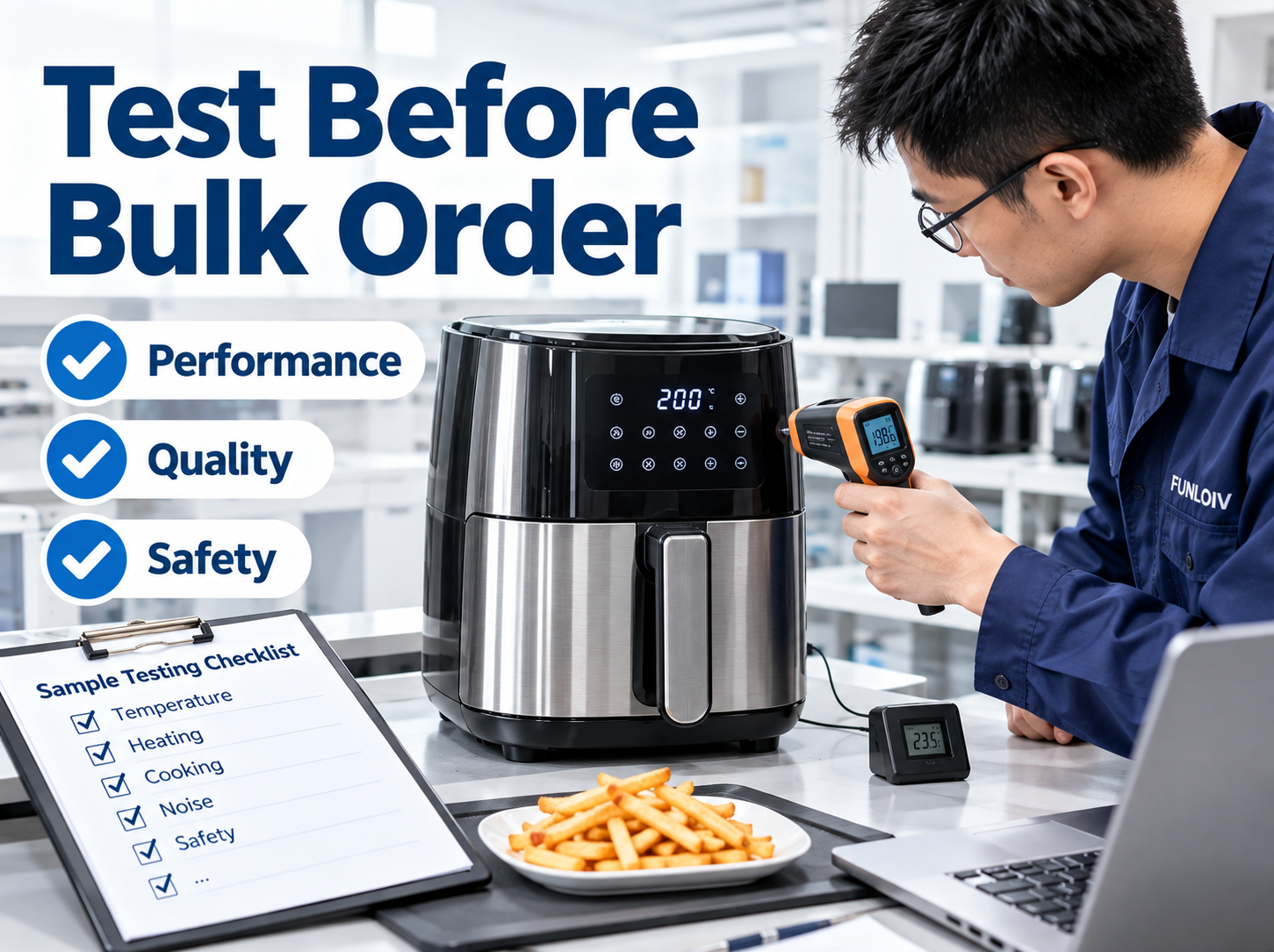
l How Can I Test an Air Fryer Sample Before Placing a Bulk Order?
l What Quality-Control Standards Should I Require from an Air Fryer Supplier?
l What Air Fryer Tests Should Be Included in a Pre-Shipment Inspection?
l What Factors Affect the FOB Price of an Air Fryer?
l How to Compare Quotations from Different Air Fryer Suppliers?
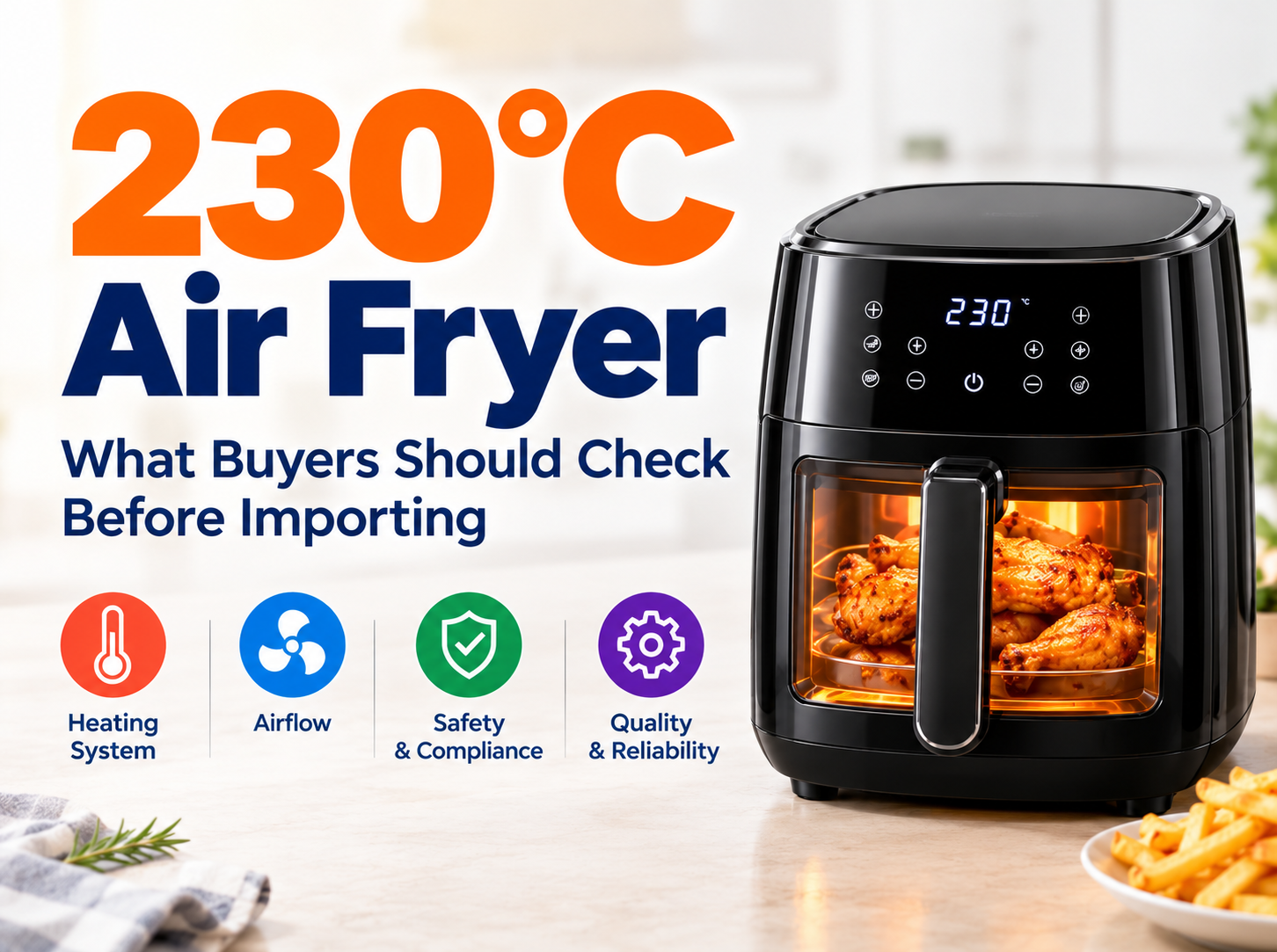
l 230°C Air Fryer: What Buyers Should Check Before Importing?
l A Dual Heating vs Single Heating Air Fryer- Which Is Better?
l What Is the Difference Between AC and DC Motors in Air Fryers?
l Air Fryer for the Middle East - A Guide to G-Mark, Specifications and Compliance?
l What Are the Most Common Quality Problems with Air Fryers?
l Air Fryer RFQ Checklist: 20 Specifications Buyers Should Include.
l How To Verify Whether an Air Fryer Supplier Is Reliable?
l How to Choose an OEM-ODM Air Fryer Supplier in China?
l 200°C vs 230°C Air Fryer: Which one is better?
l Metal-body vs plastic-body air fryer: which is better for a premium brand?
l Top Heating vs. Rear Heating Air Fryers: Which one is better for a B2B buyer?
l Is a Vertical Dual-Drawer Air Fryer Better for Saving Kitchen Space?
l Air Fryer Certifications & Compliance by Market- A Safety Guide for Importers.
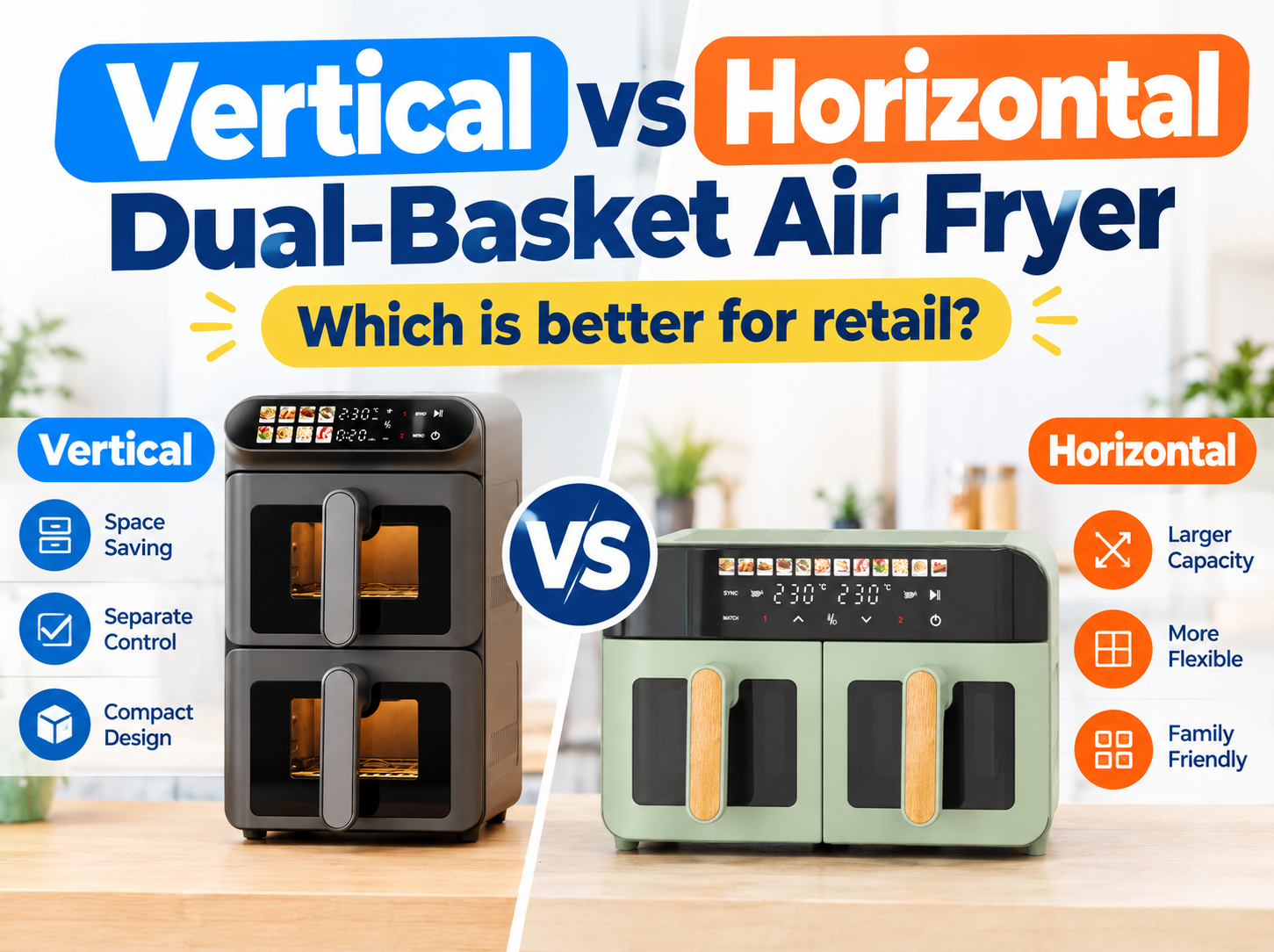
l Vertical vs. Horizontal Dual-Basket Air Fryer- Which Is Better for Retail?
l What Air Fryer Capacity Is Best for the European Market?
l What Are the Common Warranty and After-Sales Problems with Air Fryers?
l What MOQ, Lead Time and Payment Terms Should I Expect from an Air Fryer Supplier?
CTA
Developing a new air fryer or looking for a reliable OEM/ODM supplier?
Discuss your target capacity, temperature range, body material, heating structure and market requirements with our air fryer development team.
FUNLOIV supports air fryer product development, OEM/ODM customization, quality control and export supply for international brands and importers.


Wilko collapse - What Went Wrong With The High Street Retailer?
Vertical vs. Horizontal Dual-Basket Air Fryer: Which Is Better for Retail?
What Air Fryer Safety Tests Should Be Completed Before Mass Production?
230°C Air Fryer: What Buyers Should Check Before Importing
How Can I Test an Air Fryer Sample Before Placing a Bulk Order?

How to Compare Quotations from Different Air Fryer Suppliers?
 + 86 181 3826 8709
 info@funloiv.com
 6/F., Guanglong Building, Pingxin North Road, Longgang, Shenzhen City, Guangdong, China


@ 2009-2026 Shenzhen Funloiv Electric Appliance Co., LtdAll rights reserved


