 Notice:

 search
search
search
Sep 24, 2026


When buyers compare air fryers, they often focus on capacity, wattage, temperature range, cooking programs and appearance.
However, two air fryers with similar specifications can produce different cooking results and offer different cleaning experiences because their internal designs are different.
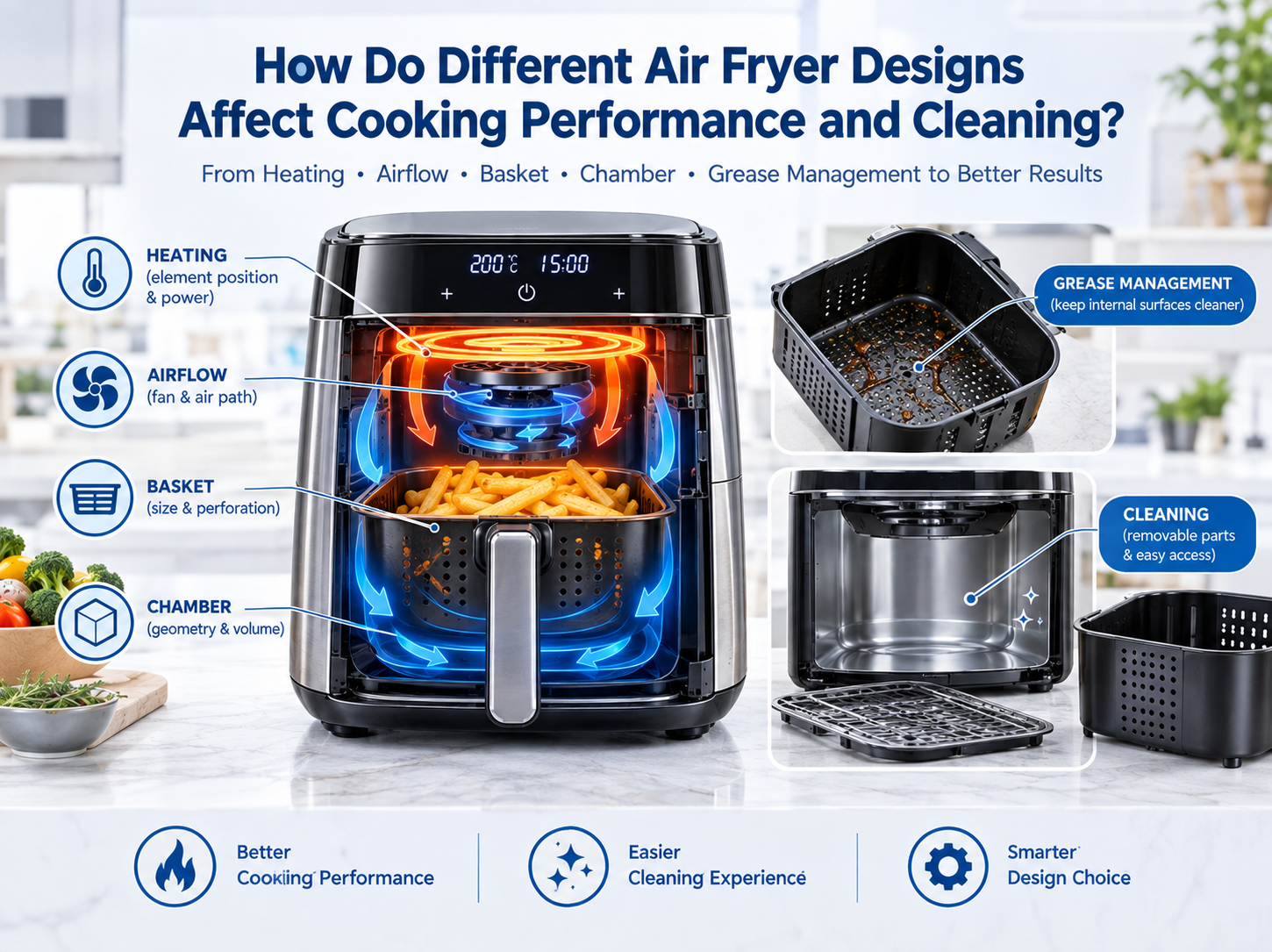
Heating-element position, fan and motor configuration, airflow path, cooking-chamber geometry, basket design, grease management and material selection can all affect how an air fryer performs.
In simple terms:
Air fryer design determines how heat, air, food and grease move through the appliance.
This affects two important aspects of the user experience:
Cooking Performance
and
Cleaning Experience
For B2B buyers, importers and brand owners, understanding this relationship is important when selecting an existing model or developing a new OEM/ODM air fryer.
1. What Does “Air Fryer Design” Actually Mean?
Air fryer design is more than the external appearance of the appliance.
From a technical perspective, it includes:
l Heating-element position
l Heating-element type
l Motor and fan configuration
l Airflow path
l Air inlet and outlet
l Cooking-chamber geometry
l Basket or drawer design
l Basket perforation
l Single- or dual-basket configuration
l Horizontal or vertical structure
l Temperature sensors
l Grease-management structure
l Internal materials
l Removable components
l Thermal insulation and protection
These components interact with each other.
For example:
Heating Element → Fan → Airflow → Cooking Chamber → Food
At the same time:
Food + Grease → Airflow → Internal Surfaces → Grease Accumulation → Cleaning
Therefore, cooking and cleaning should not be evaluated as completely separate product functions.
2. How Does Heating Design Affect Cooking Performance?
The heating system is the primary source of thermal energy in an air fryer.
Common heating configurations include:
l Top-mounted heating
l Rear-mounted heating
l Single heating element
l Dual heating elements
l Halogen heating
l Stainless steel tubular heating
However, heating power alone does not determine cooking performance.
A higher-wattage heating element does not automatically produce better cooking results.
The heating element needs to work together with:
l Fan performance
l Airflow
l Cooking-chamber volume
l Basket geometry
l Temperature control
l Food load
l Thermal insulation
For example, FUNLOIV's technical content describes the air fryer cooking system as:
Heating Element → Motor → Fan → Airflow → Food → Moisture Removal
This illustrates why the heating system should be evaluated as part of the complete thermal system rather than as an isolated component.
Why does heating-element position matter?
The position of the heating element affects:
l Heat distribution
l Airflow path
l Distance between the heater and food
l Internal temperature distribution
l Grease exposure
l Cleaning access
l Thermal protection requirements
For example, a top-mounted heating system may be suitable for certain compact or vertical designs, while a rear-mounted system can provide a different airflow architecture.
Neither configuration is universally better.
The important question is:
How well does the heating system work with the complete airflow and chamber design?
3. How Does Airflow Design Affect Cooking Performance?
Airflow is one of the most important links between the heating system and the food.
A typical system can be simplified as:
Heating Element → Fan → Hot Air → Food → Moisture Removal
Airflow affects:
l Heat transfer
l Moisture removal
l Browning
l Crisping
l Cooking uniformity
l Temperature recovery
However:
More airflow does not automatically mean better cooking performance.
The objective is optimized airflow, not maximum airflow.
A fan that moves a large volume of air may still produce inconsistent cooking if the airflow is poorly distributed.
For example, one area of the basket may receive strong airflow while another area receives weaker airflow.
This can lead to:
l Different browning levels
l Hot spots
l Undercooked areas
l Overcooked areas
l Longer cooking times
Airflow depends on several design factors, including:
l Fan diameter
l Fan blade geometry
l Fan speed
l Motor performance
l Heating-element position
l Basket perforation
l Chamber geometry
l Air inlet position
l Air outlet position
l Food loading
FUNLOIV's existing airflow research also emphasizes that fan speed, heating power, chamber volume and airflow resistance need to be balanced rather than optimized independently.
4. How Does Basket Design Affect Cooking Performance?
The basket is where the food actually interacts with the airflow.
Its design therefore has a direct influence on cooking performance.
Important factors include:
Basket size
A larger basket can accommodate more food, but food loading also affects airflow.
Overloading a basket can restrict air circulation and reduce cooking uniformity.
Basket shape
A wide and shallow basket provides a different cooking environment from a deep basket.
The shape can affect:
l Food distribution
l Air circulation
l Distance from the heating element
l Cooking surface area
Basket perforation
The size, number and distribution of holes influence how air moves around and underneath the food.
A well-designed crisper plate can help air circulate around the ingredients. Manufacturer instructions for air fryers commonly emphasize the role of the crisper plate in allowing air to circulate beneath and around food.
Food loading
Even a well-designed basket can produce inconsistent results if consumers place too much food inside.
For B2B product testing, it is therefore useful to evaluate:
l Light load
l Normal load
l Maximum recommended load
rather than testing only an almost-empty basket.
5. How Does Single- vs. Dual-Basket Design Affect Cooking?
Basket configuration changes the way cooking space is used.
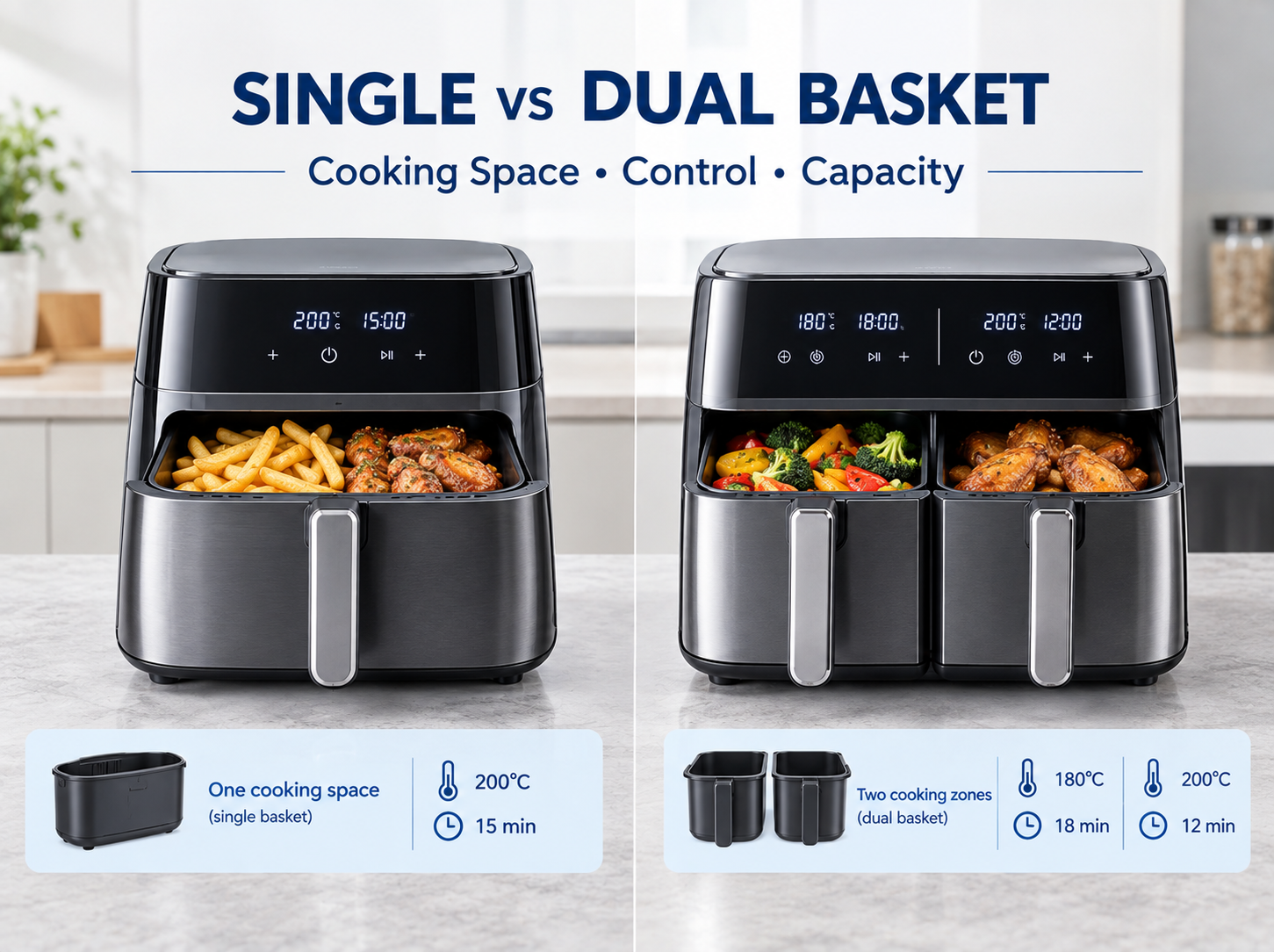
Single-basket design
A single-basket air fryer provides one continuous cooking area.
This can be useful when consumers commonly cook:
l One large batch
l Large food items
l Wider food portions
l One type of food at a time
Dual-basket design
A dual-basket air fryer divides the cooking area into two zones.
Depending on the design, each zone may have:
l Independent temperature control
l Independent timer
l Separate cooking programs
l Independent heating
l Independent airflow
This can provide greater flexibility when cooking two different foods simultaneously.
However, dual-basket architecture also creates additional engineering considerations.
The supplier needs to consider:
l Airflow distribution
l Heating balance
l Temperature sensing
l Power management
l Basket dimensions
l Heat transfer between zones
Therefore:
A dual-basket design can improve cooking flexibility, but the complete thermal architecture still determines cooking performance.
This is why basket configuration should be evaluated together with heating and airflow design.
6. How Does Vertical vs. Horizontal Design Affect Cooking and Cleaning?
The physical arrangement of an air fryer can also influence its performance and usability.
Horizontal configuration
Two cooking zones may be positioned side by side.
Potential characteristics include:
l Greater countertop width
l Easy side-by-side access
l Shorter overall height
l Separate cooking zones
Vertical configuration
Two drawers may be positioned one above the other.
Potential characteristics include:
l Reduced countertop width
l Greater overall height
l Different airflow requirements
l Different heat-distribution considerations
l Different accessibility for cleaning
A vertical configuration can therefore provide a different approach to space utilization.
But:
Vertical does not automatically mean better, and horizontal does not automatically mean better.
The appropriate structure depends on:
l Target kitchen environment
l Capacity
l Basket size
l Airflow design
l User accessibility
l Retail positioning
For FUNLOIV, this is particularly relevant to vertical dual-drawer air fryer development, where space utilization needs to be considered together with thermal architecture.
7. How Does Cooking-Chamber Geometry Affect Performance?
The cooking chamber is more important than its external appearance may suggest.
Its:
l Width
l Height
l Depth
l Internal volume
l Corners
l Air channels
l Distance from heater to food
can influence airflow and temperature distribution.
For example, increasing chamber volume without appropriately adjusting heating power and airflow can change:
l Preheating behavior
l Temperature recovery
l Air velocity
l Cooking time
l Energy consumption
Similarly, a chamber with complex internal structures may create areas with different airflow resistance.
Therefore, when developing a new air fryer, the cooking chamber should be considered together with the:
Heating Element + Fan + Basket + Food Load
rather than designed independently.
8. How Does Heating-Element Position Affect Cleaning?
Cooking performance is only one side of the design.
The heating system can also affect cleaning requirements.
During cooking, grease and small food particles can become airborne and move with the internal airflow.
Depending on the product architecture, they may reach:
l Heating elements
l Fan area
l Internal chamber surfaces
l Air ducts
l Protective structures
l Areas around the basket
For a top-heating design, buyers should examine:
l Heating-element protection
l Fan protection
l Grease exposure
l Cleaning accessibility
l Internal surface design
For a rear-heating design, buyers should consider:
l Rear airflow channels
l Vent structures
l Grease accumulation
l Access to internal areas
l Cleaning requirements
The important point is:
Heating position and cleaning performance should be evaluated together with airflow and grease exposure.
FUNLOIV's comparison of top- and rear-heating architectures similarly treats cleaning as a system-level consideration rather than assuming that one heating position is universally easier to clean.
9. How Does Grease Management Affect Cleaning?
Grease management is one of the most overlooked aspects of air fryer design.
During cooking, fat and food particles can move through the cooking chamber.
The design therefore needs to consider:
Food → Grease → Airflow → Internal Surfaces → Grease Collection
A good design should consider where grease is likely to accumulate and whether those areas can be accessed during cleaning.
Important questions include:
l Where does grease collect?
l Can grease reach the heating element?
l Can grease reach the fan?
l Are there hidden corners?
l Can the user access the internal surfaces?
l Can food residue accumulate around vents?
l Can the relevant components be removed?
This leads to an important design principle:
Good cleaning performance begins with grease management during product development.
Cleaning should not be treated as an afterthought.
10. How Do Basket and Surface Materials Affect Cleaning?
Materials can influence both cooking durability and cleaning performance.
For example, basket and crisper-plate surfaces may use non-stick coatings or other surface treatments.
Important considerations include:
l Food release
l Grease adhesion
l Surface durability
l Scratch resistance
l Repeated cleaning
l Dishwasher compatibility
l High-temperature resistance
A product may be advertised as dishwasher-safe, but that does not automatically mean every part of the appliance is equally easy to clean.
A basket with complicated corners, narrow gaps or deep perforations may still require additional manual cleaning.
Therefore:
Dishwasher compatibility is only one part of cleaning performance.
The complete geometry and accessibility of the components also matter.
11. How Do Materials Affect Both Cooking and Cleaning?
Material selection is connected to thermal performance as well as maintenance.
For plastic components, buyers should consider:
l Heat resistance
l Thermal deformation
l Discoloration
l Surface durability
l Grease resistance
l Chemical resistance
For metal components, buyers should consider:
l Surface treatment
l Corrosion resistance
l Heat resistance
l Grease accumulation
l Cleaning durability
l Surface appearance
The important point is not:
“Metal is always better than plastic.”
Instead:
The material needs to be suitable for its location, temperature exposure, mechanical function and cleaning environment.
This is especially important for components close to heating elements or airflow channels.
12. Does a More Powerful Air Fryer Always Cook Better?
No.
This is a common misunderstanding when comparing products.
For example, a buyer may compare two models:
Model A
2000W
Model B
1800W
It would not be technically correct to conclude that Model A must cook better.
Cooking performance depends on:
l Heating power
l Heating-element type
l Fan performance
l Airflow
l Chamber geometry
l Temperature control
l Basket design
l Food load
l Insulation
Similarly, a higher maximum temperature does not automatically mean better cooking performance.
FUNLOIV's 230°C air fryer guidance makes the same point: temperature should be evaluated together with heating power, airflow, basket design, temperature control and food loading.
13. Cooking Performance vs. Cleaning Performance: What Are the Design Trade-Offs?
Different design choices can affect cooking and cleaning in different ways.
Design Factor | Potential Cooking Effect | Cleaning Consideration |
Deep basket | More vertical capacity | Deeper areas may be harder to access |
Wide basket | Larger cooking surface | Larger surface to clean |
Fine perforation | Can influence airflow distribution | More openings may retain residue |
Dual basket | Two cooking zones | More baskets and components |
Complex airflow channels | Can optimize air distribution | More internal areas to manage |
Top heating | Direct upper heat in some designs | Heater/fan area needs protection and access |
Large chamber | More cooking volume | Larger internal surfaces |
Non-stick coating | Can help food release | Coating durability must be maintained |
Vertical structure | Can reduce countertop width | Upper/lower access differs |
High airflow | Can support heat transfer and moisture removal | Grease may travel through more airflow paths |
This illustrates why there is rarely a single “best” air fryer structure.
The objective is to create a balanced system.
14. Why Cooking and Cleaning Should Be Tested Together
An air fryer can perform well in a cooking test but still have poor usability during cleaning.
For example, a sample may produce:
l Good browning
l Fast cooking
l Good crisping
but have:
l Difficult-to-access internal areas
l Excessive grease accumulation
l Difficult-to-remove residue
l Fragile coating
l Complicated basket components
Conversely, a product may be easy to clean but have poor cooking uniformity.
For this reason, B2B sample testing should evaluate both areas.
FUNLOIV's sample-testing framework already includes cooking consistency, temperature accuracy, basket durability, surface temperature, plastic deformation, continuous operation and cleaning/usability.
15. How Should B2B Buyers Test Air Fryer Cooking Performance?
A repeatable test method is more useful than subjective evaluation.
Buyers should control:
Food
Use the same food type.
Quantity
Use the same weight.
Starting condition
For example:
l Frozen
l Refrigerated
l Room temperature
Temperature
Use the same set temperature.
Cooking time
Use the same cooking duration.
Basket configuration
Use the same basket and food-loading arrangement.
Then evaluate:
l Browning
l Crispiness
l Internal doneness
l Cooking uniformity
l Hot spots
l Temperature recovery
l Cooking time
l Repeatability
FUNLOIV's current quality-control guidance similarly recommends repeatable testing of heating uniformity and airflow rather than relying on a single subjective cooking result.
16. How Should Buyers Evaluate Air Fryer Cleaning Performance?
A practical cleaning evaluation should include more than simply checking whether the basket can go into a dishwasher.
Consider:
Basket
l Food residue
l Grease adhesion
l Coating condition
l Corner accessibility
Crisper plate
l Residue around perforations
l Ease of removal
l Ease of washing
Cooking chamber
l Grease accumulation
l Internal corners
l Accessibility
l Wiping area
Heating area
l Food particles
l Grease exposure
l Cleaning access
Fan and airflow area
l Grease accumulation
l Protective structure
l Accessibility
External housing
l Fingerprints
l Grease marks
l Control-panel cleaning
l Surface durability
The evaluation should ideally be repeated after several cooking cycles rather than after only one use.
17. Common Air Fryer Design Mistakes Buyers Should Avoid
Ø Mistake 1: Looking only at wattage
Higher wattage does not automatically mean better cooking.
Evaluate the complete thermal system.
Ø Mistake 2: Looking only at total capacity
An 8L single basket and an 8L dual basket can provide very different usable cooking areas.
Always check basket dimensions and cooking surface.
Ø Mistake 3: Assuming higher airflow is always better
Airflow must be matched with heating power, chamber volume and airflow resistance.
Ø Mistake 4: Assuming dishwasher-safe means easy to clean
Cleaning also depends on:
l Geometry
l Accessibility
l Grease management
l Surface treatment
l Component design
Ø Mistake 5: Evaluating heating and airflow separately
The heater and fan form one thermal system.
Changing one component may affect the performance of the other.
Ø Mistake 6: Testing cooking performance without realistic food loading
A nearly empty basket may perform differently from a realistically loaded basket.
Ø Mistake 7: Ignoring cleaning during product development
Cleaning requirements should be considered during structural design, not after the product is already finalized.
18. Air Fryer Design Evaluation Checklist for B2B Buyers
Before approving an air fryer sample, buyers can use this checklist.
Heating System
l What type of heating element is used?
l What is the rated heating power?
l Where is the heating element located?
l How is the heating element protected?
l How is temperature controlled?
Airflow
l What type of motor is used?
l What fan is used?
l What is the fan speed?
l Where is the fan located?
l How is airflow distributed?
l Where are the air inlet and outlet?
l Has airflow uniformity been tested?
Basket
l What are the basket dimensions?
l What is the usable cooking area?
l What is the basket capacity?
l What is the perforation pattern?
l How does the basket affect airflow?
Cooking Performance
l How long does preheating take?
l How stable is the cooking temperature?
l How quickly does temperature recover?
l How uniform is cooking?
l How does the product perform under realistic food loads?
Cleaning
l Which parts are removable?
l Which parts are dishwasher-safe?
l Where does grease accumulate?
l Can the heating area be cleaned?
l Can the internal chamber be easily accessed?
l Is the coating durable after repeated cleaning?
Reliability
l Has thermal cycling been tested?
l Has basket durability been tested?
l Has handle durability been tested?
l Has coating durability been tested?
l Has continuous operation been tested?
l Has cleaning usability been evaluated?
19. What Air Fryer Design Is Best for Cooking and Cleaning?
There is no single design that is universally best for every air fryer.
Different architectures solve different product requirements.
A single-basket design may prioritize:
l Continuous cooking space
l Simple operation
l Straightforward construction
A dual-basket design may prioritize:
l Multiple cooking zones
l Independent cooking
l Simultaneous preparation
A vertical design may prioritize:
l Countertop width
l Space utilization
l Multi-layer cooking
A top-heating design may prioritize a particular heating and airflow architecture.
A rear-heating design may use a different internal airflow structure.
The important question is therefore not:
Which air fryer design is the best?
Instead:
Which design provides the right balance of cooking performance, cleaning, reliability, cost and user experience for the target market?
FAQ: Air Fryer Design, Cooking Performance and Cleaning
Ø How does air fryer design affect cooking performance?
Air fryer design affects how heat and airflow move through the cooking chamber. Heating-element position, fan performance, airflow, basket geometry, chamber size, temperature control and food loading can all influence cooking results.
Ø Does a more powerful heating element make an air fryer cook better?
Not necessarily. Heating power needs to be matched with airflow, chamber volume, temperature control and basket design.
Ø Does higher airflow make an air fryer cook faster?
Not automatically. Airflow needs to be balanced with heating power, fan design, chamber geometry and food load.
Ø Does basket design affect air fryer cooking performance?
Yes. Basket dimensions, shape, perforation and food loading can affect airflow distribution, heat transfer and cooking uniformity.
Ø Is a dual-basket air fryer easier to clean?
Not necessarily. Dual-basket products may offer flexible cooking but also have more removable components. Cleaning performance depends on basket geometry, grease management, component accessibility and surface materials.
Ø Which air fryer design is easiest to clean?
There is no universal answer. Products with accessible internal surfaces, removable components, effective grease management and easy-to-clean materials can generally provide a better cleaning experience.
Ø Does heating-element position affect cleaning?
Yes. The location and protection of the heating system can affect grease exposure, food-particle accumulation and access during cleaning.
Ø Does dishwasher-safe mean an air fryer is easy to clean?
No. Dishwasher compatibility applies only to specified components. Internal chamber geometry, heating areas, fan areas, grease accumulation and accessibility also affect cleaning.
Ø Does a larger air fryer cook better?
Not necessarily. A larger chamber provides more capacity, but heating power, airflow and temperature recovery need to be properly matched to the chamber volume.
Ø What should importers test before sourcing an air fryer?
Importers should evaluate temperature accuracy, heating performance, airflow, cooking uniformity, basket dimensions, food loading, noise, durability, surface temperature, cleaning usability and continuous operation.
Conclusion: Air Fryer Design Is a System Decision
Different air fryer designs affect cooking performance and cleaning because the appliance is an interconnected thermal and mechanical system.
The basic relationship can be summarized as:
Heating Element
↓
Motor & Fan
↓
Airflow
↓
Cooking Chamber
↓
Basket Geometry
↓
Food & Heat Transfer
↓
Cooking Performance
At the same time:
Food & Grease
↓
Airflow Path
↓
Internal Surfaces
↓
Grease Accumulation
↓
Removable Components
↓
Cleaning Experience
This means that cooking performance and cleaning should not be evaluated independently.
For B2B buyers, the more useful approach is to evaluate the complete product architecture:
Heating + Airflow + Chamber + Basket + Materials + Grease Management + Temperature Control + User Access
A well-designed air fryer is not simply one with a powerful heater, high airflow or large capacity.
It is one in which these elements are properly matched to the intended cooking performance, cleaning requirements, target users and market positioning.
Related Air Fryer Buyer Guides
For buyers evaluating air fryer products and suppliers, the following topics may also be useful:
Related Articles
l Air Fryer Heating Element: Halogen vs. Stainless Steel Heating Tube.
l Why Does Airflow Matter in an Air Fryer?
l What Is the Difference Between AC and BLDC Motors in Air Fryers?
l What Makes an Air Fryer Cook More Evenly?
l How Can I Test an Air Fryer Sample Before Placing a Bulk Order?
l What Quality-Control Standards Should I Require from an Air Fryer Supplier?
l What Air Fryer Tests Should Be Included in a Pre-Shipment Inspection?
l What Factors Affect the FOB Price of an Air Fryer?
l How to Compare Quotations from Different Air Fryer Suppliers?
l 230°C Air Fryer: What Buyers Should Check Before Importing?
l A Dual Heating vs Single Heating Air Fryer- Which Is Better?
l What Is the Difference Between AC and DC Motors in Air Fryers?
l Air Fryer for the Middle East - A Guide to G-Mark, Specifications and Compliance?
l What Are the Most Common Quality Problems with Air Fryers?
l Air Fryer RFQ Checklist: 20 Specifications Buyers Should Include.
l How To Verify Whether an Air Fryer Supplier Is Reliable?
l How to Choose an OEM-ODM Air Fryer Supplier in China?
l 200°C vs 230°C Air Fryer: Which one is better?
l Metal-body vs plastic-body air fryer: which is better for a premium brand?
l Top Heating vs. Rear Heating Air Fryers: Which one is better for a B2B buyer?
l Is a Vertical Dual-Drawer Air Fryer Better for Saving Kitchen Space?
l Air Fryer Certifications & Compliance by Market- A Safety Guide for Importers.
l Vertical vs. Horizontal Dual-Basket Air Fryer- Which Is Better for Retail?
l What Air Fryer Capacity Is Best for the European Market?
l What Are the Common Warranty and After-Sales Problems with Air Fryers?
l What MOQ, Lead Time and Payment Terms Should I Expect from an Air Fryer Supplier?
Looking for an OEM/ODM Air Fryer Supplier?
FUNLOIV supports air fryer product development and OEM/ODM projects, including different heating configurations, basket structures, airflow systems, capacities and product architectures.
If you are developing a new air fryer for your market, share your target capacity, cooking requirements, basket configuration and market specifications with our team.
We can help evaluate the appropriate heating, airflow and structural design for your project.


Is it Worth Getting an Air Fryer?
How Do Different Air Fryer Designs Affect Cooking Performance and Cleaning?
How To Verify Whether an Air Fryer Supplier Is Reliable?
What Is the Difference Between a Single-Basket and Dual-Basket Air Fryer?
What Factors Affect the FOB Price of an Air Fryer?
What MOQ, Lead Time and Payment Terms Should I Expect from an Air Fryer Supplier?
 + 86 181 3826 8709
 info@funloiv.com
 6/F., Guanglong Building, Pingxin North Road, Longgang, Shenzhen City, Guangdong, China


@ 2009-2026 Shenzhen Funloiv Electric Appliance Co., LtdAll rights reserved


