 Notice:

 search
search
search
Sep 24, 2026


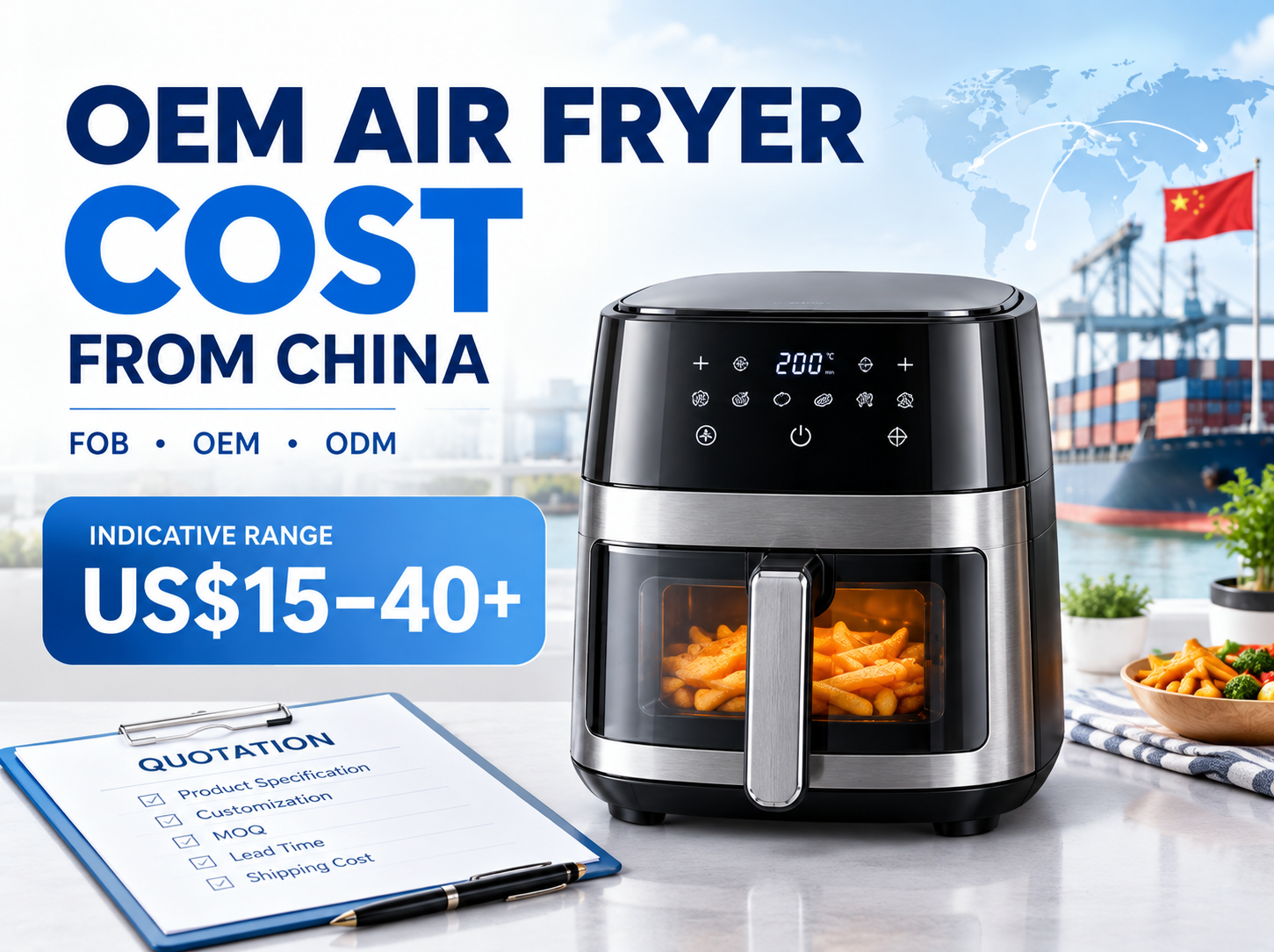
An OEM air fryer from China can cost roughly US$15–40 per unit FOB for many standard household models, while premium metal-body, dual-basket, highly customized or newly developed products can cost US$40–60+ per unit.
However, these are indicative market ranges rather than fixed industry prices.
Current public Chinese supplier listings show substantial variation. For example, recent listings include 4L products around US$13–17, 5L products around US$22–27, 6L–8L products from around US$20 to nearly US$40, and some stainless-steel or more specialized products above US$50.
The actual OEM air fryer cost depends on:
Capacity + Materials + Heating System + Controls + Functions + Basket Configuration + Customization + Order Volume + Tooling + Certification + Packaging
More importantly, the FOB unit price is only one part of the total cost of developing and importing an OEM air fryer.
1. Why Is There No Single “China OEM Air Fryer Price”?
One of the most common questions from importers and brand owners is:
“How much does an OEM air fryer cost in China?”
The problem is that an air fryer is not a standardized commodity.
An OEM supplier may be quoting:
l A basic 4L mechanical model
l A 6L digital air fryer
l An 8L premium metal-body model
l A dual-basket air fryer
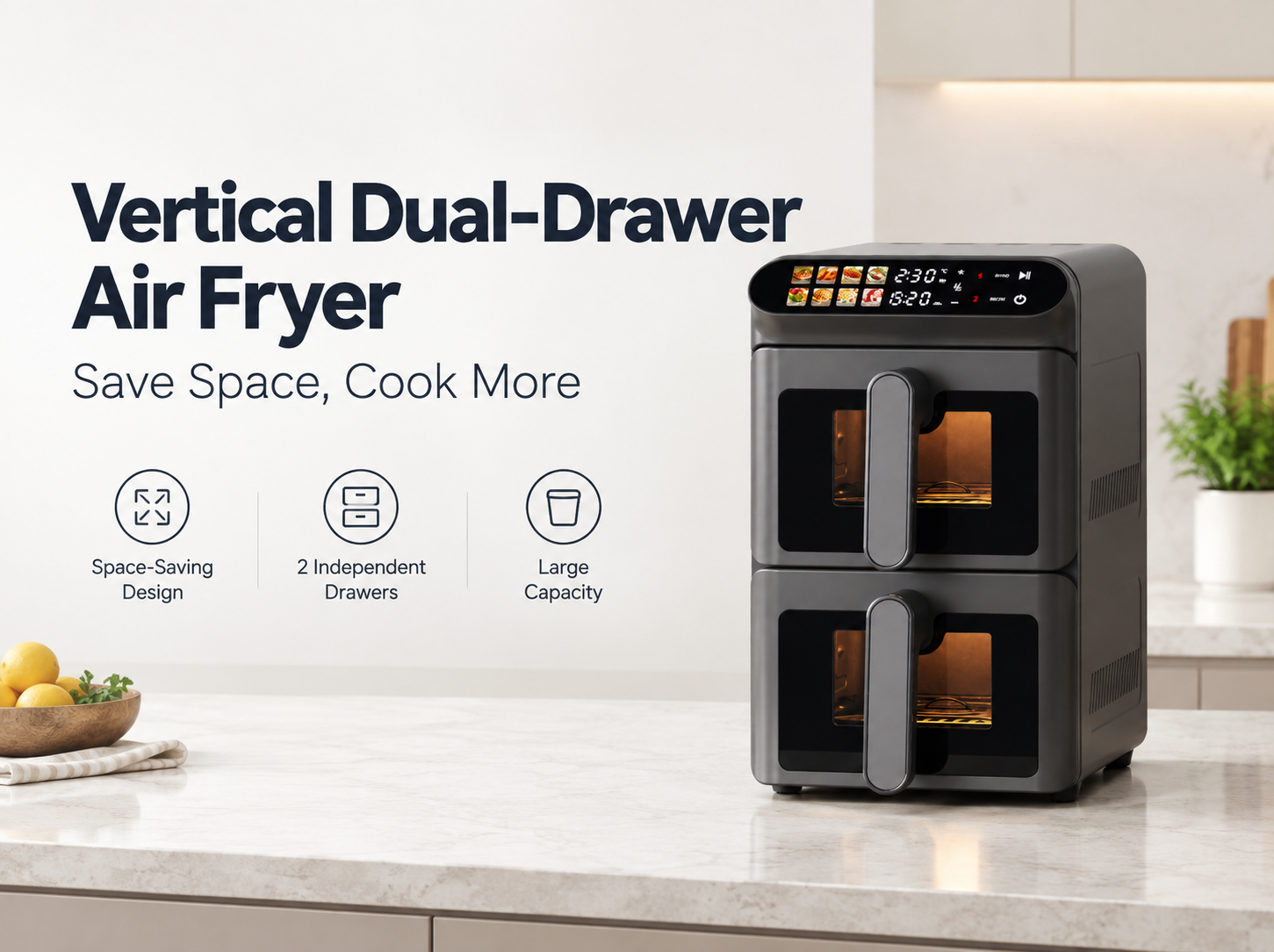
l A vertical dual-drawer air fryer
l A 10L air fryer oven
l A completely new ODM design
All of these are technically air fryers, but their manufacturing costs can be very different.
For example, recent public listings show:
l 5L mechanical air fryer: around US$21.8–26.8 FOB
l 6L touchscreen model: around US$29–34 FOB
l 8L digital model: around US$20–39 depending on configuration
l 10L stainless-steel digital model: around US$32
l 7L double-basket model: around US$34–35
l Some stainless-steel 7L models: around US$58–59
These public prices are useful as market reference points, but they should not be treated as standardized industry pricing because specifications, suppliers, order quantities and commercial terms differ.
Therefore:
The right question is not simply “What is the price of an air fryer from China?”
It is:
“What configuration, customization level and order volume are included in the quoted price?”
2. Indicative OEM Air Fryer Price Ranges from China
The following ranges can be used as a general budgeting reference, not as a fixed quotation.
Air Fryer Type | Indicative FOB Range* |
Basic 3–4L | US$15–25 |
Basic 5–6L | US$18–30 |
Digital 6–8L | US$20–40 |
Large 8–10L | US$25–45 |
Dual-basket / dual-drawer | US$30–50+ |
Premium metal-body | US$35–60+ |
Highly customized ODM product | Project-specific |
*Indicative ranges only. Actual prices depend on product specifications, quantity, materials, customization, packaging, tooling, certification and commercial terms.
Public supplier listings illustrate why such a broad range is necessary. For example, current listings include a 6L mechanical model around US$15.80–16.50, an 8L digital model around US$20.24–20.29, a 10L stainless-steel model around US$32.31–32.81, and a 7L stainless-steel model around US$58.50–59.00.
An important point for buyers
Same capacity does not mean same price.
Two 8L air fryers may have very different:
l Body materials
l Heating systems
l Motors
l Fan structures
l Controls
l Displays
l Basket designs
l Coatings
l Accessories
l Packaging
l Certification requirements
Therefore, capacity should be treated as one pricing variable—not the pricing formula.
3. What Is Included in an OEM Air Fryer Price?
Before comparing quotations, buyers should determine exactly what the quoted price includes.
A standard FOB quotation may include:
l Air fryer unit
l Standard accessories
l Standard retail packaging
l Standard product labels
l Standard user manual
l Agreed testing under the supplier's normal scope
But additional project costs may include:
l New tooling
l Customized molds
l New PCB development
l Industrial design
l Engineering development
l Special materials
l Customized packaging
l Certification
l Additional testing
l Third-party inspection
l Special accessories
l Sample development
This leads to three different concepts:
Ø Unit Price
The agreed manufacturing price per air fryer.
Ø Product Development Cost
The cost of developing or customizing the product.
Ø Total Landed Cost
The total cost required to bring the finished product to the buyer's destination.
These three numbers should not be confused.
FUNLOIV's quotation-comparison guidance similarly recommends that buyers compare specification, material, certification, MOQ, tooling, packaging, lead time, warranty and other commercial terms rather than looking only at the FOB number.
4. How Does Air Fryer Capacity Affect the Price?
Capacity is one of the first factors buyers consider.
Typical categories include:
l 3–4L
l 5–6L
l 6–8L
l 8–10L
l 10–12L+
l Dual-basket configurations
A larger air fryer can require:
l More housing material
l Larger basket
l Larger cooking chamber
l More packaging material
l Larger carton dimensions
l Higher shipping volume
l Potentially higher heating power
However, larger capacity does not automatically mean a proportionally higher unit price.
Manufacturing efficiency, existing tooling, order volume and product architecture can all influence the final quotation.
For example, public supplier listings currently show some 8L products priced below certain 6L products, demonstrating why capacity alone should not be used to estimate OEM cost.
5. How Do Materials Affect OEM Air Fryer Cost?
Material selection can have a significant impact on cost.
A basic air fryer may use:
l Plastic housing
l Standard coated basket
l Standard metal heating components
A premium model may use:
l Stainless steel
l Metal housing
l Higher-grade internal materials
l More sophisticated surface finishing
l Different structural components
For example:
Plastic-body air fryer
Potential advantages:
l Lower material cost
l Lower weight
l Flexible styling
l Efficient mass production
Metal-body air fryer
Potential considerations:
l Higher material cost
l Higher weight
l Different forming or stamping processes
l Surface finishing requirements
l Different assembly processes
l Potentially higher perceived retail value
Therefore, when requesting an OEM quotation, buyers should specify whether “metal body” means:
l Full metal housing
l Stainless-steel exterior
l Partial metal construction
l Metal decorative panels
l Metal cooking chamber
These descriptions can represent very different products.
6. How Does the Heating System Affect the Price?
The heating system is another important cost variable.
Depending on the product architecture, an air fryer may use:
l Single heating element
l Dual heating elements
l Halogen heating
l Stainless-steel heating tube
l Different heating power
l Different heating-element positions
The heating system should not be evaluated separately from:
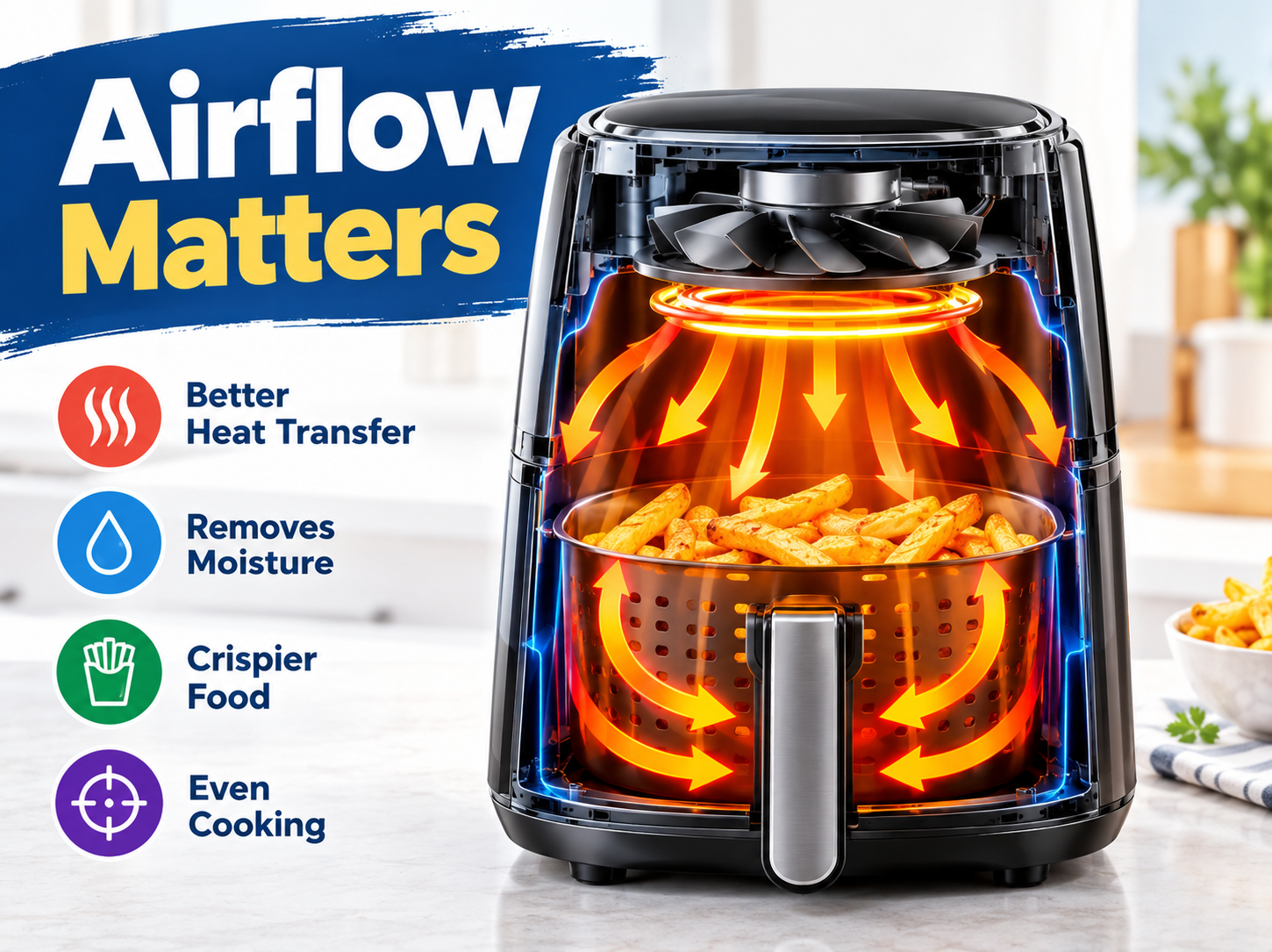
Heating Element → Motor → Fan → Airflow → Cooking Chamber → Temperature Control
A more complex heating architecture may increase:
l Component cost
l Electrical design complexity
l Assembly cost
l Thermal testing requirements
l Control-system requirements
However, a higher wattage or more complex heating system should not automatically be assumed to produce better cooking performance.
The correct evaluation should be based on the required performance and the complete thermal and airflow design.
7. How Do Motor, Fan and Airflow Design Affect the Price?
The motor and fan system also contributes to the product cost.
Possible differences include:
l Motor type
l Motor power
l Fan design
l Fan size
l Airflow requirements
l Noise requirements
l Thermal environment
l Control system
A brand may request:
“We need a quieter air fryer.”
That is a performance requirement.
The supplier may then evaluate:
l Motor
l Fan blade design
l Airflow path
l Internal structure
l Vibration control
l Acoustic performance
This is one reason brands should not always define every engineering component themselves.
For OEM/ODM development, the brand can define the required outcome, while the supplier's engineering team can help determine the appropriate technical solution.
8. How Much More Does a Digital Air Fryer Cost?
Control systems can also change the quotation.
A basic model may use:
Mechanical knob → Timer → Temperature control
A more advanced model may include:
Digital display → Touch controls → Preset programs → Sensors → More complex PCB
Additional features may include:
l Digital display
l Touch panel
l Preset programs
l Shake reminder
l Preheat
l Reheat
l Keep warm
l Dehydrate
l Interior light
l Viewing window
l Dual-zone control
l Sync cooking
l Smart connectivity
Each additional function can potentially affect:
l PCB cost
l Display cost
l Software development
l Control-panel design
l Assembly
l Testing
l Certification
Therefore, buyers should define must-have functions separately from optional features.
9. How Does Basket Configuration Affect the OEM Price?
Basket architecture can significantly affect both product cost and product positioning.
Common configurations include:
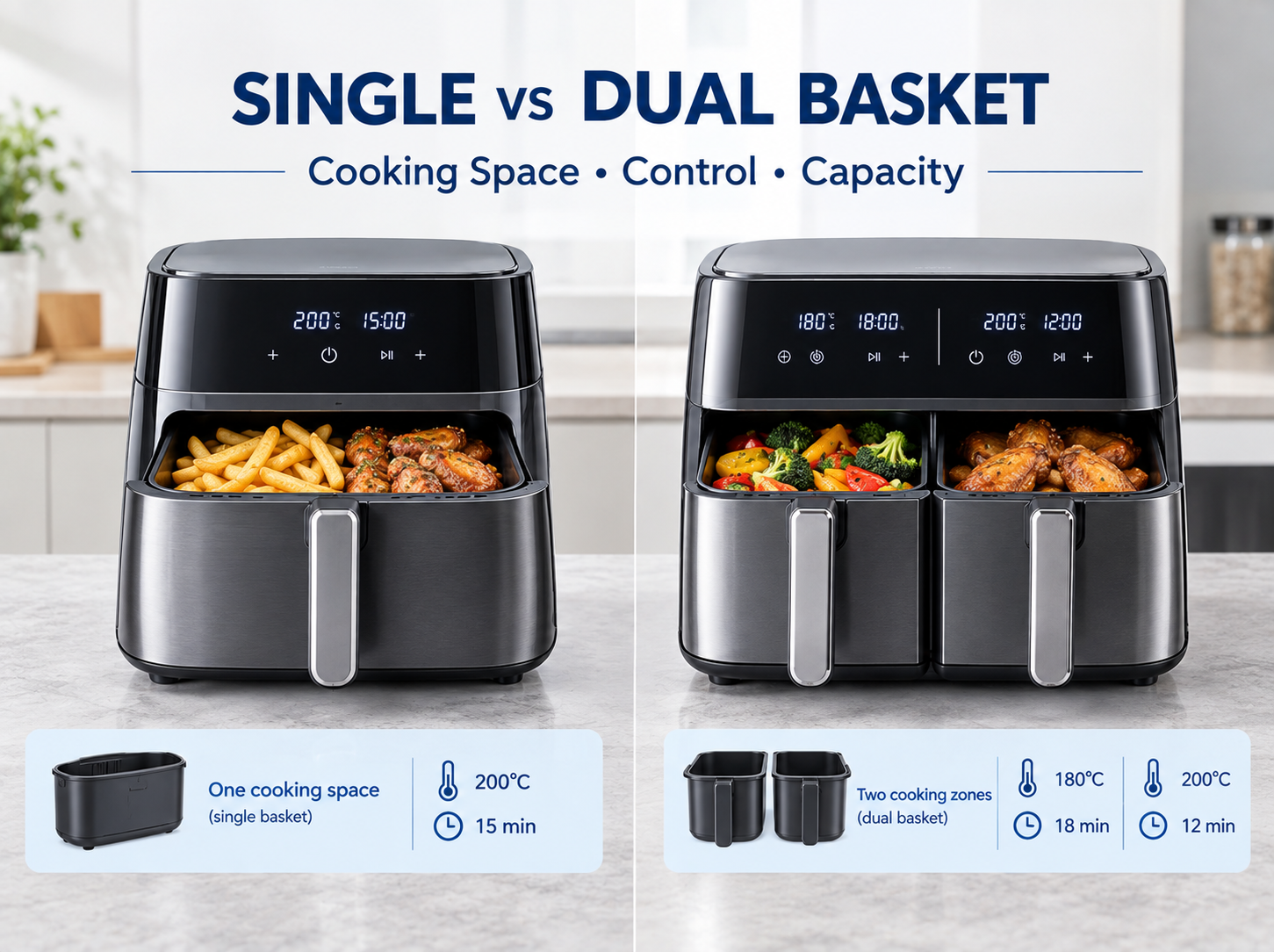
Single Basket
One continuous cooking area.
Dual Basket
Two independent cooking zones.
Dual Drawer
Two independent drawers, sometimes arranged horizontally or vertically.
Air Fryer Oven
Larger chamber with trays or racks.
A dual-basket or dual-drawer product may require:
l More components
l More complex controls
l Different heating architecture
l Additional structural parts
l More complex airflow design
l Different packaging
Therefore, buyers should not compare:
6L single basket vs 6L dual basket
as if they were simply two products with the same capacity.
The usable cooking space, structure and engineering requirements may be very different.
10. How Much Does Customization Add to the OEM Air Fryer Cost?
This is one of the most important questions for brands.
Not all OEM projects involve the same degree of customization.
I would divide them into three levels.
Level 1: Private Label
The supplier already has an existing product.
The brand changes:
l Logo
l Packaging
l Manual
l Possibly color
This is usually the simplest type of project.
Level 2: OEM Customization
The existing product is modified.
Examples:
l Housing color
l Control panel
l Handle
l Basket
l Accessories
l Display
l Functions
l Surface finish
The development cost depends on the extent of modification.
Level 3: ODM / New Product Development
The brand wants a new product or substantially different architecture.
This may involve:
l New industrial design
l New structure
l New molds
l New PCB
l New airflow system
l New heating architecture
l New basket
l Prototype development
l Engineering testing
l Certification
At this stage, the project should no longer be evaluated purely on a unit price basis.
The appropriate calculation becomes:
Development Cost + Tooling + Testing/Certification + Unit Manufacturing Cost
This distinction is especially important for brands developing a completely new air fryer.
11. How Much Do Air Fryer Tooling and Development Cost?
There is no universal tooling price for an OEM air fryer.
Tooling depends on:
l Product structure
l Number of molds
l Mold size
l Plastic components
l Metal components
l Basket structure
l Handle design
l Control-panel structure
l Custom appearance
l Production volume
l Expected mold life
Possible one-time costs include:
Tooling
l Injection molds
l Stamping tools
l Basket tooling
l Handle tooling
l Structural molds
l Decorative parts
Engineering
l Product design
l Mechanical engineering
l Electrical engineering
l PCB development
l Prototype development
l Testing
Compliance
l Safety testing
l EMC testing
l Market-specific certification
l Food-contact testing where applicable
For an existing product, some or all of these costs may already have been absorbed by the supplier.
For a new ODM product, they may become part of the initial project investment.
12. How Does MOQ Affect the OEM Air Fryer Price?
MOQ is closely related to unit cost.
A supplier may offer different prices depending on order quantity.
For example, current public supplier listings show MOQ levels of 1,000 pieces for many OEM air fryer models, while other listings show smaller MOQs such as 200 pieces.
Higher volume can allow suppliers to optimize:
l Component purchasing
l Production scheduling
l Labor efficiency
l Packaging purchasing
l Material utilization
A buyer should therefore provide both:
Initial order quantity
and, where possible:
Annual forecast
For example:
Initial order: 2,000 pcs
Annual forecast: 10,000 pcs
This gives the supplier more useful information than simply asking:
“What is your MOQ?”
13. OEM vs ODM: Which One Costs More?
The answer depends on the scope of development.
Project Type | Typical Development Requirement |
Existing product | Low |
Private label | Low |
Minor OEM customization | Low–Medium |
Significant OEM modification | Medium |
ODM development | Medium–High |
Completely new product | Project-specific |
The key difference is:
OEM
The buyer often starts with an existing product or defined specification and requests customization or manufacturing.
ODM
The supplier contributes more significantly to the product design, engineering or development.
Therefore:
A standard private-label air fryer may have very little development cost, while a completely new ODM air fryer may require substantial upfront investment.
14. FOB Price vs Total Landed Cost
This is one of the most important concepts for an importer or brand owner.
Suppose a supplier quotes:
FOB US$30 per air fryer
This does not necessarily mean the product costs US$30 when it reaches your warehouse.
FOB Cost
A simplified calculation may be:
Product Cost + Agreed Packaging + FOB Scope
But the buyer may additionally have:
l Ocean freight
l Air freight, if applicable
l Insurance
l Import duty
l Customs-related charges
l Port charges
l Local transportation
l Inspection
l Warehousing
l Other destination costs
Therefore:
Total Landed Cost
**FOB Product Cost
l Logistics
l Insurance
l Import Duty
l Destination Charges
l Other Import Costs**
The exact calculation depends on the destination market and agreed Incoterm.
This is why a US$28 quotation cannot automatically be considered cheaper than a US$31 quotation.
The two suppliers may be offering different:
l Specifications
l Packaging
l Incoterms
l Certifications
l QC scope
l Warranty
l Accessories
l Services
FUNLOIV's supplier comparison guide makes the same point: professional quotation comparison should consider the complete commercial and product scope rather than unit price alone.
15. Example: What Might an 8L OEM Air Fryer Project Cost?
Consider a hypothetical project:
Product
l 8L air fryer
l Digital control
l Metal-body construction
l Viewing window
l 220–240V / 50Hz
l European market
l Customized logo
l Customized retail packaging
Order
l Initial order: 2,000 pcs
Suppose the supplier quotes:
FOB: US$35/unit
Then:
2,000 × US$35 = US$70,000
But the project budget may also need to consider:
l Sample development
l Packaging development
l Certification/testing
l Inspection
l Tooling, if required
l Freight
l Import costs
Therefore:
US$70,000 is the FOB product value of the order—not necessarily the complete project cost.
This distinction is particularly important when preparing an investment budget for a new product launch.
16. How Can You Get a More Accurate OEM Air Fryer Quotation?
If you want an accurate quotation, do not send only:
“Please quote your 8L air fryer.”
A supplier may need additional information.
At minimum, provide:
Product
l Capacity
l Basket configuration
l Rated power
l Voltage/frequency
l Temperature range
l Heating system
l Control type
l Required functions
l Body material
l Basket/cavity material
Commercial
l Estimated quantity
l MOQ expectation
l Target FOB, if available
l Launch schedule
Market
l Target country
l Certification requirements
l Plug type
l Language requirements
Branding
l Logo
l Color
l Packaging
l Manual
l Labeling
FUNLOIV's existing Air Fryer RFQ Checklist recommends providing 20 categories of information because a simple request such as “quote an 8L air fryer” normally does not define enough information for an accurate quotation.
17. Why the Lowest OEM Air Fryer Price Is Not Always the Lowest Cost
Imagine three suppliers quote:
Supplier | FOB Price |
Supplier A | US$27 |
Supplier B | US$30 |
Supplier C | US$34 |
At first glance, Supplier A appears cheapest.
But suppose:
Supplier A
l Basic materials
l Different basket coating
l Less complete certification
l Standard packaging
l Limited customization
Supplier B
l Required specification
l Correct certification
l Better packaging
l Required functions
l Suitable MOQ
Supplier C
l Premium materials
l More advanced construction
l Higher-level customization
l Additional QC services
The three prices are not necessarily for the same product.
This is why buyers should compare:
**Specification
l Materials
l Quality
l Certification
l MOQ
l Packaging
l Tooling
l Lead Time
l Warranty
l Total Cost**
rather than simply comparing:
US$27 vs US$30 vs US$34
This principle is also reflected in FUNLOIV's current quotation-comparison guidance.
18. What Information Should You Send an OEM Air Fryer Supplier?
If you want a meaningful quotation, prepare a short product brief.
OEM Air Fryer Quotation Brief
Ø Target market:
Germany / EU
Ø Product type:
8L single-basket / dual-basket / vertical
Ø Capacity:
8L
Ø Body:
Metal / plastic / stainless steel
Ø Control:
Digital touch
Ø Temperature:
Target range / maximum temperature
Ø Key functions:
Presets / viewing window / preheat / etc.
Ø Heating:
Required or supplier-proposed
Ø Branding:
Logo / color / packaging
Ø Quantity:
Initial order + annual forecast
Ø Target price:
If available
Ø Certification:
Required market compliance
Ø Sample:
Required date
Ø Launch:
Target market launch date
The more clearly you define the project, the more meaningful the quotation becomes.
19. What Is the Best Way to Reduce OEM Air Fryer Cost?
Reducing cost does not necessarily mean asking the supplier:
“Can you give me a lower price?”
A better approach is to identify which specifications actually create cost.
Possible areas include:
Product architecture
Can the design be simplified without affecting required performance?
Materials
Can material specifications be optimized?
Components
Can standard components be used instead of customized components?
Functions
Which features are essential and which are optional?
Packaging
Can packaging be optimized without compromising protection?
Tooling
Can an existing platform or mold be adapted?
Volume
Can the annual forecast support better component purchasing?
Production
Can the design be simplified for assembly?
The objective should be:
Cost optimization without compromising the product requirements that matter to the target market.
20. How Much Should You Budget for an OEM Air Fryer Project?
A practical budget should consider more than the unit price.
For an existing model/private-label project:
Sample + Customization + Packaging + Certification/Testing + Product Cost + Logistics
For a customized OEM project:
Engineering + Sample + Tooling + Testing/Certification + Product Cost + Packaging + Logistics
For a new ODM project:
Product Development + Engineering + Prototype + Tooling + Certification/Testing + Mass Production + Packaging + Logistics
Therefore, there is no single answer to:
“How much does an OEM air fryer cost?”
The better question is:
“What is the total investment required for this specific air fryer project?”
OEM Air Fryer Cost: Quick Reference
Cost Factor | Lower-Cost Direction | Higher-Cost Direction |
Capacity | Small | Large |
Body | Standard plastic | Metal / stainless steel |
Control | Mechanical | Digital / advanced |
Heating | Standard | More complex architecture |
Basket | Single | Dual / specialized |
Functions | Basic | Multiple advanced functions |
Packaging | Standard | Customized retail packaging |
Tooling | Existing | New molds |
Development | Existing model | New ODM |
Certification | Existing scope | New market/testing |
Quantity | High volume | Small volume |
Customization | Logo only | Full product customization |
Frequently Asked Questions
Ø How much does a 6L OEM air fryer cost from China?
Public supplier listings currently show 6L air fryers ranging from roughly the mid-US$10s to around US$40 FOB, depending on control system, materials, power, design and configuration. For example, recent listings include 6L models around US$15.80–16.50 and touchscreen models around US$29–34, while another 6L product is listed around US$38.90–39.40.
These are supplier-listing reference prices, not guaranteed market quotations.
Ø How much does an 8L OEM air fryer cost?
An 8L OEM air fryer can fall broadly in the US$20–40+ FOB range for many standard configurations, with premium materials, dual-basket structures or significant customization potentially pushing the price higher. Current public listings include an 8L digital model around US$20.24–20.29 and other 6L–8L models approaching US$40.
Ø Is OEM air fryer cheaper than ODM?
Usually, an existing or lightly customized OEM/private-label product requires less upfront development than a completely new ODM product. However, the final cost depends on the scope of customization, tooling, engineering, certification and production volume.
Ø Does the OEM price include tooling?
Not necessarily. Buyers should explicitly ask whether tooling is included. Existing products may require little or no new tooling, while new product development may require custom molds and other engineering investment.
Ø Does FOB include shipping?
FOB and other Incoterms define different responsibilities and cost points. A buyer should confirm the exact Incoterm, named place/port and what costs are included in the quotation.
Ø What MOQ is typical for an OEM air fryer?
MOQ varies by supplier and project. Current public listings show examples ranging from 200 pieces to 1,000 pieces or more, while customized projects may have different requirements.
Ø How can I get an accurate air fryer OEM quotation?
Provide the supplier with the target market, capacity, basket configuration, power, voltage, heating system, materials, functions, branding, packaging, estimated quantity, certification requirements and expected timeline.
Conclusion
So, how much does an OEM air fryer cost from China?
For many standard household models, a reasonable initial budgeting range is roughly US$15–40 per unit FOB, while premium metal-body, dual-basket, highly customized and newly developed products can move into the US$40–60+ range.
But the number alone does not tell you whether the quotation is commercially attractive.
The actual OEM air fryer cost depends on:
Product Specification
l Materials
l Heating & Airflow System
l Controls & Functions
l Basket Configuration
l Customization
l MOQ & Volume
l Tooling
l Certification & Testing
l Packaging
l Commercial Terms
And the final investment can be higher once development, certification, logistics and import costs are included.
For brands and importers, the most useful approach is therefore not to search for the cheapest air fryer from China, but to define the required product clearly and compare suppliers on an apples-to-apples basis.
Need an OEM Air Fryer Quotation?
If you are sourcing an air fryer for your brand, retail business or distribution market, prepare the following information:
Target capacity + Product reference + Target market + Required functions + Material preference + Estimated quantity + Packaging requirements + Target launch date
An OEM/ODM supplier can then evaluate the product configuration and provide a quotation based on the actual project requirements.
FUNLOIV supports air fryer OEM/ODM projects including existing-model customization, product development, sample development, testing, tooling and mass production.
Have an air fryer project in mind? Send us your product reference, target market and estimated quantity to start a quotation discussion.
Related Articles
l Air Fryer Heating Element: Halogen vs. Stainless Steel Heating Tube.
l Why Does Airflow Matter in an Air Fryer?
l What Is the Difference Between AC and BLDC Motors in Air Fryers?
l What Makes an Air Fryer Cook More Evenly?
l How Can I Test an Air Fryer Sample Before Placing a Bulk Order?
l What Quality-Control Standards Should I Require from an Air Fryer Supplier?
l What Air Fryer Tests Should Be Included in a Pre-Shipment Inspection?
l What Factors Affect the FOB Price of an Air Fryer?
l How to Compare Quotations from Different Air Fryer Suppliers?
l 230°C Air Fryer: What Buyers Should Check Before Importing?
l A Dual Heating vs Single Heating Air Fryer- Which Is Better?
l What Is the Difference Between AC and DC Motors in Air Fryers?
l Air Fryer for the Middle East - A Guide to G-Mark, Specifications and Compliance?
l What Are the Most Common Quality Problems with Air Fryers?
l Air Fryer RFQ Checklist: 20 Specifications Buyers Should Include.
l How To Verify Whether an Air Fryer Supplier Is Reliable?
l How to Choose an OEM-ODM Air Fryer Supplier in China?
l 200°C vs 230°C Air Fryer: Which one is better?
l Metal-body vs plastic-body air fryer: which is better for a premium brand?
l Top Heating vs. Rear Heating Air Fryers: Which one is better for a B2B buyer?
l Is a Vertical Dual-Drawer Air Fryer Better for Saving Kitchen Space?
l Air Fryer Certifications & Compliance by Market- A Safety Guide for Importers.
l Vertical vs. Horizontal Dual-Basket Air Fryer- Which Is Better for Retail?
l What Air Fryer Capacity Is Best for the European Market?
l What Are the Common Warranty and After-Sales Problems with Air Fryers?
l What MOQ, Lead Time and Payment Terms Should I Expect from an Air Fryer Supplier?
l How Can I Prevent Plastic Melting or Deformation in an Air Fryer?
l What Air Fryer Safety Tests Should Be Completed Before Mass Production?
l What Is the Difference Between a Single-Basket and Dual-Basket Air Fryer?

Is a Vertical Dual-Drawer Air Fryer Better for Saving Kitchen Space?
How Much Does an OEM Air Fryer Cost from China?
What Is the Difference Between a Single-Basket and Dual-Basket Air Fryer?

What Are the Most Common Quality Problems with Air Fryers?
Why Does Airflow Matter in an Air Fryer?
What Quality-Control Standards Should I Require from an Air Fryer Supplier?
 + 86 181 3826 8709
 info@funloiv.com
 6/F., Guanglong Building, Pingxin North Road, Longgang, Shenzhen City, Guangdong, China


@ 2009-2026 Shenzhen Funloiv Electric Appliance Co., LtdAll rights reserved


