 Notice:

 search
search
search
Sep 30, 2026


For a small business, launching an air fryer can seem complicated.
You may have a product idea, a target market and a brand, but you may not have your own engineering team, factory, testing laboratory, quality-control department or international sourcing team.
This is where the right Chinese air fryer supplier can provide more than manufacturing.
A capable supplier can potentially support multiple stages of the project, including:
Product Selection → OEM/ODM Development → Sample Testing → Customization → Compliance → Production → QC → Packaging → Export
However, not every supplier provides the same level of support.
For a small business, the important question is therefore not simply:
“Can you manufacture air fryers?”
It is:
“How much of the product development and sourcing process can you realistically support?”
Here are the main areas small businesses should evaluate.
1. Existing Air Fryer Platforms Can Reduce the Initial Development Barrier
A small business does not necessarily need to develop a completely new air fryer from scratch.
Many suppliers have existing product platforms that can potentially be adapted for different markets and brands.
For example, you may start with an existing:
l 4–5L air fryer
l 6–8L air fryer
l 9–12L air fryer
l Single-basket model
l Dual-basket model
l Vertical dual-drawer model
l Metal-body air fryer
l Digital air fryer
Instead of developing everything from zero, you can evaluate an existing model and determine what needs to be changed.
This can potentially reduce:
l Development complexity
l Tooling requirements
l Sample-development time
l Initial engineering work
l Product-development risk
For a small business entering the air fryer category, this can be a practical starting point.
2. OEM and ODM Services Can Help Turn an Idea Into a Product
One of the biggest advantages of working with an experienced OEM/ODM supplier is the ability to move from a product concept to a manufacturable product.
OEM
OEM is generally appropriate when you already have a relatively clear product specification.
You may want:
l Your logo
l Your colors
l Your packaging
l Your capacity
l Your accessories
l Your control panel
l Your product configuration
ODM
ODM can involve deeper product development.
Depending on the supplier, support may include:
l Product architecture
l Industrial design
l Structural development
l Functional configuration
l Engineering
l Tooling
l Prototypes
l Sample development
l Testing
l Production preparation
Your existing OEM/ODM air fryer supplier guide explains these differences in greater detail.
For a small brand, ODM capability can be particularly useful when you have a clear market opportunity but do not have an internal product-development team.
3. Suppliers Can Help Translate Your Market Requirements Into Product Specifications
Small businesses often know what they want to sell, but not necessarily how the product should be engineered.
For example, you might tell a supplier:
“We want a premium 8L air fryer for the European market, with a metal appearance, strong cooking performance and a retail price around €XX.”
That is a business requirement, not yet a complete engineering specification.
The supplier may need to discuss:
l Heating system
l Rated power
l Airflow
l Motor
l Temperature range
l Control system
l Basket design
l Materials
l Insulation
l Thermal protection
l Packaging
l Certification requirements
This is why a good RFQ should contain more than just capacity and target price.
Your existing Air Fryer RFQ Checklist covers the information buyers should provide, including capacity, electrical specifications, heating system, controls, materials, packaging, target market, certification and MOQ.
The supplier's role is then to help translate the commercial concept into a product that can actually be manufactured.
4. Small Businesses Can Use OEM to Build Their Own Brand
You do not necessarily need to manufacture the air fryer yourself to build your own brand.
A small brand can potentially work with a Chinese OEM supplier to customize:
Product Branding
l Logo
l Brand name
l Control-panel branding
l Product labels
Appearance
l Color
l Surface finish
l Selected exterior components
Packaging
l Retail box
l User manual
l Barcode
l Product labels
l Shipping carton
Product Configuration
Depending on the supplier:
l Capacity
l Basket
l Accessories
l Functions
l Display
l Controls
l Temperature range
This allows a small business to create a branded product without owning an air fryer production facility.
However, buyers should clarify exactly what customization is included and what requires additional tooling, MOQ or development cost.
5. Suppliers Can Provide Samples Before a Larger Production Order
For a small business, sample testing is one of the most important risk-control steps.
You should not evaluate an air fryer only from:
l Product photos
l Videos
l A catalogue
l Supplier specifications
You need to evaluate the actual product.
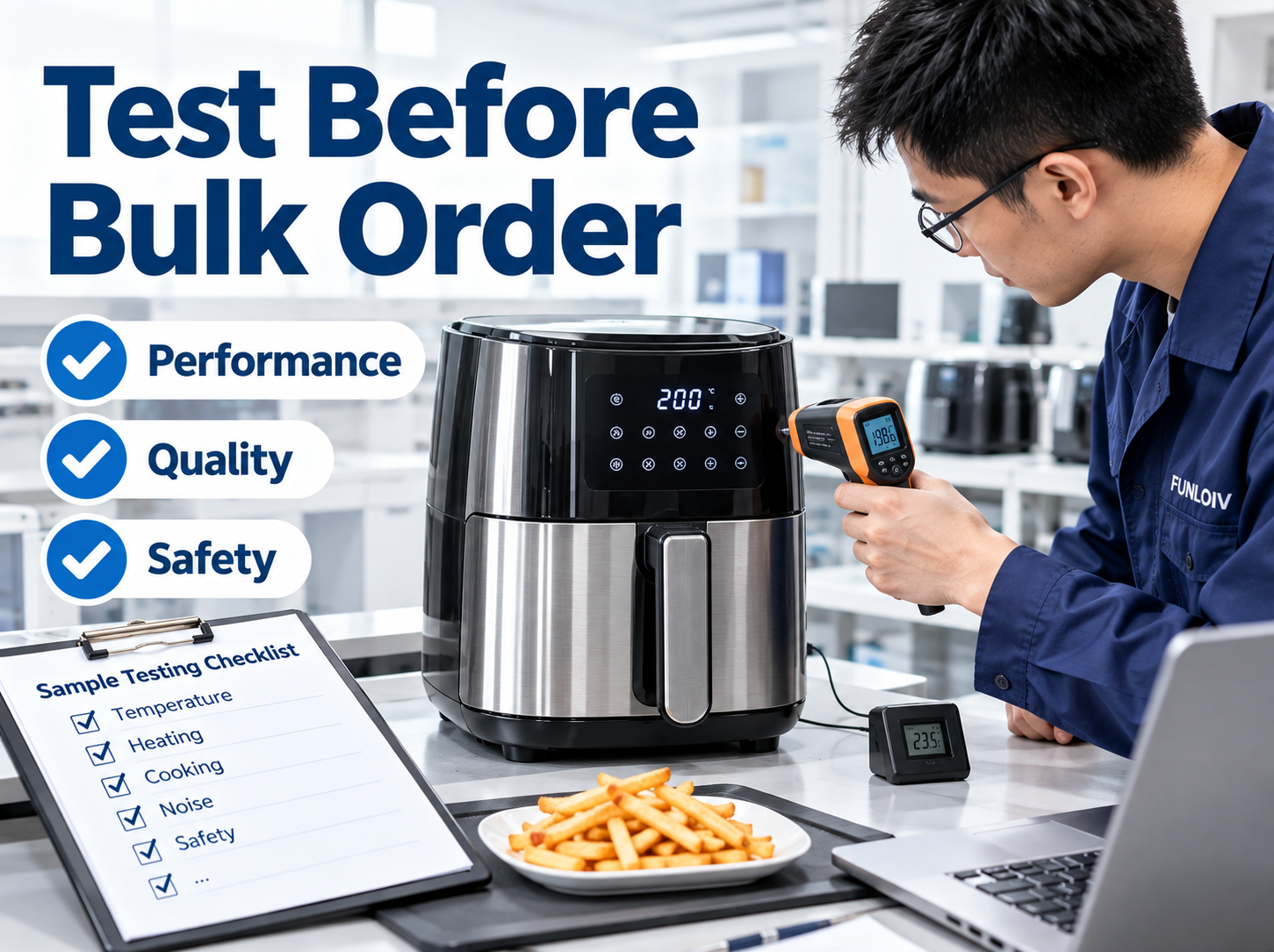
A sample can be checked for:
Cooking Performance
l Temperature accuracy
l Heating performance
l Cooking consistency
l Airflow
l Cooking time
Construction
l Basket quality
l Handle strength
l Housing
l Assembly
l Surface finish
User Experience
l Controls
l Display
l Noise
l Basket removal
l Cleaning
Safety-Related Functions
l Automatic shut-off
l Thermal protection
l Overheating protection
l Electrical performance
FUNLOIV's current sample-testing guide recommends evaluating these areas and notes that a project may use an engineering sample, revised sample and pre-production/golden sample before mass production.
For a small business, this creates an important process:
Supplier Sample → Testing → Feedback → Modification → Final Sample → Bulk Order
Rather than committing immediately to mass production.
6. Suppliers Can Help Small Businesses Develop Products Step by Step
A small brand does not always need to launch with a completely unique product.
A practical development path could be:
Stage 1 — Existing Model
Choose an existing product.
Stage 2 — Private Label
Add:
l Logo
l Packaging
l Manual
l Labels
Stage 3 — Product Customization
Modify:
l Color
l Appearance
l Accessories
l Functions
Stage 4 — Deeper OEM
Modify:
l Structure
l Components
l Control system
l Product configuration
Stage 5 — ODM Development
Develop a more differentiated product based on the brand's market requirements.
This staged approach can be particularly useful for a small business because it allows the level of investment and customization to increase as the product strategy becomes clearer.
7. Suppliers Can Help Small Businesses With Quality Control
A small company may not have its own factory inspection team.
Therefore, supplier-side QC becomes an important part of the sourcing relationship.
A structured air fryer QC process can include:
Incoming Material Inspection
↓
Production QC
↓
Assembly Inspection
↓
Functional Testing
↓
Aging Testing
↓
Final Inspection
↓
Pre-Shipment Inspection
For air fryers, quality checks may include:
l Temperature
l Heating performance
l Fan and motor operation
l Timer
l Display
l Basket
l Handle
l Plastic deformation
l Surface temperature
l Electrical performance
l Cooking consistency
l Noise
l Packaging
Your existing Air Fryer Quality-Control Standards guide explains why quality should not rely only on a final inspection and discusses incoming inspection, production control, functional testing, aging testing and pre-shipment inspection.
For a small business, this support can be particularly valuable because quality problems can be disproportionately expensive when order volumes are limited.
8. Suppliers Can Support Market-Specific Compliance
Compliance is another area where an experienced supplier can reduce the workload for a small importer.
Depending on the target market, you may need to consider requirements relating to:
l Electrical safety
l EMC
l RoHS
l Food-contact materials
l Labeling
l User manuals
l Packaging
l Market-specific requirements
A supplier may be able to provide existing test reports or coordinate additional testing for the specific product.
However, there is an important distinction:
Supplier support does not remove the buyer's regulatory responsibilities.
For example, in the EU, importers must verify that products comply with applicable requirements and that relevant documentation is available. If an importer or distributor markets a product under its own name or trademark, it can take on manufacturer responsibilities under applicable EU product rules.
Therefore, small businesses should ask:
l Which standards apply?
l Which reports are available?
l Does the report cover my exact model?
l Does it cover my voltage and configuration?
l What additional testing is required?
l Which responsibilities belong to the supplier?
l Which responsibilities belong to my company?
Never assume that a supplier's general “CE certified” statement automatically covers every product configuration.
9. Suppliers Can Support Private-Label Packaging
For a small brand, packaging is often part of the product itself.
A Chinese supplier may be able to coordinate:
l Retail box
l Color printing
l Brand logo
l Product photography
l User manual
l Barcode
l Product labels
l Shipping carton
l Carton markings
This means you may not need to source the air fryer from one company and packaging from another.
However, packaging customization can affect:
l MOQ
l Printing cost
l Artwork requirements
l Packaging lead time
l Carton quantity
l Shipping volume
These points should be confirmed before placing the order.
10. Suppliers Can Help Small Businesses Manage MOQ
MOQ is often one of the biggest concerns for a small business.
But there is no universal MOQ for every air fryer project.
MOQ may depend on:
l Existing model
l New model
l Product color
l Packaging
l Voltage
l Components
l Customization
l Tooling
l Production planning
For example, there is a significant difference between:
Existing model + logo
and:
Completely new air fryer + new mold + customized components + new packaging
The second project normally requires more development and production resources.
Therefore, instead of asking only:
“What is your MOQ?”
ask:
“What is the MOQ for this exact configuration and level of customization?”
That gives you a much more useful answer.
11. Suppliers Can Help Small Businesses Coordinate Production and Export
For a small importer, managing production can be time-consuming.
A capable supplier can potentially coordinate:
Raw Materials
↓
Production
↓
Assembly
↓
Testing
↓
Packaging
↓
Final QC
↓
Export Preparation
The supplier may also provide information needed by your freight forwarder, such as:
l Carton dimensions
l Gross weight
l Net weight
l Loading quantity
l Packing list
l Commercial invoice
l Export information
This does not mean the supplier replaces your freight forwarder or customs broker.
Instead, the supplier becomes an important part of the overall export chain.
12. A Supplier Can Potentially Help Reduce the Number of Companies You Need to Manage
For a small business, one of the hidden costs of sourcing is coordination.
Imagine managing separate companies for:
l Product design
l Engineering
l Tooling
l Manufacturing
l Testing
l Packaging
l QC
l Export
This can become complicated very quickly.
An experienced OEM/ODM supplier may be able to integrate several of these stages.
A more streamlined model can look like:
Product Concept
↓
Product Development
↓
Tooling
↓
Sample
↓
Testing
↓
Production
↓
QC
↓
Packaging
↓
Export
This is one of the most important ways a supplier can support a small business:
Not simply by manufacturing the product, but by reducing the number of development and production interfaces the buyer has to manage.
13. What Should a Small Business Ask an Air Fryer Supplier?
Before selecting a supplier, ask specific questions.
Product Development
l Do you have an engineering team?
l Can you modify existing models?
l Can you develop new products?
l Can you manage tooling?
l How many sample revisions are possible?
OEM
l Can you customize the logo?
l Can you customize colors?
l Can you customize packaging?
l Can you customize accessories?
MOQ
l What is the MOQ per model?
l Per color?
l Per packaging?
l Can different models be mixed?
Sample
l What is the sample cost?
l How long does sample development take?
l Can samples be modified after testing?
l Can a pre-production sample be approved?
Quality
l What incoming QC is performed?
l What production tests are performed?
l Is aging testing performed?
l Is pre-shipment inspection available?
Compliance
l Which reports are available?
l Do they cover the exact model?
l Which market requirements can you support?
l What documentation will be provided?
Production
l What is the mass-production lead time?
l How is the approved sample controlled?
l How are production changes communicated?
After-Sales
l What is the warranty period?
l Are spare parts available?
l How are quality claims handled?
14. A Practical Example for a Small Brand
Imagine a small European brand wants to launch an 8L digital air fryer.
The company does not have its own engineering department.
Instead of immediately developing a completely new air fryer, it could take a staged approach:
Step 1 — Define the Market
European market, mid-range positioning.
Step 2 — Shortlist Existing Models
Compare several 8L platforms.
Step 3 — Request Samples
Evaluate:
l Cooking performance
l Temperature
l Noise
l Basket
l Materials
l Controls
l Cleaning
Step 4 — Select a Product Platform
Choose the model that best fits the intended market positioning.
Step 5 — Customize
For example:
l Brand logo
l Product color
l Packaging
l Manual
l Selected accessories
Step 6 — Verify Compliance
Confirm the requirements for the exact product and intended market.
Step 7 — Approve the Final Sample
Freeze the product specification and packaging.
Step 8 — Start Production
Apply the agreed QC requirements.
Step 9 — Inspect Before Shipment
Check quantity, appearance, function, packaging and other agreed requirements.
Step 10 — Launch and Collect Market Feedback
The next product generation can then incorporate actual customer feedback.
This approach can be more manageable than attempting a completely new ODM project from day one.
15. What Should Small Businesses Not Expect From Chinese Suppliers?
A good article should also explain the limitations.
Small businesses should not automatically expect:
l Very low MOQ for fully customized products
l Free tooling for a completely new design
l Unlimited sample revisions
l Instant certification
l Extremely short lead times for complex development
l Premium quality at the lowest possible price
l The supplier to assume all regulatory responsibilities
In general:
More customization usually means more development work, cost, testing, tooling or lead time.
The best supplier relationship is therefore based on a clearly defined balance between:
Product Differentiation + MOQ + Development Cost + Lead Time + Quality + Target Price
16. What Is the Best Sourcing Strategy for a Small Business?
For many small businesses, a practical starting strategy is:
Start With an Existing Platform
Avoid unnecessary development costs.
Customize the Brand
Build your own identity through logo, color and packaging.
Test the Product
Do not rely only on product photos.
Confirm Compliance
Make sure the exact product meets your target-market requirements.
Control Quality
Define measurable QC requirements before production.
Start With a Commercially Manageable Order
Use the first order to validate the product and market.
Develop Further After Market Validation
If the product performs well, consider deeper OEM or ODM development.
This approach allows the supplier relationship to develop together with the business.
FAQ: Air Fryer Suppliers in China for Small Businesses
Ø Can a small business buy air fryers directly from China?
Yes. Small businesses can work directly with Chinese air fryer suppliers, although MOQ, customization options, payment terms and supplier policies vary by project.
Ø Can I put my own brand on an air fryer?
Many OEM suppliers can support private-label customization such as logos, colors, packaging and manuals. The exact options and MOQ should be confirmed for the selected model.
Ø Do I need to develop my own air fryer design?
Not necessarily. You can start with an existing supplier platform and customize selected elements, or work with an ODM supplier on a more customized product.
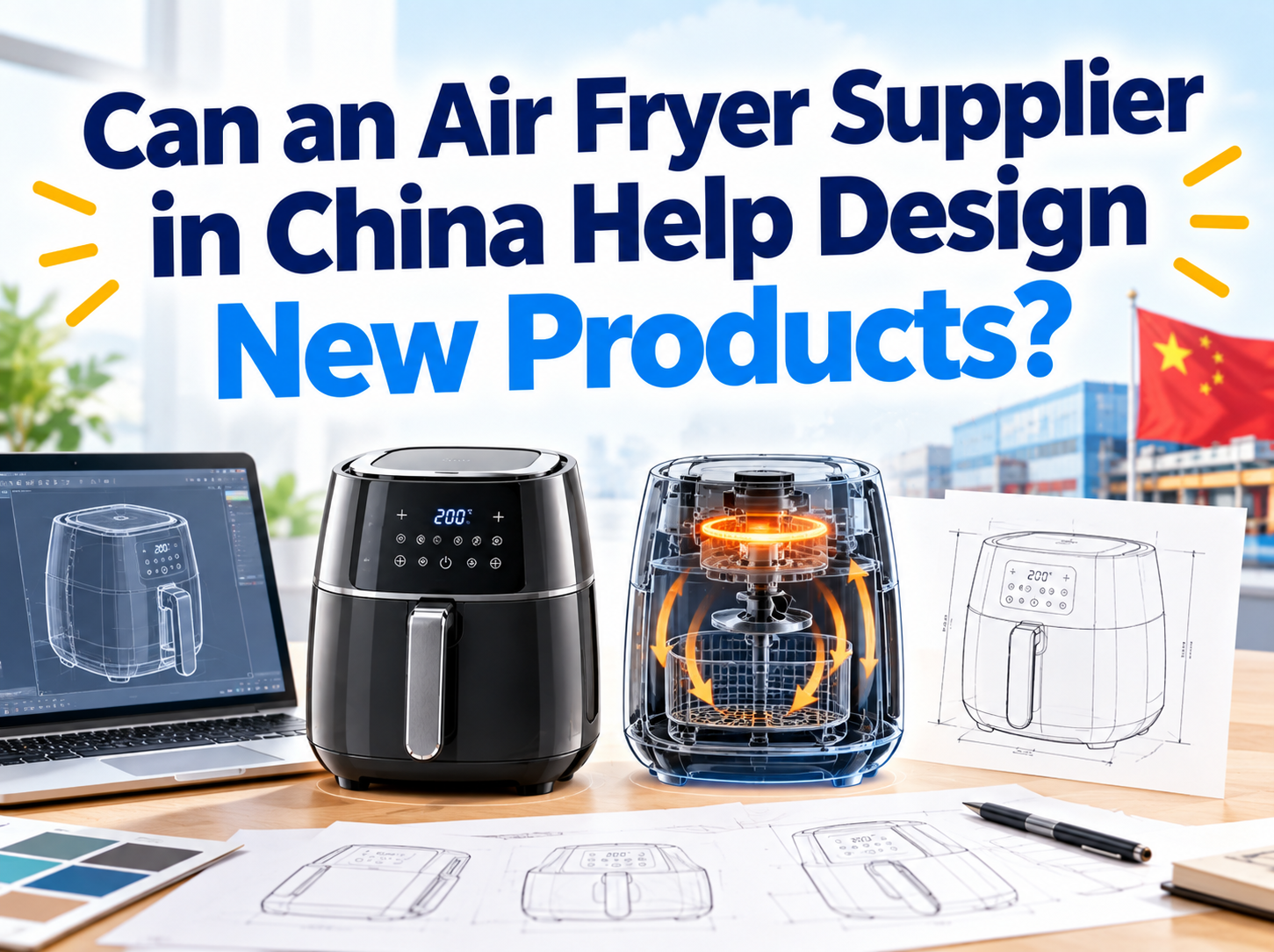
Ø Can suppliers help me develop a new air fryer?
Suppliers with OEM/ODM engineering capabilities may support product architecture, industrial design, tooling, prototypes, samples, testing and production preparation. The scope depends on the supplier and project.
Ø Can I test an air fryer before placing a bulk order?
Yes. Sample testing is an important part of supplier evaluation. Buyers should assess performance, construction, controls, safety-related functions and packaging before approving mass production.
Ø How can a small business control air fryer quality?
Agree on a detailed specification, approve a final sample and define production QC requirements. Incoming inspection, production testing, aging testing, final inspection and pre-shipment inspection can all form part of the quality-control process.
Ø Can Chinese suppliers help with CE compliance?
A supplier may provide relevant testing reports and compliance documentation or coordinate additional testing. However, the importer must still verify the requirements applicable to its product and market. EU rules place specific responsibilities on importers, and own-brand products can involve manufacturer responsibilities.
Ø Is the supplier with the lowest price the best choice for a small business?
Price alone does not show whether a supplier can support your product development, quality, compliance, lead time and after-sales requirements. A broader supplier evaluation is more useful.
Final Thoughts
For a small business, the biggest advantage of working with an experienced Chinese air fryer supplier is not simply the ability to purchase a product at a competitive factory price.
It is the ability to access product-development and manufacturing resources without building all of those capabilities internally.
A capable supplier may help connect:
Product Idea
↓
Product Selection
↓
OEM/ODM Development
↓
Sample Testing
↓
Brand & Packaging
↓
Compliance
↓
Mass Production
↓
Quality Control
↓
Export
The level of support will vary from supplier to supplier, so small businesses should evaluate actual capabilities rather than relying on the words “OEM” or “ODM” alone.
For brands considering a new air fryer project, the most useful starting point is to prepare your target market, capacity, product concept, required functions, estimated quantity and target positioning. A well-prepared RFQ gives suppliers enough information to respond with a more relevant product and commercial proposal.
Looking for an Air Fryer Supplier for Your Small Business?
If you are developing an air fryer for your own brand, retail business or distribution channel, FUNLOIV can discuss:
l Existing air fryer platforms
l OEM customization
l ODM product development
l Single and dual-basket models
l Vertical dual-drawer air fryers
l Metal-body air fryers
l Product appearance
l Functions and configurations
l Packaging
l Sample development
l Compliance requirements
l Quality control
l Mass production
l Export coordination
Send us your target market, capacity, product concept and estimated quantity to discuss a suitable starting point.
Related Articles
l Air Fryer Heating Element: Halogen vs. Stainless Steel Heating Tube.
l Why Does Airflow Matter in an Air Fryer?
l What Is the Difference Between AC and BLDC Motors in Air Fryers?
l What Makes an Air Fryer Cook More Evenly?
l How Can I Test an Air Fryer Sample Before Placing a Bulk Order?
l What Quality-Control Standards Should I Require from an Air Fryer Supplier?
l What Air Fryer Tests Should Be Included in a Pre-Shipment Inspection?
l What Factors Affect the FOB Price of an Air Fryer?
l How to Compare Quotations from Different Air Fryer Suppliers?
l 230°C Air Fryer: What Buyers Should Check Before Importing?
l A Dual Heating vs Single Heating Air Fryer- Which Is Better?
l What Is the Difference Between AC and DC Motors in Air Fryers?
l Air Fryer for the Middle East - A Guide to G-Mark, Specifications and Compliance?
l What Are the Most Common Quality Problems with Air Fryers?
l Air Fryer RFQ Checklist: 20 Specifications Buyers Should Include.
l How To Verify Whether an Air Fryer Supplier Is Reliable?
l How to Choose an OEM-ODM Air Fryer Supplier in China?
l 200°C vs 230°C Air Fryer: Which one is better?
l Metal-body vs plastic-body air fryer: which is better for a premium brand?
l Top Heating vs. Rear Heating Air Fryers: Which one is better for a B2B buyer?
l Is a Vertical Dual-Drawer Air Fryer Better for Saving Kitchen Space?
l Air Fryer Certifications & Compliance by Market- A Safety Guide for Importers.
l Vertical vs. Horizontal Dual-Basket Air Fryer- Which Is Better for Retail?
l What Air Fryer Capacity Is Best for the European Market?
l What Are the Common Warranty and After-Sales Problems with Air Fryers?
l What MOQ, Lead Time and Payment Terms Should I Expect from an Air Fryer Supplier?
l How Can I Prevent Plastic Melting or Deformation in an Air Fryer?
l What Air Fryer Safety Tests Should Be Completed Before Mass Production?
l What Is the Difference Between a Single-Basket and Dual-Basket Air Fryer?
l How Do Different Air Fryer Designs Affect Cooking Performance and Cleaning?
l How Much Does an OEM Air Fryer Cost from China?
l What Are the Most Important Features to Consider When Sourcing an Air Fryer?
l What MOQ Do Chinese Air Fryer Suppliers Usually Require?
l How Can I Import Air Fryers from China?


Is it Worth Getting an Air Fryer?
230°C Air Fryer: What Buyers Should Check Before Importing
How Do Different Air Fryer Designs Affect Cooking Performance and Cleaning?
How Can I Test an Air Fryer Sample Before Placing a Bulk Order?
Can an Air Fryer Supplier in China Help Design New Products?
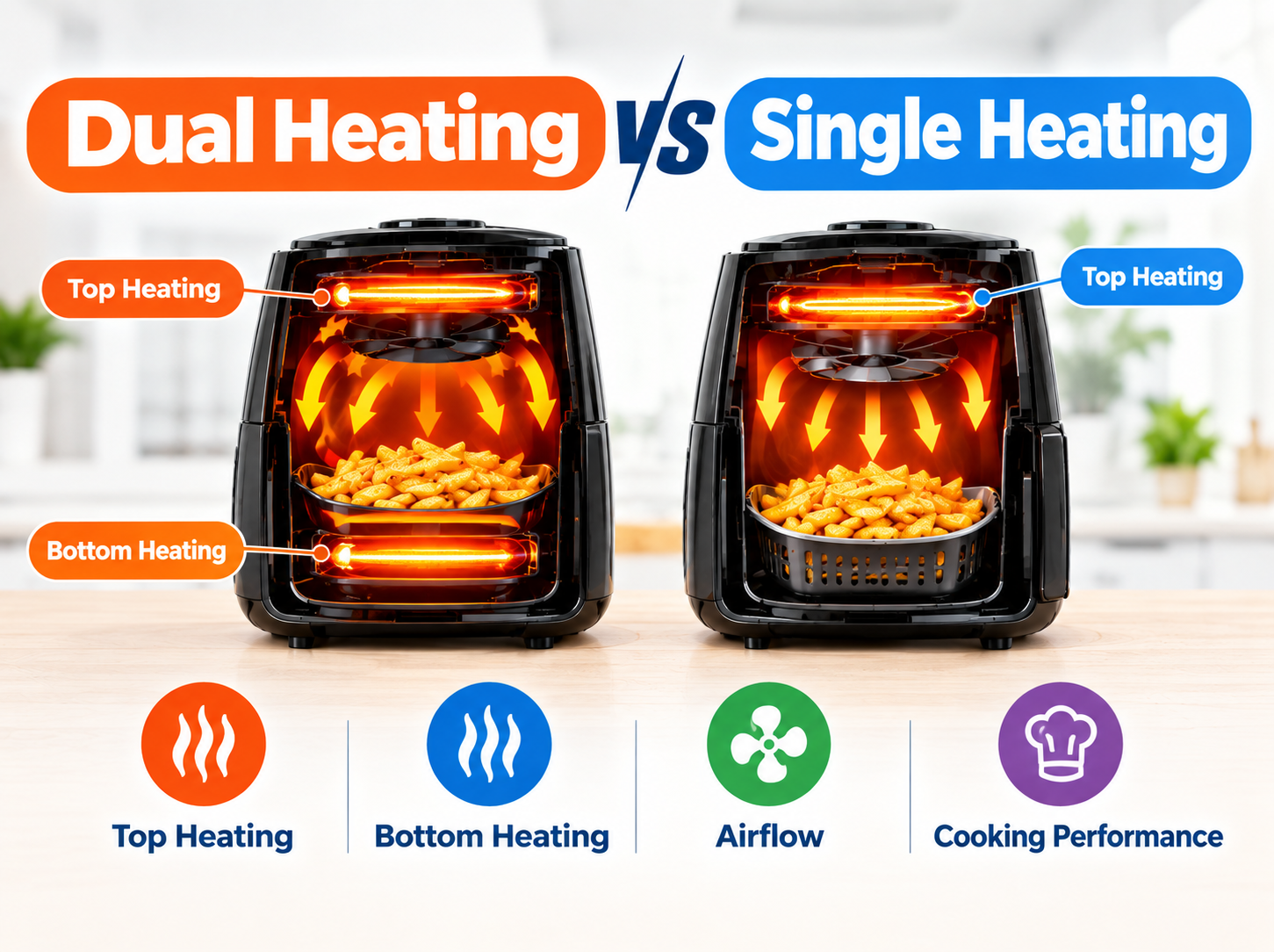
A Dual Heating vs. Single Heating Air Fryer: Which Is Better?
 + 86 181 3826 8709
 info@funloiv.com
 6/F., Guanglong Building, Pingxin North Road, Longgang, Shenzhen City, Guangdong, China


@ 2009-2026 Shenzhen Funloiv Electric Appliance Co., LtdAll rights reserved


