 Notice:

 search
search
search
Oct 05, 2026


For importers, brand owners, wholesalers and retailers, finding a competitive air fryer price is not simply about asking suppliers:
“What is your lowest price?”
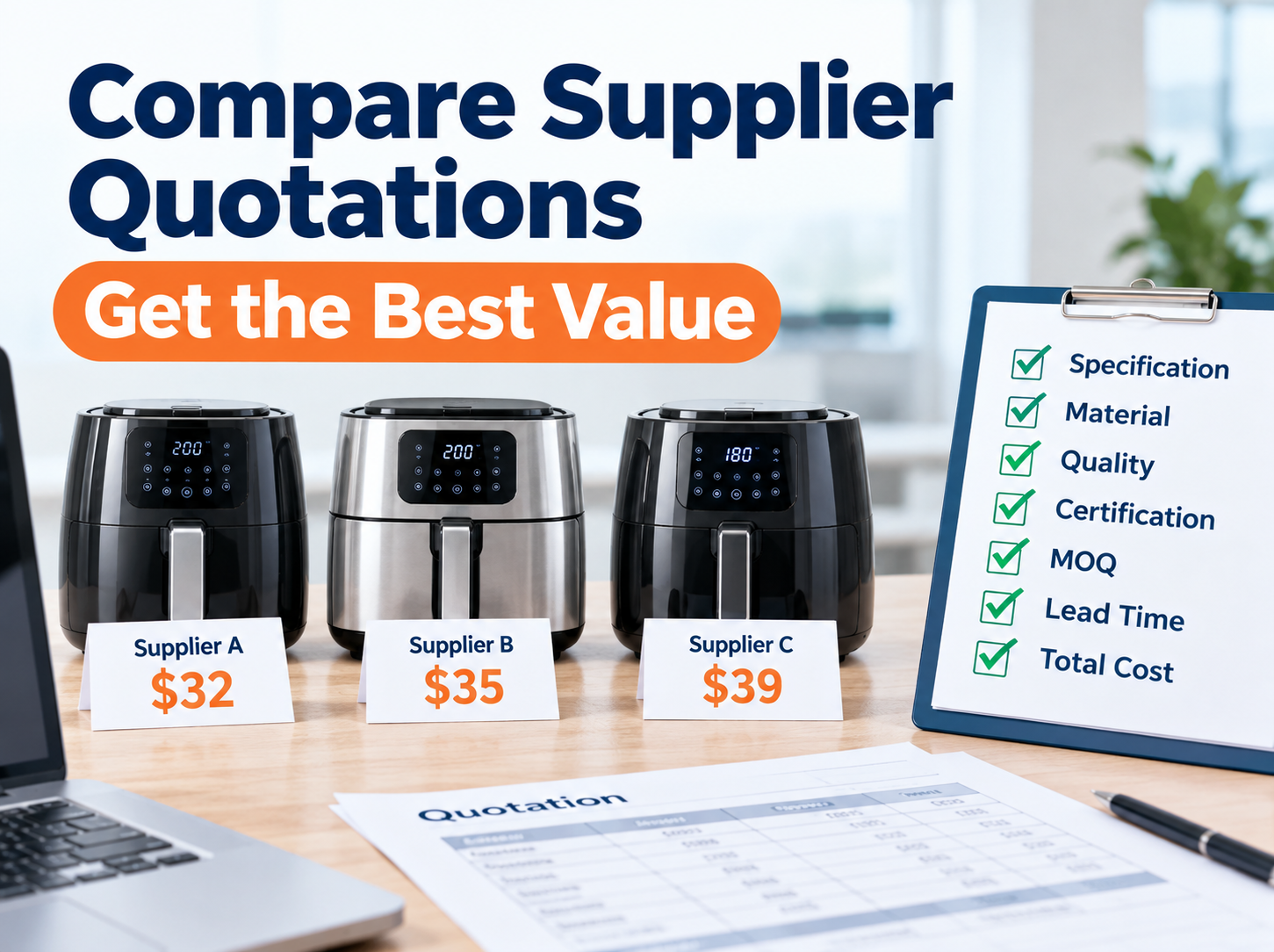
A supplier may quote USD 32, another USD 35, and another USD 39. At first glance, the USD 32 quotation looks the most competitive.
But are these suppliers quoting the same air fryer, with the same materials, heating system, packaging, certification, MOQ and commercial terms?
Not necessarily.
A truly competitive air fryer price should be evaluated together with:
Product Specification + Quality + Certification + MOQ + Packaging + Lead Time + Commercial Terms + Total Sourcing Cost
This is also why FUNLOIV recommends that buyers use a structured RFQ before comparing supplier quotations. Air Fryer RFQ Checklist: 20 Specifications Buyers Should Include
So, how can you find a competitive price from air fryer suppliers in China?
1. First Define What “Competitive Price” Means
The lowest quotation is not always the most competitive price.
Consider three suppliers:
Supplier | FOB Price | Product | Packaging | Certification |
Supplier A | $32 | Basic 8L | Basic | Standard |
Supplier B | $35 | 8L metal body | Retail box | Included |
Supplier C | $38 | 8L premium version | Customized | Included |
If your brand requires a metal body, customized packaging and specific market certification, Supplier A's USD 32 quotation may not actually meet your requirements.
Therefore, a competitive price should answer two questions:
l Does the product meet my requirements?
l Is the total cost commercially competitive?
This is different from simply asking:
Who has the lowest FOB price?
Your existing guide on quotation comparison explains why FOB price alone can be misleading when specifications, Incoterms, packaging, testing and other conditions are different. How to Compare Quotations from Different Air Fryer Suppliers
2. Compare Exactly the Same Product Specification
This is probably the most important step.
If different suppliers quote different products, you cannot make a meaningful price comparison.
Before requesting quotations, define as much of the following as possible:
l Capacity
l Single or dual basket
l Rated power
l Voltage and frequency
l Temperature range
l Timer
l Heating system
l Motor and fan
l Control system
l Display
l Preset programs
l Body material
l Basket material
l Coating
l Accessories
l Product dimensions
l Target market
l Certification requirements
l Packaging
For example, these are not necessarily equivalent products:
8L plastic air fryer — USD 30
and
8L metal-body air fryer, 1800W, 60–230°C, digital control, customized retail packaging — USD 36
The second product may cost more because the specification is different.
Your existing Air Fryer RFQ Checklist provides a 20-point framework for defining these requirements before requesting a quotation. Air Fryer RFQ Checklist
A useful rule:
Compare the price only after you have standardized the specification.
3. Send the Same RFQ to Several Suppliers
If you want to find a competitive price, you need comparable quotations.
A practical approach is to send the same RFQ to several qualified suppliers.
For example:
Target market: USA
Capacity: 8L
Control: Digital
Body: Metal
Power: 1700W
Temperature: 60–230°C
Voltage: 120V / 60Hz
Packaging: Customized retail box
Quantity: 2,000 pcs
Required certification: Applicable US requirements
Then ask each supplier to quote according to the same specification.
This gives you a much better basis for comparison than asking:
“Please send me your best air fryer price.”
A good RFQ also helps the supplier understand your project faster and reduces repeated questions during the quotation process.
4. Ask for Tiered Pricing at Different Quantities
Don't ask for only one price.
Instead, ask suppliers to provide pricing at several quantities.
For example:
Quantity | Supplier A | Supplier B | Supplier C |
500 pcs | $39 | $40 | $42 |
1,000 pcs | $36 | $37 | $39 |
3,000 pcs | $34 | $35 | $37 |
5,000 pcs | $33 | $34 | $36 |
This allows you to understand the supplier's pricing structure.
It also helps you determine whether increasing your order quantity produces a meaningful cost advantage.
For a new brand, ordering 5,000 units simply to obtain a lower unit price may not make commercial sense if the additional inventory creates cash-flow or inventory risk.
Therefore, consider:
Unit price + total order value + inventory requirement
rather than unit price alone.
5. Understand What the Quoted Price Includes
Two suppliers may quote:
Supplier A: USD 35 FOB
Supplier B: USD 33 EXW
At first glance, Supplier B looks cheaper.
But you need to ask what is included.
Check whether the quotation covers:
l Air fryer
l Accessories
l Retail packaging
l User manual
l Logo
l Product labels
l Barcode
l Carton
l Testing
l Certification
l Inspection
l Spare parts
l Customized artwork
For OEM/ODM projects, also check:
l Mold/tooling
l Engineering cost
l PCB development
l Sample development
l Packaging design
A lower unit price may simply mean that more costs have been excluded.
FUNLOIV's quotation-comparison guide recommends checking the complete commercial scope rather than comparing unit prices alone.
6. Compare OEM, ODM and Private-Label Prices Separately
One reason air fryer quotations can vary significantly is that buyers may be comparing different levels of customization.
Private Label
Existing model + your:
l Logo
l Packaging
l Label
Usually the simplest customization route.
OEM
Existing product platform with customized:
l Appearance
l Functions
l Materials
l Controls
l Accessories
l Packaging
ODM
More extensive product development may involve:
l New industrial design
l Structural development
l Mold development
l PCB development
l New functions
l Prototype development
l Testing
Therefore:
Do not compare the price of a standard private-label product with the price of a fully customized ODM project.
A USD 32 standard model and a USD 45 customized model may serve completely different commercial objectives.
If you are considering developing an air fryer for your own brand, see:
How to Choose an OEM/ODM Air Fryer Supplier in China
7. Negotiate the Product Specification, Not Just the Price
When a supplier's quotation is above your target, don't immediately ask:
“Can you reduce the price?”
A better question is:
“Which specifications can be adjusted to reach our target cost without affecting the core product positioning?”
For example, you could discuss:
l Heating system
l Motor
l Control panel
l Display
l Accessories
l Packaging
l Color
l Basket coating
l Product capacity
l Optional functions
This gives the supplier an opportunity to propose engineering or configuration alternatives.
For example:
Version A
Premium configuration
Metal body + premium control panel + customized accessories
Version B
Standard configuration
Metal body + standard control panel + simplified accessories
Version C
Cost-optimized configuration
Simplified functions + standard packaging
Instead of simply asking the supplier to “cut $3,” you are asking:
Where can we optimize the product cost?
That's a much more productive OEM/ODM discussion.
8. Don't Reduce Cost by Accidentally Reducing Quality
Cost optimization is not the same as quality reduction.
If a supplier offers a significantly lower price, ask:
“What is different between this quotation and the original specification?”
Possible differences may include:
l Body material
l Plastic grade
l Heating element
l Motor
l PCB
l Coating
l Accessories
l Packaging
l Testing
l Certification
l QC requirements
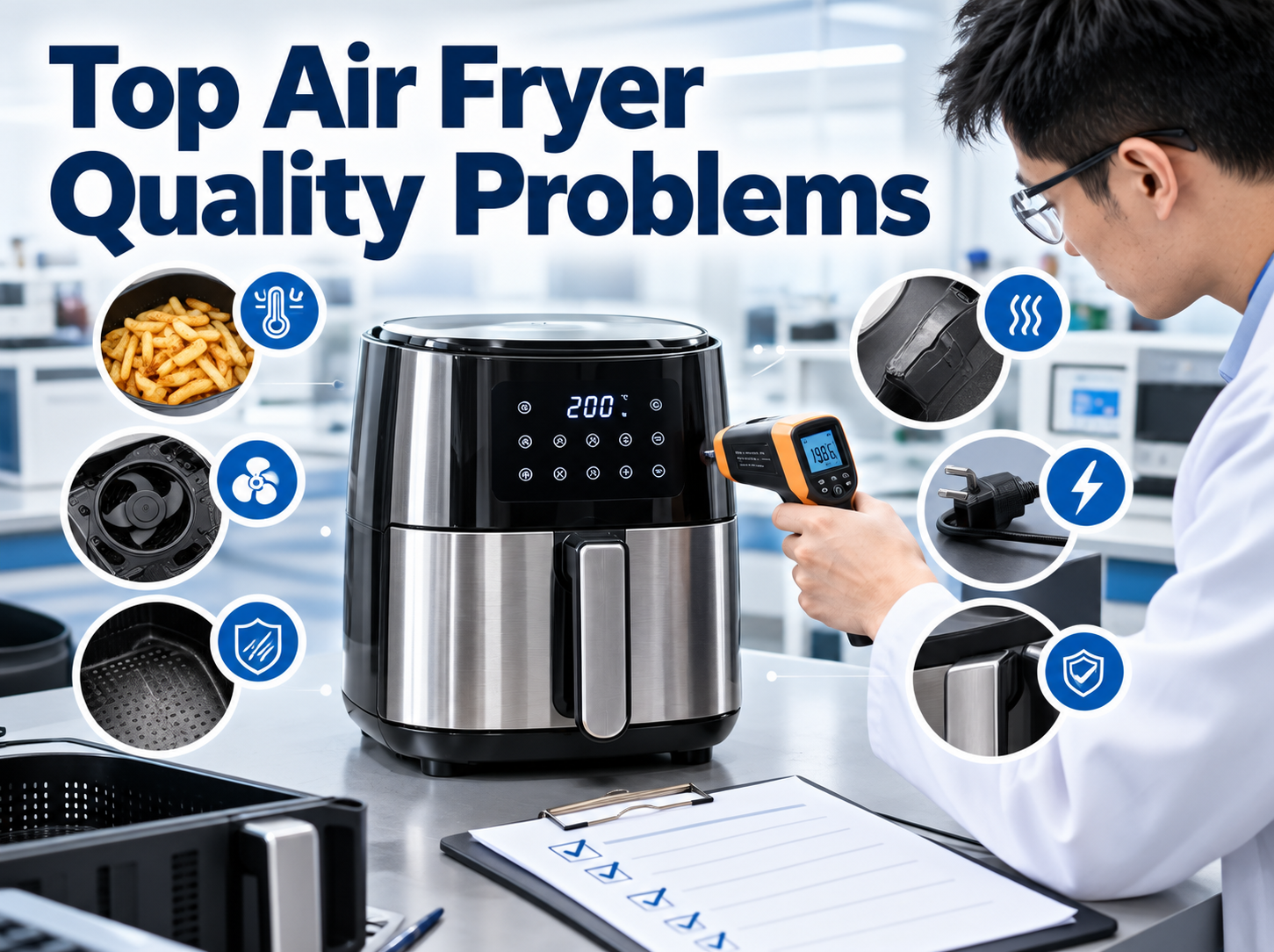
This is particularly important for air fryers because quality problems can later become warranty and after-sales costs.
Potential issues include:
l Plastic deformation
l Unpleasant odor
l Uneven cooking
l Temperature deviation
l Motor noise
l Fan failure
l Heating-element failure
l Coating problems
l Basket or handle problems
l Electrical or thermal safety issues
FUNLOIV's quality-control guide discusses why a low FOB price does not necessarily produce a lower overall business cost if quality problems occur later.
See:
What Quality-Control Standards Should I Require from an Air Fryer Supplier?
9. Compare MOQ Together with Price
A quotation should always be considered together with MOQ.
For example:
Supplier A
MOQ: 500 pcs
Price: $39
Supplier B
MOQ: 2,000 pcs
Price: $35
Supplier B has the lower unit price.
But if you are a new brand testing the market, Supplier A may require significantly less inventory investment.
Also ask:
l MOQ per model?
l MOQ per color?
l MOQ per SKU?
l MOQ per packaging design?
l MOQ per voltage version?
l MOQ per order?
Your existing quotation-comparison article highlights that MOQ needs to be evaluated alongside price and commercial conditions rather than treated as an isolated number.
For a deeper explanation:
What MOQ Do Chinese Air Fryer Suppliers Usually Require?
10. Compare Total Sourcing Cost, Not Just Factory Price
This is where professional purchasing decisions become much more meaningful.
A practical calculation is:
Total Sourcing Cost = Product Cost + Packaging + Tooling + Testing/Certification + Inspection + Logistics + Import Costs + Potential After-Sales Costs
For example:
Supplier A
Product: $35
Packaging: Included
Testing: Included
Inspection: Included
Term: FOB
Supplier B
Product: $33
Packaging: +$1
Testing: +$500
Inspection: +$300
Term: EXW
Supplier B initially looks $2 cheaper.
But once all costs are normalized, the actual difference may be much smaller.
This is why the question should not be:
“Who gives me the lowest unit price?”
It should be:
“Who provides the most competitive total sourcing cost for the exact product I need?”
11. Compare Certification and Compliance Costs
Certification can also affect the final sourcing cost.
Don't simply ask:
“Do you have CE?”
Instead ask:
l Does the certification cover the exact model?
l Does it cover the same voltage?
l Does it cover the same rated power?
l Does it cover the same configuration?
l Does it cover my target market?
l Are additional tests required?
l Who pays for additional testing?
l Is certification included in the quotation?
For example, a customized air fryer may require additional evaluation depending on the target market and the nature of the modification.
Therefore, certification should be considered part of the sourcing cost, not an afterthought.
You can link this article to your existing:
Air Fryer Certifications & Compliance by Market
12. Compare Lead Time and Payment Terms
Price is only one part of the commercial offer.
Also compare:
l Sample lead time
l Tooling lead time
l Certification lead time
l Mass production lead time
l Payment terms
l Deposit percentage
l Balance payment timing
l Price validity
l Currency
l Bank charges
For example:
Supplier A
USD 35 FOB
30% deposit / 70% before shipment
60-day production lead time
Supplier B
USD 34 FOB
50% deposit / 50% before shipment
80-day production lead time
The USD 1 difference may not tell the whole commercial story.
If your product launch is tied to a specific retail season, lead time may have significant commercial importance.
13. Ask Suppliers Why Their Price Is Higher or Lower
When one supplier's price is significantly different from the others, don't immediately reject the quotation.
Ask:
“Could you explain the main cost differences between your quotation and the market offers we received?”
A professional supplier should be able to explain differences in:
l Materials
l Heating system
l Motor
l PCB
l Packaging
l Certification
l QC
l MOQ
l Product configuration
This question can also reveal how well the supplier understands its own product.
A supplier that can clearly explain why its product costs USD 38 instead of USD 34 may give you more useful information than a supplier that simply says:
“This is our best price.”
14. Use Samples to Verify Whether the Price Is Real
A competitive quotation is only meaningful if the supplier can consistently manufacture the approved product at that price.
Before placing a large order, compare:
Quotation
↓
Sample
↓
Testing
↓
Golden Sample
↓
Mass Production
↓
Pre-Shipment Inspection
Your existing sample-testing article recommends checking more than appearance, including temperature accuracy, heating performance, cooking consistency, motor noise, basket durability, electrical safety and continuous operation.
You can read:
How Can I Test an Air Fryer Sample Before Placing a Bulk Order?
The important point is:
The quotation should correspond to the product configuration you actually approve.
15. Check Whether the Supplier Can Maintain the Same Cost During Mass Production
Another important question is:
“Will the components and specifications used in the approved sample remain unchanged during mass production?”
Ask about:
l Critical components
l Component substitutions
l Engineering changes
l Material changes
l PCB revisions
l Heating-element changes
l Motor changes
l Packaging changes
A low quotation is not very useful if the supplier later proposes cheaper components to maintain its margin.
For this reason, the final product specification should become a production-control reference.
FUNLOIV's QC guidance recommends controlling quality from incoming materials through production, assembly, functional testing, aging testing and final inspection.
16. Use a Standardized Supplier Comparison Table
Once you have several quotations, don't compare them from separate emails.
Create one comparison table.
Evaluation Factor | Supplier A | Supplier B | Supplier C |
Product specification | |||
Capacity | |||
Heating system | |||
Body material | |||
Motor | |||
Control system | |||
Temperature range | |||
Certification | |||
Packaging | |||
MOQ | |||
FOB price | |||
Tooling cost | |||
Sample lead time | |||
Production lead time | |||
Payment terms | |||
Warranty | |||
QC system | |||
Inspection support | |||
Total sourcing cost |
This prevents a common mistake:
Remembering only the lowest number and forgetting everything else.
17. What Are the Red Flags When Comparing Air Fryer Prices?
Be careful when you see a quotation that is significantly lower than the others.
Red Flag 1: The specification is unclear
The supplier provides only:
“8L air fryer — USD 29.”
Ask for the complete specification.
Red Flag 2: The quotation excludes important costs
Check packaging, testing, certification, tooling and inspection.
Red Flag 3: The supplier changes the specification
Make sure an alternative component is clearly identified as an alternative rather than silently replacing your original requirement.
Red Flag 4: Certification is unclear
Ask which exact model and configuration are covered.
Red Flag 5: The supplier cannot explain the price difference
A professional supplier should be able to explain the main cost drivers.
Red Flag 6: The price is valid for only a very short period
Ask why and clarify which material or commercial factors could affect the quotation.
18. The Best Way to Find Competitive Air Fryer Prices
A practical sourcing process looks like this:
Step 1 — Define Your Product
Capacity + functions + material + heating system + target market
↓
Step 2 — Prepare a Standard RFQ
Use the same specifications for every supplier.
↓
Step 3 — Contact Several Qualified Suppliers
Don't compare random products from unrelated suppliers.
↓
Step 4 — Request Tiered Pricing
For example:
500 / 1,000 / 3,000 / 5,000 pcs
↓
Step 5 — Normalize the Quotations
Compare:
Same Product + Same Quantity + Same Commercial Terms
↓
Step 6 — Calculate Total Sourcing Cost
Include packaging, testing, certification, inspection and other relevant costs.
↓
Step 7 — Evaluate Quality and Capability
Don't choose based on price alone.
↓
Step 8 — Test the Sample
Verify that the actual product matches the quotation.
↓
Step 9 — Approve the Production Specification
Create a clear reference for mass production.
↓
Step 10 — Conduct Pre-Shipment Inspection
Confirm that the delivered products match the approved requirements.
Air Fryer Supplier Price Comparison Checklist
Before selecting a supplier, ask yourself:
Product
l Are all suppliers quoting the same model?
l Same capacity?
l Same heating system?
l Same motor?
l Same material?
l Same control system?
l Same accessories?
Commercial
l Same quantity?
l Same MOQ conditions?
l Same Incoterm?
l Same payment terms?
l Packaging included?
l Tooling included?
l Testing included?
l Inspection included?
Compliance
l Same target market?
l Same certification requirements?
l Same voltage/frequency?
l Same product configuration?
Quality
l Sample approved?
l QC standard defined?
l Aging testing available?
l Pre-shipment inspection available?
l Warranty defined?
Cost
l Unit price compared?
l Total sourcing cost calculated?
l Logistics considered?
l Potential after-sales cost considered?
If you cannot answer these questions, the quotations may not yet be genuinely comparable.
The Lowest Price Is Not Always the Most Competitive Price
For air fryer importers and brands, a competitive quotation should balance:
Price
Product Specification
Quality
Compliance
MOQ
Lead Time
Commercial Terms
After-Sales Support
=
Total Sourcing Value
A supplier offering USD 33 may not be more competitive than one offering USD 35 if the second supplier provides the required specification, stronger quality control, complete compliance support and better commercial conditions.
The objective should therefore be:
Find the most competitive total sourcing solution for your target product—not simply the lowest factory price.
Need a Competitive Air Fryer Quotation?
If you are currently sourcing air fryers for your brand, import business, wholesale business, supermarket or retail channel, send the supplier a clear specification rather than simply asking for the lowest price.
You can provide:
l Target capacity
l Product design or reference model
l Target market
l Required functions
l Material requirements
l Estimated order quantity
l Packaging requirements
l Target retail positioning
FUNLOIV can then evaluate the requirements and provide a quotation based on the specified product configuration, including product specifications, MOQ, packaging, lead time and applicable compliance considerations.
Looking for a competitive air fryer quotation?
Send us your target market, product requirements and estimated quantity.
We can quote based on the same specification you are using to compare other suppliers—making the comparison more meaningful for your purchasing decision.
Related Articles
l Air Fryer Heating Element: Halogen vs. Stainless Steel Heating Tube.
l Why Does Airflow Matter in an Air Fryer?
l What Is the Difference Between AC and BLDC Motors in Air Fryers?
l What Makes an Air Fryer Cook More Evenly?
l How Can I Test an Air Fryer Sample Before Placing a Bulk Order?
l What Quality-Control Standards Should I Require from an Air Fryer Supplier?
l What Air Fryer Tests Should Be Included in a Pre-Shipment Inspection?
l What Factors Affect the FOB Price of an Air Fryer?
l How to Compare Quotations from Different Air Fryer Suppliers?
l 230°C Air Fryer: What Buyers Should Check Before Importing?
l A Dual Heating vs Single Heating Air Fryer- Which Is Better?
l What Is the Difference Between AC and DC Motors in Air Fryers?
l Air Fryer for the Middle East - A Guide to G-Mark, Specifications and Compliance?
l What Are the Most Common Quality Problems with Air Fryers?
l Air Fryer RFQ Checklist: 20 Specifications Buyers Should Include.
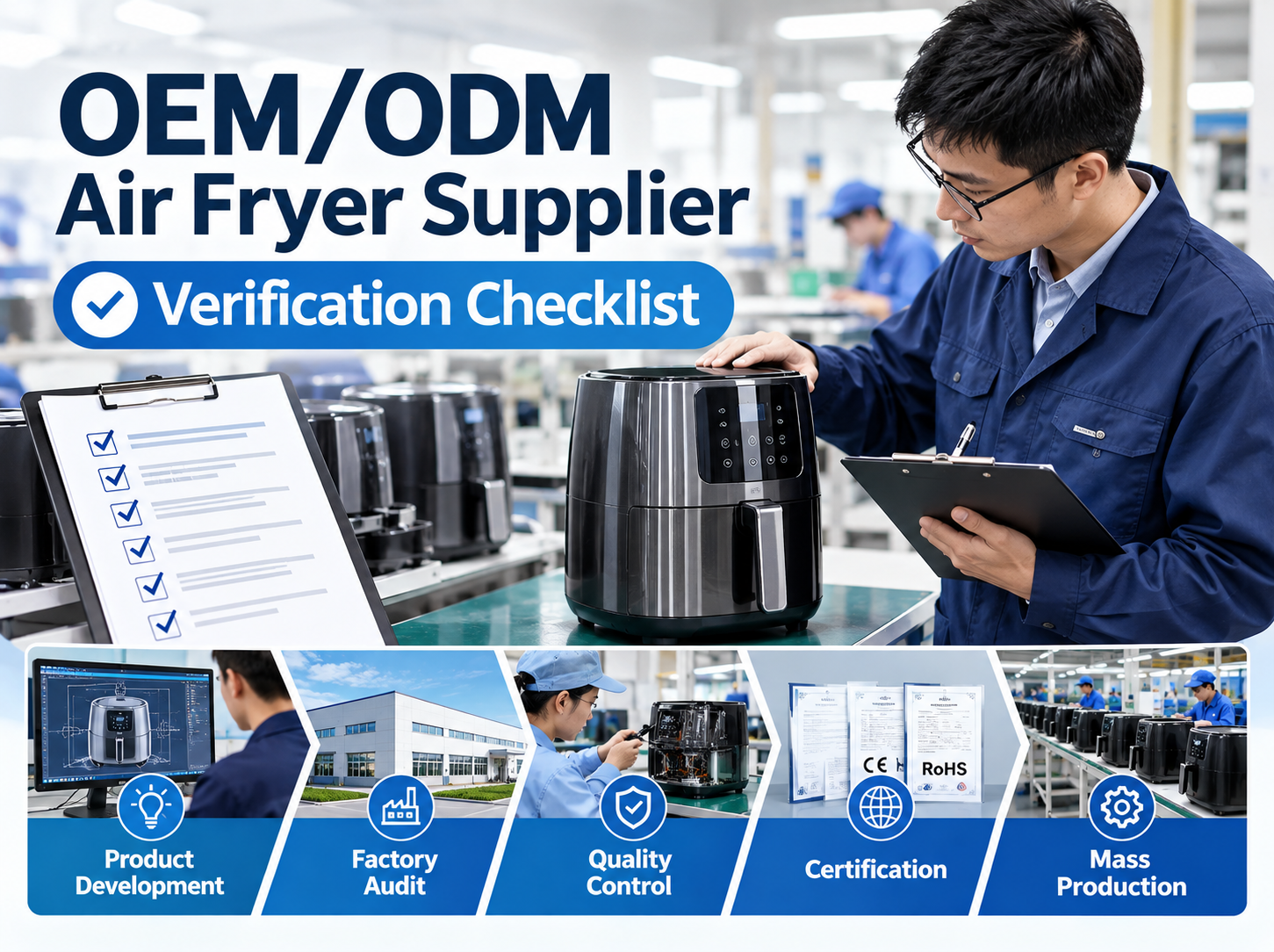
l How To Verify Whether an Air Fryer Supplier Is Reliable?
l How to Choose an OEM-ODM Air Fryer Supplier in China?
l 200°C vs 230°C Air Fryer: Which one is better?
l Metal-body vs plastic-body air fryer: which is better for a premium brand?
l Top Heating vs. Rear Heating Air Fryers: Which one is better for a B2B buyer?
l Is a Vertical Dual-Drawer Air Fryer Better for Saving Kitchen Space?
l Air Fryer Certifications & Compliance by Market- A Safety Guide for Importers.
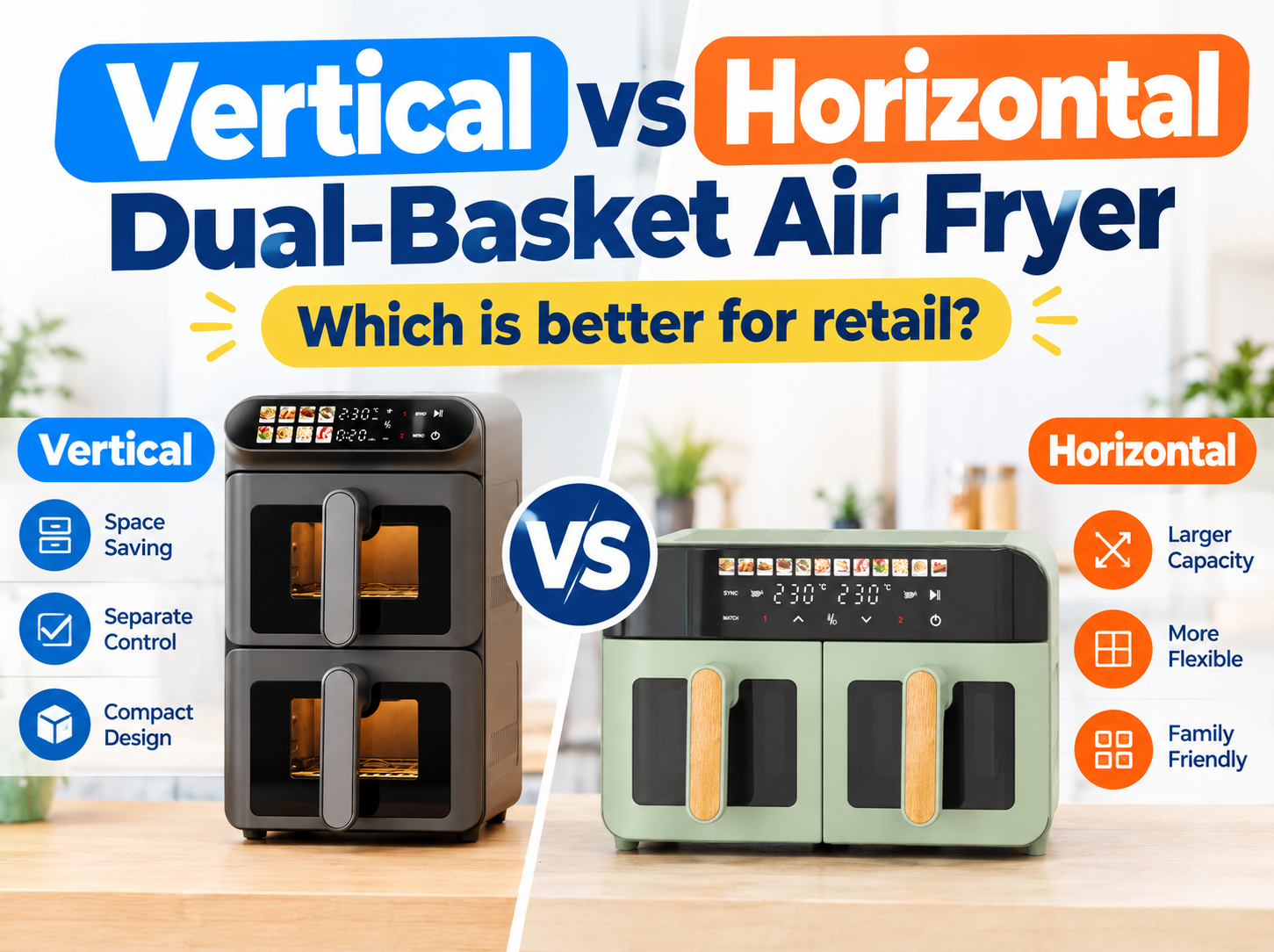
l Vertical vs. Horizontal Dual-Basket Air Fryer- Which Is Better for Retail?
l What Air Fryer Capacity Is Best for the European Market?
l What Are the Common Warranty and After-Sales Problems with Air Fryers?
l What MOQ, Lead Time and Payment Terms Should I Expect from an Air Fryer Supplier?
l How Can I Prevent Plastic Melting or Deformation in an Air Fryer?
l What Air Fryer Safety Tests Should Be Completed Before Mass Production?
l What Is the Difference Between a Single-Basket and Dual-Basket Air Fryer?
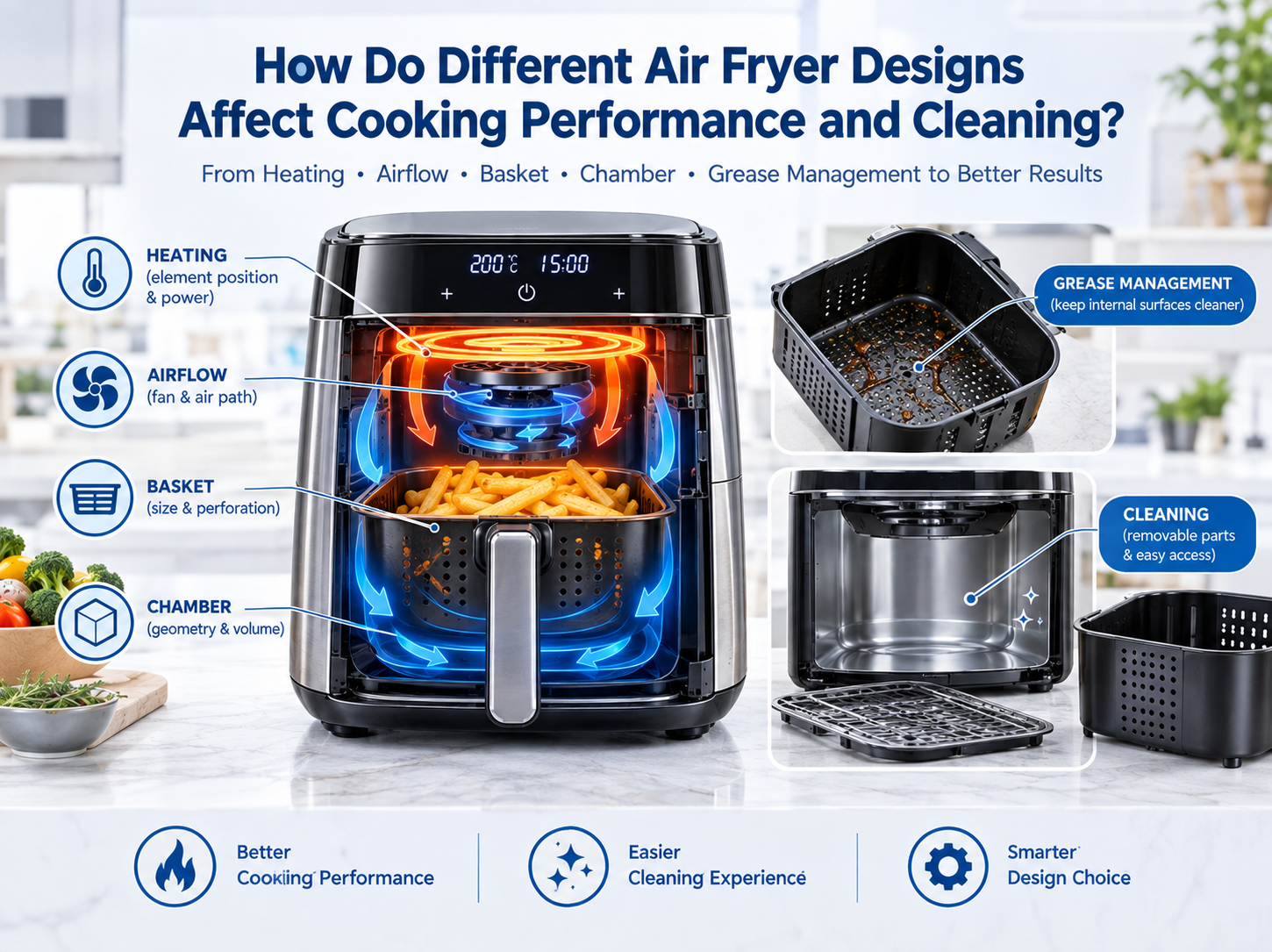
l How Do Different Air Fryer Designs Affect Cooking Performance and Cleaning?
l How Much Does an OEM Air Fryer Cost from China?
l What Are the Most Important Features to Consider When Sourcing an Air Fryer?
l What MOQ Do Chinese Air Fryer Suppliers Usually Require?
l How Can I Import Air Fryers from China?
l Can an Air Fryer Supplier in China Help Design New Products?
l How Can Air Fryer Suppliers in China Support Small Businesses?

How To Verify Whether an Air Fryer Supplier Is Reliable?
How to Compare Quotations from Different Air Fryer Suppliers?

Is it Worth Getting an Air Fryer?
How Do Different Air Fryer Designs Affect Cooking Performance and Cleaning?
Vertical vs. Horizontal Dual-Basket Air Fryer: Which Is Better for Retail?
What Are the Most Common Quality Problems with Air Fryers?
 + 86 181 3826 8709
 info@funloiv.com
 6/F., Guanglong Building, Pingxin North Road, Longgang, Shenzhen City, Guangdong, China


@ 2009-2026 Shenzhen Funloiv Electric Appliance Co., LtdAll rights reserved


