 Notice:

 search
search
search
Oct 06, 2026


Sourcing air fryers from China can give importers, brand owners, wholesalers and retailers access to a wide range of products, OEM/ODM capabilities and competitive manufacturing costs.
But a competitive quotation does not automatically mean a low-risk sourcing project.
Business problems can occur at many stages:
l The supplier does not fully understand the product requirements.
l Different suppliers quote different specifications.
l The sample performs well, but mass production does not.
l A certification document does not cover the final configuration.
l Critical components are changed without clear approval.
l Production is delayed.
l Packaging is not strong enough for international transportation.
l Warranty claims become expensive after the products reach the market.
For this reason, reducing sourcing risk is not about finding a supplier that promises “good quality.”
It is about building a process that controls risk before, during and after production.
A practical approach is:
Supplier Verification → Product Specification → Quotation Comparison → Sample Testing → Compliance → Production Control → Inspection → Warranty & After-Sales
This guide explains how overseas buyers can use this process to reduce business risk when working with air fryer suppliers in China.
1. Start With the Right Air Fryer Supplier
The first risk is choosing the wrong supplier.
An air fryer supplier may offer an attractive catalogue and competitive FOB prices, but that does not necessarily mean the supplier can successfully support your project from sample development to mass production.
For an importer or brand owner, evaluate more than the product itself.
Check:
l OEM/ODM capability
l Product-development experience
l Air fryer engineering capability
l Production capacity
l Quality-control system
l Certification support
l Export experience
l Sample-development process
l Communication
l Warranty and after-sales support
Our existing guide, How to Choose an OEM/ODM Air Fryer Supplier in China, covers these supplier-selection factors in more detail. It specifically focuses on the capabilities brands, importers, retailers and wholesalers should evaluate before selecting an OEM/ODM supplier.
A useful rule:
Do not evaluate an air fryer supplier only by asking, “What is your price?”
Also ask:
“How will you help me control the risks of this project?”
A supplier's answers to technical and production questions can reveal much more than a catalogue.
2. Define the Product Clearly Before Asking for a Quote
One of the easiest ways to create sourcing risk is to provide an incomplete product specification.
For example:
“Please quote your 8L air fryer.”
This sounds simple, but it leaves many questions unanswered.
Does the buyer mean:
l 8L nominal capacity or usable capacity?
l Mechanical or digital control?
l What voltage?
l What frequency?
l What power?
l What temperature range?
l What heating configuration?
l What basket material?
l What body material?
l What packaging?
l Which market?
l Which certification?
l What accessories?
l What logo and branding?
l What MOQ?
Our existing Air Fryer RFQ Checklist: 20 Specifications Buyers Should Include explains why a detailed RFQ can make supplier quotations more accurate and easier to compare.
Why does this reduce business risk?
Because:
Incomplete specification → different supplier assumptions → different quotations → misleading comparison
A clear specification gives all suppliers the same target.
3. Compare Specifications, Not Just FOB Prices
Price is important, but FOB price alone is not a reliable measure of sourcing cost.
Imagine three suppliers quote:
Supplier | FOB Price | Product Specification | Certification | QC | Warranty |
A | $32 | ? | ? | ? | ? |
B | $35 | ? | ? | ? | ? |
C | $39 | ? | ? | ? | ? |
Supplier A appears cheaper.
But what if:
l Supplier A uses a different heating system?
l Supplier B includes stronger packaging?
l Supplier C includes more comprehensive testing?
l Supplier A has a shorter warranty?
l Supplier B has a lower MOQ?
l Supplier C has better sample-to-production control?
The actual commercial comparison becomes very different.
Our existing How to Compare Quotations from Different Air Fryer Suppliers recommends comparing specifications, MOQ, certification, quality control, sample consistency and other commercial conditions instead of looking only at the quoted unit price.
Think about total sourcing cost:
Product Cost + Quality Cost + Compliance Cost + Logistics Cost + After-Sales Cost
The lowest FOB price is not necessarily the lowest total business cost.
4. Reduce Sample Risk Before Placing a Bulk Order
A supplier's product photos cannot tell you how the actual air fryer will perform.
Before placing a significant order, test the sample.
Important areas can include:
Performance
l Temperature accuracy
l Heating performance
l Cooking consistency
l Timer accuracy
l Temperature recovery
Mechanical
l Basket durability
l Handle strength
l Drawer movement
l Housing assembly
Thermal
l Surface temperature
l Plastic deformation
l Heating-element performance
l Thermal protection
Electrical
l Electrical safety
l Power consumption
l Continuous operation
User Experience
l Noise
l Controls
l Cleaning
l Odor
l Ease of use
Packaging
l Retail packaging
l Carton protection
l Drop resistance
Our existing Air Fryer Sample Testing Guide provides a 14-point sample-testing framework covering temperature, heating, cooking consistency, noise, durability, surface temperature, materials, safety, continuous operation, cleaning and packaging.
The important point:
You are not only testing the air fryer. You are also testing the supplier.
When you report a problem, observe how the supplier responds.
Can they explain:
l Why the problem occurred?
l Whether it is within specification?
l What corrective action is possible?
l Whether the design needs modification?
l Whether the problem can be controlled during mass production?
That response tells you something about the supplier's engineering and problem-solving capability.
5. Make the Approved Sample the Production Reference
This is one of the most important risk-control steps in OEM/ODM sourcing.
A common mistake is:
Sample approved → Purchase order placed → Assume production will be identical
Instead, the approved sample should become a production reference.
It should be connected to:
l Product specification
l Approved components
l Materials
l Dimensions
l Color
l Functions
l Temperature performance
l Noise
l Accessories
l Packaging
l Artwork
l Certification requirements
l Test reports
Our sample-testing guide recommends establishing a golden sample or approved reference sample and linking it to the product specification, components, materials, packaging and quality requirements.
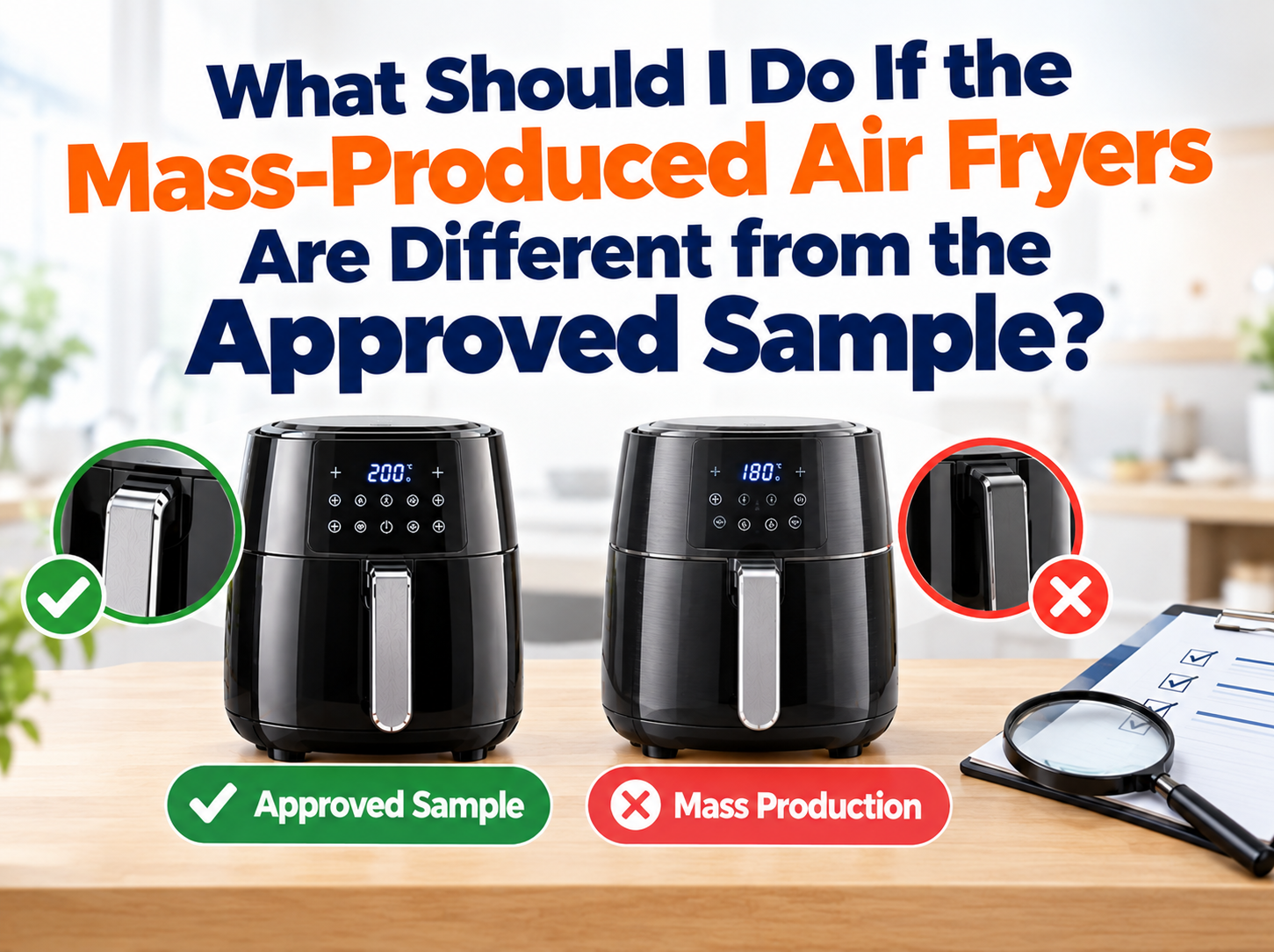
This reduces the risk of receiving a product that is technically different from the sample you approved.
6. Control Component Changes During Production
This is a risk that many first-time importers overlook.
Imagine you approve an air fryer using:
l Heating element A
l Motor A
l Fan A
l PCB A
l Plastic material A
l Coating A
Then the supplier changes one component during production.
The product may still look almost identical.
But the change could affect:
l Heating performance
l Temperature accuracy
l Airflow
l Noise
l Reliability
l Energy consumption
l Safety
l Product lifespan
Our existing supplier-quotation and sample-testing content highlights the importance of checking whether the production configuration remains consistent with the approved sample and whether critical components can be substituted.
Buyers should therefore establish:
Critical component changes require buyer approval before mass production.
This is particularly important for OEM and ODM projects.
7. Don't Ask “Is Your Quality Good?” Ask “How Do You Control Quality?”
“Good quality” is too general to be useful.
A better question is:
“What is your air fryer quality-control process?”
A structured QC system can include:
Incoming QC
↓
Production QC
↓
Assembly QC
↓
Functional Testing
↓
Aging Testing
↓
Final Inspection
↓
Pre-Shipment Inspection
Our existing What Quality-Control Standards Should I Require from an Air Fryer Supplier? explains this process in detail, including incoming inspection of plastics, metals, heating elements, motors, fans and electronic components, as well as production and finished-product testing.
Buyers should ask:
l Are critical components inspected before assembly?
l Are heating elements tested?
l Are motors and fans tested?
l Are electrical connections checked?
l Are finished products function-tested?
l Is aging testing performed?
l Is pre-shipment inspection available?
l Can third-party inspection be arranged?
The objective is not simply to find defects at the end.
It is to prevent defects from moving through the production process.
8. Pay Special Attention to Heating, Airflow and Thermal Design
Air fryers are thermal appliances.
This means product-design problems can become quality problems, safety problems and eventually warranty problems.
When evaluating a product, consider:
l Heating element position
l Fan performance
l Motor performance
l Airflow path
l Cooking chamber design
l Basket design
l Temperature control
l Thermal insulation
l Surface temperature
l Plastic location
l Over-temperature protection
For example, a product advertised as a 230°C air fryer should not be evaluated simply by looking at the number “230°C.”
The buyer should also understand how the heating system, airflow, materials and thermal protection work together.
Our existing 230°C Air Fryer: What Buyers Should Check Before Importing specifically discusses temperature performance, heating-system testing, aging tests and sample-to-mass-production consistency.
9. Verify Certification and Compliance for the Actual Product
Certification is another important sourcing-risk area.
A supplier may say:
“This product has CE.”
That statement alone may not be enough for a buyer.
Ask:
l Does the documentation cover the exact model?
l Does it cover the same voltage version?
l Does it cover the same configuration?
l Does it relate to the actual supplier/product?
l Which standards were applied?
l Is additional testing required for customized versions?
l Who is responsible if the product is modified?
Our existing Air Fryer Certifications & Compliance by Market explains that there is no single certification that automatically makes an air fryer compliant in every market. Requirements can involve product safety, EMC, chemical requirements, food-contact requirements and market-specific conformity assessment.
The important distinction:
Don't ask only:
“Do you have CE?”
Ask:
“Does the exact product I am buying meet the requirements of my target market, and can you provide the relevant documentation?”
10. Complete Safety Testing Before Mass Production
Safety problems discovered after mass production can be particularly expensive.
A design change at that stage may affect:
l Tooling
l Components
l PCB
l Wiring
l Heating system
l Housing
l Certification
l Packaging
l Production schedule
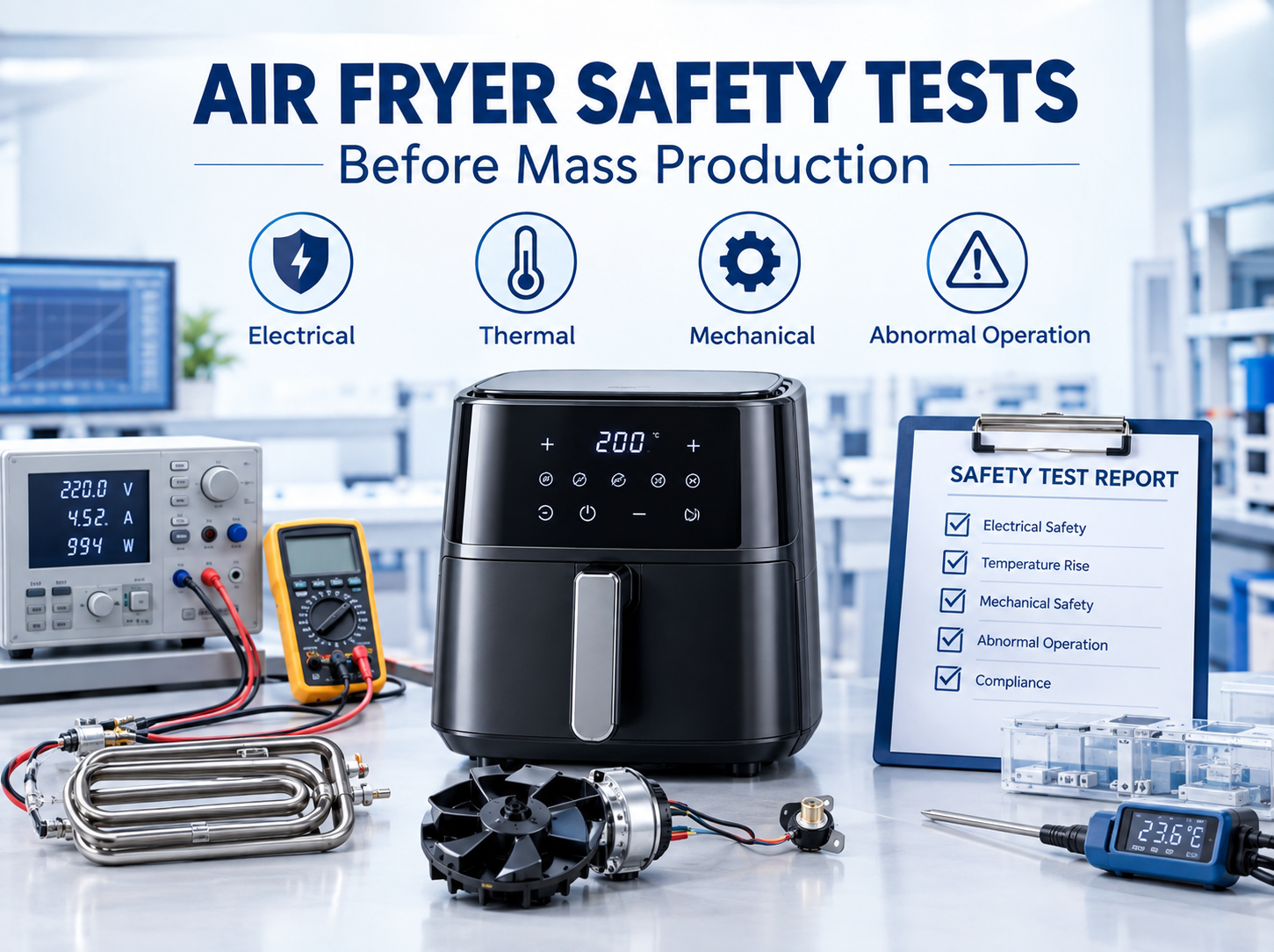
Our existing What Air Fryer Safety Tests Should Be Completed Before Mass Production? recommends treating safety testing as a design-verification step rather than simply a certification formality.
A practical development sequence is:
Product Design
↓
Engineering Sample
↓
Safety Testing
↓
Design Verification
↓
Certification / Compliance
↓
Golden Sample
↓
Mass Production
The exact tests depend on the product design, target market and applicable requirements.
The important principle is:
The product being mass-produced should be consistent with the product that was tested and approved.
11. Control MOQ, Lead Time and Payment Risks
Business risk is not only product quality.
Commercial terms can also affect profitability.
Before placing an order, clarify:
MOQ
Is the MOQ:
l Per model?
l Per color?
l Per SKU?
l Per packaging design?
l Per voltage version?
l Per order?
Our existing quotation-comparison article highlights this issue: a supplier saying “MOQ 500 pcs” may actually mean 500 pieces per color or packaging configuration.
Lead Time
Clarify:
l Sample lead time
l Tooling lead time
l Production lead time
l Packaging lead time
l Peak-season impact
l Shipping schedule
Payment Terms
Clarify:
l Deposit percentage
l Balance payment
l Payment timing
l Payment conditions
l Any additional charges
A product that arrives late can create significant business problems even when the quality is excellent.
For example:
Production Delay → Missed Launch → Missed Promotion → Lost Sales Opportunity
12. Reduce Warranty and After-Sales Risk Before Shipment
A sourcing project does not end when the container leaves China.
Once the products reach the market, problems may include:
l Heating failure
l Fan noise
l Control-panel malfunction
l Temperature deviation
l Basket deformation
l Coating damage
l Motor failure
l Electrical problems
These can become:
Warranty Claims + Replacement Costs + Spare Parts + Customer Service + Brand Reputation Risk
Our existing What Are the Common Warranty and After-Sales Problems with Air Fryers? explains why buyers should evaluate the supplier's warranty and after-sales system before placing a bulk order.
Before ordering, clarify:
l Warranty period
l Covered defects
l Exclusions
l Spare-parts policy
l Replacement procedure
l Claim procedure
l Response time
l Root-cause analysis
l Corrective action
A supplier saying “We offer a one-year warranty” does not tell you enough.
Ask:
“What happens when a recurring defect appears in the market?”
That is a much more useful question.
13. Don't Forget Packaging and Transportation Risk
An air fryer can pass every factory inspection and still arrive at the customer's warehouse damaged.
International transportation can expose products to:
l Drops
l Impact
l Vibration
l Compression
l Moisture
l Rough handling
l Carton deformation
Therefore, packaging should also be part of the product-development and quality-control process.
Check:
l Retail box structure
l Internal protection
l Carton strength
l Product fixation
l Accessories placement
l Drop-test performance
l Shipping marks
l Palletization, where applicable
Our sample-testing framework also includes packaging and drop testing as part of the pre-order evaluation.
14. Use Pre-Shipment Inspection as the Final Risk Check
Pre-shipment inspection should not replace supplier QC.
It should be the final verification point before the goods leave the factory.
Depending on the agreed inspection standard, buyers may check:
Quantity
Does the actual quantity match the purchase order?
Appearance
l Scratches
l Gaps
l Deformation
l Color
l Logo
l Assembly
Function
l Power
l Heating
l Controls
l Timer
l Fan
l Display
l Safety functions
Accessories
Are all required accessories included?
Packaging
l Retail box
l Manual
l Labels
l Carton
l Barcode
Specification
Does the finished product match the approved specification and sample?
This creates an important final checkpoint:
Do not discover a production problem after the container arrives at your warehouse if it could have been identified before shipment.
15. Build a Simple Risk-Control System
For buyers who regularly import air fryers, the following framework can be used as a practical checklist:
Business Risk | What to Control |
Supplier risk | R&D, production, QC, export experience |
Specification risk | Complete and measurable product specification |
Price risk | Compare equivalent configurations |
Sample risk | Test actual product performance |
Production risk | Approved sample + change control |
Quality risk | IQC + production QC + final inspection |
Compliance risk | Exact model + target-market requirements |
Safety risk | Pre-production safety verification |
MOQ risk | Confirm what the MOQ actually applies to |
Lead-time risk | Agree on realistic production milestones |
Payment risk | Define payment conditions clearly |
Logistics risk | Packaging and transportation protection |
Warranty risk | Written warranty and claim procedure |
After-sales risk | Spare parts + corrective action |
This is ultimately the difference between buying a product and managing a sourcing project.
16. A Lower-Risk Air Fryer Sourcing Process
For an importer, brand owner, wholesaler or retailer, I would recommend thinking about the entire project as nine checkpoints:
Step 1 — Define Your Product
Capacity + functions + materials + market + target positioning
↓
Step 2 — Verify Suppliers
OEM/ODM + engineering + production + QC + certification
↓
Step 3 — Send a Detailed RFQ
Use measurable product requirements.
↓
Step 4 — Compare Quotations
Compare equivalent specifications, not simply unit prices.
↓
Step 5 — Test Samples
Check performance, durability, safety and usability.
↓
Step 6 — Approve the Production Reference
Lock the specifications and critical components.
↓
Step 7 — Control Mass Production
IQC + production QC + functional testing + aging testing
↓
Step 8 — Pre-Shipment Inspection
Verify quantity, quality, packaging and specifications.
↓
Step 9 — Manage After-Sales
Warranty + spare parts + root-cause analysis + corrective action
This process does not eliminate every possible problem.
Instead, it creates multiple opportunities to identify problems before they become expensive.
17. What Is the Biggest Mistake Buyers Make?
One common mistake is focusing too heavily on the initial FOB price.
For example:
Supplier A: $32
Supplier B: $35
The buyer immediately chooses Supplier A.
But if Supplier A later creates:
l Higher defect rates
l More replacement units
l More warranty claims
l Additional inspection costs
l Certification problems
l Production delays
l Packaging damage
the original $3 saving may become insignificant.
The better approach is to compare:
Price + Product + Quality + Compliance + Delivery + Warranty + Supplier Capability
Our existing quotation-comparison guide makes the same distinction by recommending that buyers compare specifications, certification, QC, sample consistency, MOQ and other commercial conditions rather than simply choosing the lowest quotation.
18. What Questions Should You Ask an Air Fryer Supplier Before Ordering?
Before placing a bulk order, consider asking:
About the Supplier
l How long have you supplied air fryers?
l Do you have an internal engineering team?
l What OEM/ODM services can you provide?
l Which markets do you regularly supply?
About the Product
l What are the exact specifications?
l Which materials are used?
l What heating system is used?
l What motor and fan are used?
l What temperature range does it support?
About Quality
l What is your incoming QC process?
l What production QC is performed?
l Is functional testing performed?
l Is aging testing performed?
l Is pre-shipment inspection available?
About Compliance
l Which market requirements does the product meet?
l Does the documentation cover the exact model?
l Are additional tests required for customization?
About Production
l Will the production units use the same critical components as the approved sample?
l How are engineering changes controlled?
l Can the buyer approve a pre-production sample?
About After-Sales
l What is the warranty period?
l Which defects are covered?
l How are spare parts supplied?
l How are recurring defects handled?
A supplier that can answer these questions clearly gives the buyer more information for evaluating sourcing risk.
19. The Goal Is Not Zero Risk
No international sourcing project is completely risk-free.
The objective is to make the important risks:
Identifiable → Measurable → Testable → Controllable
For example:
Quality Risk
Define specification → Test sample → QC production → Inspect shipment
Compliance Risk
Define target market → Identify requirements → Test → Verify documentation
Delivery Risk
Agree milestones → Monitor production → Inspect → Arrange shipment
Warranty Risk
Define quality standard → Agree warranty → Track defects → Correct root cause
This is a much more realistic approach than simply trying to find a supplier that promises:
“No problem.”
Frequently Asked Questions
Ø How can I reduce risk when sourcing air fryers from China?
Use a structured process covering supplier verification, detailed product specifications, quotation comparison, sample testing, certification, production QC, pre-shipment inspection and warranty management.
Ø How do I know if an air fryer supplier in China is reliable?
Evaluate its engineering capability, product-development experience, quality-control system, certification support, export experience, sample process and after-sales support—not only its FOB price.
Ø Should I test an air fryer sample before placing a bulk order?
Yes. Buyers should evaluate temperature accuracy, heating performance, cooking consistency, noise, durability, materials, electrical safety, continuous operation and packaging before approving a bulk order.
Ø Is the lowest air fryer quotation the best option?
Not necessarily. Quotations should be compared using equivalent specifications and should also consider certification, quality control, MOQ, lead time, warranty and sample-to-production consistency.
Ø How can I prevent the supplier from changing components after sample approval?
Establish an approved sample, product specification and component list, and require buyer approval for changes to critical components before mass production.
Ø What should I check about air fryer certification?
Check whether the documentation applies to the exact model, configuration, voltage version and target market. Different markets can have different safety, EMC, chemical and food-contact requirements.
Ø Should safety testing be completed before mass production?
Safety testing should be integrated into product development before mass production. The exact tests depend on the product, target market and applicable requirements.
Ø What should an air fryer supplier's QC process include?
A comprehensive process can include incoming QC, production QC, assembly inspection, functional testing, aging testing, final inspection and pre-shipment inspection.
Ø What warranty terms should I discuss with an air fryer supplier?
Clarify the warranty period, covered defects, exclusions, spare parts, replacement procedures, claim process, response time and how recurring defects are investigated and corrected.
Conclusion: Reduce Risk Before You Place the Order
When sourcing air fryers from China, business risk cannot be controlled by choosing the lowest quotation alone.
A better approach is to build risk-control checkpoints throughout the sourcing process:
Choose the right supplier
l Define the product
l Compare equivalent quotations
l Test the sample
l Verify compliance
l Approve the production reference
l Control mass production
l Inspect before shipment
l Prepare for after-sales
The most important principle is simple:
The earlier you identify a problem, the easier and cheaper it is usually to correct.
A design problem discovered during sample development is easier to address than one discovered after tooling.
A production problem discovered during factory inspection is easier to address than one discovered after the container reaches your warehouse.
A recurring warranty problem identified early is easier to correct than one that has already generated hundreds of customer complaints.
For importers, brand owners, wholesalers and retailers, the goal is therefore not to find a supplier that claims to have “zero problems.”
The goal is to work with a supplier that has a clear process for identifying, preventing and correcting problems.
Related Air Fryer Sourcing Guides from FUNLOIV
If you are building this article as a pillar page, I recommend linking to the following existing content naturally throughout the article:
Related Articles
l Air Fryer Heating Element: Halogen vs. Stainless Steel Heating Tube.
l Why Does Airflow Matter in an Air Fryer?
l What Is the Difference Between AC and BLDC Motors in Air Fryers?
l What Makes an Air Fryer Cook More Evenly?
l How Can I Test an Air Fryer Sample Before Placing a Bulk Order?
l What Quality-Control Standards Should I Require from an Air Fryer Supplier?
l What Air Fryer Tests Should Be Included in a Pre-Shipment Inspection?
l What Factors Affect the FOB Price of an Air Fryer?
l How to Compare Quotations from Different Air Fryer Suppliers?
l 230°C Air Fryer: What Buyers Should Check Before Importing?
l A Dual Heating vs Single Heating Air Fryer- Which Is Better?
l What Is the Difference Between AC and DC Motors in Air Fryers?
l Air Fryer for the Middle East - A Guide to G-Mark, Specifications and Compliance?
l What Are the Most Common Quality Problems with Air Fryers?
l Air Fryer RFQ Checklist: 20 Specifications Buyers Should Include.
l How To Verify Whether an Air Fryer Supplier Is Reliable?
l How to Choose an OEM-ODM Air Fryer Supplier in China?
l 200°C vs 230°C Air Fryer: Which one is better?
l Metal-body vs plastic-body air fryer: which is better for a premium brand?
l Top Heating vs. Rear Heating Air Fryers: Which one is better for a B2B buyer?
l Is a Vertical Dual-Drawer Air Fryer Better for Saving Kitchen Space?
l Air Fryer Certifications & Compliance by Market- A Safety Guide for Importers.
l Vertical vs. Horizontal Dual-Basket Air Fryer- Which Is Better for Retail?
l What Air Fryer Capacity Is Best for the European Market?
l What Are the Common Warranty and After-Sales Problems with Air Fryers?
l What MOQ, Lead Time and Payment Terms Should I Expect from an Air Fryer Supplier?
l How Can I Prevent Plastic Melting or Deformation in an Air Fryer?
l What Air Fryer Safety Tests Should Be Completed Before Mass Production?
l What Is the Difference Between a Single-Basket and Dual-Basket Air Fryer?
l How Do Different Air Fryer Designs Affect Cooking Performance and Cleaning?
l How Much Does an OEM Air Fryer Cost from China?
l What Are the Most Important Features to Consider When Sourcing an Air Fryer?
l What MOQ Do Chinese Air Fryer Suppliers Usually Require?
l How Can I Import Air Fryers from China?
l Can an Air Fryer Supplier in China Help Design New Products?
l How Can Air Fryer Suppliers in China Support Small Businesses?
CTA
Planning to source air fryers from China?
Send us your target market, capacity, key product requirements and estimated order quantity. We can discuss the suitable product, OEM/ODM options and sourcing approach for your project.

Can An Air Fryer Replace A Toaster Oven?
How Can Air Fryer Suppliers in China Support Small Businesses?
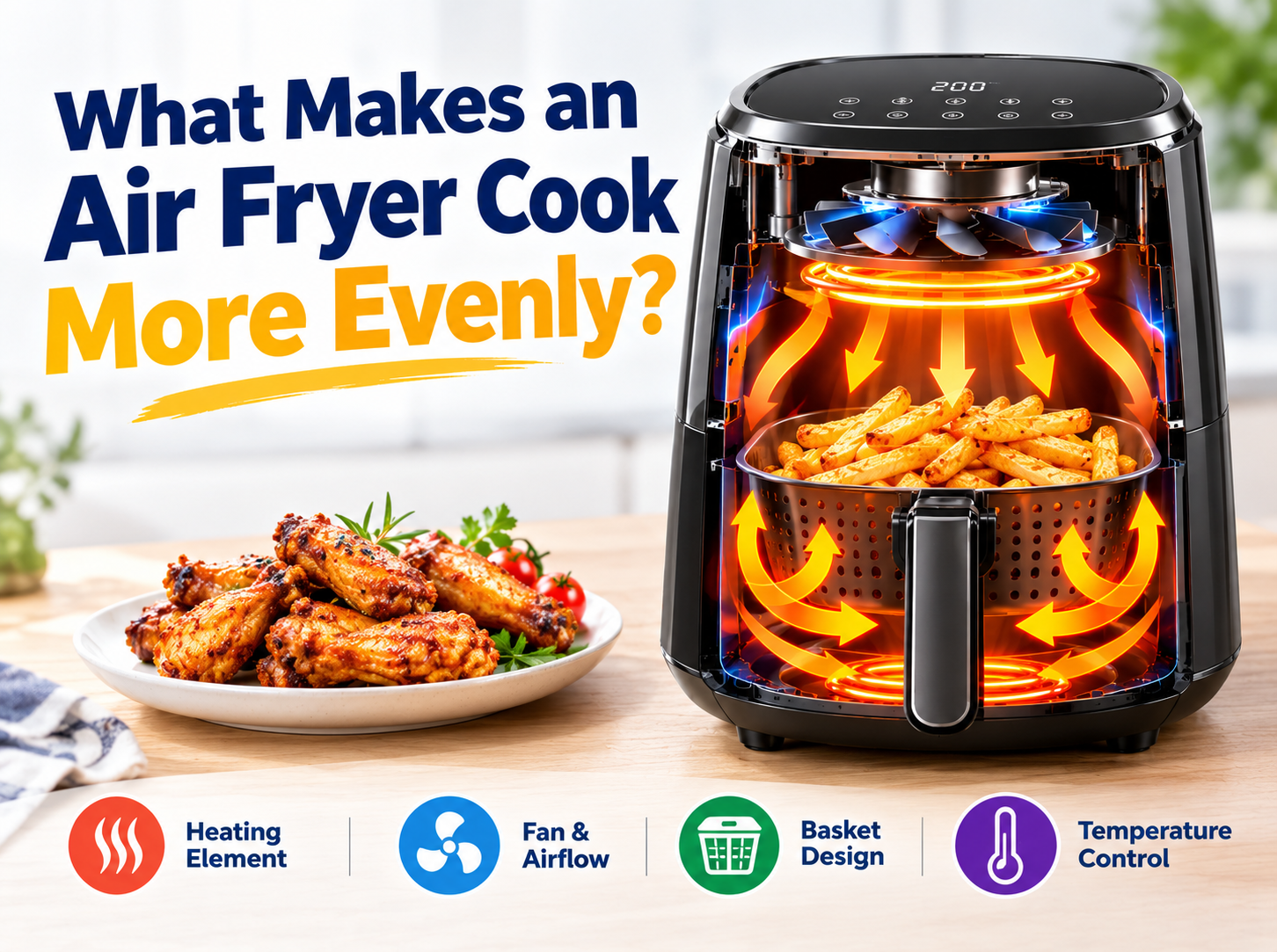
What Makes an Air Fryer Cook More Evenly?
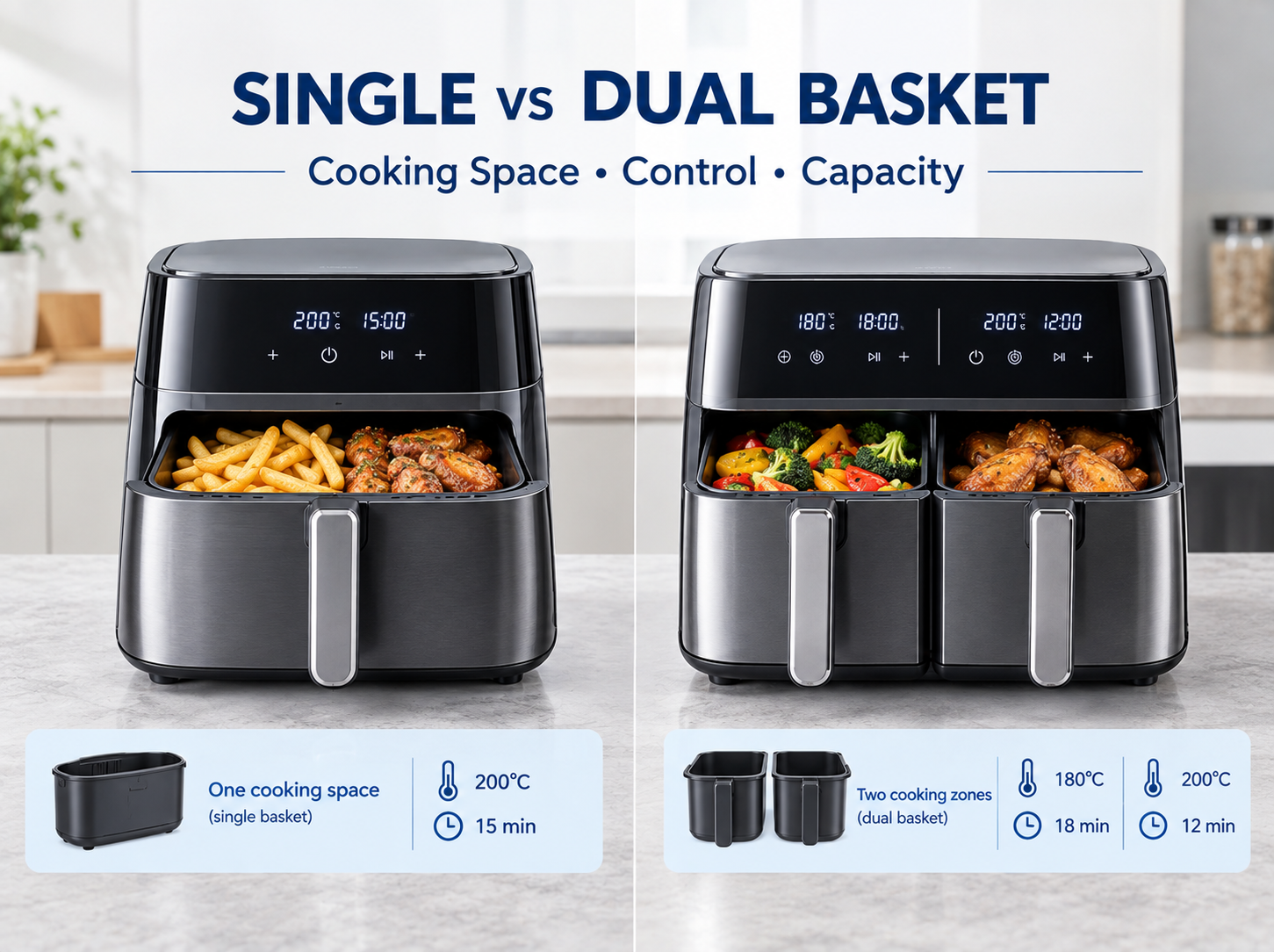
What Is the Difference Between a Single-Basket and Dual-Basket Air Fryer?
What Air Fryer Safety Tests Should Be Completed Before Mass Production?
What Should I Do If the Mass-Produced Air Fryers Are Different from the Approved Sample?
 + 86 181 3826 8709
 info@funloiv.com
 6/F., Guanglong Building, Pingxin North Road, Longgang, Shenzhen City, Guangdong, China


@ 2009-2026 Shenzhen Funloiv Electric Appliance Co., LtdAll rights reserved


