 Notice:

 search
search
search
Oct 06, 2026


You approved an air fryer sample, placed a bulk order, and expected the production units to match the approved version.
But when the mass-produced air fryers arrive, you notice differences.
Maybe:
l The body material looks different.
l The color is slightly different.
l The basket feels lighter.
l The heating performance has changed.
l The motor sounds different.
l The control panel is different.
l The packaging has been changed.
l A component has been substituted.
l The product does not perform exactly like the approved sample.
What should you do?
The first step is not to immediately accept or reject the entire shipment.
Instead, determine exactly what has changed, whether the change is within the agreed specification, and whether the change affects product performance, compliance, safety or your retail positioning.
For B2B buyers, the basic process should be:
Identify → Compare → Document → Classify → Communicate → Correct → Re-Inspect → Approve
This issue is particularly important for OEM and ODM air fryer projects, where the buyer and supplier may develop a customized product together. FUNLOIV's existing sample-testing guidance also emphasizes that an approved sample should become the reference for mass production.
How Can I Test an Air Fryer Sample Before Placing a Bulk Order?
1. First, Confirm What the Approved Sample Actually Was
Before claiming that the supplier produced the wrong product, make sure you have a clearly documented reference.
An approved sample should ideally be linked to:
l Supplier model number
l Buyer project number
l Product specifications
l Dimensions
l Materials
l Color
l Rated power
l Voltage and frequency
l Temperature range
l Heating system
l Motor and fan
l Control panel
l Basket and tray
l Accessories
l Packaging
l Artwork
l Labels
l User manual
l Certification requirements
The approved sample should not simply be:
“The sample we received last month.”
It should be a controlled production reference.
Our existing article on air fryer sample testing recommends linking the approved sample to product specifications, components, materials, packaging, artwork, accessories, certification requirements and quality requirements.
How Can I Test an Air Fryer Sample Before Placing a Bulk Order?
A better approach
Create an Approved Sample / Golden Sample Record containing:
Sample Photos
Technical Specification
BOM / Critical Components
Packaging
Approved Test Results
Buyer Approval Date
This gives both buyer and supplier a common reference if a dispute occurs later.
2. Identify Exactly What Is Different
Don't simply tell the supplier:
“The mass production is different from the sample.”
That statement is too general.
Create a Sample vs Mass Production Comparison.
For example:
Item | Approved Sample | Mass Production | Difference |
Body | Stainless steel | Stainless steel | No |
Color | Matte black | Gloss black | Yes |
Rated power | 2000W | 1800W | Yes |
Temperature | 60–230°C | 60–230°C | No |
Basket | Metal | Metal | No |
Handle | Version A | Version B | Yes |
Motor | Spec A | Spec B | Yes |
Packaging | Approved artwork | Revised artwork | Yes |
This immediately changes the conversation from:
“I don't like this product.”
to:
“These five production characteristics differ from the approved specification.”
That is a much stronger commercial position.
3. Not Every Difference Has the Same Level of Risk
One of the most important things buyers should understand is that not every production difference represents the same problem.
I recommend classifying deviations into four categories.
Level 1 — Cosmetic Difference
Examples:
l Slight color difference
l Logo position
l Minor printing difference
l Packaging artwork adjustment
These may not affect product function, but they may still matter for a private-label brand.
Level 2 — Functional Difference
Examples:
l Different motor noise
l Different heating speed
l Different cooking performance
l Different timer behavior
l Different control response
These require technical evaluation.
Level 3 — Specification Difference
Examples:
l Different power
l Different material
l Different capacity
l Different heating element
l Different PCB
l Different motor
l Different temperature performance
These should not simply be accepted without review.
Level 4 — Safety or Compliance Difference
Examples:
l Different electrical components
l Different thermal protection
l Different insulation
l Different power cord
l Different safety-related materials
l Changes affecting certification
These should be treated as a higher-priority issue and evaluated before the products are released for sale.
FUNLOIV's quality-control guidance similarly distinguishes product specifications, component control, functional testing, safety testing and pre-shipment inspection as separate parts of production quality management.
What Quality-Control Standards Should I Require from an Air Fryer Supplier?
4. Check Whether the Supplier Made an Engineering Change
Sometimes the difference is intentional.
For example, a supplier may have changed:
l Heating element
l Motor
l Fan
l PCB
l Plastic material
l Coating
l Power cord
l Connector
l Packaging
The supplier may argue:
“The new component performs the same function.”
But that does not automatically mean the change is acceptable.
For a private-label or OEM project, the important question is:
Was the change approved before mass production?
A supplier should not normally make an important change to the approved production configuration without informing the buyer and obtaining the required approval.
Our existing OEM/ODM supplier-selection article specifically recommends asking how BOM changes are controlled, whether components can be substituted without approval, and who approves engineering changes.
How to Choose an OEM/ODM Air Fryer Supplier in China:
5. Ask for the Reason Behind the Difference
Once you identify a deviation, ask the supplier:
What changed?
Then:
Why was it changed?
Then:
When was it changed?
And finally:
Who approved the change?
Possible reasons could include:
l Original component discontinued
l Supplier shortage
l Cost increase
l Engineering improvement
l Production issue
l Supplier's internal decision
l Material availability
l Certification requirement
l Manufacturing optimization
The reason matters because it helps determine whether the change is:
Acceptable → Correctable → or Unacceptable
For example, replacing a cosmetic component with an equivalent version may be relatively simple.
Replacing a heating element or PCB is a different situation.
6. Ask the Supplier to Provide Objective Evidence
Do not rely only on statements such as:
“This new component is better.”
Ask for evidence.
Depending on the change, this may include:
l Updated specification
l Component datasheet
l Test report
l Performance comparison
l Material information
l Certification documentation
l Safety test results
l Sample comparison
l Production test data
For example, if the supplier changed the heating element, ask:
Does the new heating element provide the same rated power and temperature performance?
If the motor changed:
Does the new motor provide equivalent airflow, noise performance and durability?
If the PCB changed:
Does the new PCB maintain the same functions, control logic and safety protection?
This is particularly important when the product has differentiated specifications such as 230°C maximum temperature. Our existing 230°C buyer guide recommends verifying temperature performance and sample-to-mass-production consistency rather than relying only on catalogue specifications.
230°C Air Fryer: What Buyers Should Check Before Importing
7. Compare the Mass-Production Units Against the Golden Sample
If the difference is significant, don't inspect only one production unit.
Take representative units from the production batch and compare them with the approved sample.
Check:
Appearance
l Color
l Surface finish
l Logo
l Dimensions
l Housing
l Handle
Materials
l Body material
l Basket material
l Tray
l Coating
l Internal components
Performance
l Heating time
l Maximum temperature
l Temperature stability
l Cooking consistency
l Timer accuracy
l Airflow
l Motor noise
Electrical
l Rated power
l Voltage
l Frequency
l Plug
l Power cord
Accessories
l Basket
l Tray
l Rack
l Manual
l Other accessories
Packaging
l Retail box
l Carton
l Inserts
l Labels
l Barcode
l Artwork
These areas are already part of the sample-testing and QC framework published on FUNLOIV.
How Can I Test an Air Fryer Sample Before Placing a Bulk Order?
8. Don't Release the Entire Shipment Before the Problem Is Understood
If the difference is potentially serious, the buyer should consider putting the affected shipment on hold until the issue has been evaluated.
This is particularly relevant when the difference involves:
l Safety
l Certification
l Electrical components
l Heating system
l Product performance
l Food-contact materials
l Rated power
l Critical components
The goal is not to create unnecessary conflict with the supplier.
The goal is to prevent a problem from moving from:
Factory → Warehouse → Retailer → Consumer
before its cause and impact are understood.
9. Ask the Supplier for a Corrective Action Plan
Once the supplier confirms that the mass-production product does not meet the agreed requirement, ask for a concrete corrective action plan.
A useful corrective-action document should answer:
Ø What is the problem?
Example:
Production units use a different heating element from the approved sample.
Ø Why did it happen?
Example:
Original component was unavailable during production.
Ø How many units are affected?
Example:
600 units.
Ø What is the immediate action?
Example:
Hold affected inventory.
Ø What is the corrective action?
Example:
Replace the component and retest.
Ø How will recurrence be prevented?
Example:
Critical component substitution requires buyer approval before production.
This is much more useful than simply asking the supplier to:
“Please make it the same next time.”
10. Decide Whether to Accept, Rework or Reject the Production
After the supplier provides its explanation and evidence, the buyer normally has several possible paths.
Option A — Accept
The difference is minor, documented and does not affect the agreed product requirements.
Option B — Accept with Correction
The difference is acceptable after:
l Rework
l Replacement
l Additional inspection
l Updated documentation
Option C — Request Partial Rework
Only the affected units are corrected.
Option D — Require Full Rework
If the deviation affects a critical specification, a larger-scale correction may be necessary.
Option E — Reject the Non-Conforming Goods
If the product significantly fails to meet the agreed requirements, the buyer may need to reject the affected goods according to the purchase agreement and applicable commercial terms.
The exact commercial remedy depends on the contract, purchase order, inspection agreement and applicable law.
The important principle is:
Do not make the decision based only on the supplier's explanation or the buyer's frustration. Base it on the documented product requirements and evidence.
11. Conduct a Pre-Shipment Inspection Before the Goods Leave the Factory
This is one of the best ways to reduce the risk of discovering a problem after shipment.
Our existing FUNLOIV content specifically recommends pre-shipment inspection to verify that finished products match the approved sample, purchase-order specifications and agreed quality requirements.
What Air Fryer Tests Should Be Included in a Pre-Shipment Inspection?
A pre-shipment inspection can check:
l Appearance
l Dimensions
l Materials
l Functions
l Temperature
l Timer
l Heating performance
l Electrical safety
l Accessories
l Packaging
l Labels
l Carton markings
l Quantity
For higher-risk projects, buyers can also consider an independent third-party inspection.
12. Control Critical Components, Not Just the Finished Product
One common mistake is to define the approved sample only by appearance.
For air fryers, several internal components can significantly affect performance.
For example:
Heating Element
→ Heating performance
Motor + Fan
→ Airflow + Noise
Temperature Sensor
→ Temperature control
PCB
→ Functions + Control
Thermal Protection
→ Safety
Power Cord
→ Electrical configuration
Therefore, a production reference should include critical components, not just exterior appearance.
Our existing QC article specifically recommends controlling heating elements, motors, fans, temperature sensors, PCBs, wiring and connectors during incoming and production QC.
What Quality-Control Standards Should I Require from an Air Fryer Supplier?
13. Put Engineering Change Control Into the Purchase Process
This is one of the most important lessons for OEM/ODM buyers.
Before production begins, agree with the supplier:
No critical component or specification change without buyer approval.
The change-control process can be:
Supplier Identifies Proposed Change
↓
Supplier Provides Reason
↓
Technical Comparison
↓
Sample / Test if Necessary
↓
Buyer Approval
↓
BOM Update
↓
Production
↓
Inspection
This is particularly important for private-label products because your brand is responsible for what ultimately reaches the market.
14. Your Purchase Order Should Reference the Approved Product
A purchase order should not simply say:
Air Fryer, 8L, 2,000 pcs
It should be much more specific.
Where appropriate, reference:
l Model number
l Product specification
l Approved sample
l BOM / critical components
l Material
l Color
l Packaging
l Accessories
l User manual
l Label
l Certification
l Quality standard
l Inspection requirements
l Engineering-change procedure
This creates a stronger link between:
RFQ → Quotation → Sample → Approval → PO → Production → Inspection
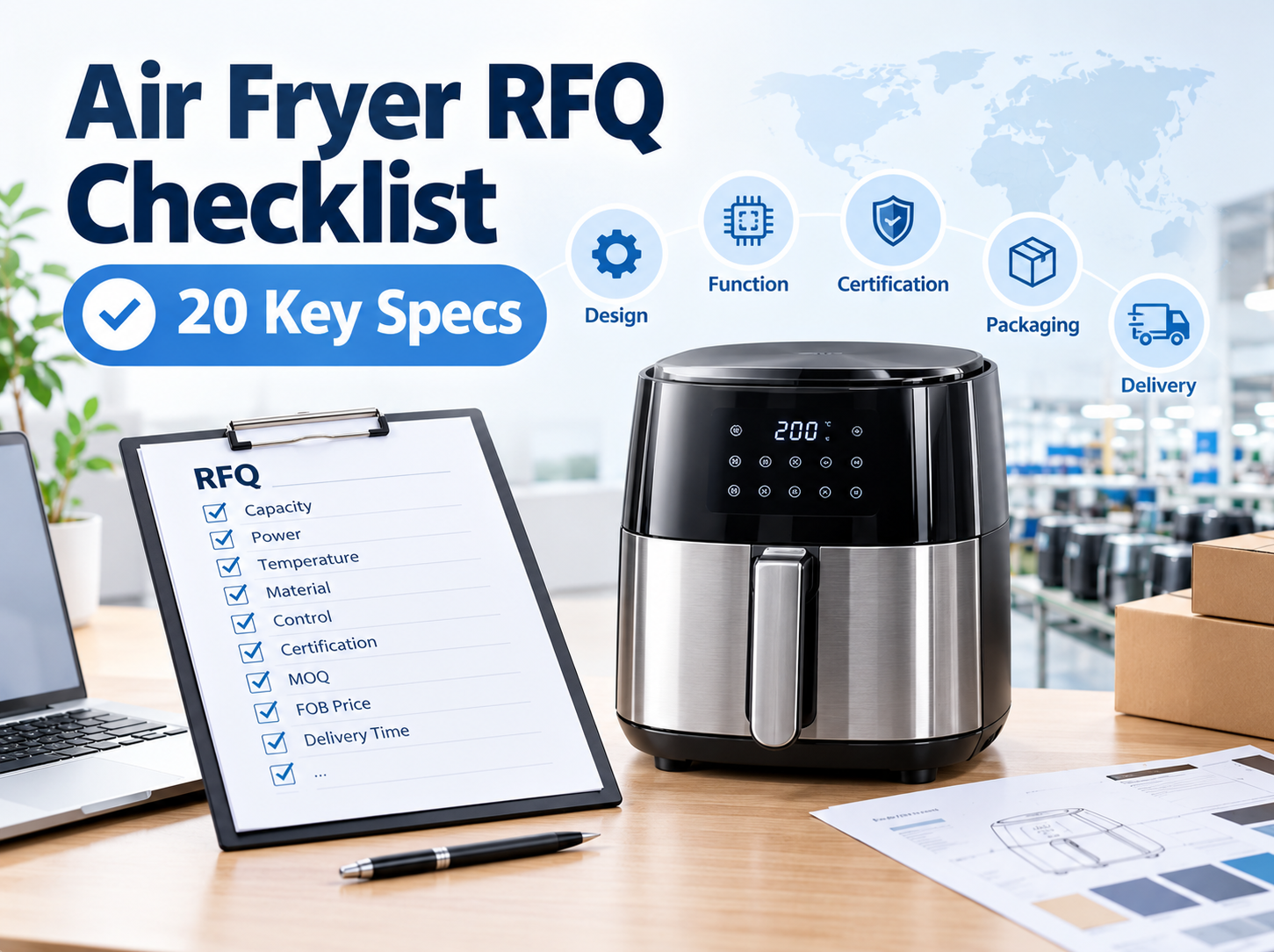
Our existing RFQ guide already recommends defining capacity, power, voltage, heating system, materials, controls, certification, target market, MOQ and delivery requirements before requesting a meaningful quotation.
Air Fryer RFQ Checklist: 20 Specifications Buyers Should Include.
15. What If the Supplier Says the New Version Is Better?
This happens frequently in OEM/ODM projects.
The supplier may say:
“We changed it because the new component is better.”
The correct response is not necessarily:
“No.”
Instead, ask:
l What exactly changed?
l Why was it changed?
l Is performance equivalent or better?
l Does certification remain valid?
l Does the change affect the retail specification?
l Does the new version require a new sample?
l Does the change affect the agreed cost?
l Can we approve the change before continuing production?
A genuine engineering improvement can sometimes be valuable.
But it should still go through change control and buyer approval.
16. What If the Difference Is Only Cosmetic?
Not every difference requires rejecting a shipment.
For example:
Approved sample: matte black
Production: slightly different surface finish
If the difference has no impact on:
l Product performance
l Safety
l Certification
l Material requirements
l Brand guidelines
the buyer may decide to accept it.
However, for a private-label brand, even cosmetic differences can matter if the product is part of a carefully controlled visual identity.
Therefore, define in advance which characteristics are:
Critical
Must match.
Major
Limited tolerance.
Minor
Acceptable within an agreed range.
This is much better than trying to decide everything after production.
17. What If the Supplier Produces the Wrong Version?
This is a more serious situation.
For example:
Approved:
11L vertical dual-drawer air fryer, metal body, 230°C
Production:
11L vertical dual-drawer air fryer, different body material, different heating system and different control panel
This is not simply a cosmetic deviation.
The buyer should stop and compare:
l Product specification
l Approved sample
l BOM
l Quotation
l Purchase order
l Production version
l Test reports
If the production version does not correspond to the agreed configuration, the buyer should request clarification before releasing the goods.
18. What Can Buyers Do to Prevent This Problem Before Mass Production?
The best solution is to prevent the problem rather than solve it after production.
A practical process is:
Step 1
Define the product specification.
Step 2
Receive the engineering sample.
Step 3
Test the sample.
Step 4
Make corrections.
Step 5
Approve the final sample.
Step 6
Create the golden sample / controlled reference.
Step 7
Freeze critical components.
Step 8
Approve the BOM.
Step 9
Define engineering-change procedures.
Step 10
Conduct pre-production verification.
Step 11
Monitor production.
Step 12
Conduct pre-shipment inspection.
Step 13
Approve shipment.
This creates a controlled transition:
Engineering Sample → Revised Sample → Approved Sample → Golden Sample → Mass Production → Pre-Shipment Inspection
FUNLOIV's existing sample-testing article describes essentially this transition and recommends using the approved sample as the production reference.
How Can I Test an Air Fryer Sample Before Placing a Bulk Order?
19. What Should an Importer Check During Production?
For an air fryer, I would divide production control into five areas.
Incoming Materials
Check:
l Heating elements
l Motors
l Fans
l PCB
l Sensors
l Plastic parts
l Metal parts
l Coating
l Power cords
Assembly
Check:
l Wiring
l Heating-element installation
l Motor/fan installation
l Sensor positioning
l Insulation
l Grounding
l Housing assembly
Functional Testing
Check:
l Heating
l Temperature
l Timer
l Controls
l Fan
l Motor noise
Reliability Testing
Check:
l Continuous operation
l Aging
l Thermal stability
Final Inspection
Check:
l Appearance
l Accessories
l Packaging
l Labels
l Quantity
This matches the broader quality-control framework already published on our website: Incoming QC → Production QC → Assembly QC → Finished Product QC → Aging Testing → Pre-Shipment Inspection.
What Quality-Control Standards Should I Require from an Air Fryer Supplier?
20. What Should You Do If You Discover the Difference After Shipment?
Sometimes the buyer only discovers the issue after the goods arrive.
In that situation:
First
Stop selling the affected model if the issue may involve safety or compliance.
Second
Identify the affected production batch.
Third
Collect evidence:
l Photos
l Videos
l Serial numbers
l Batch numbers
l Customer complaints
l Test results
Fourth
Compare the product against the approved sample.
Fifth
Notify the supplier with documented evidence.
Sixth
Request:
l Root-cause analysis
l Corrective action
l Replacement parts
l Replacement units
l Rework
l Commercial solution
Our existing warranty and after-sales guidance recommends treating repeated defects through batch information, failure data, root-cause analysis and corrective action rather than handling every complaint as an isolated case.
What Are the Common Warranty and After-Sales Problems with Air Fryers?
Approved Sample vs Mass Production: Buyer Checklist
Before accepting a bulk shipment, compare:
Product
l Model number
l Capacity
l Dimensions
l Weight
l Color
l Body material
l Basket material
Electrical
l Voltage
l Frequency
l Rated power
l Plug
l Power cord
Heating & Performance
l Heating system
l Maximum temperature
l Temperature accuracy
l Heating time
l Cooking performance
l Airflow
l Motor noise
Electronics
l PCB
l Display
l Control panel
l Sensors
l Functions
Mechanical
l Handle
l Basket
l Drawer
l Tray
l Assembly
Packaging
l Retail box
l Artwork
l Barcode
l Manual
l Accessories
l Carton markings
Compliance
l Certification
l Test reports
l Safety-related components
l Market-specific requirements
5 Questions to Ask Your Air Fryer Supplier
Before mass production, ask:
l Will the approved sample be retained as the production reference?
l Can any critical component be changed without buyer approval?
l How are BOM and engineering changes controlled?
l How will you verify mass-production consistency?
l Can I conduct a pre-shipment inspection before shipment?
A supplier's answers to these questions can tell you a great deal about its production-control system. Your existing supplier-selection guide recommends these same areas when evaluating whether an OEM/ODM supplier can control production after sample approval.
How to Choose an OEM/ODM Air Fryer Supplier in China:
FAQ: Air Fryer Sample vs Mass Production
Ø Can a supplier change components after sample approval?
A supplier may need to make engineering changes in some situations, but critical changes should be communicated, evaluated and approved according to the agreed change-control process.
Ø Is the approved sample legally binding?
That depends on the contract, purchase order and applicable law. Buyers should clearly incorporate the approved product specification and sample/reference requirements into their commercial documentation.
Ø What if the production air fryer has a different motor?
Ask the supplier why the motor changed, compare the technical specifications and performance, and determine whether the change affects the approved product requirements before accepting it.
Ø What if the supplier says the replacement component is better?
Ask for objective evidence and evaluate the change. A supplier's claim that a component is “better” does not by itself establish that the change is acceptable for your project.
Ø Should I inspect every air fryer?
Not necessarily. Inspection methodology depends on order size, product risk, agreed inspection standards and sampling plans. For larger orders, buyers may use a defined sampling inspection or independent third-party inspection.
Ø Can a third-party inspection company check the production?
Yes. Buyers can arrange third-party inspections where appropriate. The inspection scope and acceptance criteria should be agreed before production or shipment.
The Key Lesson: An Approved Sample Is Not Enough
For an importer or brand owner, there are actually three different questions:
1. Does the sample work?
Product testing
2. Can the supplier reproduce the sample?
Production consistency
3. Can the supplier maintain the same quality throughout the entire order?
Quality management
A professional sourcing process therefore needs:
Approved Sample + Controlled Specification + Critical Component Control + Change Management + Production QC + Pre-Shipment Inspection
Our existing quality article makes the same fundamental point: a good sample does not automatically guarantee a good bulk order; buyers need to evaluate both product quality and the supplier's quality system.
What Are the Most Common Quality Problems with Air Fryers?
Related Air Fryer Sourcing Guides
For buyers who want to understand the complete sourcing process, this article can link naturally to several existing FUNLOIV resources:
l How Can I Test an Air Fryer Sample Before Placing a Bulk Order? — How to evaluate temperature, heating, cooking performance, materials, noise, durability and other sample characteristics.
l What Quality-Control Standards Should I Require from an Air Fryer Supplier? — Covers incoming QC, production QC, assembly, aging testing and pre-shipment inspection.
l How to Choose an OEM/ODM Air Fryer Supplier in China — Includes questions about BOM changes and mass-production control.
l How to Compare Quotations from Different Air Fryer Suppliers — Explains why sample consistency and QC capability should be considered when comparing suppliers.
l What Are the Most Common Quality Problems with Air Fryers? — Useful for identifying the types of defects that should be monitored during production.
l What Are the Common Warranty and After-Sales Problems with Air Fryers? — Connects production quality problems with warranty claims, spare parts and corrective action.
Final Takeaway for Air Fryer Importers
If your mass-produced air fryers are different from the approved sample, do not treat the issue simply as a disagreement with your supplier.
Treat it as a controlled quality and change-management problem.
The correct process is:
Approved Sample
↓
Identify the Difference
↓
Compare Against Specification
↓
Classify the Deviation
↓
Request Evidence
↓
Determine Root Cause
↓
Agree Corrective Action
↓
Re-Inspect
↓
Approve or Reject
↓
Prevent Recurrence
For an OEM/ODM air fryer project, the real goal is not simply to receive one good sample.
It is to ensure that the 1st production unit, 100th unit and 10,000th unit remain consistent with the product you approved.
Need Help Developing and Controlling a New Air Fryer Product?
If you are an importer, private-label brand, wholesaler, retailer or supermarket developing an air fryer for your market, send us your:
l Target capacity
l Product reference or design
l Target market
l Required functions
l Estimated order quantity
l Quality requirements
We can discuss the process from sample development → product testing → approved sample → production control → QC → pre-shipment inspection → after-sales support.
Looking for an air fryer OEM/ODM supplier that can control your product from sample to mass production?
Send us your product requirements and target market to discuss your project.
Related Articles
l Air Fryer Heating Element: Halogen vs. Stainless Steel Heating Tube.
l Why Does Airflow Matter in an Air Fryer?
l What Is the Difference Between AC and BLDC Motors in Air Fryers?
l What Makes an Air Fryer Cook More Evenly?
l How Can I Test an Air Fryer Sample Before Placing a Bulk Order?
l What Quality-Control Standards Should I Require from an Air Fryer Supplier?
l What Air Fryer Tests Should Be Included in a Pre-Shipment Inspection?
l What Factors Affect the FOB Price of an Air Fryer?
l How to Compare Quotations from Different Air Fryer Suppliers?
l 230°C Air Fryer: What Buyers Should Check Before Importing?
l A Dual Heating vs Single Heating Air Fryer- Which Is Better?
l What Is the Difference Between AC and DC Motors in Air Fryers?
l Air Fryer for the Middle East - A Guide to G-Mark, Specifications and Compliance?
l What Are the Most Common Quality Problems with Air Fryers?
l Air Fryer RFQ Checklist: 20 Specifications Buyers Should Include.
l How To Verify Whether an Air Fryer Supplier Is Reliable?
l How to Choose an OEM-ODM Air Fryer Supplier in China?
l 200°C vs 230°C Air Fryer: Which one is better?
l Metal-body vs plastic-body air fryer: which is better for a premium brand?
l Top Heating vs. Rear Heating Air Fryers: Which one is better for a B2B buyer?
l Is a Vertical Dual-Drawer Air Fryer Better for Saving Kitchen Space?
l Air Fryer Certifications & Compliance by Market- A Safety Guide for Importers.
l Vertical vs. Horizontal Dual-Basket Air Fryer- Which Is Better for Retail?
l What Air Fryer Capacity Is Best for the European Market?
l What Are the Common Warranty and After-Sales Problems with Air Fryers?
l What MOQ, Lead Time and Payment Terms Should I Expect from an Air Fryer Supplier?
l How Can I Prevent Plastic Melting or Deformation in an Air Fryer?
l What Air Fryer Safety Tests Should Be Completed Before Mass Production?
l What Is the Difference Between a Single-Basket and Dual-Basket Air Fryer?
l How Do Different Air Fryer Designs Affect Cooking Performance and Cleaning?
l How Much Does an OEM Air Fryer Cost from China?
l What Are the Most Important Features to Consider When Sourcing an Air Fryer?
l What MOQ Do Chinese Air Fryer Suppliers Usually Require?
l How Can I Import Air Fryers from China?
l Can an Air Fryer Supplier in China Help Design New Products?
l How Can Air Fryer Suppliers in China Support Small Businesses?
l Can Air Fryer Suppliers Produce Products Compatible with the Voltage in My Country?
l Do Air Fryer Suppliers in China Provide Replacement Parts for After-Sales Service?
l How Can I Find Competitive Prices from Air Fryer Suppliers?

Can An Air Fryer Replace A Toaster Oven?
Air Fryer RFQ Checklist: 20 Specifications Buyers Should Include
How Do Different Air Fryer Designs Affect Cooking Performance and Cleaning?
How Can I Find Competitive Prices from Air Fryer Suppliers?

Kitchen Appliance Regulations In the European Union
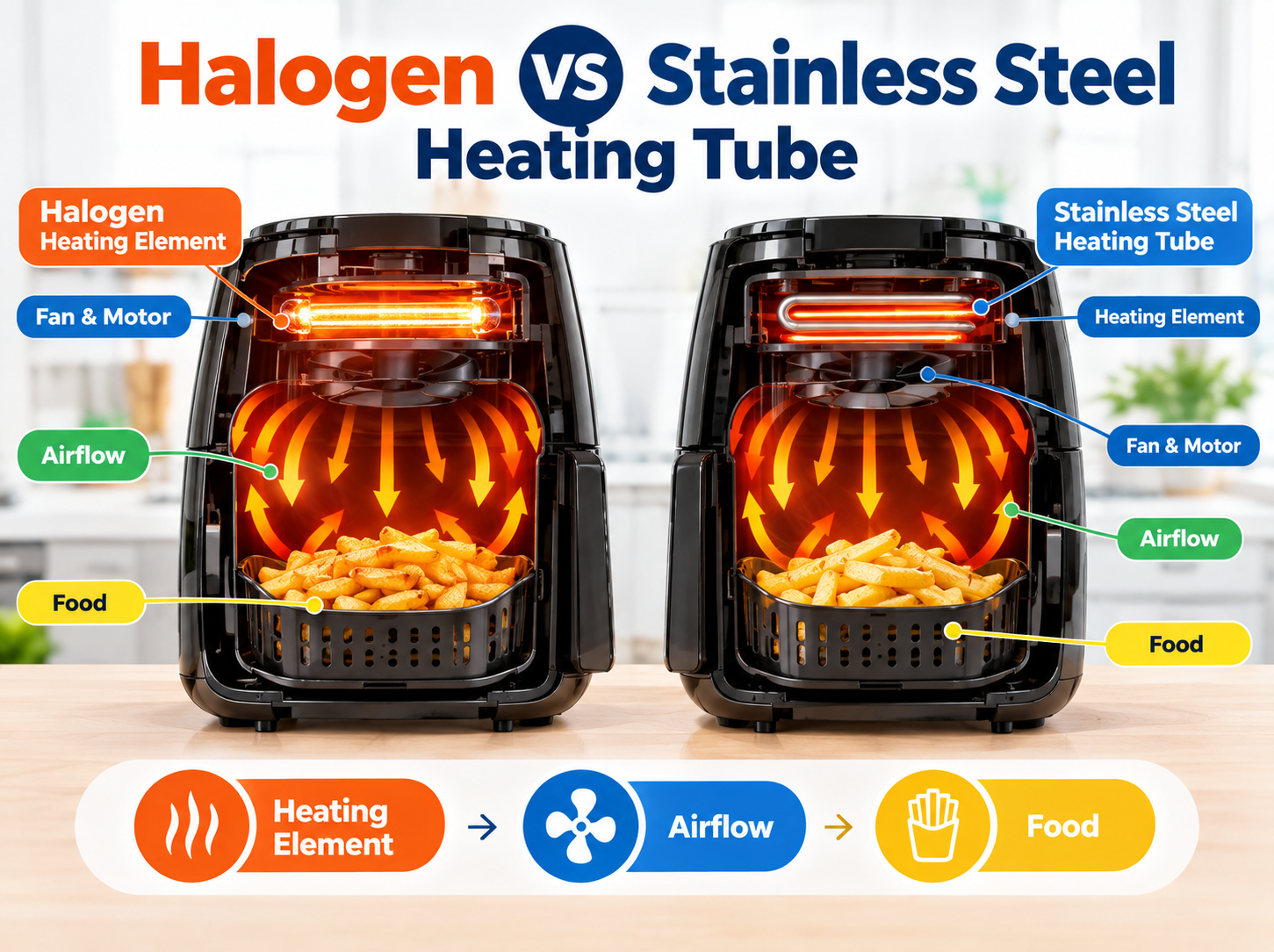
Air Fryer Heating Element: Halogen vs Stainless Steel Tube
 + 86 181 3826 8709
 info@funloiv.com
 6/F., Guanglong Building, Pingxin North Road, Longgang, Shenzhen City, Guangdong, China


@ 2009-2026 Shenzhen Funloiv Electric Appliance Co., LtdAll rights reserved


