 Notice:

 search
search
search
Oct 06, 2026


For an air fryer importer, brand owner, wholesaler or retailer, the agreed delivery date is more than a date on a purchase order.
A delayed air fryer shipment can affect:
l Warehouse planning
l Container booking
l Retail launches
l Amazon or e-commerce launches
l Promotional campaigns
l Seasonal sales
l Customer commitments
l Inventory levels
l Cash flow
So, what should you do if your air fryer supplier cannot meet the agreed delivery date?
The first step is not necessarily to cancel the order.
Instead, the buyer should:
Identify the cause → Confirm the actual delay → Assess the business impact → Request a recovery plan → Agree on a revised schedule → Control the shipment
The key is to turn a vague statement such as:
“We need a few more days.”
into a clear and measurable production plan.
1. What Can Cause an Air Fryer Supplier to Miss the Delivery Date?
Before deciding what to do, you need to understand why the order is delayed.
Not every delay has the same cause or commercial responsibility.
Common causes include:
Ø Component shortages
Air fryers contain multiple critical components, such as:
l Heating elements
l Motors
l Fans
l PCBs
l Temperature sensors
l Displays
l Power cords
l Baskets
l Metal parts
l Plastic components
A shortage of one critical component can stop the production line.
Ø Production capacity problems
A supplier may experience:
l Peak-season production
l Unexpected large orders
l Limited assembly capacity
l Labor shortages
l Production-line changes
l Factory maintenance
This is particularly relevant when ordering during busy periods.
Ø OEM/ODM development delays
New-product projects can have additional steps:
Design → Prototype → Sample → Testing → Modification → Certification → Final Approval → Mass Production
A delay in any of these stages can move the final delivery date.
For OEM/ODM buyers, our existing guide on choosing an air fryer supplier explains why buyers should evaluate the supplier's development process, sample capability and production capability rather than focusing only on price.
How to Choose an OEM/ODM Air Fryer Supplier in China?
Ø Quality problems during production
Sometimes production has already started, but QC discovers a problem.
For example:
l Temperature deviation
l Heating problem
l Motor noise
l Basket problem
l Electrical issue
l Appearance defect
l Material problem
The supplier may need to stop production and rework the affected units.
This can create a delay, but in some situations correcting a quality problem before shipment is preferable to shipping defective products on time.
Our existing QC guide explains why air fryer quality should be controlled throughout incoming inspection, production, functional testing, aging testing and pre-shipment inspection rather than relying only on the final inspection.
What Quality-Control Standards Should I Require from an Air Fryer Supplier?
2. First Check: When Does the Agreed Lead Time Actually Start?
This is one of the most important questions for an importer.
Suppose three suppliers tell you:
Supplier A: 45 days
Supplier B: 50 days
Supplier C: 55 days
At first glance, Supplier A appears to have the shortest lead time.
But what does “45 days” mean?
It could mean:
45 days after deposit
while another supplier may mean:
50 days after final sample approval
and another:
55 days after artwork and packaging confirmation.
These are not necessarily comparable.
Our RFQ should therefore clearly define the starting point of the production lead time. Our existing RFQ checklist recommends separating sample, tooling, certification and mass-production lead times and specifying the expected shipping and launch dates.
Air Fryer RFQ Checklist: 20 Specifications Buyers Should Include
Ask your supplier:
When does the mass-production lead time officially start?
Also confirm whether the lead time begins after:
l Deposit
l PO confirmation
l Specification confirmation
l Sample approval
l Artwork approval
l Certification
l Packaging approval
This can prevent many misunderstandings before production starts.
3. How Serious Is the Delivery Delay?
A five-day delay does not necessarily have the same business impact as a five-day delay before a major retail launch.
You should evaluate the delay based on your actual business schedule.
Low-impact delay
For example:
A regular replenishment order is delayed by three days.
You may simply adjust warehouse receiving or shipping arrangements.
Medium-impact delay
For example:
The order is delayed by 10 days and your inventory is running low.
You may need to adjust purchasing and logistics plans.
High-impact delay
For example:
l Christmas promotion
l Black Friday campaign
l New product launch
l Retail shelf launch
l Amazon launch
l Seasonal promotion
l Contracted delivery date with a customer
In these situations, even a relatively short delay can create a much larger commercial problem.
Therefore, the buyer should tell the supplier about important commercial deadlines before production starts.
4. What Should You Ask the Air Fryer Supplier When a Delay Occurs?
Don't simply ask:
“When can you ship?”
Ask a structured set of questions.
Question 1
What caused the delay?
Question 2
How many days will the order be delayed?
Question 3
How many units have already been completed?
Question 4
How many units are still in production?
Question 5
Which component or production process is causing the delay?
Question 6
What is the revised completion date?
Question 7
What actions are being taken to recover the schedule?
This turns the discussion from a general explanation into a measurable production situation.
5. Ask for a Real Recovery Plan
A professional supplier should be able to provide more than:
“We will try our best.”
Ask for a recovery plan.
For example:
Item | Information |
Original delivery date | June 10 |
Revised completion date | June 17 |
Expected delay | 7 days |
Reason | Component shortage |
Quantity ordered | 2,000 pcs |
Completed | 1,200 pcs |
Remaining | 800 pcs |
Corrective action | Additional production arrangement |
QC date | June 17 |
Revised shipping date | June 18 |
The exact details will vary by project, but the principle is simple:
A delivery problem should be managed with a schedule, not a promise.
6. What Can You Do If the Supplier Cannot Meet the Original Shipping Date?
Depending on the situation, several solutions may be available.
Option 1 — Wait for the Complete Order
This may be suitable when:
l The delay is short
l The product is not urgently needed
l There is no immediate promotion
l The additional logistics cost would be unnecessary
Option 2 — Arrange a Partial Shipment
Suppose you ordered:
2,000 units
and:
1,200 units are ready
You could discuss shipping the 1,200 completed units first and sending the remaining 800 units later.
This may help protect your immediate inventory needs.
However, consider the additional logistics cost before choosing this option.
Option 3 — Expedite a Critical Quantity
For example:
100 units by air freight
900 units by sea freight
This may make sense when a small quantity is urgently required for a launch or customer commitment.
But the additional freight cost should be calculated carefully.
Option 4 — Adjust the Shipping Schedule
If the delay is relatively short, you may be able to:
l Change the vessel
l Change the booking
l Adjust warehouse receiving
l Change the delivery appointment
Option 5 — Request an Accelerated Production Plan
The supplier may be able to:
l Add production workers
l Add production hours
l Adjust production scheduling
l Prioritize critical components
l Add production capacity
The feasibility depends on the specific factory and project.
7. Who Should Pay for Additional Costs Caused by the Delay?
This is a common concern for B2B buyers.
The answer depends on why the delay occurred and what the commercial agreement says.
Supplier-caused delay
Possible additional costs may include:
l Rebooking
l Storage
l Additional inspection
l Expedited production
l Additional transportation
l Other documented costs
The exact responsibility should be determined according to the contract, purchase order and agreed commercial terms.
Buyer-caused delay
For example:
l Late deposit
l Late artwork approval
l Late specification confirmation
l Late sample approval
l Late certification information
In these situations, the supplier may have reasonable grounds for revising the production schedule.
External events
Examples could include:
l Port disruption
l Natural disasters
l Government restrictions
l Other events covered by the contract
Again, the applicable commercial agreement should determine how such situations are handled.
Important principle
Do not assume:
“The supplier is late, so the supplier must pay everything.”
Instead, establish:
Cause → Responsibility → Contractual Terms → Actual Cost → Agreed Solution
8. Should You Accept a Partial Shipment?
A partial shipment can be useful, but it is not automatically the best solution.
Consider it when:
Partial shipment may help if:
l You urgently need some inventory
l Your customer has a fixed launch date
l A promotion is already scheduled
l Most of the order is ready
l The additional logistics cost is acceptable
It may not make sense if:
l The remaining quantity is very small
l Additional freight is too expensive
l Your warehouse cannot efficiently receive multiple shipments
l The products need to arrive together for a retail launch
Before agreeing, calculate:
Additional logistics cost vs. commercial cost of waiting
This is a business decision rather than simply a production decision.
9. Do Not Solve a Delivery Problem by Sacrificing Product Quality
This is particularly important for air fryers.
When a supplier is already behind schedule, the buyer may be tempted to say:
“Just ship it as soon as possible.”
But the supplier should not solve a schedule problem by skipping important QC.
For example, don't remove necessary:
l Functional testing
l Electrical testing
l Aging testing
l Final inspection
l Packaging checks
simply to save a few days.
Our existing quality-control article explains that air fryer quality should be controlled through multiple stages, including incoming materials, assembly, functional testing, aging testing, final inspection and pre-shipment inspection.
What Are the Most Common Quality Problems with Air Fryers?
A useful principle is:
Recover the schedule without compromising the agreed quality standard.
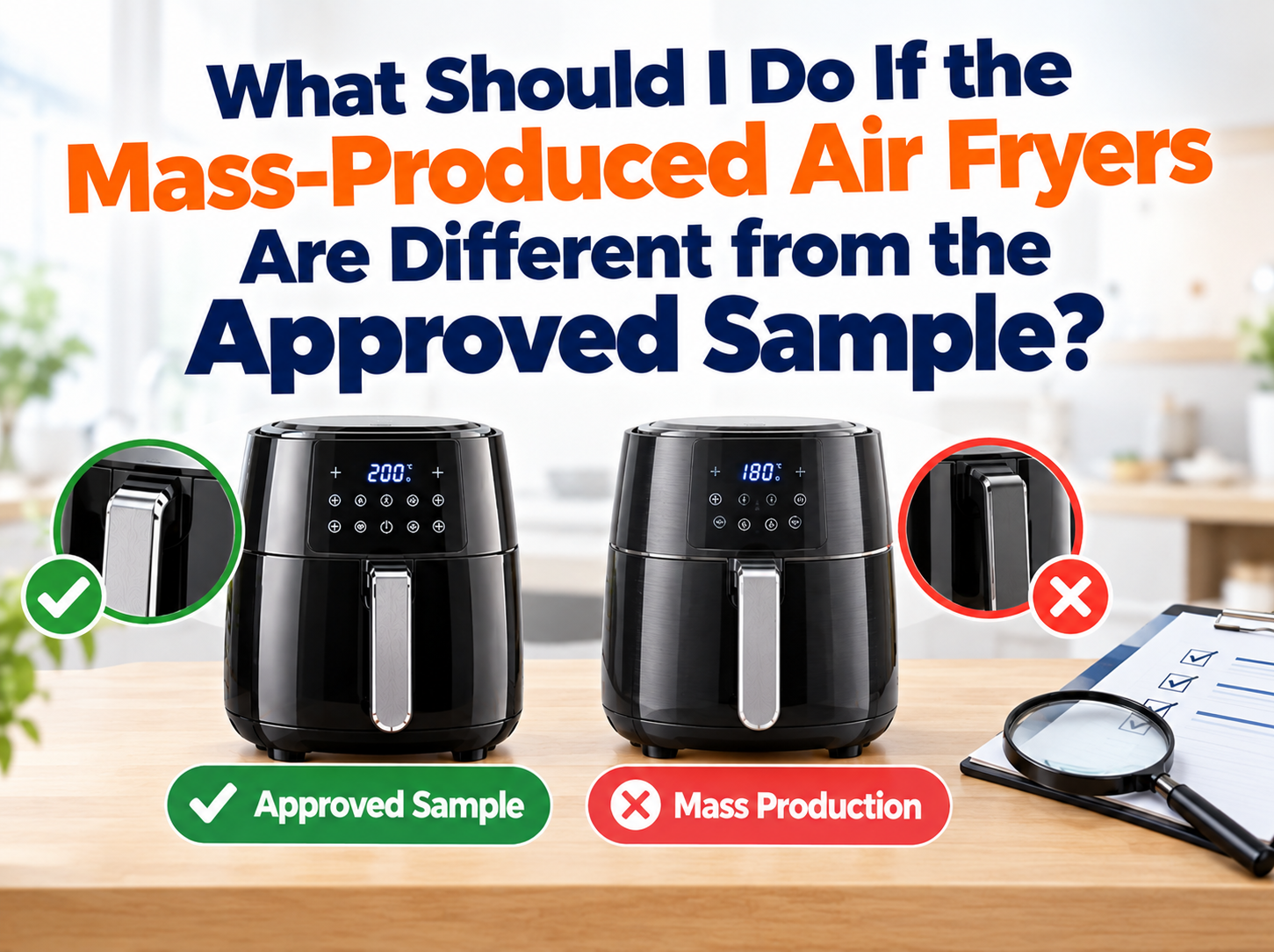
10. Make Sure the Production Air Fryers Still Match the Approved Sample
A delivery delay can sometimes create another risk.
When production is rushed, buyers should make sure that the finished products still match the approved version.
Check:
l Product model
l Capacity
l Rated power
l Voltage
l Heating system
l Motor
l Fan
l Body material
l Basket
l Control panel
l Accessories
l Packaging
l Labels
l Product appearance
This is especially important for customized OEM/ODM products.
Our existing sample-testing guide explains that an approved sample should become the reference for mass production and that critical components and product specifications should be controlled.
How Can I Test an Air Fryer Sample Before Placing a Bulk Order?
11. Use Pre-Shipment Inspection Before Releasing the Delayed Order
If the production schedule has changed significantly, pre-shipment inspection becomes even more useful.
The purpose is to confirm:
The products being shipped are still the products you approved.
The inspection can cover:
Product appearance
l Housing
l Color
l Logo
l Surface finish
Function
l Heating
l Temperature
l Timer
l Controls
l Fan
l Motor
Construction
l Basket
l Handle
l Drawer
l Accessories
Electrical
l Voltage
l Power
l Plug
l Power cord
Packaging
l Retail box
l Manual
l Barcode
l Labels
l Carton
For higher-risk orders, an independent inspection can also be considered.
Our website already has a dedicated article on air fryer pre-shipment inspection, which is a natural internal link from this article. The inspection concept is also consistent with your existing QC guidance.
What Quality-Control Standards Should I Require from an Air Fryer Supplier?
12. What If the Supplier Keeps Changing the Delivery Date?
This is more concerning than a single delay.
For example:
Original date: June 10
Revised date: June 15
Revised again: June 20
Revised again: June 25
At this point, the buyer should stop asking only:
“When will it ship?”
and start asking:
“What is preventing the supplier from giving me a reliable completion date?”
Repeated changes may indicate problems with:
l Production planning
l Component supply
l Factory capacity
l Project management
l Communication
l Quality control
l Supplier reliability
This is one reason your existing supplier-verification content should be linked here: delivery capability should be evaluated before a large order is placed, not only after a problem occurs.
13. How Can Buyers Reduce Air Fryer Delivery Risk Before Placing an Order?
The best way to deal with a delivery problem is to prevent it.
Before placing the PO, clearly define:
Product
l Capacity
l Basket configuration
l Power
l Voltage
l Heating system
l Materials
l Controls
l Accessories
Commercial
l Order quantity
l MOQ
l Price
l Incoterm
l Payment terms
Project
l Sample date
l Sample approval date
l Tooling date
l Certification date
l Production start date
l Production completion date
l Inspection date
l Shipping date
l Launch date
Our existing Air Fryer RFQ Checklist covers these areas and specifically recommends providing the target market, expected quantity and required delivery schedule when requesting quotations.
14. Compare Lead Time When Comparing Air Fryer Suppliers
When comparing suppliers, don't look at:
Supplier A — 45 days
Supplier B — 50 days
Supplier C — 60 days
and automatically choose the shortest lead time.
Instead, ask:
l When does lead time start?
l Is sample approval included?
l Is packaging approval included?
l Is certification included?
l Is tooling included?
l Is material preparation included?
l Is QC included?
l Is pre-shipment inspection included?
Our existing quotation-comparison guide already recommends comparing specification, material, quality, certification, MOQ, lead time, warranty, commercial terms and total sourcing cost, rather than comparing FOB price alone.
How to Compare Quotations from Different Air Fryer Suppliers?
The same principle applies to delivery.
A short quoted lead time is only useful if it represents the complete production process.
15. Five Red Flags That May Indicate Delivery Risk
Before choosing an air fryer supplier, watch for these warning signs.
Red Flag 1 — The supplier cannot explain when lead time starts
If the supplier simply says:
“Lead time: 45 days”
ask:
45 days from what point?
Red Flag 2 — The supplier promises an unusually short lead time without reviewing your specification
A serious OEM/ODM project normally requires consideration of:
l Product configuration
l Materials
l Packaging
l Certification
l Quantity
l Customization
Red Flag 3 — The supplier cannot provide a production schedule
A supplier does not necessarily need to provide every internal factory detail, but it should be able to explain the major production milestones.
Red Flag 4 — The delivery date keeps changing
One unexpected delay can happen.
Repeated unexplained changes deserve closer attention.
Red Flag 5 — The supplier gives explanations but no recovery plan
A reason is useful.
A reason + action + revised date is much more useful.
16. How to Build a More Reliable Air Fryer Delivery Process
For an OEM/ODM project, a practical process can look like this:
Step 1 — Define the RFQ
Product + Quantity + Market + Target Date
↓
Step 2 — Supplier Quotation
Price + MOQ + Lead Time + Payment Terms
↓
Step 3 — Sample Development
Engineering Sample
↓
Step 4 — Sample Testing
Performance + Quality + Safety
↓
Step 5 — Final Approval
Approved Sample / Golden Sample
↓
Step 6 — Production Planning
Components + Packaging + Production Schedule
↓
Step 7 — Mass Production
Production QC + Functional Testing
↓
Step 8 — Pre-Shipment Inspection
Final Product + Quantity + Packaging
↓
Step 9 — Shipment
Confirmed Shipping Schedule
This is also why our existing sample-testing content is relevant: the purpose of sample testing is not only to verify that an air fryer works, but also to determine whether the supplier can reproduce the approved quality consistently in mass production.
How Can I Test an Air Fryer Sample Before Placing a Bulk Order?
17. What Should Be Included in the Purchase Order?
For an important air fryer project, the PO should ideally make the delivery requirement clear.
Where appropriate, include:
l Product model
l Product specification
l Quantity
l Approved sample reference
l Packaging
l Certification
l Inspection requirements
l Payment terms
l Agreed production lead time
l Expected shipment date
l Engineering-change procedure
For example:
Mass production lead time: 60 days after deposit and final approval of all production-related materials.
This is much clearer than:
Delivery: ASAP
18. What If the Delay Causes You to Miss a Retail Promotion?
This can be a serious commercial problem.
For example:
You planned a new air fryer launch for November.
The supplier originally confirmed:
October 15 shipment.
But the shipment moves to:
November 5.
Now the problem may affect:
l Retail promotion
l Product launch
l Marketing campaign
l Warehouse stock
l Customer commitments
l Seasonal sales
In this situation, communicate the commercial deadline to the supplier as early as possible.
Instead of saying:
“Please ship quickly.”
say:
“Our retail launch is scheduled for November 15. We need the goods ready for shipment by October 15 to meet the launch schedule. Please confirm the production plan and any potential risks before we finalize the order.”
This gives the supplier something measurable to manage.
19. What Should a Reliable Air Fryer Supplier Be Able to Explain?
Before placing a significant order, ask the supplier:
Production
What is the normal mass-production lead time for this model?
Lead Time
When does the lead time start?
Components
Which components have the longest procurement lead time?
Capacity
What is the normal monthly production capacity for this model?
Quality
How do you control quality during production?
Delay Management
What happens if a critical component becomes unavailable?
Recovery
How do you handle an unexpected production delay?
Inspection
Can pre-shipment inspection be arranged before shipment?
Communication
How often will you provide production updates?
These questions can reveal much more about a supplier than asking:
“Can you deliver on time?”
Air Fryer Delivery Delay Checklist for Buyers
If your supplier tells you that the order will be delayed, use this checklist:
Step 1
Confirm the original agreed delivery date
Step 2
Confirm when the lead-time clock started
Step 3
Identify the reason for the delay
Step 4
Confirm completed quantity
Step 5
Confirm remaining quantity
Step 6
Ask for the revised completion date
Step 7
Ask for a recovery plan
Step 8
Evaluate partial shipment
Step 9
Calculate additional logistics costs
Step 10
Confirm QC will not be skipped
Step 11
Arrange pre-shipment inspection
Step 12
Confirm final shipping date in writing
FAQ: Air Fryer Supplier Delivery Delays
Ø What should I do if my air fryer supplier is late?
First confirm the cause and actual delay. Then request a revised production schedule and recovery plan, assess the commercial impact, and agree on the next steps before shipment.
Ø What is a normal lead time for air fryers from China?
There is no single lead time that applies to every air fryer. Lead time depends on the product, order quantity, customization, component availability, packaging, certification and supplier production schedule.
For this reason, buyers should ask suppliers to state exactly when the quoted lead time starts and what it includes.
Ø Can an air fryer supplier make a partial shipment?
A partial shipment may be possible depending on production status, order terms, logistics cost and supplier capability. Buyers should compare the additional shipping cost against the commercial impact of waiting for the complete order.
Ø Should I cancel the order if the supplier is late?
Not necessarily. A short, clearly explained delay with a credible recovery plan may be manageable. The buyer should consider the cause, length of delay, business impact, supplier communication and contractual terms before deciding how to proceed.
Ø Who is responsible for an air fryer delivery delay?
Responsibility depends on the cause of the delay and the agreed purchase terms. Buyer-caused delays, supplier-caused delays and external events may be treated differently under the applicable commercial agreement.
Ø Can I ask the supplier to pay for expedited shipping?
You can discuss it with the supplier, particularly where additional costs result from a supplier-caused delay. Whether the supplier is contractually responsible depends on the purchase agreement and circumstances.
Ø How can I reduce air fryer delivery risk?
Define the complete product specification, target delivery date, lead-time starting point, sample approval process, production milestones, inspection requirements and communication process before placing the order.
Related Articles
l Air Fryer Heating Element: Halogen vs. Stainless Steel Heating Tube.
l Why Does Airflow Matter in an Air Fryer?
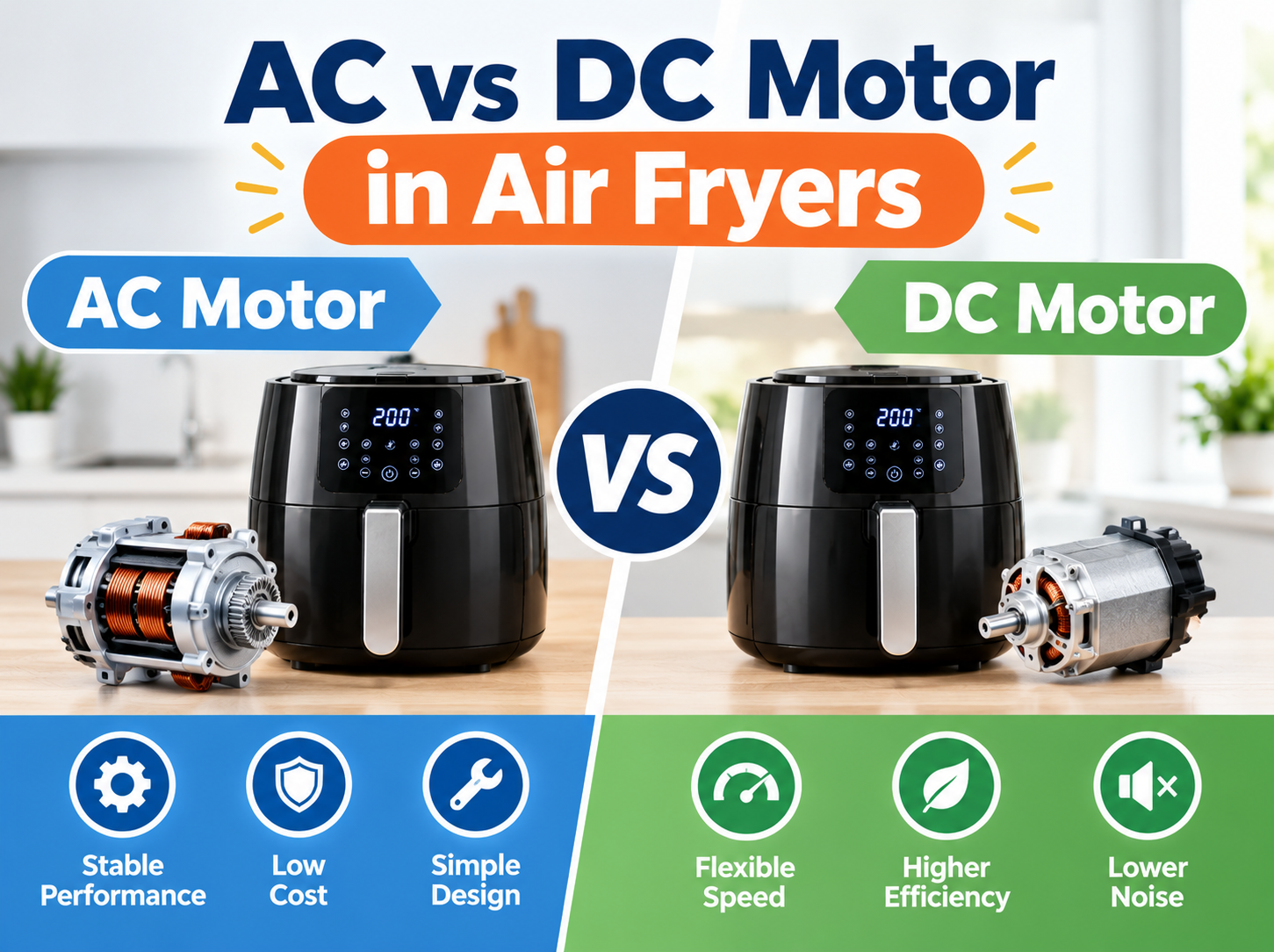
l What Is the Difference Between AC and BLDC Motors in Air Fryers?
l What Makes an Air Fryer Cook More Evenly?
l How Can I Test an Air Fryer Sample Before Placing a Bulk Order?
l What Quality-Control Standards Should I Require from an Air Fryer Supplier?
l What Air Fryer Tests Should Be Included in a Pre-Shipment Inspection?
l What Factors Affect the FOB Price of an Air Fryer?
l How to Compare Quotations from Different Air Fryer Suppliers?
l 230°C Air Fryer: What Buyers Should Check Before Importing?
l A Dual Heating vs Single Heating Air Fryer- Which Is Better?
l What Is the Difference Between AC and DC Motors in Air Fryers?
l Air Fryer for the Middle East - A Guide to G-Mark, Specifications and Compliance?
l What Are the Most Common Quality Problems with Air Fryers?
l Air Fryer RFQ Checklist: 20 Specifications Buyers Should Include.
l How To Verify Whether an Air Fryer Supplier Is Reliable?
l How to Choose an OEM-ODM Air Fryer Supplier in China?
l 200°C vs 230°C Air Fryer: Which one is better?
l Metal-body vs plastic-body air fryer: which is better for a premium brand?
l Top Heating vs. Rear Heating Air Fryers: Which one is better for a B2B buyer?
l Is a Vertical Dual-Drawer Air Fryer Better for Saving Kitchen Space?
l Air Fryer Certifications & Compliance by Market- A Safety Guide for Importers.
l Vertical vs. Horizontal Dual-Basket Air Fryer- Which Is Better for Retail?
l What Air Fryer Capacity Is Best for the European Market?
l What Are the Common Warranty and After-Sales Problems with Air Fryers?
l What MOQ, Lead Time and Payment Terms Should I Expect from an Air Fryer Supplier?
l How Can I Prevent Plastic Melting or Deformation in an Air Fryer?
l What Air Fryer Safety Tests Should Be Completed Before Mass Production?
l What Is the Difference Between a Single-Basket and Dual-Basket Air Fryer?
l How Do Different Air Fryer Designs Affect Cooking Performance and Cleaning?
l How Much Does an OEM Air Fryer Cost from China?
l What Are the Most Important Features to Consider When Sourcing an Air Fryer?
l What MOQ Do Chinese Air Fryer Suppliers Usually Require?
l How Can I Import Air Fryers from China?
l Can an Air Fryer Supplier in China Help Design New Products?
l How Can Air Fryer Suppliers in China Support Small Businesses?
Final Takeaway
If an air fryer supplier cannot meet the agreed delivery date, the buyer should not focus only on the number of delayed days.
The more important questions are:
l Why is the order delayed?
l When can the supplier realistically complete production?
l What is the recovery plan?
l How will the delay affect my business?
l Can part of the order be shipped earlier?
l Will product quality and inspection requirements remain unchanged?
l How can I prevent the same problem on my next order?
A reliable sourcing process should connect:
Clear RFQ
l Realistic Lead Time
l Approved Sample
l Production Planning
l Production QC
l Pre-Shipment Inspection
l Confirmed Shipment
The objective is not simply to find an air fryer supplier who promises a short lead time.
It is to work with a supplier who can plan realistically, communicate clearly, control production and respond professionally when unexpected problems occur.
Need an Air Fryer Supplier With a Clear Production and Delivery Process?
If you are an air fryer importer, private-label brand, wholesaler, retailer or supermarket, send us your:
l Target capacity
l Product reference
l Target market
l Estimated order quantity
l Required functions
l Packaging requirements
l Target delivery date
We can discuss the project from sample development and product testing to mass production, QC, inspection and shipment.
Looking for an air fryer OEM/ODM supplier for your next project?
Send us your requirements and target delivery schedule to discuss your project

What Should I Do If the Mass-Produced Air Fryers Are Different from the Approved Sample?

200°C vs 230°C Air Fryer: Which one is better?

Wilko collapse - What Went Wrong With The High Street Retailer?

Can Air Fryer Suppliers Produce Air Fryers for My Country's Voltage?
What Is the Difference Between AC and DC Motors in Air Fryers?

What Air Fryer Capacity Is Best for the European Market? A Buyer’s Guide
 + 86 181 3826 8709
 info@funloiv.com
 6/F., Guanglong Building, Pingxin North Road, Longgang, Shenzhen City, Guangdong, China


@ 2009-2026 Shenzhen Funloiv Electric Appliance Co., LtdAll rights reserved


