 Notice:

 search
search
search
Oct 10, 2026


If you search for air fryer suppliers on Alibaba, you can quickly find a large number of companies offering similar-looking products.
The problem is not finding suppliers.
The real problem is deciding:
Which suppliers are actually worth contacting?
If you contact every company you find, you may end up with dozens of catalogs, quotations, product specifications and follow-up messages. More communication does not necessarily lead to a better sourcing decision.
For importers, brand owners, wholesalers, supermarkets and private-label businesses, a better approach is to shortlist suppliers before starting detailed communication.
The objective is not to find the largest number of suppliers.
The objective is to identify a small number of suppliers that are potentially capable of providing the right product, quality, compliance, price and production support for your market.
This guide explains how to shortlist air fryer suppliers on Alibaba without contacting too many companies.
1. Start With Your Air Fryer Requirements — Not the Supplier
Before evaluating suppliers, define what you are actually looking for.
This sounds simple, but it is one of the most important steps in the sourcing process.
For example, saying:
“I need an 8L air fryer.”
is not enough information for a serious B2B sourcing project.
An 8L air fryer could be:
l Plastic or metal
l Single-basket or dual-basket
l Single heating or dual heating
l Mechanical or digital
l 200°C or 230°C
l Standard or private label
l Existing model or new ODM development
Before searching Alibaba, try to define the main requirements, including:
l Capacity
l Basket or drawer configuration
l Rated power
l Voltage and frequency
l Temperature range
l Timer
l Heating system
l Motor and fan requirements
l Body material
l Basket and cooking chamber material
l Control type
l Display
l Preset programs
l Packaging
l Certification
l Target market
l Estimated order quantity
l OEM/ODM requirements
For a detailed checklist, see:
Air Fryer RFQ Checklist: 20 Specifications Buyers Should Include
The more clearly you define your product requirements, the easier it becomes to eliminate suppliers that are simply not suitable.
2. Shortlist Products Before You Shortlist Companies
When searching Alibaba, it is easy to focus on the supplier name or company profile.
However, your first question should be:
Does this supplier actually offer the type of air fryer I need?
Start by evaluating the products shown on the supplier's page.
For example, if you are looking for an 11L vertical dual-drawer air fryer, a supplier whose main range consists of 3L–5L plastic mechanical models may not be a strong candidate, even if the supplier has a professional-looking Alibaba profile.
Look at:
Product architecture
l Single basket
l Dual basket
l Dual independent drawers
l Vertical stacked
l Horizontal dual basket
l Multi-layer
l Air fryer oven
Product positioning
l Entry-level
l Mainstream
l Premium
l Metal-body
l Stainless-steel
l Private-label
l Smart / connected
Product specifications
l Capacity
l Temperature
l Heating system
l Power
l Control system
l Basket design
l Materials
The goal at this stage is not to decide which product you will purchase.
The goal is to determine whether the supplier's product range is relevant enough to deserve further evaluation.
3. Check Whether the Supplier Has Real Air Fryer Experience
A company selling air fryers is not necessarily an experienced air fryer supplier.
For B2B buyers, there is an important difference between:
“We can supply air fryers.”
and:
“We understand how air fryers are designed, tested and produced.”
Air fryers involve more than capacity and wattage.
A capable supplier should understand areas such as:
l Heating elements
l Airflow
l Fan design
l Motor selection
l Temperature control
l Thermal protection
l Basket structure
l Cooking chamber
l Materials
l Electrical safety
l Control systems
l Product testing
l Mass-production consistency
This becomes particularly important when you are developing a private-label or OEM/ODM product.
For more detailed supplier-evaluation criteria, see:
How to Choose an OEM/ODM Air Fryer Supplier in China: 10 Things Brands Should Check
A useful rule is:
A good air fryer supplier should be able to discuss the product, not just the price.
4. Use the Alibaba Product Page as Your First Screening Tool
You do not need to contact every company to determine whether it deserves a place on your shortlist.
The product page itself can provide useful initial information.
Look for:
Complete specifications
Does the supplier clearly provide:
l Capacity?
l Power?
l Temperature range?
l Timer?
l Product dimensions?
l Materials?
l Control type?
l Heating configuration?
If the product information is extremely limited, you may need additional communication before deciding whether the supplier is suitable.
Relevant product range
Does the supplier offer multiple air fryer configurations?
For example:
l 6L
l 8L
l 10L
l 11L
l Dual basket
l Metal body
l Digital models
l Different heating systems
A broader relevant range can indicate that the supplier has experience across different product requirements.
However, a large product catalog alone does not prove manufacturing capability.
You still need to verify the supplier later.
OEM/ODM information
Look for evidence that the supplier can support:
l Logo customization
l Product color
l Packaging
l Product modifications
l New tooling
l Product development
This is especially important if you are building your own brand rather than purchasing an existing model.
5. Don't Judge a Supplier by How Fast It Replies
Response speed is useful, but it should not be the main selection criterion.
A supplier that replies within five minutes with:
“Best price USD 28. Please check catalog.”
has not necessarily demonstrated strong sourcing capability.
For a serious B2B project, pay attention to the quality of the supplier's questions.
A capable supplier may ask:
l What is your target market?
l What voltage and frequency do you require?
l What is your estimated order quantity?
l Are you looking for an existing model or an OEM/ODM project?
l Do you have a reference product?
l What certification is required?
l What is your target retail positioning?
These questions show that the supplier is trying to understand the project before recommending a product.
This is particularly important for OEM and ODM development.
A useful principle is:
The quality of a supplier's questions can be more informative than the speed of its first reply.
6. Ask a Few Technical Questions Before Requesting a Detailed Quotation
You do not need to conduct a full engineering audit at the initial screening stage.
Instead, ask a few technical questions that can reveal whether the supplier understands the product.
For example:
Heating system
What heating configuration does this model use?
Temperature
How is the actual operating temperature verified?
Airflow
What type of motor and fan system does the model use?
Materials
What materials are used for the main body and cooking chamber?
Safety
What thermal protection and safety testing are used?
You are not necessarily looking for one specific answer.
Different product designs can use different technical solutions.
The objective is to see whether the supplier can clearly explain why the product uses a particular configuration and how the design is tested.
This is a much stronger screening method than simply asking:
“Is the quality good?”
7. Check Whether the Supplier Understands Your Target Market
An air fryer suitable for one market may not be suitable for another.
Before adding a supplier to your serious shortlist, check whether the supplier understands the market where you intend to sell.
Consider:
l Voltage
l Frequency
l Plug
l Safety requirements
l Certification
l Food-contact requirements
l Labeling
l Packaging
l User manual
l Energy requirements
l Retail requirements
For example, a buyer sourcing for Germany may have different compliance and documentation requirements from a buyer sourcing for the USA, Australia or the GCC region.
A supplier should therefore understand that:
“CE available” is not the same as proving that the exact product configuration is suitable for the target market.
For more information:
Air Fryer Certifications & Compliance by Market: A Safety Guide for Importers
The supplier's ability to discuss market requirements should be part of your shortlist decision.
8. Check Certification — But Don't Stop at the Certificate Logo
Certification is another area where buyers should avoid making decisions based only on a logo.
When a supplier says:
“CE available.”
you should ask:
l Which model?
l Which configuration?
l Which manufacturer?
l Which factory?
l Which test report?
l Which applicable standard?
l Does the documentation match the product being quoted?
The same principle applies to other market requirements.
A supplier may have certification documents for one model that do not automatically prove compliance for another model.
Therefore:
Verify the relationship between the certificate, test report, product model, factory and actual configuration.
This is particularly important when your project involves product modifications or new development.
9. Evaluate the Supplier's Quality-Control System Before Requesting Samples
A sample is important, but the supplier's quality-control system is equally important.
Why?
Because your business is not going to purchase one sample.
You may eventually purchase:
l 1,000 units
l 3,000 units
l 5,000 units
l 10,000 units
l Or more
The supplier therefore needs to demonstrate that the approved sample can be reproduced consistently.
Ask how the supplier controls:
Incoming materials
Are critical components inspected before production?
Production
Are key processes inspected during manufacturing?
Assembly
Are electrical and mechanical functions checked?
Finished products
Are finished units tested before packing?
Aging
Is product aging testing performed?
Pre-shipment inspection
Are finished products inspected against the approved specifications?
For a more detailed explanation:
What Quality-Control Standards Should I Require from an Air Fryer Supplier?
A supplier that cannot clearly explain its QC process deserves additional scrutiny before you place a bulk order.
10. Don't Use FOB Price as Your First Screening Criterion
Price is important.
But price should usually come after product fit and supplier capability, not before them.
Imagine that you receive:
Supplier | FOB Price |
A | US$29 |
B | US$31 |
C | US$34 |
D | US$38 |
It is tempting to keep Supplier A.
But what if:
l Supplier A uses a different heating system?
l Supplier A uses plastic instead of metal?
l Supplier A has a lower temperature specification?
l Supplier A has a higher MOQ?
l Supplier A does not include your required packaging?
l Supplier A cannot provide the required documentation?
l Supplier A has a longer lead time?
The price comparison is meaningless if the products are not equivalent.
A professional comparison should consider:
Product Specification
Materials
Heating System
Quality
Certification
MOQ
Packaging
Lead Time
Warranty
Commercial Terms
Total Sourcing Cost
For a deeper comparison framework:
How to Compare Quotations from Different Air Fryer Suppliers?
11. Use a Simple Supplier Shortlist Scorecard
If you want to reduce the number of suppliers efficiently, create a simple scoring system.
For example:
Evaluation Area | Suggested Weight |
Product Fit | 20% |
Air Fryer Experience | 15% |
Technical Capability | 15% |
Quality Control | 15% |
Certification / Compliance | 10% |
OEM/ODM Capability | 10% |
Commercial Terms | 10% |
Communication | 5% |
Total | 100% |
You can then score each supplier from 1 to 5.
For example:
Supplier A
Strong product fit, good technical communication and strong QC.
High score.
Supplier B
Very low price but limited technical information.
Medium score.
Supplier C
Good product range but weak market-compliance knowledge.
Medium score.
Supplier D
Strong OEM/ODM capability and excellent communication but higher price.
Potentially high score.
This prevents one attractive factor—usually price—from dominating the entire supplier-selection process.
12. A Practical Shortlisting Funnel
For many B2B air fryer sourcing projects, you can use a simple funnel:
Step 1 — Alibaba Search
Identify approximately 20–30 potentially relevant suppliers.
You do not need to contact all of them.
First screen their:
l Product range
l Product specifications
l Market relevance
l OEM/ODM information
l Supplier profile
↓
Step 2 — Initial Screening
Reduce the list to approximately 8–12 suppliers.
↓
Step 3 — Capability Evaluation
Evaluate:
l Product fit
l Technical capability
l Certification
l QC
l OEM/ODM
l Communication
↓
Step 4 — RFQ
Send the same product requirements to approximately 5–8 qualified suppliers.
↓
Step 5 — Sample
Select approximately 2–4 suppliers for sample evaluation, depending on the project.
↓
Step 6 — Final Selection
Choose:
1 primary supplier + 1 qualified backup supplier
The exact numbers are not an industry standard.
A simple ready-to-ship project may require fewer suppliers, while a new ODM project may require a broader initial search.
The important principle is:
Screen first. Contact second.
13. Make Sure You Are Comparing the Same Product
One of the biggest problems in supplier shortlisting is comparing products that only appear similar.
For example:
Specification | Supplier A | Supplier B |
Capacity | 8L | 8L |
Body | Plastic | Metal |
Heating | Single | Dual |
Max Temp. | 200°C | 230°C |
Control | Touch | Touch |
Basket | Non-stick | Non-stick |
Power | 1700W | 2000W |
Both suppliers may advertise an:
“8L Digital Air Fryer.”
But they are not necessarily offering the same product.
Therefore, before comparing prices, create a standardized specification sheet.
This is one reason a detailed RFQ is so useful.
Again, see:
Air Fryer RFQ Checklist: 20 Specifications Buyers Should Include
14. Shortlist Suppliers That Can Support Your Future Product, Not Just Today's Model
If you are a brand owner or importer planning a long-term product range, think beyond the first SKU.
You may initially need:
8L air fryer
But later you may want:
l 6L
l 8L
l 10L
l 11L
l Dual basket
l Vertical dual-drawer
l Metal-body models
l Air fryer ovens
l New colors
l New control panels
A supplier with relevant product-development capability may therefore be more valuable than a supplier that can only provide one low-cost model.
This does not mean you should choose the supplier with the largest catalog.
Instead, ask:
Can this supplier develop and scale products with me as my business grows?
That is a much more useful long-term question.
15. Don't Choose a Supplier Based Only on One Good Sample
A good sample is necessary.
But it is not sufficient.
The final question is:
Can the supplier reproduce the approved sample consistently during mass production?
This is particularly important for:
l Heating performance
l Temperature accuracy
l Motor and fan performance
l Control systems
l Basket quality
l Materials
l Appearance
l Electrical safety
l Packaging
For a serious project, sample evaluation may involve several stages:
Engineering Sample
↓
Revised Sample
↓
Pre-Production / Golden Sample
↓
Mass Production
For a practical testing framework, see:
How Can I Test an Air Fryer Sample Before Placing a Bulk Order?
The objective is not simply to find the supplier with the best-looking sample.
It is to find the supplier that can reliably reproduce the approved product at your required volume.
16. What Should Make You Remove a Supplier From Your Shortlist?
A good shortlist process is also about knowing when to say no.
Consider removing a supplier if:
The product does not really match your requirements
For example, the supplier has no suitable capacity, basket configuration or product architecture.
The supplier cannot explain important specifications
Especially heating, airflow, materials or safety-related questions.
Certification information is unclear
The supplier cannot clearly explain whether the documentation applies to the quoted model.
The quotation is impossible to compare
The supplier does not clearly specify what is included in the price.
The MOQ is unsuitable
The required order quantity is far beyond your business plan.
Communication remains poor
Repeatedly incomplete or unclear answers create unnecessary risk.
The supplier refuses reasonable sample or quality discussions
A supplier that does not want to discuss product quality before a bulk order should be treated carefully.
The sample cannot meet your requirements
There is no reason to continue simply because the supplier offers a low price.
17. What Should a Strong Air Fryer Supplier Be Able to Discuss With You?
By the time a supplier reaches your serious shortlist, you should be able to have a meaningful discussion about:
Product
What configuration is appropriate?
Performance
What heating and airflow system is being used?
Materials
Why were the selected materials used?
Market
What requirements apply to your target country?
Compliance
What documentation is available?
Customization
What can be changed?
Sample
How will the sample be developed and tested?
Quality
How will the approved sample be controlled during production?
Commercial
What are the MOQ, price and lead time?
Mass production
Can the supplier meet your expected order volume?
This is a much stronger supplier-evaluation method than simply asking:
“What is your best price?”
18. Alibaba Can Help You Find Suppliers — But It Should Not Make the Final Decision for You
Alibaba can be useful for supplier discovery, product comparison and initial communication.
Its Trade Assurance program also provides an additional transaction-protection mechanism for eligible online orders, with product quality and ship-date terms defined in the Alibaba.com order. Buyers should still carefully define the agreed product requirements and shipping terms.
However, an Alibaba supplier badge, product listing or attractive price should not replace your own supplier evaluation.
The most important question remains:
Can this supplier produce the exact air fryer I need, at the required quality, quantity, compliance level and cost?
That answer usually requires more than a product page.
19. A Practical Supplier Shortlist Checklist
Before moving a supplier into your serious RFQ list, ask:
Product Fit
l Does the supplier offer the right air fryer architecture?
l Is the capacity suitable?
l Are the required functions available?
l Does the product match my market positioning?
Technical Capability
l Can the supplier explain heating?
l Can the supplier explain airflow?
l Can the supplier discuss motor and fan selection?
l Can the supplier explain temperature control and safety?
OEM/ODM
l Can the supplier customize the product?
l Can the supplier support packaging?
l Can the supplier support new product development?
l Can the supplier handle tooling if required?
Compliance
l Does the supplier understand my target market?
l Can it provide relevant documentation?
l Does the documentation correspond to the actual product?
Quality
l Is there an incoming QC process?
l Is there production QC?
l Is functional testing performed?
l Is aging testing performed?
l Is pre-shipment inspection available?
Commercial
l Is the MOQ suitable?
l Is the quotation comparable?
l Is the lead time realistic?
l Are payment and shipping terms acceptable?
l Is after-sales support available?
Communication
l Does the supplier understand my questions?
l Does it ask useful questions?
l Does it provide complete information?
l Does it communicate clearly and consistently?
If a supplier passes most of these checks, it deserves a place on your shortlist.
20. The Goal Is Not to Contact More Suppliers. It Is to Contact Better Suppliers.
When sourcing air fryers on Alibaba, it is easy to believe that contacting more suppliers will automatically produce a better result.
In practice, the opposite can happen.
Contacting too many suppliers can create:
l Too many quotations
l Inconsistent specifications
l Difficult comparisons
l Repeated communication
l More sample costs
l Longer decision-making
l More opportunities to choose based on price alone
A better process is:
Define Your Product Requirements
↓
Search Alibaba
↓
Screen Product Fit
↓
Evaluate Supplier Experience
↓
Check Technical Capability
↓
Check Market & Compliance Capability
↓
Evaluate QC
↓
Score Suppliers
↓
Send RFQ to the Best Candidates
↓
Test Samples
↓
Select the Supplier That Can Support Mass Production
This approach allows you to reduce the number of companies you need to communicate with while improving the quality of your final supplier selection.
How FUNLOIV Approaches Air Fryer Supplier Cooperation
From a supplier's perspective, we believe a serious air fryer project should start with the product and market requirements, not simply with a request for the lowest price.
When an importer, brand owner, wholesaler or retailer approaches an air fryer supplier, the most useful information usually includes:
l Product reference or concept
l Target capacity
l Product configuration
l Target market
l Required functions
l Certification requirements
l Estimated order quantity
l Branding requirements
l Packaging requirements
l Target launch schedule
This allows the supplier to recommend a more appropriate product and provide a quotation based on clearly defined requirements.
FUNLOIV's website currently presents air fryer products alongside OEM/ODM-oriented sourcing support, and its published resources cover supplier selection, RFQ preparation, quotation comparison, sample testing, certification and quality control.
Our goal is not simply to provide an air fryer quotation.
The goal is to understand the product you are trying to bring to your market and determine whether we can support the project from:
l Product Selection
l Sample Development
l Testing
l Quotation
l Quality Control
l Mass Production
l Export Delivery
Already Have Air Fryer Suppliers on Alibaba?
If you have already found several air fryer suppliers on Alibaba, you do not necessarily need to contact all of them.
You can start by comparing:
l Product specifications
l Product architecture
l Materials
l Heating system
l Target temperature
l Technical capability
l Certification
l QC system
l MOQ
l Price
l Lead time
l OEM/ODM capability
If you already have an Alibaba product link, competitor model, product photo or supplier quotation, you can also use the same information when approaching another supplier.
For a professional B2B sourcing project, apples-to-apples comparison is much more useful than simply collecting the largest number of quotations.
Looking for an Air Fryer Supplier for Your Next Bulk Order?
If you are currently sourcing air fryers for your brand, retail business, wholesale business or supermarket channel, you can send FUNLOIV:
l Your product reference or Alibaba link
l Target capacity
l Target market
l Required functions
l Estimated order quantity
l Your current supplier quotation, if available
We can then discuss the product specification, OEM/ODM possibilities, sample requirements, certification, quality control and bulk-order quotation based on the same requirements.
Request an Air Fryer Quotation
Send us your air fryer requirements or existing supplier quotation, and let's discuss whether FUNLOIV is the right supplier for your next bulk order.
Related Articles
l Air Fryer Heating Element: Halogen vs. Stainless Steel Heating Tube.
l Why Does Airflow Matter in an Air Fryer?
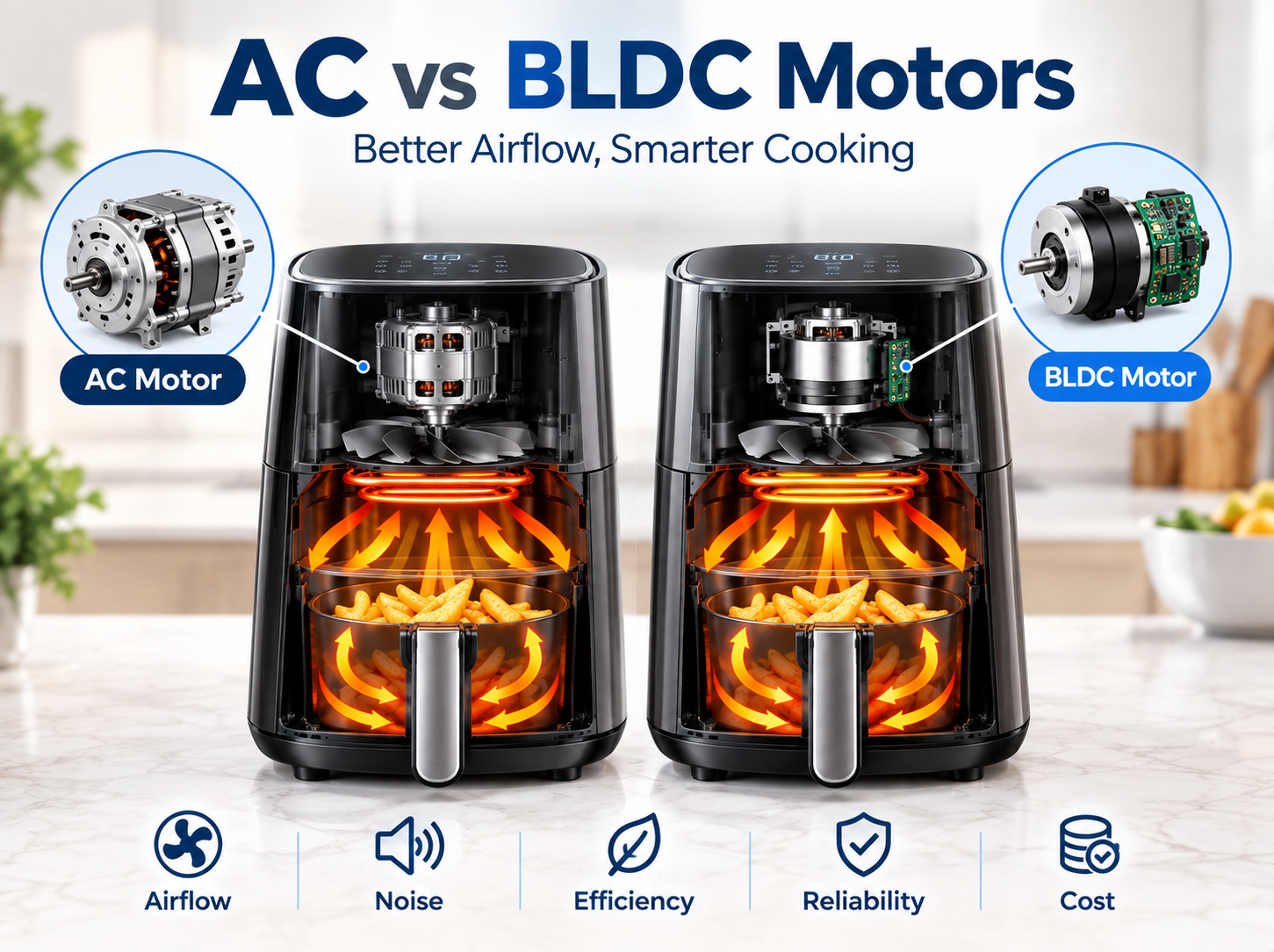
l What Is the Difference Between AC and BLDC Motors in Air Fryers?
l What Makes an Air Fryer Cook More Evenly?
l How Can I Test an Air Fryer Sample Before Placing a Bulk Order?
l What Quality-Control Standards Should I Require from an Air Fryer Supplier?
l What Air Fryer Tests Should Be Included in a Pre-Shipment Inspection?
l What Factors Affect the FOB Price of an Air Fryer?
l How to Compare Quotations from Different Air Fryer Suppliers?
l 230°C Air Fryer: What Buyers Should Check Before Importing?
l A Dual Heating vs Single Heating Air Fryer- Which Is Better?
l What Is the Difference Between AC and DC Motors in Air Fryers?
l Air Fryer for the Middle East - A Guide to G-Mark, Specifications and Compliance?
l What Are the Most Common Quality Problems with Air Fryers?
l Air Fryer RFQ Checklist: 20 Specifications Buyers Should Include.
l How To Verify Whether an Air Fryer Supplier Is Reliable?
l How to Choose an OEM-ODM Air Fryer Supplier in China?
l 200°C vs 230°C Air Fryer: Which one is better?
l Metal-body vs plastic-body air fryer: which is better for a premium brand?
l Top Heating vs. Rear Heating Air Fryers: Which one is better for a B2B buyer?
l Is a Vertical Dual-Drawer Air Fryer Better for Saving Kitchen Space?
l Air Fryer Certifications & Compliance by Market- A Safety Guide for Importers.
l Vertical vs. Horizontal Dual-Basket Air Fryer- Which Is Better for Retail?
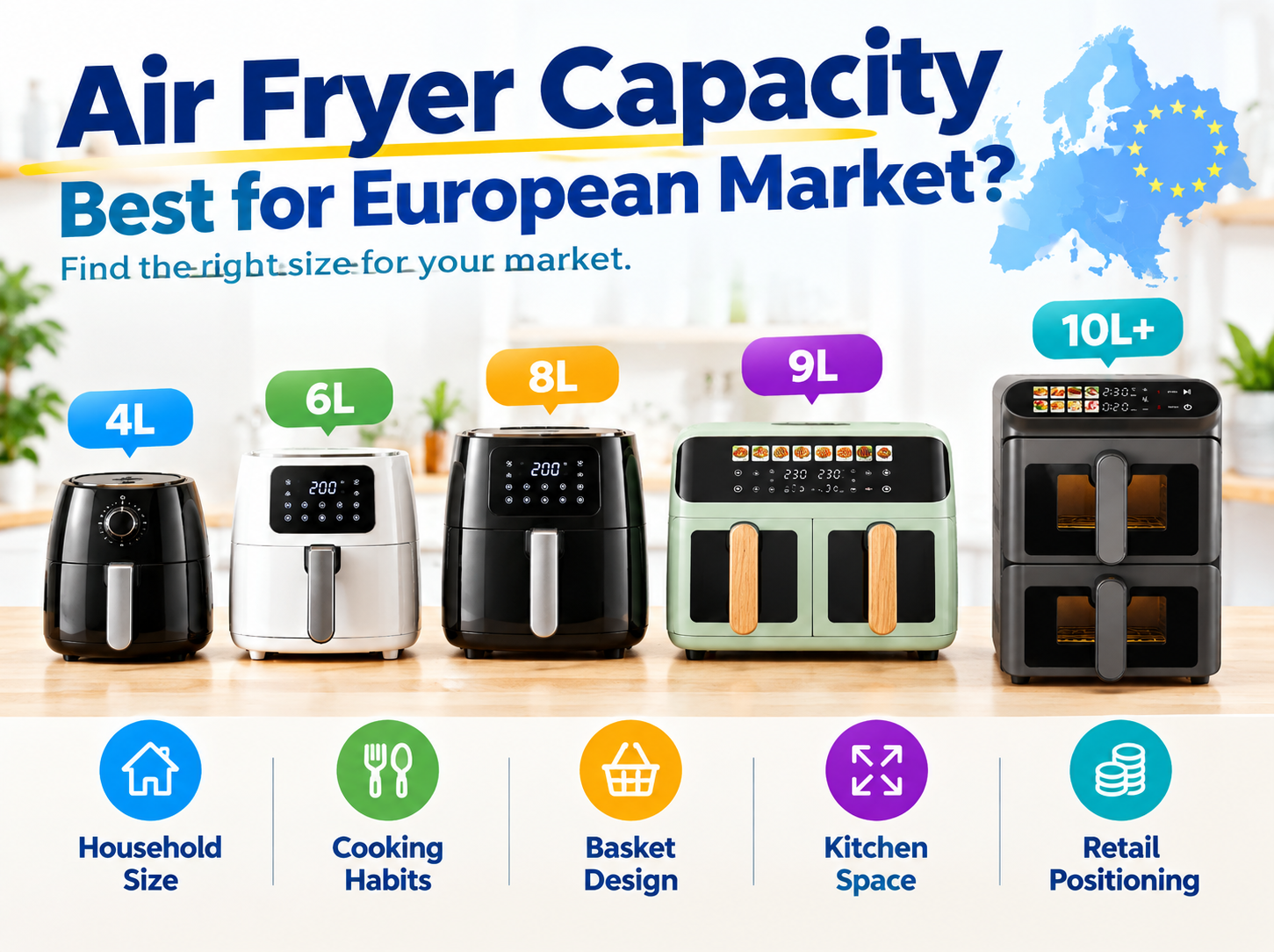
l What Air Fryer Capacity Is Best for the European Market?
l What Are the Common Warranty and After-Sales Problems with Air Fryers?
l What MOQ, Lead Time and Payment Terms Should I Expect from an Air Fryer Supplier?
l How Can I Prevent Plastic Melting or Deformation in an Air Fryer?
l What Air Fryer Safety Tests Should Be Completed Before Mass Production?
l What Is the Difference Between a Single-Basket and Dual-Basket Air Fryer?
l How Do Different Air Fryer Designs Affect Cooking Performance and Cleaning?
l How Much Does an OEM Air Fryer Cost from China?
l What Are the Most Important Features to Consider When Sourcing an Air Fryer?
l What MOQ Do Chinese Air Fryer Suppliers Usually Require?
l How Can I Import Air Fryers from China?
l Can an Air Fryer Supplier in China Help Design New Products?
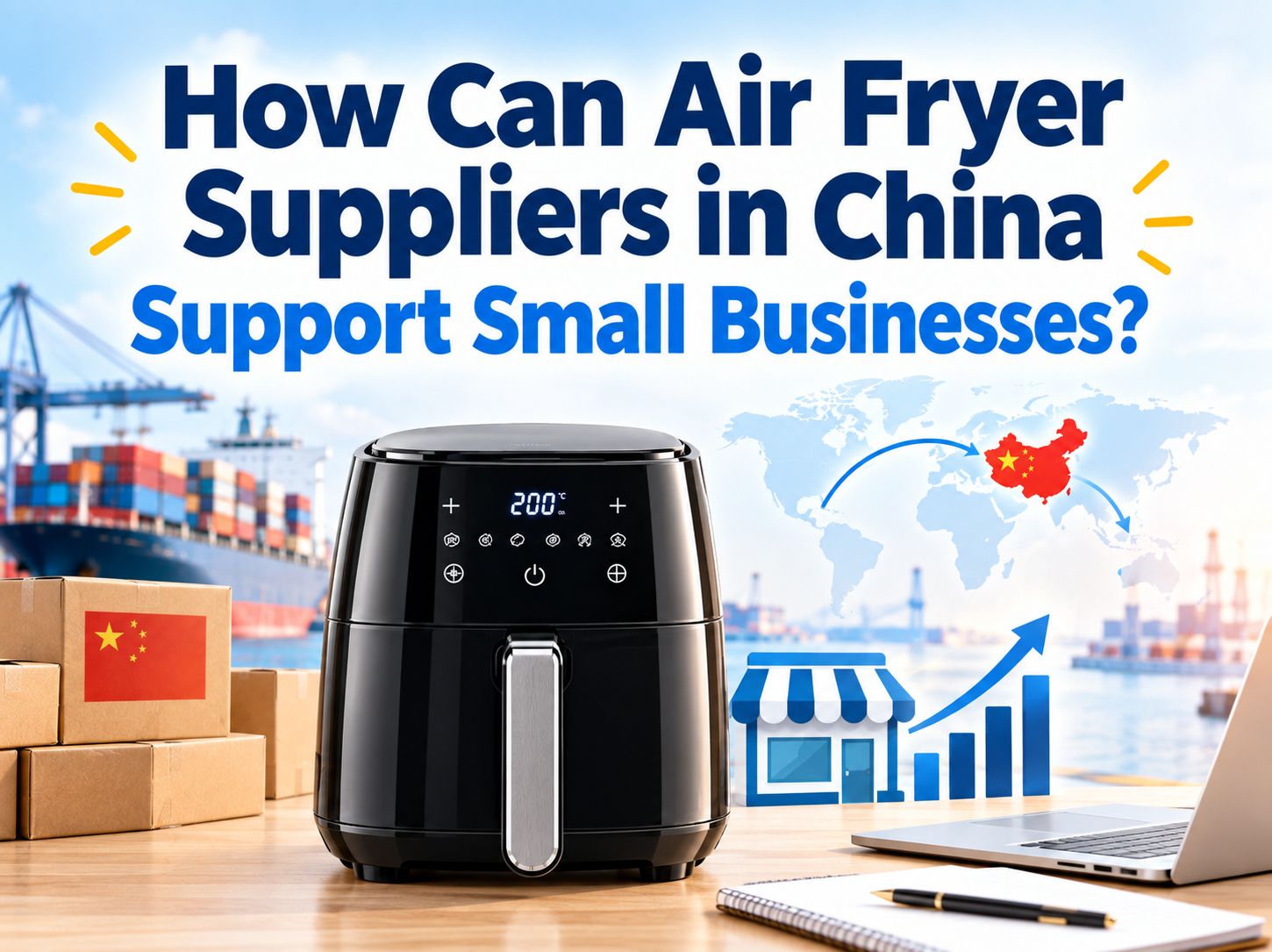
l How Can Air Fryer Suppliers in China Support Small Businesses?
l Can Air Fryer Suppliers Produce Products Compatible with the Voltage in My Country?
l Do Air Fryer Suppliers in China Provide Replacement Parts for After-Sales Service?
l How Can I Find Competitive Prices from Air Fryer Suppliers?
l How to Reduce Business Risk When Working with Air Fryer Suppliers in China?
l What Happens If the Air Fryer Supplier Cannot Meet the Agreed Delivery Date?

What Air Fryer Capacity Is Best for the European Market? A Buyer’s Guide
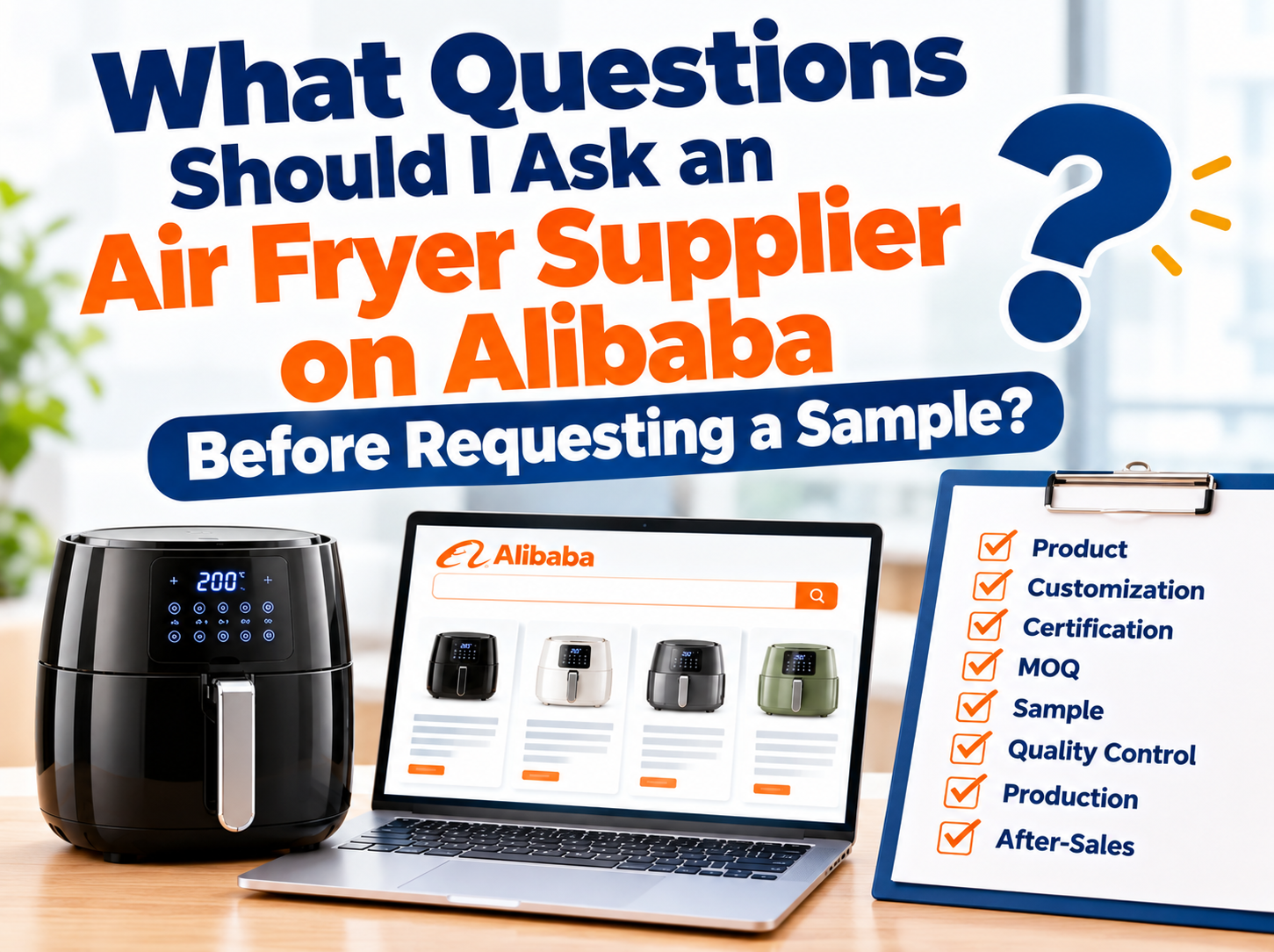
What Questions Should I Ask an Air Fryer Supplier on Alibaba Before Requesting a Sample?
What Is the Difference Between AC and BLDC Motors in Air Fryers?
How Can Air Fryer Suppliers in China Support Small Businesses?

Why Personal Care Appliances Become Popular Globally?
200°C vs 230°C Air Fryer: Which one is better?
 + 86 181 3826 8709
 info@funloiv.com
 6/F., Guanglong Building, Pingxin North Road, Longgang, Shenzhen City, Guangdong, China


@ 2009-2026 Shenzhen Funloiv Electric Appliance Co., LtdAll rights reserved


