 Notice:

 search
search
search
Oct 14, 2026


Finding an air fryer supplier on Alibaba is relatively easy.
Finding a supplier that actually understands your air fryer project is much more important—and often much more difficult.
You may receive replies from several suppliers within a few hours. They may all offer similar product photos, capacities, specifications and prices.
But there is a major difference between a supplier that can sell you an air fryer and a supplier that can help you develop the right air fryer for your market.
For importers, brand owners, wholesalers, retailers and supermarkets, this distinction can affect:
l Product positioning
l Product performance
l Certification
l Sample development
l Quality
l Production consistency
l Launch timing
l After-sales costs
l Long-term sourcing risk
So how can you tell whether an Alibaba air fryer supplier really understands your project?
A useful rule is:
A supplier who understands your project should not simply answer your questions. They should ask the right questions, identify trade-offs, and help translate your business requirements into a workable product.
This article explains what to look for before moving from supplier discussion to sample development and bulk production.
1. Does the Supplier Ask About Your Target Market?
One of the first signs that a supplier understands your project is whether they ask where and how you will sell the product.
A weak supplier may immediately ask:
“How many liters do you need?”
A more experienced supplier may ask:
l Which country will you sell in?
l What is your target market?
l Who are your target consumers?
l What sales channels will you use?
l Are you selling through Amazon, supermarkets, retail stores or distribution?
l What retail price are you targeting?
l Which brands or products are you competing with?
Why does this matter?
Because the same air fryer specification may not be suitable for every market.
An 8L air fryer designed for a premium European brand may have very different requirements from an entry-level product intended for a high-volume supermarket program.
The target market can influence:
l Voltage and frequency
l Plug
l Certification
l Product functions
l Materials
l Packaging
l Labeling
l User manual
l Product positioning
l Target cost
Therefore, one of the best questions to ask yourself is:
“Is this supplier trying to understand why I need the product, or are they only trying to sell me an existing model?”
For a deeper discussion of supplier capability, see:
How to Choose an OEM/ODM Air Fryer Supplier in China: 10 Things Brands Should Check
2. Does the Supplier Understand Your Product Positioning?
Capacity alone does not define an air fryer project.
If you tell a supplier:
“I need an 8L air fryer.”
That is only the beginning.
A supplier who understands product positioning may ask:
l Is this an entry-level or premium product?
l What is your target retail price?
l What brands are you competing with?
l Is price your main advantage?
l Is product appearance important?
l Do you need a metal body?
l Is a higher maximum temperature important?
l Is low noise important?
l Do you need dual heating?
l Is a space-saving design important?
l Which features matter most to your customers?
Consider two products:
Product A
8L + plastic body + basic digital control
Product B
8L + metal body + higher-temperature operation + differentiated heating system + premium appearance
Both may be described as “8L air fryers,” but they may target completely different retail segments.
A supplier who understands your project should help connect:
Target Market → Consumer → Retail Positioning → Product Configuration → Target Cost
rather than simply sending you a catalog.
3. Does the Supplier Ask About Your Competitors or Reference Products?
Another useful indicator is whether the supplier asks for a reference product.
For example:
“Do you have a competitor model you are comparing against?”
You may provide:
l An Amazon product link
l A competitor SKU
l Product photos
l A product video
l An existing product
l A retail listing
l A product specification sheet
A capable supplier should then be able to discuss differences in:
l Capacity
l Product architecture
l Heating system
l Airflow
l Materials
l Controls
l Accessories
l Appearance
l Functions
l Product positioning
This is especially important when several Alibaba suppliers show similar air fryers.
A supplier saying:
“Yes, we have the same product.”
does not necessarily demonstrate strong product capability.
A more useful response would be:
“We can offer a similar platform, but based on your target market and retail positioning, we would recommend changing these specifications.”
The real value of a supplier is often not providing the same product.
It is helping you understand how your product should be different.
4. Can the Supplier Translate Your Business Requirements Into Technical Requirements?
This is one of the most important tests of supplier capability.
Buyers often describe a product using commercial language rather than engineering language.
For example:
“I want the air fryer to cook more evenly.”
or:
“I want a quieter motor.”
or:
“I want a premium product that can justify a higher retail price.”
These are business requirements.
A capable supplier should be able to discuss the technical factors behind them.
For example:
Buyer requirement:
More even cooking
Possible technical discussion:
l Heating system
l Airflow
l Fan design
l Cooking chamber
l Heating-element position
l Temperature distribution
l Basket configuration
Buyer requirement:
Lower noise
Possible technical discussion:
l Motor
l Fan
l Airflow resistance
l Vibration
l Structural design
l Operating conditions
Buyer requirement:
Premium positioning
Possible technical discussion:
l Body material
l Surface finish
l Control interface
l Heating performance
l Accessories
l Product architecture
l Packaging
l Perceived quality
This is the difference between:
“We can make it.”
and:
“Here is how we would approach your requirement.”
A capable air fryer supplier should be able to help convert:
Commercial Requirement → Product Requirement → Technical Specification
Our existing RFQ guide explains the information buyers should provide when developing an air fryer project:
Air Fryer RFQ Checklist: 20 Specifications Buyers Should Include
5. Does the Supplier Explain Trade-Offs?
Be careful when a supplier says:
“Everything is possible.”
Product development always involves trade-offs.
For example, a higher power rating may affect:
l Electrical design
l Components
l Thermal management
l Certification
l Cost
A metal body may affect:
l Material cost
l Weight
l Tooling
l Thermal design
l Shipping volume
A larger capacity may affect:
l Product dimensions
l Packaging
l Shipping volume
l Heating performance
l Retail positioning
A higher temperature range may require closer attention to:
l Heating elements
l Thermal protection
l Materials
l Temperature control
l Safety testing
Therefore, a professional supplier should be willing to say:
“This is possible, but it may affect cost, tooling, lead time or certification.”
That is not a negative answer.
It is often a sign that the supplier understands the project.
A supplier who always says “yes” may simply be trying to win the order.
A supplier who explains the trade-offs may be trying to make the project work.
6. Does the Supplier Understand Private Label, OEM and ODM?
Many buyers use the word “OEM” to describe every type of customization.
But there can be significant differences between:
Private Label
Usually involves:
l Logo
l Product color
l Packaging
l Labels
l User manual
OEM
The buyer may have a clearer product specification, while the supplier manufactures according to agreed requirements.
Customization may include:
l Capacity
l Functions
l Control panel
l Accessories
l Appearance
l Packaging
l Market-specific configuration
ODM
The supplier contributes more actively to product development, potentially including:
l Product architecture
l Industrial design
l Engineering
l Functional configuration
l Tooling
l Prototype development
l Sample testing
l Production preparation
Therefore, ask the supplier:
“What level of product development can you support?”
A supplier who understands your project should be able to distinguish between simply adding a logo and actually developing a differentiated product.
For a detailed explanation, see:
How to Choose an OEM/ODM Air Fryer Supplier in China: 10 Things Brands Should Check
7. Does the Supplier Treat the Sample as Part of Product Development?
Another important sign is how the supplier talks about samples.
A basic supplier may say:
“Sample available. We can ship tomorrow.”
That may be perfectly appropriate if you are buying a standard product.
But for a customized or OEM/ODM project, you should ask more questions.
For example:
l Is this a standard production sample?
l Is it an engineering sample?
l Can the sample be customized?
l Can the color be changed?
l Can the logo be added?
l Can the control panel be modified?
l Can the packaging be customized?
l How long will sample development take?
l How are sample revisions handled?
l Can a revised sample be produced after testing?
l Will the approved sample become the production reference?
A sample should not always be viewed simply as:
One unit to inspect.
For a development project, it can be part of:
Engineering → Sample → Testing → Revision → Approval → Mass Production
A supplier who understands your project should want to know how you intend to evaluate the sample.
For example:
l “Which functions are most important for your testing?”
l “Are there any performance differences you want us to focus on?”
l “Do you need the sample to represent the final production configuration?”
These are much stronger signals of project understanding than simply offering a fast sample shipment.
For the next stage, see:
How Can I Test an Air Fryer Sample Before Placing a Bulk Order?
8. Does the Supplier Think About Mass Production Before You Place the Order?
A good sample is important.
But your real objective as an importer or brand owner is not to buy one good sample.
It is to receive consistent bulk production.
Therefore, ask:
“What happens after I approve the sample?”
A supplier that understands your project should be able to discuss:
l Approved sample
l Product specification
l BOM
l Critical components
l Production version
l Golden sample
l QC standards
l Aging testing
l Final inspection
l Pre-shipment inspection
l Engineering change control
You can also ask:
l Can components be substituted after sample approval?
l Who approves engineering changes?
l Will I be informed before critical components are changed?
l Can I approve a pre-production sample?
l How do you control production against the approved sample?
This is especially important because two air fryers can look almost identical while having different:
l Heating elements
l Motors
l Fans
l PCBs
l Plastic materials
l Coatings
l Thermal protection
l Power cords
Therefore:
Sample approval should be connected to production control, not just product appearance.
9. Does the Supplier Have a Clear Quality-Control Process?
Do not ask only:
“Do you have good quality?”
Almost every supplier can answer:
“Yes.”
Instead, ask:
“How do you control quality from incoming components to shipment?”
A supplier should be able to explain a process such as:
l Incoming QC
l Production QC
l Assembly QC
l Functional Testing
l Safety Testing
l Aging Testing
l Finished Product Inspection
l Pre-Shipment Inspection
For air fryers, quality control may cover:
l Heating elements
l Motors
l Fans
l Wiring
l Temperature sensors
l Thermal protection
l PCBs
l Plastic components
l Metal components
l Coatings
l Baskets
l Handles
l Controls
l Finished-product functions
The important point is not whether a supplier uses exactly the same QC terminology.
The important point is whether they can explain what is checked, when it is checked and how problems are handled.
Our existing article goes into much greater detail:
What Quality-Control Standards Should I Require from an Air Fryer Supplier?
10. Does the Supplier Understand Your Certification Requirements?
Another strong test is how the supplier discusses certification.
If you say:
“I need CE.”
and the supplier simply replies:
“CE available.”
you still do not know very much.
A better discussion should include:
l Target country
l Voltage
l Frequency
l Plug
l Exact model
l Rated power
l Product configuration
l Applicable standards
l Test reports
l Certification documents
l Critical components
l Food-contact requirements where applicable
The important question is:
“Does the certification and supporting documentation apply to the exact product configuration I am buying?”
Certification should not be treated as a logo on a quotation.
The target market, product configuration and compliance route should be considered together.
For more information:
Air Fryer Certifications & Compliance by Market: A Safety Guide for Importers
11. Does the Supplier Understand Your Commercial Project?
Technical capability is important, but a supplier also needs to understand the commercial side of your project.
For example, if you say:
“Our initial order is 1,000 units.”
A supplier who understands your project may ask:
“Is 1,000 units your first order or your expected annual volume?”
Those are very different situations.
The supplier may also ask about:
l Annual forecast
l Initial order quantity
l Target retail price
l Launch date
l Sales channel
l Packaging requirements
l Target market
l Expected reorder frequency
l Seasonal demand
Similarly, if you say:
“I need delivery in 45 days.”
The supplier should clarify:
l When will the sample be approved?
l When will artwork be approved?
l Is certification already available?
l Is tooling required?
l Are components available?
l When can production begin?
l When is the required shipment date?
This is why a supplier who immediately gives you a price without asking about your project may not necessarily be the best supplier for a long-term B2B relationship.
12. Does the Supplier Give You Recommendations, Not Just Answers?
This is perhaps the simplest test.
Ask the supplier:
“Based on my target market and price positioning, which of your air fryer models would you recommend and why?”
Then listen carefully.
A weak answer might be:
“This is our best-selling model.”
A stronger answer might explain:
“For your target retail price and European market, we would recommend Model A rather than Model B because the product configuration, material, capacity and packaging are better aligned with your positioning.”
That is a very different level of supplier support.
Another useful question is:
“If you were developing this product for your own market, what would you change?”
The answer can reveal whether the supplier has:
l Product knowledge
l Engineering experience
l Market understanding
l Practical judgment
l Development experience
A supplier does not have to agree with every buyer requirement.
In fact, sometimes a useful supplier should tell you:
“We recommend changing this requirement because it may increase cost without creating enough retail value.”
That kind of discussion can save money and development time.
13. Look at the Quality of the Supplier's Questions
One of the strongest indicators of supplier capability is often the questions the supplier asks you.
Compare these two conversations.
Supplier A
l What capacity?
l What quantity?
l Logo?
l Target price?
l Here is our quotation.
Supplier B
l Which country will you sell in?
l What is your target retail price?
l Who is the target consumer?
l Which competitors are you comparing with?
l Is this private label, OEM or ODM?
l Which functions are important?
l What level of customization do you need?
l What is your initial order quantity and annual forecast?
l What certification is required?
l What are the most important points you want to verify during sample testing?
Supplier B is not necessarily better simply because it asks more questions.
The important point is whether the questions are relevant to your project.
A good supplier should not ask questions just to collect information.
The questions should help them:
Understand the project → identify constraints → recommend a product → develop the sample → prepare for mass production.
14. A Simple Supplier Evaluation Framework
You can use the following framework when comparing Alibaba air fryer suppliers.
Evaluation Area | What to Look For |
Market Understanding | Does the supplier ask about your target country and sales channel? |
Product Positioning | Can they understand premium, mainstream or value positioning? |
Product Knowledge | Can they explain heating, airflow, materials and controls? |
Engineering | Can they translate requirements into technical solutions? |
Customization | Can they explain what can and cannot be changed? |
OEM/ODM | Can they support the level of development you need? |
Sample Development | Do they have a clear sample and revision process? |
Certification | Can they connect compliance with the exact product and market? |
Quality Control | Can they explain how quality is controlled? |
Mass Production | Can they control production against the approved sample? |
Commercial Understanding | Do they understand quantity, target cost and launch timing? |
Communication | Do they provide clear, technically meaningful answers? |
You do not need every supplier to score perfectly in every category.
Instead, look for a supplier that is strong enough in the areas that matter most to your project.
15. Red Flags That May Indicate the Supplier Does Not Understand Your Project
Watch for these situations.
Red Flag 1: The supplier sends a price immediately
You explain your project and receive:
“8L — USD XX.”
No questions about the market, positioning, specifications or requirements.
Red Flag 2: Everything is “Yes”
OEM?
Yes.
ODM?
Yes.
Custom heating?
Yes.
New mold?
Yes.
Special certification?
Yes.
If everything is possible but no process, cost, timeline or technical limitation is explained, ask for more detail.
Red Flag 3: The supplier cannot explain technical differences
For example:
“Why does this model use this heating configuration?”
Answer:
“It is better quality.”
That does not tell you much.
Red Flag 4: The supplier focuses only on capacity
6L / 8L / 10L / 12L.
Capacity is important, but it does not explain the complete product.
Red Flag 5: The supplier cannot explain sample revisions
If you ask:
“What happens if I find a problem with the sample?”
and the supplier has no clear process, be careful with complex OEM/ODM projects.
Red Flag 6: Certification is treated as a checkbox
“CE available.”
Ask for the applicable documentation and model coverage.
Red Flag 7: The supplier avoids discussing mass production
If the conversation focuses entirely on the sample but nobody discusses:
l Production
l QC
l Critical components
l Approved sample
l Inspection
l Change control
then the supplier may not be thinking far enough ahead.
16. The Difference Between a Product Seller and a Project Supplier
This is an important distinction for B2B buyers.
Product Seller
Usually focuses on:
Product → Price → Order
Project Supplier
Looks at:
Market
↓
Consumer
↓
Product Positioning
↓
Technical Requirements
↓
Engineering
↓
Sample
↓
Testing
↓
Certification
↓
QC
↓
Mass Production
↓
After-Sales
The second approach is generally more relevant when you are:
l Developing a new brand
l Launching a new air fryer
l Replacing an existing supplier
l Customizing a product
l Building a supermarket program
l Planning recurring orders
l Developing a differentiated product
The goal is not simply to find a supplier that can ship one container.
The goal is to find a supplier that can support the entire product lifecycle.
17. How Supplier Understanding Should Change Your Next Step
If the supplier demonstrates a good understanding of your project, you can move to the next stage.
Step 1 — Define the Project
Confirm:
l Target market
l Consumer
l Sales channel
l Product positioning
l Target price
l Estimated volume
Step 2 — Define the Product
Confirm:
l Capacity
l Configuration
l Heating system
l Materials
l Functions
l Controls
l Accessories
l Packaging
Step 3 — Evaluate the Supplier
Confirm:
l Engineering
l OEM/ODM
l Certification
l QC
l Export experience
l Communication
Step 4 — Develop the Sample
Confirm:
l Sample configuration
l Customization
l Testing
l Revision process
Step 5 — Approve the Product
Confirm:
l Final specification
l Approved sample
l Critical components
l Packaging
l Certification
Step 6 — Prepare for Mass Production
Confirm:
l QC standards
l Production schedule
l Inspection
l Change control
l After-sales support
This is much safer than selecting a supplier based only on the Alibaba product page and lowest quotation.
18. How to Compare Suppliers After They Respond
If you contact several Alibaba suppliers, do not compare only their FOB prices.
Instead, compare the quality of their understanding.
Ask yourself:
Supplier A
l Did they understand my target market?
l Did they ask relevant questions?
l Could they explain technical differences?
l Did they identify trade-offs?
l Did they recommend a suitable configuration?
l Could they explain the sample process?
l Could they explain mass production?
Supplier B
l Did they simply send a catalog and price list?
l Did they repeatedly ask only for quantity?
l Did they say everything was customizable without explaining how?
l Could they explain certification?
l Could they explain QC?
l Could they explain what happens after sample approval?
This type of comparison can be much more useful than:
Supplier A = $35
Supplier B = $34
Supplier C = $37
Our existing quotation guide explains how buyers can compare specifications, materials, certification, MOQ, lead time, warranty, quality and total sourcing cost rather than relying on FOB price alone.
How to Compare Quotations from Different Air Fryer Suppliers?
19. A Quick Test: Give the Supplier a Real Project
If you are unsure whether a supplier understands your project, give them a practical scenario.
For example:
“We are developing an 8L air fryer for the European market. We want a premium positioning, a target retail price of approximately EUR XXX, and an initial order of 1,000 units. We are comparing several existing models but want some product differentiation.”
Then ask:
“Which model would you recommend and what would you change?”
A capable supplier should be able to discuss:
l Product positioning
l Capacity
l Materials
l Heating system
l Functions
l Product appearance
l Certification
l Packaging
l MOQ
l Sample development
l Cost implications
You are effectively testing the supplier's ability to turn a business brief into a product proposal.
That is much more meaningful than asking:
“Are you a factory?”
20. Final Checklist: Does This Alibaba Supplier Understand My Project?
Before moving to a sample or bulk quotation, ask yourself:
Market
✓ Does the supplier understand my target country?
✓ Do they understand my sales channel?
✓ Do they understand my target consumer?
Product
✓ Do they understand my product positioning?
✓ Can they explain the technical configuration?
✓ Can they recommend alternatives?
Engineering
✓ Can they translate my requirements into technical solutions?
✓ Can they explain the trade-offs?
✓ Can they identify potential technical risks?
Customization
✓ Do they understand whether I need private label, OEM or ODM?
✓ Can they explain what can be customized?
Sample
✓ Do they understand what I need to test?
✓ Can they support sample revisions?
✓ Can the approved sample become the production reference?
Compliance
✓ Do they understand my target-market requirements?
✓ Can they provide applicable documentation?
Quality
✓ Can they explain their QC process?
✓ Can they control mass production against the approved specification?
Commercial
✓ Do they understand my quantity and launch schedule?
✓ Can they provide realistic MOQ and lead-time information?
Communication
✓ Do they ask relevant questions?
✓ Do they explain the reasons behind their recommendations?
✓ Do they tell me about potential limitations instead of simply saying “yes”?
If most of the answers are yes, you may have found a supplier worth taking to the next stage.
What Does a Good Air Fryer Supplier Really Need to Understand?
The most important point is that an air fryer project is not simply:
Capacity + Price + Quantity
A serious B2B project is closer to:
l Market
l Consumer
l Product Positioning
l Technical Requirements
l Engineering
l Sample
l Testing
l Certification
l Quality Control
l Mass Production
l After-Sales
A supplier who understands this chain can contribute much more than a supplier who simply provides a product catalog.
The right supplier should be able to tell you not only:
“Yes, we can make it.”
but also:
“Here is how we recommend developing it, what the trade-offs are, what needs to be tested, and how we can control it during mass production.”
That is the difference between finding an air fryer seller and finding a long-term air fryer supply partner.
Looking for an Air Fryer Supplier for Your Project?
If you are currently comparing Alibaba air fryer suppliers, you do not need to have every technical specification finalized before starting a discussion.
You can start with:
l Target market
l Product reference or competitor model
l Target capacity
l Required functions
l Target retail positioning
l Estimated order quantity
l Any specific product differentiation you want
A capable OEM/ODM supplier should be able to help you identify the technical requirements that need to be defined next.
At FUNLOIV, we can discuss your air fryer project from product selection and specification through sample development, testing, quality control and mass production.
If you already have an Alibaba reference product, competitor model, photo or product link, send it together with your target market and estimated quantity.
We can discuss what configuration may be suitable for your project and what should be clarified before moving to a sample or bulk quotation.
Start Your Air Fryer Project
Send us your product reference, target market and estimated quantity, and let's discuss the requirements before you move to the next sourcing stage.
Related Articles
l Air Fryer Heating Element: Halogen vs. Stainless Steel Heating Tube.
l Why Does Airflow Matter in an Air Fryer?
l What Is the Difference Between AC and BLDC Motors in Air Fryers?
l What Makes an Air Fryer Cook More Evenly?
l How Can I Test an Air Fryer Sample Before Placing a Bulk Order?
l What Quality-Control Standards Should I Require from an Air Fryer Supplier?
l What Air Fryer Tests Should Be Included in a Pre-Shipment Inspection?
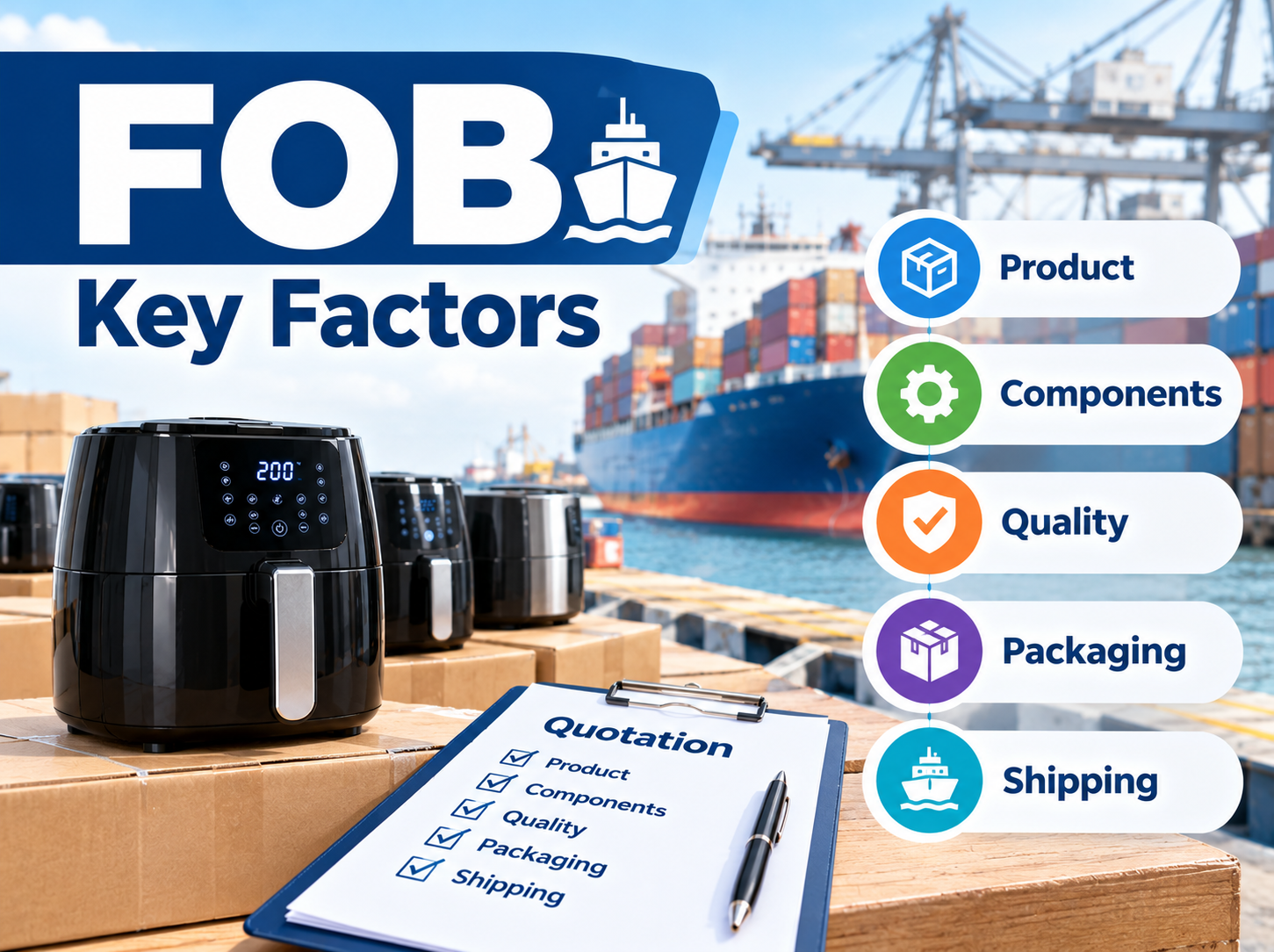
l What Factors Affect the FOB Price of an Air Fryer?
l How to Compare Quotations from Different Air Fryer Suppliers?
l 230°C Air Fryer: What Buyers Should Check Before Importing?
l A Dual Heating vs Single Heating Air Fryer- Which Is Better?
l What Is the Difference Between AC and DC Motors in Air Fryers?
l Air Fryer for the Middle East - A Guide to G-Mark, Specifications and Compliance?
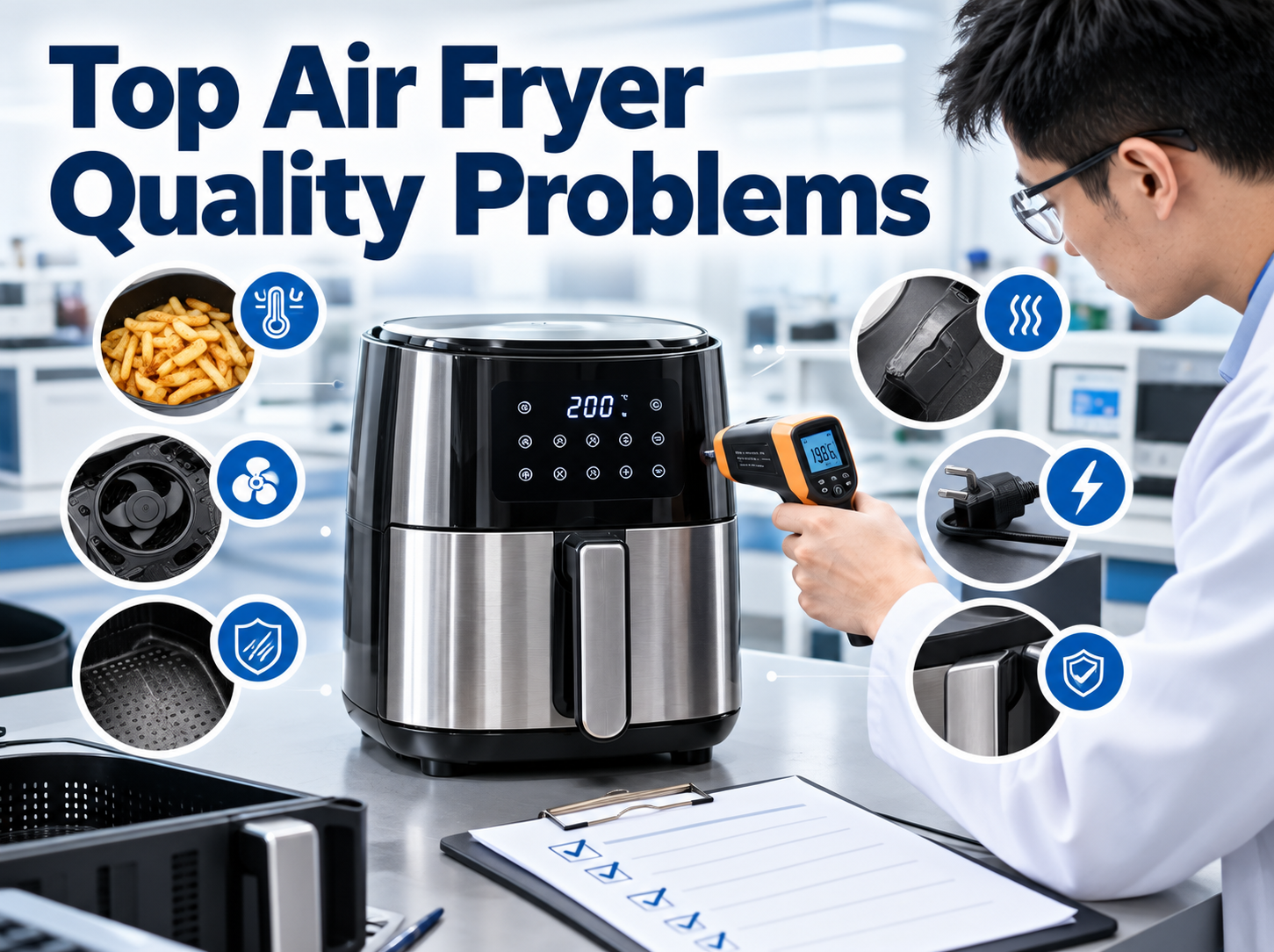
l What Are the Most Common Quality Problems with Air Fryers?
l Air Fryer RFQ Checklist: 20 Specifications Buyers Should Include.
l How To Verify Whether an Air Fryer Supplier Is Reliable?
l How to Choose an OEM-ODM Air Fryer Supplier in China?
l 200°C vs 230°C Air Fryer: Which one is better?
l Metal-body vs plastic-body air fryer: which is better for a premium brand?
l Top Heating vs. Rear Heating Air Fryers: Which one is better for a B2B buyer?
l Is a Vertical Dual-Drawer Air Fryer Better for Saving Kitchen Space?
l Air Fryer Certifications & Compliance by Market- A Safety Guide for Importers.
l Vertical vs. Horizontal Dual-Basket Air Fryer- Which Is Better for Retail?
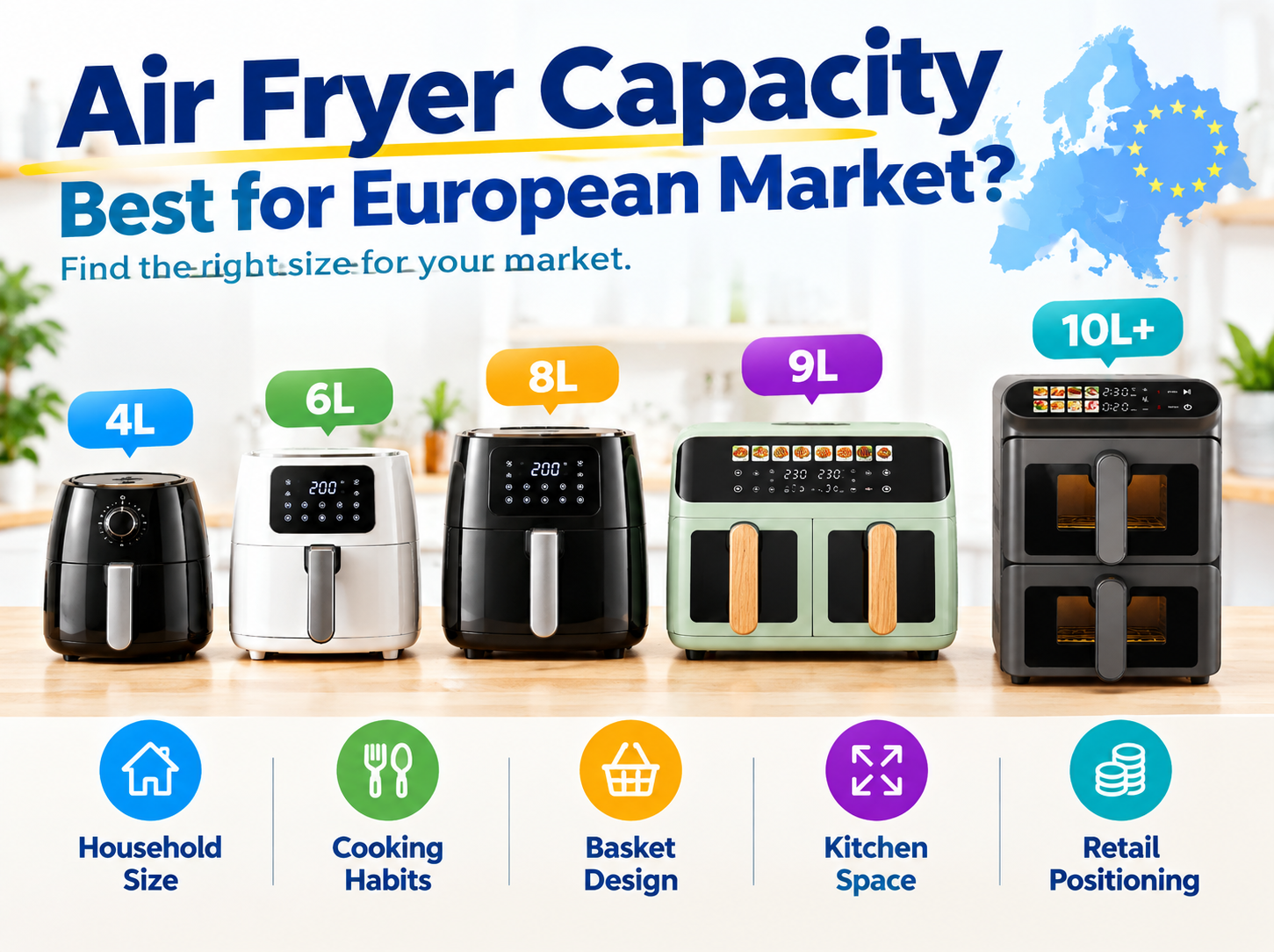
l What Air Fryer Capacity Is Best for the European Market?
l What Are the Common Warranty and After-Sales Problems with Air Fryers?
l What MOQ, Lead Time and Payment Terms Should I Expect from an Air Fryer Supplier?
l How Can I Prevent Plastic Melting or Deformation in an Air Fryer?
l What Air Fryer Safety Tests Should Be Completed Before Mass Production?
l What Is the Difference Between a Single-Basket and Dual-Basket Air Fryer?
l How Do Different Air Fryer Designs Affect Cooking Performance and Cleaning?
l How Much Does an OEM Air Fryer Cost from China?
l What Are the Most Important Features to Consider When Sourcing an Air Fryer?
l What MOQ Do Chinese Air Fryer Suppliers Usually Require?
l How Can I Import Air Fryers from China?
l Can an Air Fryer Supplier in China Help Design New Products?
l How Can Air Fryer Suppliers in China Support Small Businesses?
l Can Air Fryer Suppliers Produce Products Compatible with the Voltage in My Country?
l Do Air Fryer Suppliers in China Provide Replacement Parts for After-Sales Service?
l How Can I Find Competitive Prices from Air Fryer Suppliers?
l How to Reduce Business Risk When Working with Air Fryer Suppliers in China?
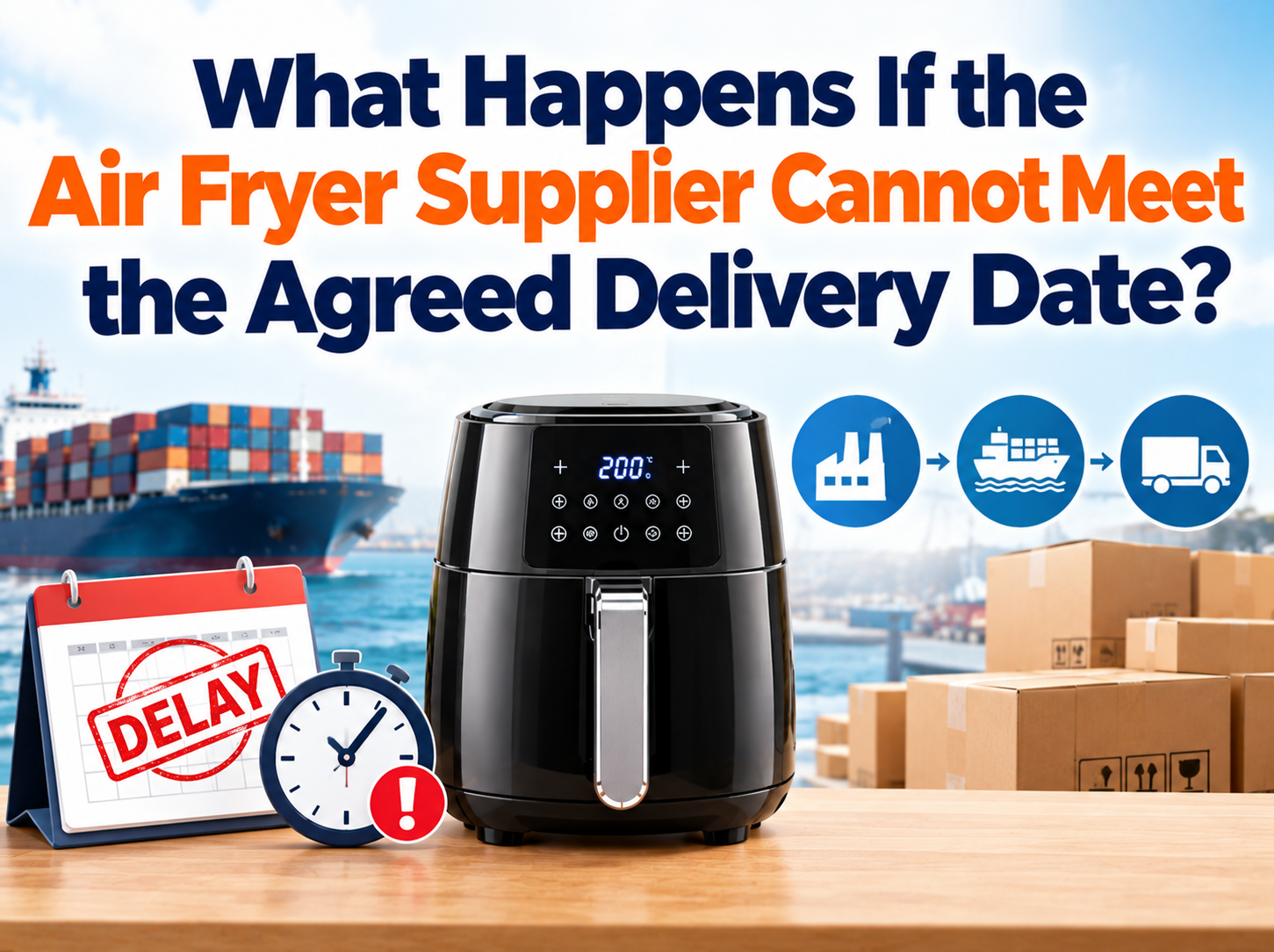
l What Happens If the Air Fryer Supplier Cannot Meet the Agreed Delivery Date?
l How Can I Protect My Air Fryer Design When Working with a Chinese Supplier?
l How Can I Reduce the Risk of Supplier Changes to Components After Approval?

What Happens If the Air Fryer Supplier Cannot Meet the Agreed Delivery Date?
What Factors Affect the FOB Price of an Air Fryer?
What Are the Most Common Quality Problems with Air Fryers?
What Air Fryer Capacity Is Best for the European Market? A Buyer’s Guide
What MOQ, Lead Time and Payment Terms Should I Expect from an Air Fryer Supplier?
How Can I Import Air Fryers from China? A Step-by-Step Guide for Importers and Brands
 + 86 181 3826 8709
 info@funloiv.com
 6/F., Guanglong Building, Pingxin North Road, Longgang, Shenzhen City, Guangdong, China


@ 2009-2026 Shenzhen Funloiv Electric Appliance Co., LtdAll rights reserved


